

Saginaw Train Bridge, photo by n8xd.
Keith DeLong writes: This is a train bridge near St. Mary’s Hospital in Saginaw, Michigan.
I recommend you check this one out bigger.
Saginaw Train Bridge, photo by n8xd.
Keith DeLong writes: This is a train bridge near St. Mary’s Hospital in Saginaw, Michigan.
I recommend you check this one out bigger.

I-96 Overpass, Southfield Freeway, Michigan, photo by buckeye616.
I guess if you only have the eyes to see it, anything can be beautiful.

Vintage bridge, photo by pnygirl1.
BJ writes Playing around with some techniques – liked how this effect captured the old wooden bridge…like it was captured back in time. She has more views of this and other bridges (and a ton more photos).
The Michigan Historical Markers page on the Fallasburg Bridge (includes map) has the text of the marker:
John W. and Silas S. Fallas settled here in 1837, founded a village which soon boasted a chair factory, sawmill, and gristmill. About 1840 the first of several wooden bridges was placed across the Flat River, but all succumbed in a short time to high water and massive spring ice jams. Bridge builder Jared N. Bresee of Ada was given a contract in 1871 to build the present structure. Constructed at a cost of $1500, the bridge has lattice work trusses made of white pine timbers. As in all covered bridges, the roof and siding serve to protect the bridge timbers from rot. Repairs in 1905 and 1945 have kept the bridge safe for traffic for one hundred years.
You can learn a bunch more about the bridge from Michael Frazier’s Covered Bridges of Michigan, get a surprising amount of information and links from Wikipedia’s entry on the Fallasburg Bridge and get details on Fallasburg Park from Kent County Parks.
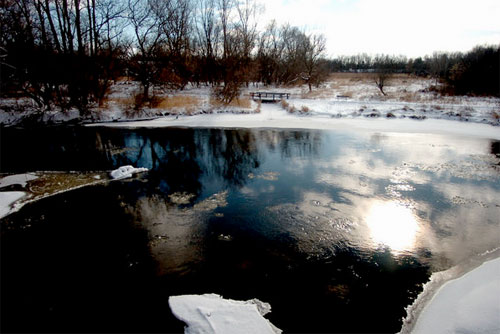
Chippewa River, photo by Lisa Yanick
If you click the photo above, blogger Eric Baerran of Among the Trees will take you down to the Chippewa River in Mt. Pleasant with a cool fusion of photographer Lisa Yanick’s great photos of the river with spoken words, sounds from the river and Bob Busch’s music.
Be sure to click the link for “the cleaner version” and also check out Eric’s two part feature on canoeing the river a couple years ago (part 1 and part 2).

Water And Sky 2, photo by s•stop.
I didn’t say anything about the last photo I blogged from this photographer, and though I feel that I should say something about this one, all I can come up with is: “Check out all Sam’s photos because he has some amazing shots from all over the world.”

Van Dyke: Elizabeth Park, photo by Matt Blackcustard.
It’s been a little while since we’ve blogged one of Matt’s photos.
This one was taken with a modified Voigtlander brilliant pinhole (apparently the pinhole was not standard). It is a Van Dyke brown print, which you can learn about here and here. One of the things I learned is that the process was named for the resemblance of the print color to the brown oil paint named for the Flemish painter Van Dyck.
Elizabeth Park is on the Detroit River in Wayne County and has the distinction of being Michigan’s first county park.
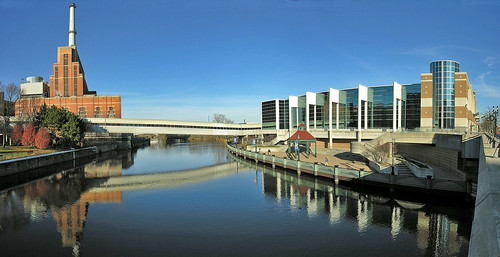
Past and Present, photo by O Caritas.
Patrick writes From Michigan Avenue, looking north… the idle Board of Water & Light building is on the left and Lansing Center is on the right. The walk bridge connects the Lansing Center with the Radisson Hotel.
This photo is part of a huge set of panoramas including shots of Spartan Stadium, the Red Cedar River, Magdalena’s Tea House and an amazing 72 shot Autostitched shot of the US-127 overpass.
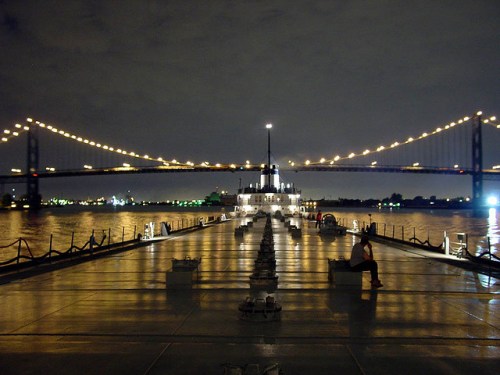
Quiet Night on the Detroit River, photo by theempirebuilder.
The latest entry into the Small World Files is today’s photo of the 100 year old Southdown Challenger upbound on the Detroit River just above the Ambassador Bridge. Mac of Detroit Bike Blog wondered if I’d seen these photos. I hadn’t and spent a good long while poring through this amazing set of Southdown/St. Mary’s Challenger photos that takes you all across the Great Lakes, under the Mackinac Bridge and even belowdecks.

A few recent ones were taken on Leelanau County’s Suttons Bay. I mentioned that the hill in one of them looked like the hill on a site we had designed for a housing development. Wade, the photographer, said “I’m sure you are right. In fact, in the link you sent, the Challenger is in the 5th row from the top on the far left side.”
Anyway, check out this amazing gallery of photos and also head over to Boatnerd.com to read the equally amazing history of the St. Mary’s Challenger, which was built in 1906 in Detroit and has gone through a dizzying array of names and circumstances in the century that followed. Seriously, there should be a movie or something about this ship.
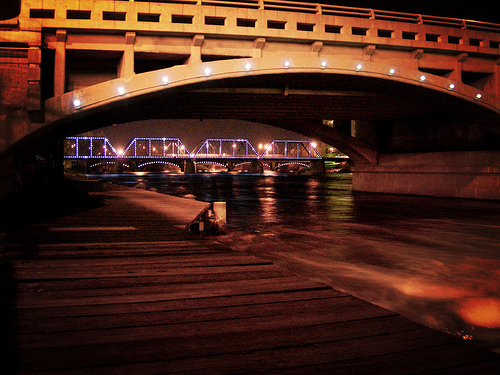
A Little Lomo, photo by docksidepress.
Well, this isn’t actually from a Lomo camera, but it certainly has a Lomo vibe.
What the heck is this Lomo, anyway? The best place to find out is at the Lomographic Society International where you can learn about the Lomo’s birth in the LOMO Russian Arms and Optical factory (where the Lomo Compact Automat was born) and subsequent rise to world domination. Almost at least.
Be sure to click on the 10 Golden Rules, where you learn to Take your camera everywhere you go, to shoot from the hip and generally chuck everything you know about photography out the window.
Reading about lomography really made me smile … maybe it will make you smile too.
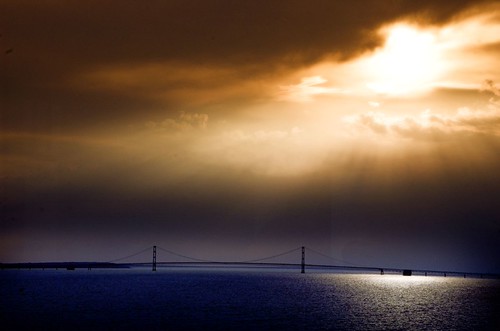
Mackinaw Bridge, photo by wyoming_1.
David Vernon writes:
An interesting picture. Taken from the somewhat world famous Cupola Bar at the Grand Hotel on Mackinac Island, looking west towards the wonderful Mackinaw Bridge. The sun was behind the clouds and setting fast but not entirely influencing life at the bridge colorwise.This shot was taken through a window but you have to look hard to see any reflection.
He can probably be excused for getting the last letter of the bridge wrong (though he is out of the spelling bee!) as he lives near the Mackinaw River in Illinois. Besides, it’s confusing to know whether it’s Mackinac or Mackinaw. Regarding “Mackinac or Mackinaw?”, the St. Ignace Chamber says:
The native people called the area Michinni-makinong. The name was shortened over the years by French and British settlers. In the 1600s, the French pronounced the ending as “aw”, which translated to their spelling as “ac”. Michilimackinac, Fort Mackinac, Mackinac Island the Straits of Mackinac and the Mackinac Bridge are spelled with an “ac”, but pronounced “aw”. Upon the arrival of the British, a village established as Mackinaw was pronounced as “aw” and also spelled that way.
Basically, the bridge and the island are “ac” and the city is “aw”.
 Michigan in Pictures