Bradley Fleet in “the Frog Pond”

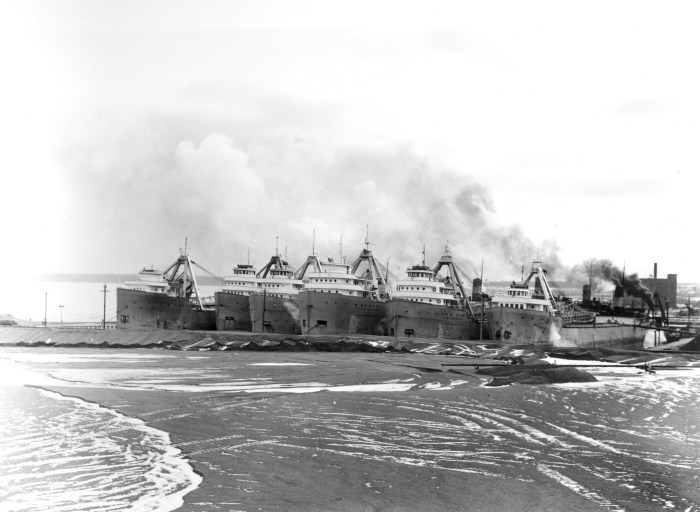
Bradley Fleet in the Frog Pond

Layed-up in the Frog Pond, photo courtesy Presque Isle County Historical Museum

This would be where I would tell you the fascinating history of why the winter harbor at Rogers City was referred to as the Frog Pond, but I’m unable to find much except for that’s what everyone calls it. There’s one in Toledo too.

The Presque Isle County Historical Museum is located in the historic home of Carl D. Bradley, general manager of Michigan Limestone and subsidiary Calcite Transportation. About the photo, they write:

The Bradley fleet layed-up in the “frog pond” at Calcite in 1949. From left to right are the W. F. White, B. H. Taylor, John G. Munson, Carl D. Bradley, T. W. Robinson, and Calcite.

View it big as the Bradley and see more in their Bradley Transportation Fleet slideshow including this aerial shot of the Frog Pond.

Click for more about the Carl D Bradley which ultimately became one of Michigan’s most tragic wrecks.


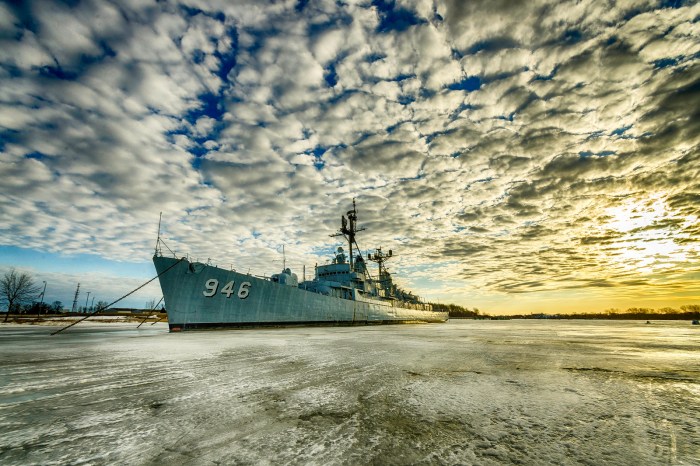
USS Edson at the Saginaw Valley Naval Ship Museum

uss-edson-frozen-in-the-saginaw-river

USS Edson frozen in the Saginaw river, photo by Tom Clark

The USS Edson is located at the Saginaw Valley Naval Ship Museum in Bay City. The say (in part):

The keel for the Forrest Sherman class destroyer USS EDSON (DD-946) was laid at Bath Iron Works in Bath, Maine, on 3 December 1956. EDSON is one of the relatively few ships of the U.S. Navy named for a United States Marine, in this case Major General Merritt Austin Edson.

Edson was launched on 4 January 1958 by General Edson’s widow, Ethel Robbins Edson, who broke the traditional bottle of champagne over the ship’s bow. EDSON’S final fitting out and sea trials occupied the next ten months, and on 7 November 1958, EDSON was commissioned under the command of CDR Thomas J. Moriarty, USN. She then sailed in early 1959 to the Caribbean and through the Panama Canal to reach her original homeport of Long Beach, California, on 2 March 1959.

For the next two decades, EDSON served as a valuable member of the U.S. Pacific Fleet, earning a reputation as a Top Gun ship and the nickname, “The Destroyer.” Her ship’s crest included a skull copied from the shoulder patch worn by then Colonel Edson’s First Marine Raider Battalion.

Note that the Museum itself is closed for the winter until March!

View Tom’s photo bigger and see more in his Ships & Boats slideshow.

More ships & boats on Michigan in Pictures!


Anchors Aweigh: S.S. Greater Detroit Anchor Recovered

ss-greater-detroit

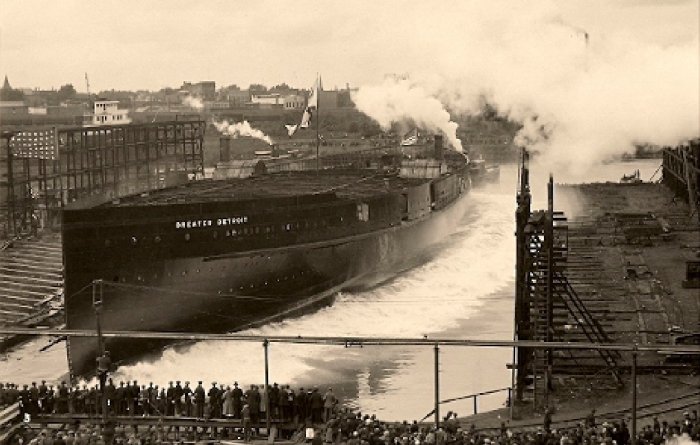
Launch of the SS Greater Detroit,  courtesy Great Lakes Maritime Institute

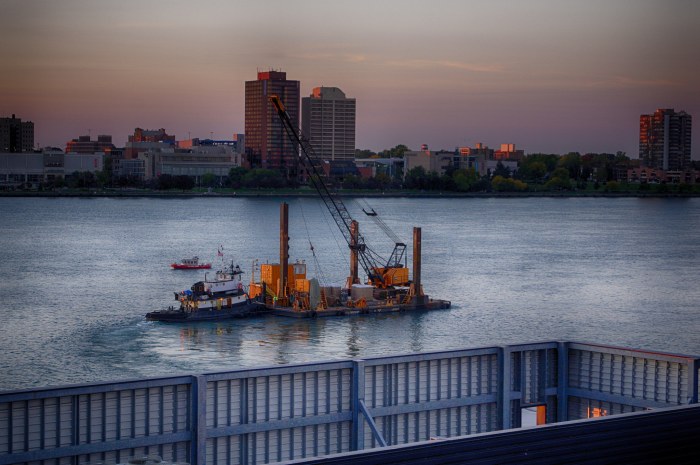
Thanks to an alert reader who let me know that the dredge in yesterday’s photo was on the way back from a mission to retrieve a 6000-pound anchor from the Detroit River for the Great Lakes Maritime Institute. There’s a video below and you can get the story via mLive:

The anchor emerged from the river just before the sun set behind the Ambassador Bridge, catching its first glimpse of daylight for the first time in 60 years.It once belonged to the luxury steamer Greater Detroit, one of the two largest side-wheel steamers ever built, which ferried passengers around the Great Lakes in style from the mid-1920’s through the mid-1950’s.

The Great Lakes Maritime Institute has a nice history of the SS Greater Detroit aka “Leviathan of the Great Lakes” that says in part:

The Detroit & Cleveland Navigation Company was planning on expanding after World War I by providing more daily commercial traffic on Lake Erie between Buffalo, New York and Detroit, Michigan.

…In 1922 the naval architect Frank E. Kirby provided the Detroit & Cleveland Navigation Company with a architectural drawing for a massive side wheel steamer that would carry passengers and freight on the Buffalo to Detroit route. The plan called for the Detroit & Cleveland Navigation company to construct two vessels, the S.S. GREATER DETROIT and the S.S. GREATER BUFFALO which would provide continual service across Lake Erie.  The length overall of the vessels was 536 feet and with the side paddle wheels the overall width of the vessel was ninety six feet.

…The Detroit & Cleveland Navigation Company was so proud of the Steamer GREATER DETROIT that when they issued new stock certificates in 1925 the image of this vessel was engraved at the top of the certificates. The vessel could not only carry some 2,127 passengers, but provided 625 staterooms and made allowances for the storing of 103 automobiles on the main deck.

There were excellent accommodations provided for the passengers and the crew. In the pilothouse there was a separate steering wheel for the bow rudder to help navigate the narrow rivers and harbors. The bow rudder also helped when the steamer left the Detroit dock. At 5:30 P.M. the captain would ring the telegraph to the engine room and request the engineer to start the engines and to back away from the dock. Using the Detroit River current and the bow rudder the vessel would swing out into the current and turn around headed downriver to Lake Erie.

Read on for lots more including some cool old brochures and click to their homepage for more in the recovery!

Barge on the Detroit River

barge-on-the-river

Barge on the River, photo by charles hildebrandt

View Charles’ photo background bigtacular and see more in his Detroit slideshow.

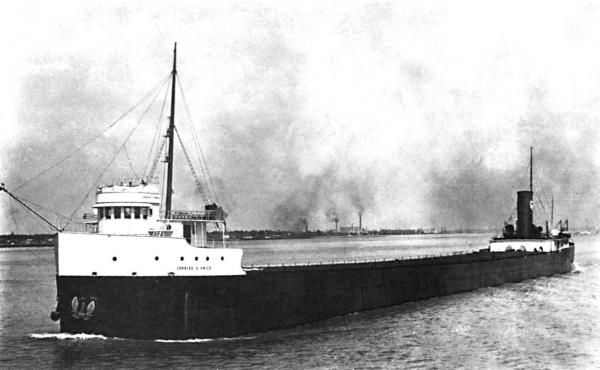
The Great Storm of 1913 and the Charles S. Price

charles-s-price-great-storm-1913

I’ve featured the worst storm in Great Lakes history before, but ThumbWind has a cool feature on The Great Storm of 1913 that includes some interesting information and photos. It says in part:

…the most savage storm in the history of the Great Lakes swept the inland waters November 7-12, 1913 resulting in much greater loss of life. Combined of the forces of two storm fronts colliding with hurricane force bringing monstrous waves and driving snow and ice that doomed anyone caught out on the big lake. The greatest losses in lives and ships occurred on Lake Huron where 24 vessels were lost or severely damaged. 10 ships went to the bottom of the lake.

…On Lake Huron big freighters were tossed about by winds blowing from seventy-five to eighty miles an hour. One of these steamers was the Charles S. Price which received more space on the front pages of newspapers than any other ship. On Saturday morning, the Price, laden with soft coal, left Ashtabula, Ohio. When the freighter passed the town of St. Clair before dawn on Sunday morning, November 9, Second Mate Howard Mackley gave a short blast of the whistle as a signal to his young bride that he was passing and in reply she turned on an upstairs light in their home. By dawn the Price was making its way up Lake Huron. About noon Sunday the Price was seen north of Harbor Beach by Capt. A. C. May of the Steamer H. B. Hawgood.

On Monday afternoon a big steel freighter was seen floating upside down in the lake about eight miles north and east of the mouth of Lake Huron. Many people were anxious to learn the name of the steamer, although it was generally believed to be the Regina. On Wednesday morning an attempt was made to find out the identity of the vessel, however, owing to the high sea the diver did not make his descent. Lake Huron kept its awful secret for almost a week. It was not until Saturday morning, November 15, that William H. Baker, a diver from Detroit, solved the mystery. When he went down he read the name of the steamer twice and the letters spelled out Charles S. Price. The forward part of the bottom of the ship was buoyed up by air that was held in her when she turned turtle, but two streams of bubbles were coming out of the bow which meant that she would settle gradually. On Monday morning, November 17, the Price disappeared from view.

Read on for much more and follow Thumbwind on Facebook too!

More Michigan shipwrecks on Michigan in Pictures.

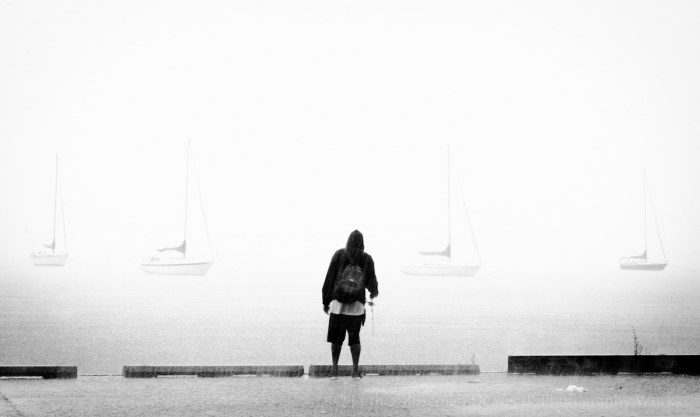
Headed into Lake Charlevoix

foggy-harbor

Foggy Harbor, photo by Julie

Julie says that yesterday they had thick fog in Charlevoix and she spotted this boat heading out into Lake Charlevoix.

View her photo bigger and see more in Julie’s massive Charlevoix slideshow.

Round Island Run

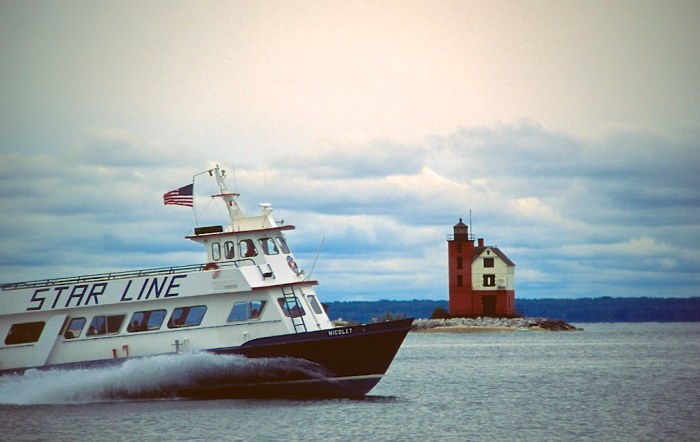
Ferry & lighthouse

Round Island, MI, photo by Bill Johnson

Bill took this photo 21 years ago on September 21, 1995! It shows the Star Line Ferry’s Nicolet speeding past the Round Island Lighthouse. Star Line explains:

Star Line Ferry was started by Tom Pfeiffelmann, Sam McIntire, and others in the late 1970s. They purchased Argosy Boat Line. The company was then renamed Star Line after the 5 original stockholders making up a 5 pointed star. At that time they operated slower ferries including the Nicolet, Treasure Islander and Flamingo.

In 1979 Star Line bought their first fast ferry, Marquette. Over the next few years the old LaSalle and Nicolet were replaced with sisters to the Marquette. In 1987 Star Line decided to take it up a notch with Radisson, an 85-foot fast ferry which was modeled after a luxury yacht.

View Bob’s photo background big and see more in his Lighthouses slideshow.

PS: Check out this cool yesterday and today at Round Island Lighthouse on Michigan in Pictures!

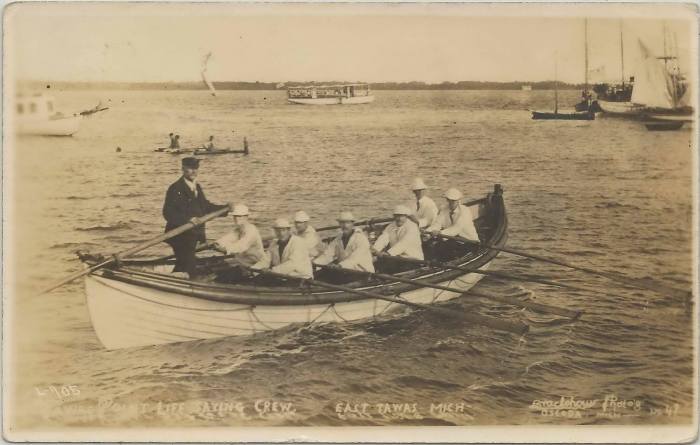
#TBT Tawas Point US Lighthouse Service Crew Training

Tawas Point Lighthouse USLSS Life Saving Service Crew Training on Tawas Bay

Tawas Point Lighthouse Crew Training, photo by UpNorth Memories

The U.S. Life-Saving Service Heritage Association has an excellent history of the U.S. Life-Saving Service that says in part:

In 1878 the growing network of lifesaving stations was finally organized as a separate agency of the Treasury Department and named the U.S. Life-Saving Service. Sumner I. Kimball was chosen as the General Superintendent of the Service. Kimball held tight reign over the Service and, in fact, remained the only General Superintendent of the organization. The law which created the U.S. Coast Guard in 1915, also provided for the retirement of Kimball. The Service’s reputation for honest, efficient, and non-partisan administration, plus performance of duty, can be largely attributed to the efforts of this one man.

The stations of the Service fell into three broad categories: lifesaving, lifeboat, and houses of refuge. Lifesaving stations were manned by full-time crews during the period when wrecks were most likely to occur. On the East Coast this was usually from November to April, and was called the “active season.” By the turn of the century, the active season was year-round. Most stations were in isolated areas and crewmen had to be able to perform open beach launchings. That is, they were required to launch their boats from the beach into the surf. Before the turn of the century, there were very few recreational boaters and most assistance cases came from ships engaged in commerce.

Lifeboat stations were located at or near port cities. Here, deep water, combined with piers and other waterfront structures, allowed the launching of heavy lifeboats directly into the water by marine railways on inclined ramps. In general, lifeboat stations were located on the Great Lakes, but some lifesaving stations were situated in the more isolated areas of the lakes. The active season on the Great Lakes stretched from April to December.

…The U.S. Life-Saving Service had two means of rescuing people on board ships stranded near shore: by boat and by a strong line stretched from the beach to the wrecked vessel. The Service’s boats were either a 700 to 1,000 pound, self-bailing, self-righting surfboat pulled by six surfmen with twelve to eighteen foot oars, or a two to four ton lifeboat. The surfboat could be pulled on a cart by crewmen, or horses, to a site near a wreck and then launched into the surf. The lifeboat, following a design originated in England, could be fitted with sails for work further offshore and was used in very heavy weather. Some crews, at first, viewed the lifeboat with skepticism because of its great weight and bulk. The skepticism soon changed and crews began to regard it as “something almost supernatural,” for it enabled them to provide assistance “when the most powerful tugs and steam-craft refused to go out of the harbor. …”

Terry Pepper’s Seeing the Light has a bunch of information and photos of the Tawas Point Lighthouse.

This photo shows the crew of the Tawas Point Lighthouse participating in USLSS crew training on Tawas Bay. Check it out bigger and join the Northern Michigan Photo Postcards – Our History and Heritage group for more great old photos from Don and others.

More history from Michigan in Pictures.

Against the Daylight

Some fish for fun others fish for food

Some fish for fun; While others fish for food, photo by Luther Roseman Dease, II

The term “contre-jour” is French for “against the daylight”, a photographic technique in which the camera is pointing directly toward a source of light.  In Shooting into the light: mastering the contre-jour technique, Jeremy Walker writes:

One of the first pieces of advice I was given was: ‘Don’t shoot into the light – always have the sun over your left shoulder.’ At the time I was young and naïve, and it seemed like good advice – but it wasn’t. In landscape photography you will often be looking for cross lighting to bring out the texture and character of the countryside. This is fine, but I would also advise trying your hand at contre-jour technique, or to put it more simply, shooting into the light. This technique creates a striking backlight behind your subject and will help to emphasise lines, shapes and silhouettes.

Read on for a bunch of tips and tricks.

View Luther’s photo bigger,  see more in his Contre-jour slideshow, and visit his website to view more work

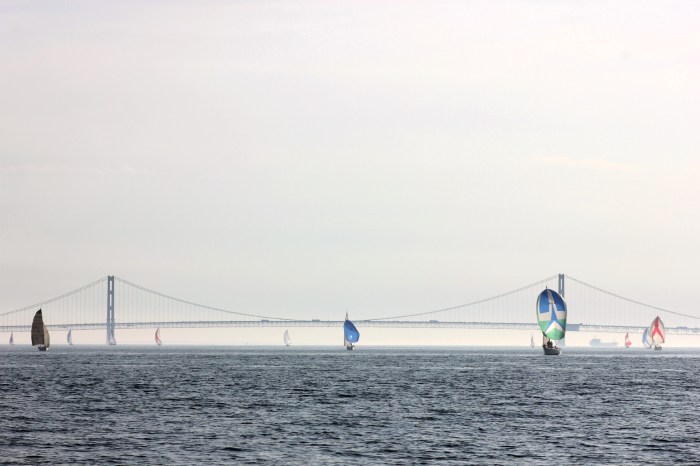
2016 Chicago to Mackinac Sailing Race

Chicago to Mac Sailboats & Mackinac Bridge

Sailboats and Mackinac, photo by Alex Duncan

On July 23, 2016, over 350 sailboats will leave the Chicago Yacht club for the longest annual freshwater race in the world. 2016 marks the 108th annual Chicago Yacht Club Race to Mackinac aka the Chicago to Mac. On their Race History page the CYC shares that:

Starting in 1898 with a mere five boats, The Mac has evolved into a world-class sporting event. After the first race in 1898, the Race to Mackinac was not held for five years until the second race in 1904. By 1906, the race had developed a healthy following and, in that year, the original Mackinac trophy was purchased. The race has seen occasional sustained violent weather in the blows of 1911, 1937 and 1970. After gale force winds took down most of the fleet in the Mac of 1911, the finish in the 1912 and 1913 races was changed to Harbor Springs on Little Traverse Bay instead of Mackinac Island. Race organizers felt the shorter distance was safer.

From 1914 until 1916 the Mac was back to its full distance until WWI. From 1917-1920 there were no Mac races due to the strains of the War, which took away yachtsmen and put many boats out of commission. Since 1921, the Race to Mackinac has run consecutively every year, remains the longest annual freshwater distance race, and is recognized as one of the most prestigious sailing races in the world.

Read on for lots more including an account of the first race. If you’re wondering when to catch a glimpse of them, Pyewacket set the monohull record in 2002 with a time of 23 hours, 30 minutes and 34 seconds. The race starts at noon on Saturday and usually takes between 40-60 hours to finish.

View Alex’s photo from 2011 background bigtacular and see more in his Pure Michigan slideshow.

More summer wallpaper on Michigan in Pictures!