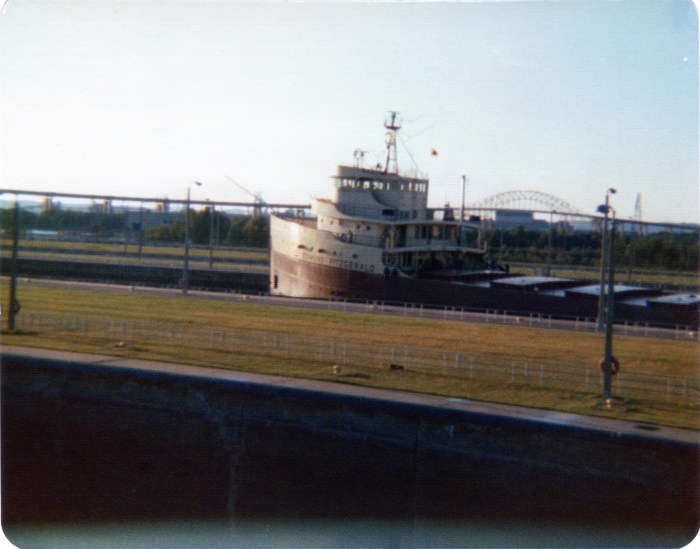
The Edmund Fitzgerald in the Soo Locks

Never before published photo of the Edmund Fitzgerald, taken only months before it was lost with all hands in Lake Superior. Remember, you saw if first on Flickr! My father-in-law took this shot. He told my wife that he wasn't taking a picture of the Big Fitz; he just wanted a photo of the locks, and this happened to be in the photo. Unfortunately, the negative is long gone and this photo was printed on some sort of rough-coated matte paper so that it could be mailed as a postcard. My father-in-law didn't realize until months after the sinking that he had a picture of this vessel. The photo was taken in August 1975; the Edmund Fitgerald sank in November of that year. It was, ironically, the sinking that made this ship famous. After it was built it was the largest ship on the Great Lakes, but other than that, it was just another anonymous working vessel plying the waters between Wisconsin and Michigan.

The Edmund Fitzgerald in the Soo Locks, photo by bill.d.

Through Gordon Lightfoot’s song, the Edmund Fitzgerald has become an icon for the power of the Great Lakes. Nowhere can you see it better than Joseph Fulton’s video of The Wreck of the Edmund Fitzgerald, a fantastic piece of film-making that you need to see if you haven’t already.

What I suspect that a lot of people forget (because I know I do) is that the S.S. Edmund Fitzgerald was just one of many ships plying the Great Lakes. About the photo above, Bill writes:

My father-in-law took this shot. He told my wife that he wasn’t taking a picture of the Big Fitz; he just wanted a photo of the locks, and this happened to be in the photo. Unfortunately, the negative is long gone and this photo was printed on some sort of rough-coated matte paper so that it could be mailed as a postcard.

My father-in-law didn’t realize until months after the sinking that he had a picture of this vessel.

The photo was taken in August 1975; the Edmund Fitzgerald sank November 10th of that year. It was, ironically, the sinking that made this ship famous. After it was built in 1958, until 1971, it was the largest ship on the Great Lakes, but other than that, it was just another anonymous working vessel plying the waters between Wisconsin and Michigan.

Check it out background big and see the back of the postcard. Visit the links below for more about the SS Edmund Fitzgerald:

More shipwrecks on Absolute Michigan and Michigan in Pictures.
Fury: The White Hurricane of 1913

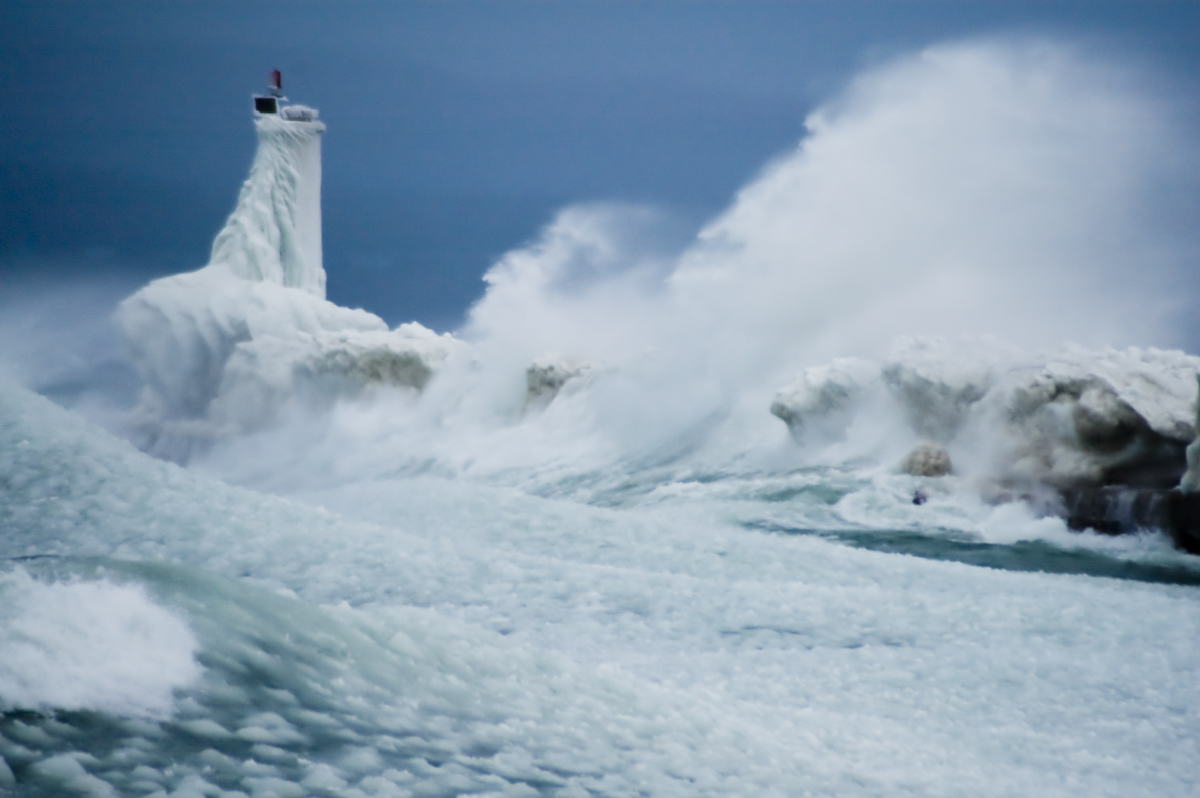
Furious Lake Michigan

Furious Lake Michigan Petoskey, photo by Odalaigh.

“No lake master can recall in all his experience a storm of such unprecedented violence with such rapid changes in the direction of the wind and its gusts of such fearful speed! Storms ordinarily of that velocity do not last over four or five hours, but this storm raged for sixteen hours continuously at an average velocity of sixty miles per hour, with frequent spurts of seventy and over.

Obviously, with a wind of such long duration, the seas that were made were such that the lakes are not ordinarily acquainted with. The testimony of masters is that the waves were at least 35 feet high and followed each other in quick succession, three waves ordinarily coming one right after the other.

~Report from the Lake Carriers Association in the wake of the Great Lakes “White Hurricane”

97 years ago the Great Lakes region reeled under the deadliest storm in its history. Known as the “Big Blow” and the “Freshwater Fury”, was a blizzard with hurricane-force winds that devastated the Great Lakes Basin in the Midwestern United States and the Canadian province of Ontario from November 7 through November 10, 1913. Read on for more!

Check this out bigger and in Charles’ Petoskey Storm Photos slideshow. He also has video of this storm.

Freshwater Fury: The Great Storm of 1913

Dear wife and Children. We were left up here in Lake Michigan by McKinnon, captain James H. Martin tug, at anchor. He went away and never said goodbye or anything to us. Lost one man yesterday. We have been out in storm forty hours. Goodbye dear ones, I might see you in Heaven. Pray for me. / Chris K. / P.S. I felt so bad I had another man write for me. Goodbye forever.

~A message found in a bottle 11 days after Plymouth disappeared, dictated by Chris Keenan, federal marshal in charge of the barge.

Wikipedia says that the Great Lakes Storm of 1913, also known as the “Freshwater Fury“or the “White Hurricane”, was a blizzard with hurricane-force winds that ravaged the Great Lakes November 7-10, 1913. With the sinking of 19 ships, the stranding of another 19 and a death toll of at least 250, it remains the deadliest and most destructive natural disaster in Great Lakes history.

Major shipwrecks occurred on all but Lake Ontario, with most happening on southern and western Lake Huron. Lake masters recounted that waves reached at least 35 feet (11 m) in height. Being shorter in length than waves ordinarily formed by gales, they occurred in rapid succession, with three waves frequently striking in succession. Masters also stated that the wind often blew in directions opposite to the waves below. This was the result of the storm’s cyclonic motion*, a phenomenon rarely seen on the Great Lakes.

In the late afternoon of November 10, an unknown vessel was spotted floating upside-down in about 60 feet (18 m) of water on the eastern coast of Michigan, within sight of Huronia Beach and the mouth of the St. Clair River. Determining the identity of this “mystery ship” became of regional interest, resulting in daily front-page newspaper articles. The ship eventually sank, and it was not until early Saturday morning, November 15, that it was finally identified as the Charles S. Price. The front page of that day’s Port Huron Times-Herald extra edition read, “BOAT IS PRICE” DIVER IS BAKER “SECRET KNOWN”. Milton Smith, the assistant engineer who decided at the last moment not to join his crew on premonition of disaster, aided in identifying any bodies that were found.

More shipwrecks on Michigan in Pictures!

Support Michigan in Pictures with Patreon

Painted Rocks at Pictured Rocks National Lakeshore

Pictured Rocks National Lakeshore

Pictured Rocks National Lakeshore, photo by onewildwest.

Here’s a beautiful shot of the amazing colors of the rock at Pictured Rocks National Lakeshore, likely taken from the Pictured Rocks Boat Cruise. GORP’s page on the Pictured Rocks National Lakeshore says:

The name “pictured rocks” comes from the streaks of mineral stain that decorate the face of the sculpted cliffs. The ramparts of the cliffs are composed of 500-million-year-old Cambrian sandstone of the Munising Formation. The Munising Formation makes up much of the angled slopes and formations, such as Miners Castle. Closest to lake level is the Jacobsville Formation, a late-Precambrian mottled red sandstone that is the oldest exposed rock in the park. Covering all is the 400-million-year-old Ordovician Au Train Formation, a harder, limy sandstone that serves as a capstone and protects the underlying sandstone from rapid erosion. The streaks on the cliffs occur when groundwater oozes out of cracks. The dripping water contains iron, manganese, limonite, copper, and other minerals that leave behind a colorful stain as water trickles down the cliff face.

Check it out bigger in Brent’s slideshow.

More Pictured Rocks from Michigan in Pictures!

Lightning over Silver Lake

Insanity

Insanity, photo by neubauerphotography.

Todd caught some crazy lightning here – be sure to check it out in his slideshow and also see the uncropped version of this picture!

Lightning strikes more than once on Michigan in Pictures – check out our weather photos for more including another lightning pic from Mike!!!

Indian Head: Pictured Rocks National Lakeshore

Pictured Rocks National Lakeshore Boat Tour

Pictured Rocks National Lakeshore Boat Tour, photo by napowell30d.

“These coasts are most delightful and wondrous … for Nature made it so pleasant to the eye, the spirit and the belly.”
Pierre Radisson, 1658

The above is from the Pictured Rocks timeline on Google. The Pictured Rocks National Lakeshore entry on Wikipedia relates:

In October 1966, Congress passed a bill authorizing the establishment of the Pictured Rocks National Lakeshore in Michigan’s Upper Peninsula, “… in order to preserve for the benefit, inspiration, education, recreational use, and enjoyment of the public, a significant portion of the diminishing shoreline of the United States and its related geographic and scientific features.” When President Lyndon Johnson signed the bill, Alger County became the home of America’s first National Lakeshore.

This shot of the sandstone formation “Indian Head” was taken from the Pictured Rocks Cruises boat tour – a great way to see the many waterfalls, formations and sights of one of Michigan’s unquestioned jewels. More Pictured Rocks on Michigan in Pictures.

Check this out background big and in Norm’s Pictured Rocks National Lakeshore slideshow.

Water Cannon!!

CG2010-8

CG2010-8, photo by Twinz8.

From the 2010 Grand Haven Coast Guard Festival.

Check it out bigger and in Paul’s Coast Guard Festival 2010 slideshow.

Hope your weekend is a blast!

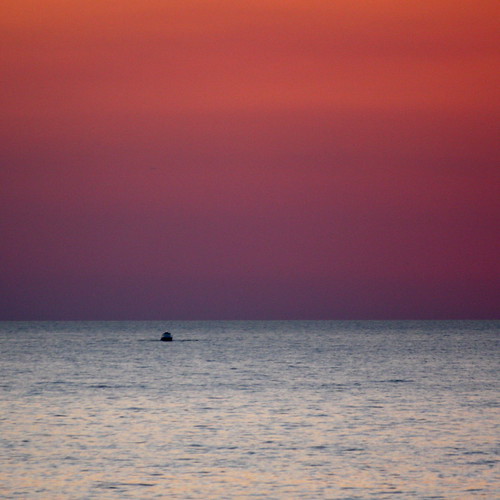
Edge of the night

Edge of the night

Edge of the night, photo by kevindooley.

Here’s a “beauty shot” from Michigan’s Creative Commons King, Kevin Dooley. You can learn a lot about how Flickr works from Kevin right here.

View it bigger and in his Water slideshow.

Here’s more messing about in boats on Michigan in Pictures, and have a wonderful weekend!

Cooler by the Lake

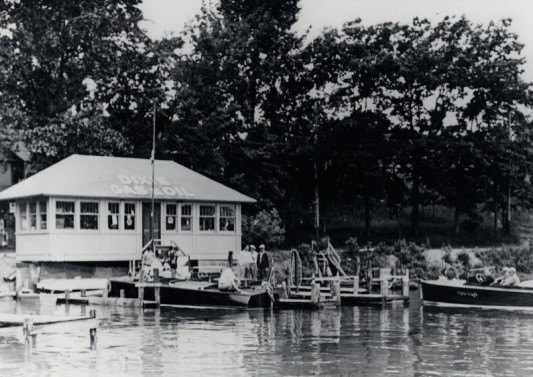
Gull Lake, Michigan, Circa 1930, photo courtesy Archives of Michigan

On Cooler by the Lake at seekingmichigan.org – the Library of Michigan and the Archives of Michigan’s very cool Michigan history site – Mary Zimmeth writes:

I am an urban child. During the summer, I rode my bike everywhere and took in a matinee at least once a week. I went to Tigers baseball games, enjoyed bittersweet hot fudge sundaes at Sanders, and watched the Scott Fountain change colors on Belle Isle. It was a great childhood, yet I envied people who owned cottages and boats. It did not matter that I could not swim. Each summer I desired a vacation near a lake with a boat in the dock. Boats in the water or being towed on the road equal summer.

This first image comes from the Charles R. Childs Collection of photograph prints and negatives dating 1922-1951. (Childs was a photographer from Illinois who specialized in tourist shots.) Taken at Gull Lake, this photograph (c. 1930) centers on Chris-Craft boats filling up at Dixie Gas and Oil. Builders of the standard “runabout,” the company marketed to the middle class by introducing payment plans in the mid-1920s. Boats were no longer just for the wealthy.

Read the rest and see lots more of Michigan’s photographic history at Seeking Michigan!

Boat Night and a boatload of Michigan July Events!

Boat Night
Boat Night, photo by Jon DeBoer

“Deep summer is when laziness finds respectability.”
~Sam Keen

Every month, we feature some of the coolest events in Michigan on Absolute Michigan. Our July Michigan Event Calendar features big events you probably know like the Ann Arbor Summer Festival, Common Ground in Lansing and Blissfest in Cross Village and some less well-known ones including Jackson’s Michigan Shakespeare Festival and the Michigan Elvisfest in Ypsilanti. Head over for all these and many more!

One event we didn’t have was Boat Night in Port Huron. It’s held every year on Black River in Port Huron on the Friday night before the Port Huron to Mackinac sailing race. The race is Saturday, July 17th, making Boat Night Friday the 16th.

Check this out bigger in Port Huron, MI + surrounding areas slideshow and get out and enjoy some Michigan July!

I know of a place…

I know of a place...

I know of a place…, photo by Kiran Bhat..

Port Austin, Michigan. Hasselblad 500C.

Check it out bigger in Kiran’s Hasselblad slideshow.

Hope you’re having a wonderful weekend.