Chasing the Sun on the Summer Solstice

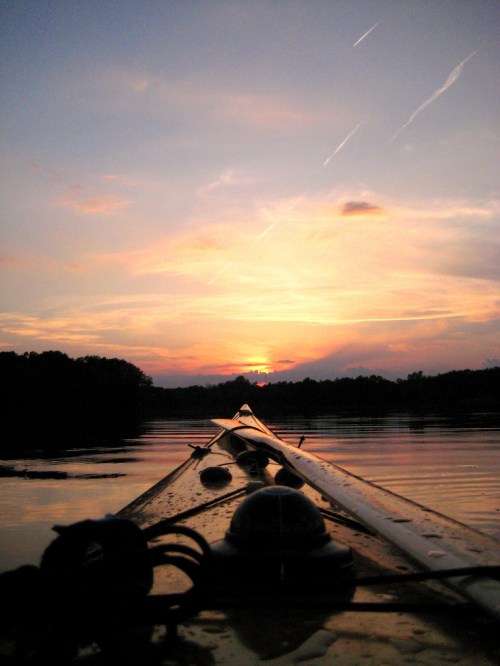
I chased the sun tonight

I chased the sun tonight, photo by Todd

If you were up at 4:51 AM this morning marking summer solstice, you have a long day ahead of you. The longest of the year in fact! More about the summer solstice at EarthSky and I hope you enjoy today and your summer!

View Todd’s photo bigger and see more in his Photo Paddling slideshow.

More about solstices on Michigan in Pictures.

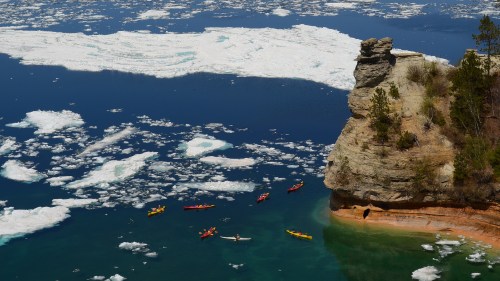
Miners Castle, with ice and kayaks

Miners Castle, with ice and kayaks

Miners Castle, with ice and kayaks, photo by Ann Fisher

The Washington Post has a feature on Lake Superior’s stubborn ice cover:

As of Memorial Day, ice covered 4.5 percent of Lake Superior according to NOAA, and 1.7 percent of the Great Lakes overall (though Superior is the only lake with remaining ice). The recent Great Lakes ice cover is unrivaled in records dating back to the early 1970s.

Ice cover the Great Lakes has been way above normal and, at times record-setting, for months.

In early March this year, the Great Lakes ice extent reached 94.19%, the second most on record for any month, dating back to 1973 in NOAA’s dataset, and most on record so late in the season. In late April, ice still covered nearly one-third of the Great Lakes, the most on record by a large margin so late into spring.

Click through for some photos of people enjoying the ice.

Ann took this last weekend at Miners Castle in the Pictured Rocks National Lakeshore. How cold is that water right now? Michigan Sea Grant’s Coastwatch for the central UP shore of Lake Superior recorded a balmy 36.7 degrees on May 25th!!

View Ann’s photo big as Lake Superior and see more in her 2014 U.P. slideshow.

There’s more Miners Castle and more Lake Superior wallpaper on Michigan in Pictures.

Sometimes, Mother Nature Wins

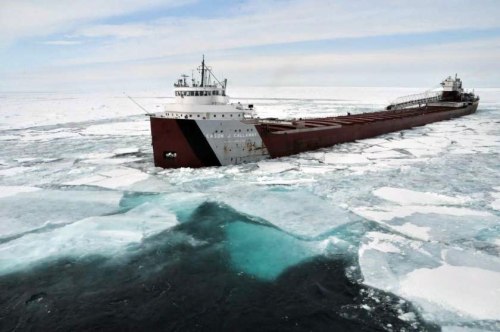
Cason J Calloway in Lake Superior Ice

Stuck in the ice, eastern Lake Superior, photo courtesy US Coast Guard Cutter Mackinaw

As of yesterday, no ships had passed through the Soo Locks due to the overwhelming mass of ice on the world’s biggest lake. That doesn’t stop them from trying and (in this case) failing. The Cason J. Callaway ended up locked in ice and had to be rescued by the US Coast Guard’s flagship icebreaker Mackinaw.

Soo Today reported yesterday:

Two freighters bound from Duluth, Minn. are battling their way through what a United States Coast Guard spokesperson called “brutal” and “extreme” ice conditions on Lake Superior to reach the Soo Locks.

The vessels, John P. Munson and Cason J. Callaway, are following the USCG Cutter Mackinaw but are making very slow progress.

Randy Elliott, vessel traffic manager with the USCG stationed in Soo Michigan, said Tuesday that the convoy left Duluth around the time the Soo locks opened for traffic on March 25. As of late yesterday, the southbound convoy was located about 40 kilometres south of Michipicoten Island, and were confronting ice three to three and a half feet thick with windrows six feet high in some places.

The three vessels opted not to use their normal route across the lake, and instead are following the north shore of Lake Superior, Elliott said.

No commercial ships, either north or southbound, have locked through since the official opening a week ago.

That also is not normal.

“Usually at this time of the year we would see 12 to 15 vessels north and southbound a day using the locks,” Elliott said.

Read on for more and definitely check out pasty.com’s photos by Callaway wheelsman, Keith Baker.

Thanks Shawn Malone of Lake Superior photo for the find and for the title! Get more on icebreaking on the the Great Lakes on Michigan in Pictures.

Quiet Opening Day at the Soo Locks in 2014

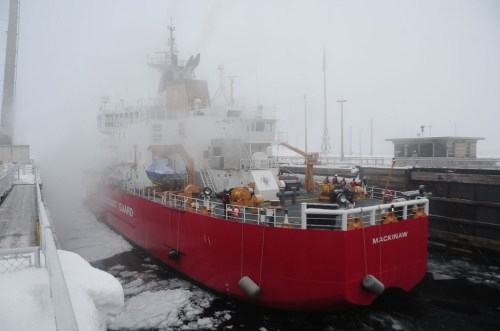
Coast Guard cutters pass through Soo Locks

Coast Guard cutters pass through Soo Locks, photo by Coast Guard News

Although the Soo Locks opened yesterday, UpNorthLive reports that for the first time in 20 years no ships passed through. Click through for a video story that includes footage from the Locks and an interview with Soo Locks Lock Master Tom Soeltner.

About the photo, the Coast Guard News writes:

The crew of Coast Guard Cutter Mackinaw steers the cutter through the fog as it passed through the Soo Locks in Sault Ste. Marie, Mich., March 21, 2014. The Mackinaw along with the Coast Guard Cutters Morro Bay and Katmai Bay passed through the locks together en route to breaking ice in the St. Marys River and Lake Superior in preparation of the scheduled opening of the Locks, March 25. U.S. Coast Guard photo by Petty Officer 2nd Class Levi Read.

View Levi’s photo background bigtacular and see more at the Coast Guard News’ Soo Locks tag.

There’s more boats and more Sault Ste. Marie, and if you’re interested in the Icebreaker Mackinac and other icebreakers, Michigan in Pictures has that too!

The DN Ice Boat and the 2014 Central Regional Ice Boating Championship

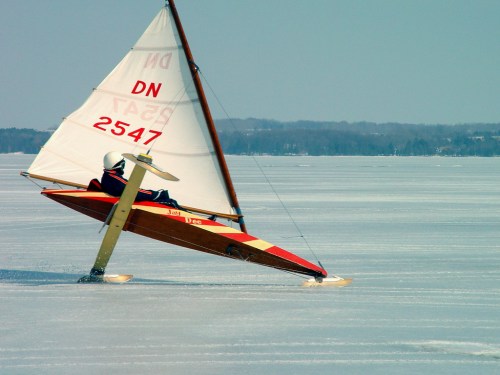
DN hiking it, Elk Lake- Elk Rapids, Michigan

DN hiking it, Elk Lake- Elk Rapids, Michigan, photo by rickrjw

Last night I learned from my iceboating friend Andy that the 2014 Central Regional DN Iceboating Championship will be held this Saturday & Sunday (March 15-16, 2014) on West Grand Traverse Bay. The primary launch site will be the DNR launch at Hilltop Rd. and M-22, approximately 9 miles north of Traverse City and 5 miles south of Suttons Bay on the Leelanau Peninsula. More details at DNA America.

Wikipedia explains that the International DN is a class of ice boat:

The name stands for Detroit News, where the first iceboat of this type was designed and built in the winter of 1936-1937. Archie Arrol was a master craftsman working in the Detroit News hobby shop, and together with iceboaters Joe Lodge and Norman Jarrait designed a racing boat they called the “Blue Streak 60”, later to become known as the “DN 60”. In 1937 a group of 50 laymen worked with Archie in the hobby shop to produce the first fleet of the new iceboats. These first boats broke during the initial season, and after Norm and Joe modified the design to increase the strength, the group got back together to build a second set of iceboats in 1938.

This design, featuring a narrow, single-person cockpit, three steel blades in tricycle style arrangement and a steeply raked mast, remains to this day the most popular ice boat design in use.

…The class has a devout following. The International DN Ice Yacht Racing Association (IDNIYRA) is the governing body for the class. It publishes standards for boat design and allows enthusiasts to assemble for races and to share good ice locations. The DN is raced extensively in the northern United States, Canada, and throughout Northern Europe, with World Championships alternating between North American and Europe each year.

One of the reasons that the DN Ice Boat Class has become so popular over the years has been largely in part to how transportable and fast they truly are. With a steady 10-12 mile per hour wind and good ice conditions, the DN, when piloted properly, can reach speeds in excess of 50 miles per hour. And with just a 12-15 mile per hour steady wind, the DN ice boat can reach a readily attainable 55–65 miles per hour, providing a thrilling rush of purely unadulterated bone chilling wind powered ice sailing.

Rick took this photo of a DN on Elk Lake almost exactly 5 years ago, and March is prime season for ice boating in Michigan due to typical snow melts that lay the thickest ice of the year bare. GT Bay is nearly in my front yard and I can assure you that the ice is thick and almost like glass this year! View his photo bigger and see lots more in his Iceboating slideshow.

More ice boating on Michigan in Pictures including one of my favorite videos, Ice Boat vs Chevy!

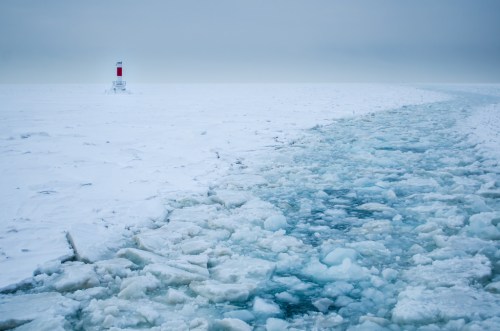
Icebreaking on the Great Lakes with USCG Bristol Bay

Shipping Lane

Shipping Lane, photo by rellet17

Winter 2014 has been a big challenge to keep up with for road crews and homeowners, and it’s a challenge that doesn’t end at the shoreline!

On Friday, Ross got a chance ride aboard the US Coast Guard Icebreaker Bristol Bay as it opened a path for shipping traffic on Lake Saint Clair. The captain told him the ice has only been this dense one other time in the past 30 years! The Coast Guard says:

The USCGC BRISTOL BAY is one of just two Bay-class cutters that work in conjunction with a special barge. BRISTOL BAY the second of the U.S. Coast Guard’s 140-foot icebreaking tugs. She is named after the body of water formed by the Alaskan peninsula which empties into the Bering Sea. BRISTOL BAY was built by the Tacoma Boatbuilding Co. in 1978. She was commissioned in Detroit in 1979.

Designed by U.S. Coast Guard engineers, the BRISTOL BAY’s primary responsibility is opening and maintaining icebound shipping lanes in the Great Lakes. Bay-class tugs are designed to continuously break at least 20 inches of hard, freshwater ice. The ships can break more than 3 feet of ice by backing and ramming. The Bay tugs have a special hull air lubrication system that helps extract the ship from thick ice and improves ice breaking ability at slower speeds.

View Ross’s photo background bigtacular and see more in his ice breaking slideshow.

PS: A few weeks ago I came across this video of more Great Lakes icebreaking action, showing the Icebreaker Mackinaw and others clearing a path from Sault Ste Marie down the St Marys River that you might enjoy. It was shot from the wheelhouse of the CSL Assiniboine.

There’s more ice and more winter wallpaper to be found on Michigan in Pictures!

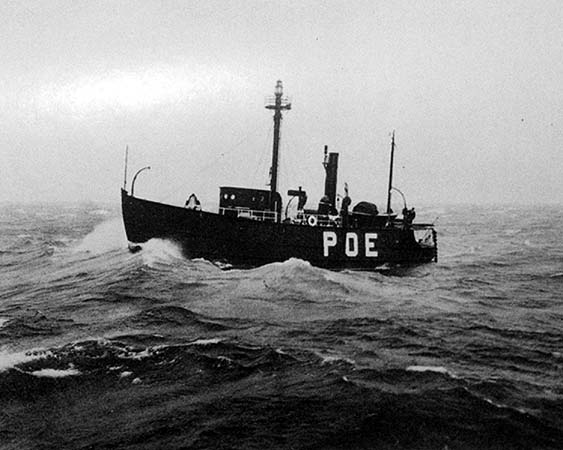
Riding the storm out with the Poe Reef Lightship

Poe Reef Lightship

Poe Reef Lightship LV62 riding out a storm on her station, courtesy the Lake Carrier’s Association

The Poe Reef Lighthouse page at Terry Pepper’s Seeing the Light begins with the story of the vessel that preceded the lighthouse:

Poe Reef lies just eight feet beneath the water’s surface between Bois Blanc Island and the Lower Peninsula mainland, and as such has long represented a significant hazard to vessels making their way through the Straits between Lakes Michigan and Huron.

In the early 1890’s the Lighthouse Board faced a vexing problem. Increasing vessel traffic created a need to install navigational aids at a number of offshore shoals and reefs. With Congressional funds increasingly difficult to obtain, and the costs of offshore lighthouse construction prohibitively high, the Board determined that the use of lightships to mark such hazards would be both significantly more expeditious and cost effective.

Unable to convince Congress to free up the funds for these lightships, the Board took the chance of redirecting an existing $60,000 congressional appropriation for a lighthouse off Peninsula Point to the purchase of four lightships.

In 1892 two contracts totaling $55,960 were awarded to the Craig Shipbuilding Company in Toledo for the construction of four lightships. Designated as Lightships LV59, LV60, LV61 and LV62, all four vessels were built to similar specifications. Framed and planked of white oak they measured 87′ 2″ inches in length, 21′ 6″ inches in the beam, with a draft of 8 feet. In a cost-cutting effort, the vessels were un-powered, outfitted with only a small riding sail carried on a short after mast. Equipped with a cluster of three oil-burning lens lanterns hoisted on their foremasts, each was also equipped with 6″ steam whistles and hand-operated bells for fog use. Work was completed on the four vessels the following year, and after sea trials, all four were commissioned by the Board and placed into service, LV59 being assigned to Bar Point, LV60 to Eleven Foot Shoal, LV61 to Corsica Shoal and LV62 to Poe Reef.

With the words POE REEF brightly painted in white on her fire engine red hull, LV62 was towed to Poe Reef by the lighthouse tender Marigold, and anchored on station to begin her vigil on September 29, 1893. For the next seventeen years LV62 spent every shipping season faithfully guarding the shoal. With the end of each shipping season, one of the lighthouse tenders would make the rounds of all lightship stations in the Straits area, and tow them into Cheboygan harbor for winter lay-up. While in Cheboygan, necessary repairs and improvements would be made in preparation for the following season. At some time in March or April, the ice would break up sufficiently to allow the vessels to be towed back to their stations to stand guard for yet another season.

Read on for another shot of this vessel and for more about the lighthouse that replaced the lightship at Poe Reef. Also have a look at these photos of Light Vessel 96, which took over for LV 62 from 1915-1920 at Poe Reef.

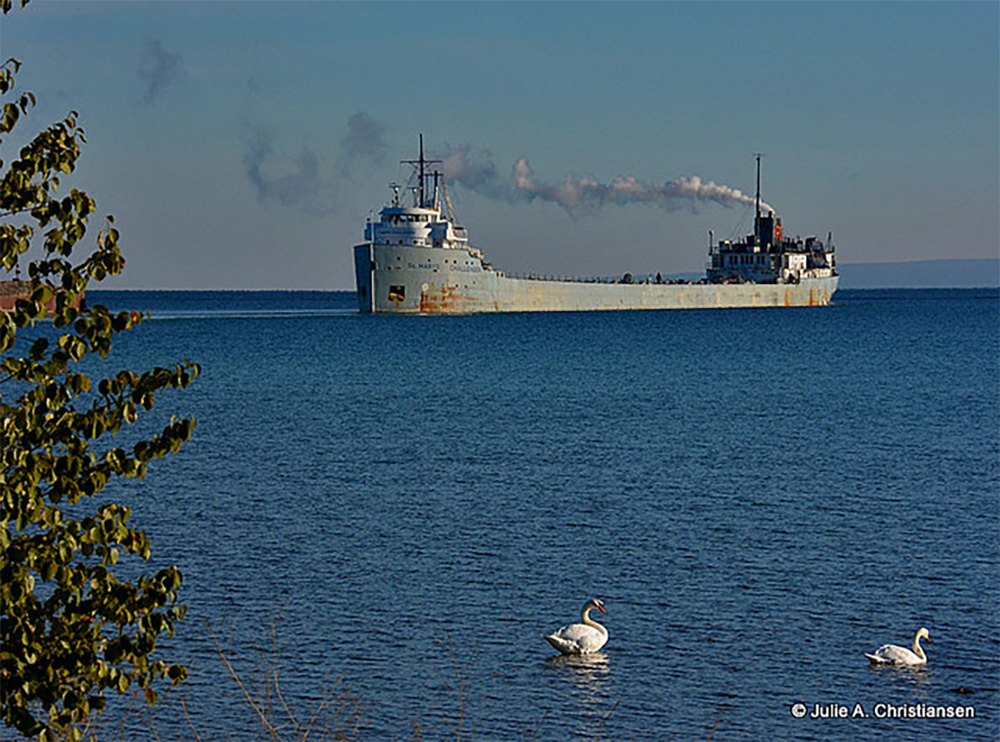
The Oldest Ship on the Great Lakes: The St. Mary’s Challenger

Departing…….. by smiles7

7 years ago I shared the story of the Southdown Challenger on Michigan in Pictures. I was happy to see that the oldest operational freighter on the Great Lakes is still in action. The feature on the St. Marys Challenger on Boatnerd.com begins:

Currently holding the honors of being the oldest lake boat still trading on the Great Lakes, the self unloading cement carrier St. Marys Challenger was built as a traditional Great Lakes bulk carrier as hull #17 by Great Lakes Engineering Works, Ecorse (Detroit), MI in 1906. This veteran of the lakes was launched February 7, 1906 as the William P. Snyder for Shenango Steamship & Transportation Co. (subsidiary of Shenango Furnace Co.), Cleveland, OH. Retaining her original overall dimensions, the St. Marys Challenger is now powered by a Skinner Marine Unaflow 4 cylinder reciprocating steam engine burning heavy fuel oil rated at 3,500 i.h.p. (2,611 kW) with 2 water tube boilers. The power is fed to a single fixed pitch propeller and the vessel is equipped with a bow thruster. The vessel is capable of carrying 10,250 tons (10,415 mt) in 8 holds at mid summer draft of 21’09” (6.63m). Cargoes of bulk or powdered cement can be unloaded by a fully automated system including air slides, conveyor equipment and bucket elevators feeding a forward mounted 48’ (14.63m) discharge boom.

Of note, the St. Marys Challenger is one of only two remaining U.S. flagged vessels still active on the Great Lakes to be powered by the classic Skinner Marine Unaflow steam engine. The other vessel is the car ferry Badger (2) which is powered by two of these engines and, in turn, remains as the only coal fired vessel still in active service on the Great Lakes. The only remaining Canadian-flagged steamer powered by a Canadian-built (Vickers) Skinner Unaflow engine is the James Norris.

Read on for more and also check out this set of photos by Wade Bryant, who served aboard the Challenger.

Julie took this shot as the St. Marys Challenger steamed out of Charlevoix last week. Check it out bigger and see more in her boat slideshow.

Many more Michigan ships & boats on Michigan in Pictures!

Support Michigan in Pictures with Patreon

We have met the enemy and they are ours: The Battle of Lake Erie

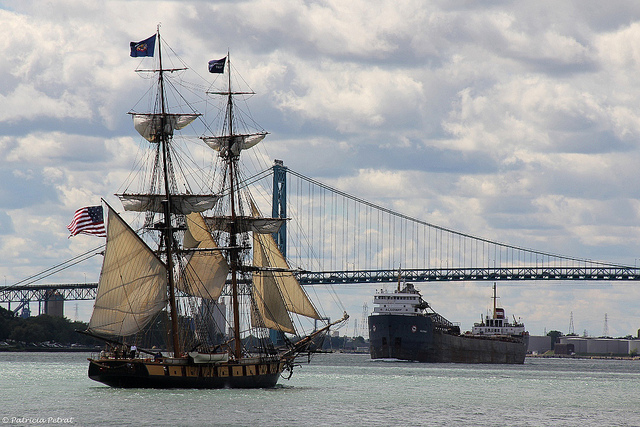
Flagship Niagara

Flagship Niagara, photo by Trish P. – K1000 Gal

“We have met the enemy and they are ours; two ships, two brigs, one schooner, and one sloop.”
~Commodore Oliver Hazard Perry

September 10, 2013 is the Bicentennial of the Battle of Lake Erie, a critical battle that helped turn the tide of the War of 1812. The Flagship Niagara page on the Battle of Lake Erie relates:

On September 10, 1813, nine small ships – six of them, including Niagara, constructed at Erie – defeated a British squadron of six vessels in the Battle of Lake Erie. A pivotal event in the War of 1812, it led to regaining Detroit, lost at the war’s outset, and lifted the nation’s morale.

The U.S. Brig Niagara is a two-masted, square-rigged sailing vessel. In 1813, she had a crew of 155 men and boys who manned her sails, 18 carronades and two long guns. The crew was organized into two watch sections (port and starboard) for routine duties while underway. More experienced sailors were stationed aloft, while others under the direction of petty officers manned the rigging which controlled the sails from deck. In battle, men also manned the guns and carronades. Boys carried the black powder charges from the magazine to the guns. Marines and soldiers were assigned to the fighting tops on the masts where they could fire their muskets on the enemy ships. Officers directed setting sails, firing cannon, and maneuvering the brig in response to orders from the captain.

…On September 10th, 1813, the British under Commodore Robert Heriot Barclay and the Americans under Perry met in battle near Put-in-Bay, Ohio. Perry’s flagship, Lawrence, engaged the British ships Detroit and Queen Charlotte, while the Niagara, for unknown reasons, did not close the enemy.

After the Lawrence was completely disabled, with most of her crew wounded or killed, Perry transferred by boat to the undamaged Niagara, hoisted his battle flag – “DONT GIVE UP THE SHIP” – sailed her into close action, broke the British battle line, and forced Barclay to surrender. In the aftermath, Commodore Perry wrote his famous report to General William Henry Harrison, “We have met the enemy and they are ours; two ships, two brigs, one schooner, and one sloop.”

You can…

Trish wrote that the Flagship Niagara was in Detroit a year ago for Navy Week to commemorate the bicentennial of the War of 1812. Detroit was chosen as a host city because of its direct link to the War of 1812. The city was an important military outpost in the war — but mainly for the British, who tricked the commander of Fort Detroit into surrendering the city without a shot and occupied it for more than a year. She also says to note the authentic 1812 U.S. flag!

Check her photo out bigger and see more in her Detroit slideshow.

More ships & boats on Michigan in Pictures.

Going for the gold

SUP'rs ... going for the 'gold'

SUP’rs … going for the ‘gold’, photo by Ken Scott

It’s hard to believe that Summer 2013 is almost in the books. I hope you’ve had fun and that you get a chance to grab a little more “summer gold” this weekend!!

Check this out bigger and see more in Ken’s Benzie slideshow.