A Tale of Two Bridges: History of Port Huron’s Blue Water Bridge

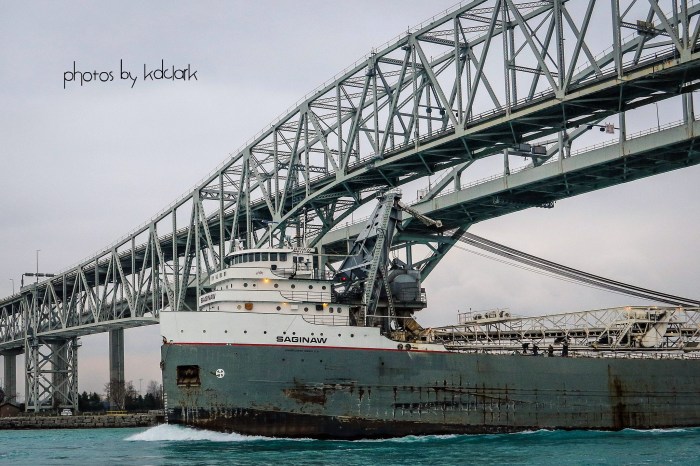
Freighter Saginaw Under the Blue Water Bridge

Untitled, photo by Diane

The website Michigan History was produced by someone at MSU. While I have no idea who or why they gave up on what was shaping up to be a cool website, the history checks out. The page on Port Huron’s Blue Water Bridge says:

Perhaps Port Huron’s greatest claim to fame is the Blue Water Bridge, a historic arcing bridge that serves as a means of transportation between Canada and the United States. The bridge is located over the St. Clair River, and connects Port Huron, Michigan, to Sarnia, Ontario. In 2013 the Blue Water Bridge celebrated its 75th anniversary, and a closer look at its history show why Port Huron residents take pride in the structure.

The original Blue Water Bridge was constructed in 1938, and was built by the American Bridge Company of New York, and the Hamilton Bridge Company of Ontario. The original bridge is an arch cantilever bridge, which was designed to not only support large amounts of traffic, but also to have an aesthetic arching look. In the late 1980s the border crossing became so popular that plans for a new bridge were brought up. However, instead of demolishing the old bridge, a new one was built in 1997 beside the old bridge, to support eastbound traffic.

The Michigan cost for building the new bridge, and renovating the old one was $62.6 million dollars. (Michigan Department of Transportation) The project was considered an enormous success and won awards from the American Society of Civil Engineers, the Ontario Institution of Steel Construction, and the Federal Highway Administration. For Port Huron residents the bridge signifies the close connection with Canada, and the willingness of the two sides to work closely together.

Click for more about the history of Port Huron. If you want to get really in depth, The Construction History of the Blue Water Bridge (pdf) is an excellent account that details the political maneuverings and construction challenges of both bridges.

View Diane’s photo of the freighter Saginaw passing under the Blue Water Bridge background bigtacular and see more in her Freighters and the St. Clair River slideshow.

There’s more Michigan bridges on Michigan in Pictures, and since you’ve read this far, Boatnerd’s page on the Saginaw has everything you’ll want to know about the self-unloading bulk carrier that was launched May 9th, 1953 as the John J. Boland. It’s one of three near sister vessels built by this shipyard: The John G. Munson which is still plying the lakes and the Detroit Edison that suffered a career-ending grounding in Lake Michigan in December of 1980.
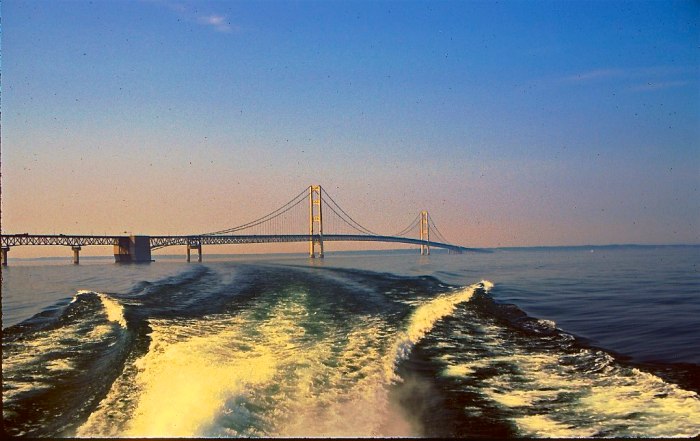
Mackinac Wake

Mackinac Bridge from ferry

Mackinac Wake, photo by Bill Johnson

Bill took this photo in May of 1987 and writes:

We had been out to the island and were returning via ferry when the captain announced a slight detour in our route. There was some kind of a special group aboard and as a treat, our boat went under the Mighty Mac, something they hardly ever do. It was pretty neat. The five mile long bridge is no longer the longest suspension bridge in the world, but to me it’s still the prettiest. I’ve personally seen several other suspension bridges, including the Golden Gate, and I’ll pick the Mac every time.

View his photo background big and see more in his Michigan slideshow.

Lots more of the Mighty Mackinac Bridge on Michigan in Pictures!

#TBT: The Boblo Boat aka the Ste. Claire

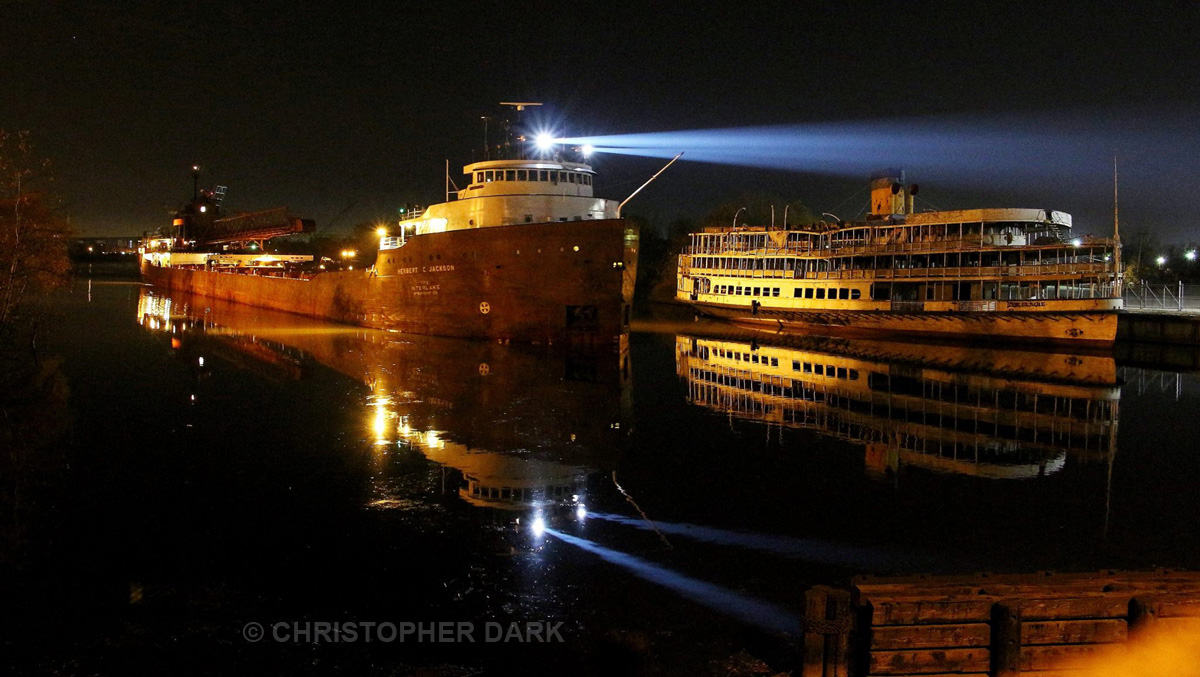
Herbet Jackson and Boblo Boat Ste Claire

Herbert C Jackson and the Bob-Lo Boat, photo by Christopher Dark

One of the Boblo Boats, the Ste. Claire, is shown here at its new berth, where it was moved a couple of weeks ago.

The Ste. Claire Restoration Project’s History page explains:

The steamer Ste. Claire represents the typical propeller-driven excursion steamer of the turn of the century, a type once found in many parts of the country. Excursion steamers are steamships built primarily for passengers for day trips. Ste. Claire and her running mate Columbia represent the “ocean-going” type of excursion vessel although they were used on lakes.

The steamer Columbia and Ste. Claire are the last two remaining classic excursion steamers in the country; and the last essentially unaltered passenger ships designed by Frank E. Kirby; and for their essentially unaltered propulsion machinery of a type becoming increasingly rare ; as the two last vessels of the Detroit and Windsor Ferry Co.; as two of the few surviving vessels built by the Detroit Dry Dock Company, and for their unaltered propulsion machinery, which is of a rare type. Columbia is the oldest passenger steamer in the United States, excepting vessels properly classed as ferries. Columbia and her running-mate Ste. Claire are the last two steamers of their type with integrity left in the United States. The pair shared their original run from Detroit to Bob-Lo Island for 81 years, a record of service on a single run unequalled in U. S. history

There’s a ton of cool stuff on the Boblo Boat website including their media center, plans for the restoration and of course donations!

Christopher got this great shot of the Herbert C Jackson upbound on the Rouge River as she passed the Ste. Claire. Click to view it bigger and see more of his photos on Facebook.

More great night photography and more ships on Michigan in Pictures.

November 18, 1958: The Wreck of the Carl D Bradley

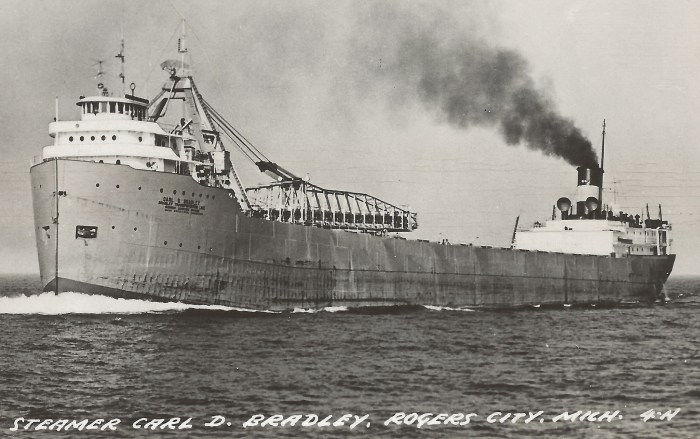
Steamer Carl D Bradley Rodgers City Mich

Steamer Carl D Bradley Rogers City Mich, photo by UpNorth Memories/Don Harrison

Every year, I revisit the story of the Edmund Fitzgerald on November 10th. I do this because I remember the ferocity of the winds on the day of the wreck vividly from my childhood, because as a Michigander Lightfoot’s song is probably coded in my DNA by now, and also because it’s very popular with readers. Nonetheless, the feature Should musicians decide the shipwrecks we know? from IPR News Radio by Peter Payette & Morgan Springer definitely struck a chord. There are thousands of ships that have gone down the world’s eighth sea, and so many families that have felt the loss when a sailor doesn’t return from one of the most dangerous jobs there is. We’d do well to remember some of the others as well!

On this day in 1958, my vote for the most devastating Great Lakes shipwreck of the modern era took place. 33 of 35 crew members perished in the wreck, and 23 of them were from the town of Rogers City that boasted a population of less than 4000 people. The Presque Isle County Historical Museum’s website for the Steamer Carl D. Bradley tells the tale of the wreck of the Bradley:

The steamer was 638 feet long overall, with a 65-foot beam, a depth of 33 feet and a cargo capacity of 14,000 tons of crushed stone. The unloading boom was 160 feet long. The engineering and propulsion plant on the Carl D. Bradley was similar to that on the T.W. Robinson which was built two years before the Carl D. Bradley.

…The Carl D. Bradley, traveling light departed Buffington, Indiana around 9:30 pm, Monday, November 17, and headed up Lake Michigan bound for the Port of Calcite. Roland Bryan, a sailor since age fourteen, was the master. This trip was the last for the season and the steamer was going home. The Bradley never made it. In less than 24 hours the Carl D. Bradley was on the bottom of Lake Michigan and 33 of the 35-man crew were dead or missing.

When the vessel left Buffington, the winds were blowing up to 35 miles per hour from the south. The storm that was about to engulf the Bradley was developing over the plains when a cold front from the north met a warm front over the plains. The temperature in Chicago had dropped about 20 degrees that day. The forecast warned of gale winds. The crew prepared for severe weather by securing the unloading boom and the hatches. The steamer followed the route up the Wisconsin shore to Cana Island then changed course and cut across Lake Michigan toward Lansing Shoal. As the wind velocity increased, the crew filled the ballast tanks to maximum practical condition. By 4:00 pm of the next day, the 18th, the winds had reached 65 miles per hour. Even though the lake was rough and the winds high, the boat rode the heavy seas with no hint of the laboring.

Captain Bryan had asked the cooks to serve an early dinner. He knew the turn from Lake Michigan toward Lake Huron would put heavy weather broadside of the vessel. He wanted to give the mess crew the opportunity to clean up and secure before turning. The mess room was full of crewmembers anticipating going home.

About 5:30 pm First Mate Elmer Flemming radioed Calcite that the Bradley would arrive at 2:00 am. Then a “loud thud” was heard. In the pilothouse Captain Bryan and Flemming looked aft and saw the stern sag. Flemming immediately sent a distress signal over the radio. “Mayday! Mayday! This is the Carl D. Bradley. Our position is approximately twelve miles southwest of Gull Island. We are in serious trouble! We’re breaking up!” Captain Bryan sounded the general alarm, signaled the engine room to stop the ship, and blew the whistle to abandon ship. The power system failed and the lights in the bow section went out. The Bradley heaved upward near amidships and broke in two. The forward section rolled over and sank. The stern end plunged to the bottom. Within a few minutes the Carl D. Bradley was gone.

Read on for much more including theories of how the ship sank and the story of how deckhand Frank Mays & Elmer Flemming survived the wreck. At the website you’ll also find some cool old photos of the ship, newspaper clippings and photos of the crewmen lost at sea. The Wikipedia entry for the Carl D Bradley is particularly good as well with a lot more details!

This trailer for November Requiem, a DVD about the Carl D Bradley, the impact on Rogers City and the dive to the Bradley:

View Don’s photo big as the Bradley, check out more of his freighter postcards & pics, and friend him up on Facebook for lots more great old photos of Michigan.

PS: I added a new category that I somehow didn’t have already: Michigan shipwrecks – enjoy!

PPS: Apparently great minds this alike – check this out from today’s Interlochen Public Radio!

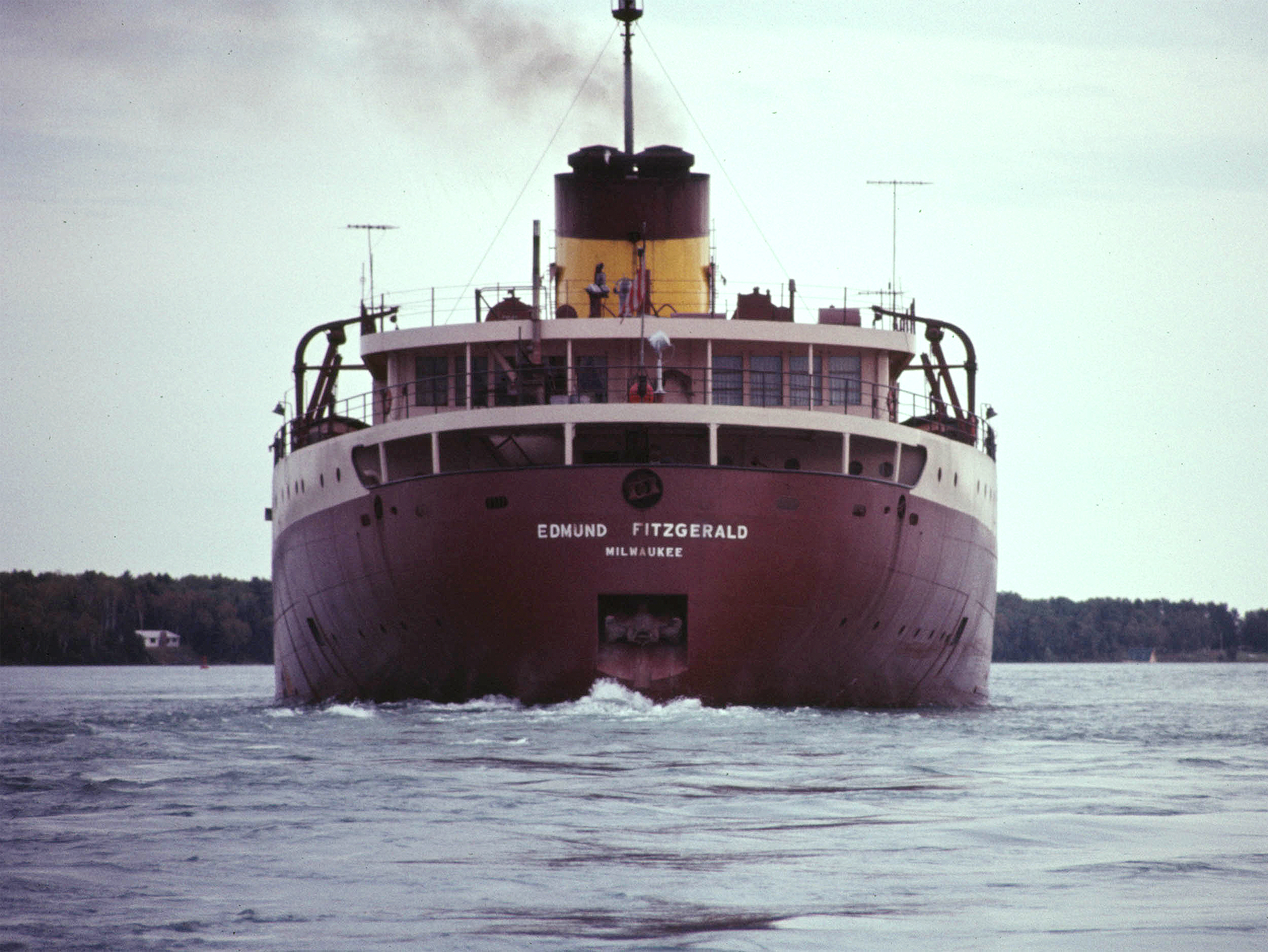
The Wreck of the Edmund Fitzgerald

SS Edmund Fitzgerald Underway

SS Edmund Fitzgerald Underway, photo via Wikimedia Commons

I went and bought all of the old newspapers, got everything in chronological order, and went ahead and did it because I already had a melody in my mind. It was from an old Irish dirge that I heard when I was about three and a half years old. I think it was one of the first pieces of music that registered to me as being a piece of music. That’s where the melody comes from, from an old Irish folk song.
~Gordon Lightfoot on The Wreck of the Edmund Fitzgerald

40 years ago today, Michigan’s most remembered shipwreck took place. A big part of this is certainly Gordon Lightfoot’s signature ballad The Wreck of the Edmund Fitzgerald. The song – familiar to almost every Michigander – seems to memorialize more than simply the 29 men who perished in that horrible storm. There is certainly no better video of this song than this one crafted by Joseph Fulton featuring footage of the Fitz that you’ve probably never seen. It starts out with Walter Cronkite’s Harry Reasoner’s news report from November 11, 1975 and just gets better from there – definitely worth your time!

mLive has an article about how & why Gordon Lightfoot wrote ‘The Wreck of the Edmund Fitzgerald’ that you should check out. It includes a nice little video where he shares how he’s edited the live lyrics to reflect what’s been learned about the sinking of the ship. They got Lightfoot’s account of  the writing of the song from the songwriter’s Ask Me Anything on Reddit, an interesting look inside of the mind of a thoughtful and talented songwriter.

I made some minor corrections to today’s photo to get the colors a little closer to those of the Fitz. View it big as the Fitz and see more at Edmund Fitzgerald images at Wikmedia.

There more ships and more shipwrecks on Michigan in Pictures.

Continue reading The Wreck of the Edmund Fitzgerald

Marquette Lower Harbor Ore Dock

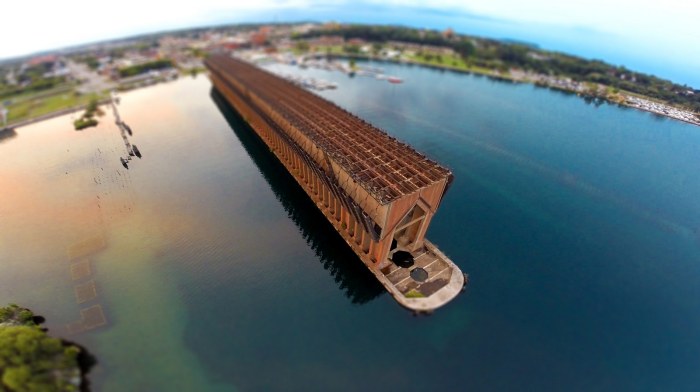
Marquette Lower Harbor Ore Dock

Lower Harbor Ore Dock, photo by Rudy Malmquist

Travel Marquette shares the story of the Iron Ore Dock in Marquette’s Upper Harbor is also known as the Presque Isle Dock.

The dock was built in 1911 and is still commercially active. Each year approximately 9.5 to 10 million tons of ore are shipped from this dock. The dock is owned and operated by the Cliffs Natural Resources. This steel-framed dock is 1,250 feet long and 60 feet wide, with the top deck sitting 75 feet above the water level. It contains 200 pockets, each of which has a capacity of 250 tons of ore, for a total storage capacity of 50,000 tons. Supporting the dock is a foundation of 10,000 wooden piles enclosed by a 12-inch thick timber sheet plank wall filled with sand.

After being mined the ore is crushed and the iron separated out with either a chemical or magnetic process. The iron is combined with a binding agent (a glorified cornstarch) and rolled into small balls roughly an inch in diameter. The balls are fed through a kiln and fired by temperatures exceeding 2,000 degrees F. The result is Taconite Pellets which are loaded on the ore boats and shipped. Most of the pellets shipped from the Presque Isle dock go to Algoma Steel in Sault Ste. Marie, Ontario the largest integrated steel mill. These pellets, which are roughly 70% iron, will be combined with coke and limestone at the mill to make steel.

The ore comes to the dock via railcars and is dumped into steel “pockets” or bins beneath the tracks. To load the boat, the chute is lowered to the open cargo hatch and a door at the bottom of the pocket opens, allowing the pellets to run into the boat shown in the picture. Loading time is variable, depending on the size of the boat and how prepared the dock is to load. Four hours is typical. Loading is the responsibility of the First Mate. It is important to load the ore in a proper sequence to avoid over-stressing the boat unevenly. Each chute (or drop of ore) is about 20 tons.

View Rudy’s photo big as the sky and see more in his slideshow.

More Marquette and more aerial photography on Michigan in Pictures.

Badger in the Mist

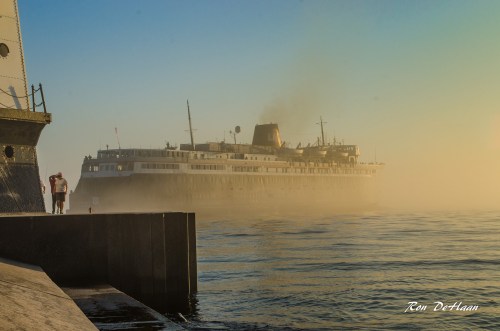
Badger Heading Out

Ludingtons SP_0103, photo by Ron DeHaan

Here’s the S.S. Badger heading out for Wisconsin. I rode the Badger many times in my Junior & Senior year of high school (Go Wausau East Lumberjacks!) to get from Michigan to Wisconsin. It was such a pleasant way to cross Lake Michigan, and at the prices they charged there were a number of people who would do a round trip crossing, playing cribbage, drinking beer from a cooler and laughing as they enjoyed the ride.

View Ron’s photo bigger and see more cool shots from the Ludington area in his slideshow.

More ships & boats, more Ludington and more of the Badger (and badgers) on Michigan in Pictures.

Spraymasters Water Ski Club: Skis Optional

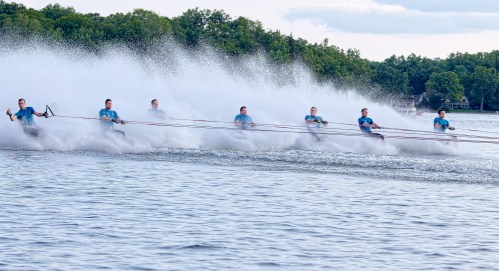
Barefoot Ski Line

Barefoot ski line, photo by Mark Zacks

This looks like fun. The Spraymasters Water Ski Club says:

Our team was founded in 1987 by Bob Dowling. We have continued to grow and perform since then. For anyone unfamiliar with show skiing, it is made up of exciting acts that are not normally seen in recreational water skiing. These acts include barefooting, ballet line, doubles, swivel skiing, and pyramids up to four tiers high.

Throughout the summer, we perform our themed shows at our home site on Big Lake in Davisburg, Michigan. We also perform numerous shows for other lake associations and organizations around the state. Furthermore, Spray Masters is a part of the National Show Ski Association (NSSA). The team competes in several tournaments each summer as a team as well as individual performances.

The team starts preparing for each season before the ice is even off the lake. Beginning in February we practice in a gym learning the new moves we are going to perform that year. We practice pyramid climbing, doubles, trios, showmanship and dances. We usually start water practices in May and practice twice a week on Tuesdays and Thursdays throughout the summer. Our first show is usually in late June, and continue through late August.

Head over to their website for a calendar of their performances.

View Mark’s photo background big and see more of his lake photos on Flickr.

More summer wallpaper on Michigan in Pictures.

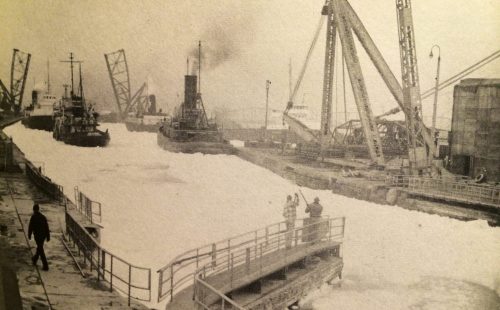
#TBT: Soo Ice Jam of 1953

Soo Ice Jam of 1953

Soo Ice Jam of 1953, shared by John Rodawn

The Ludington Daily News from April 9, 1953 had an article titled Try to Clear Soo Lock Ice with Freighters’ Backwash that said:

SAULT STE. MARIE MICHIGAN – Three powerful lakes craft churned their propellers in a huge “Operations Backwash” today hopeful they could clear the Sault locks of an ice jam which has lied up nearly one-third of the Great Lakes fleet. The Coast Guard icebreaker Mackinaw was joined by the Pittsburgh Steamship Company freighter Arthur Anderson and the Canadian freighter Manladoc (not sure this is the right name) in the operation. Shipping men and lock engineers decided on the maneuver after an aerial survey showed the Whitefish Bay area, above the locks, was entirely free of the ice formation which has passed into the proper.

The three craft were tied up side by side at a dock and then went into action, with the propellers turning at full speed to churn up the water. Officials were hopeful the backwash would push the icy mess about 800 feet upstream, against the current, and get the ice in a position so it would be caught in a cross – current and washed over the Soo Rapids and out of the locks area. Coast Guard Commander T. A. Dahlburg of the Sault area expressed belief the ice would be cleared by this weekend, perhaps as early as Friday. Dahlburg reported 90 lake craft were tied up above the locks awaiting passage, while 64 were tied up below the locks upward bound. He called it the largest concentration of shipping ever assembled in the Sault area.

Under Dahlburg’s plan to keep some traffic operating, only the most powerful of the lake freighters and carriers were permitted to make their way downbound through the icy slush in the American locks. The only upbound traffic yesterday was through the Canadian lock, seven vessels passing through while 17 came down on the U.S. side.

View this postcard shared by John Rodwan bigger on Facebook and see a lot more in the Northern Michigan Postcards group.

More about the Soo Locks and more #TBT aka Throwback Thursdays on Michigan in Pictures.

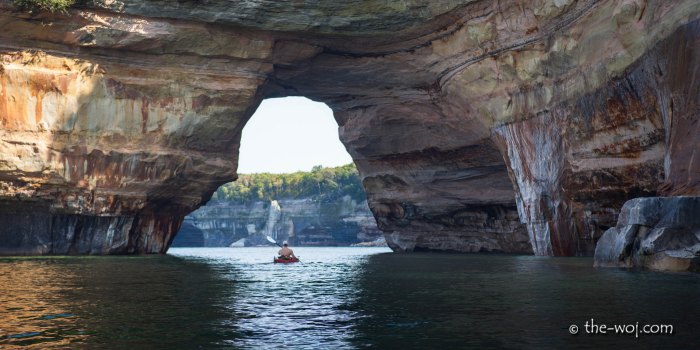
I am officially stalking the Petit Portal

Pictured Rocks National Lakeshore

Pictured Rocks National Lakeshore, photo by Paul Wojtkowski

Sorry folks, but people keep adding these awesome shots of Petit Portal in the Pictured Rocks National Lakeshore. Near the top of my personal Michigan Bucket List is being where this kayaker is.

View Paul’s photo background bigtacular, see more in his slideshow and be sure to check out his website at the-woj.com!

More summer wallpaper & more Pictured Rocks on Michigan in Pictures.