Fog Bank at Grand Sable Dunes

Fog Bank

Fog Bank, photo by siskokid.

Jim writes:

Fog rolls off of Lake Superior and up the Grand Sable Dunes on the Pictured Rocks Lakeshore as seen from the Log Slide Overlook west of Grand Marais in the Upper Peninsula Of Michigan. The Grand Sable Dunes are located on a five mile stretch between the Sable River and Au Sable Point in Alger County. The banks rise up to 275 feet high, created during the last ice age when sand and gravel filled in a deep rift in the glacier. Atop the gravelly banks, sand dunes rise another 80 feet. These are “perched dunes” because they are perched on top of another landform. They were probably formed when wind and waves piled up sand at the edge of Lake Nipissing, the forerunner of Lake Superior.

If you click through to Flickr you can see a few other shots from one of the most amazing vantages in Michigan. Be sure to check this out bigger or in his Lake Superior Slideshow.

For more, check out Grand Sable Dunes on Michigan in Pictures.

Calm Before The Storm

Calm Before The Storm

Calm Before The Storm, photo by Anapko.

Check this photo out bigger. It’s part of Anapko’s Pictured Rocks National Lakeshore set (slideshow).

Check Michigan in Pictures for many more photos from the Pictured Rocks National Lakeshore and also see this Pictured Rocks slideshow Absolute Michigan pool.

Throw in a Petoskey Stone Day

petoskey stones on the beach2

petoskey stones on the beach2, photo by jimevans_2000.

In the summertime in northwest Michigan, almost any Lake Michigan beach will have a person or two slowly walking or wading their way along the beach, gathering Petoskey stones in a bucket.

While I don’t begrudge anyone the extra money from harvesting them or the simple pleasure of finding, I do get a little peeved that there are times when I can’t find one to show a visitor or child who has never seen one. In honor of that, I am hereby creating Throw in Petoskey Stone Day, wherein participants head to a likely beach, look for Petoskey stones and then throw them way out in the water so that folks in the months or years to come can find them. It takes place every year on the third Saturday of July – tomorrow this year and Saturday, July 17 2010 if you’re the planning ahead sort.

Wikipedia’s Petoskey stone entry says:

A Petoskey stone is a rock and a fossil, often pebble-shaped, that is composed of a fossilized coral, Hexagonaria percarinata. The stones were formed as a result of glaciation, in which sheets of ice plucked stones from the bedrock, grinding off their rough edges and depositing them in the northwestern portion of Michigan’s lower peninsula.

Petoskey stones are found in the Gravel Point Formation of the Traverse Group. They are fragments of a coral reef that was originally deposited during the Devonian period, about 350 million years ago. When dry the stone resembles ordinary limestone but when wet or polished using lapidary techniques, the distinctive mottled pattern of the fossil emerges. It is sometimes made into decorative objects. Other forms of fossilized coral are also found in the same location.

In 1965, it was named the state stone of Michigan.

You can learn more about the name of the Petoskey stone from Rose Petoskey.

Jim found these on the Lake Michigan shore near Watervale (an amazing resort). Be sure to check this photo out bigger.

Making tracks for Harrisville … and the Sunrise Side Wine Festival

Untitled, photo by Werwin15.

Werwin15 sugests that you view it on black (or view it bigger).

The Sunrise Side Wine & Food Festival takes place next Saturday (July 18) at the Harrisville Harbor. It’s Northeast Michigan’s largest wine and food festival and features Michigan wines and culinary delights from area chefs.

I’ve never been but my vintner friends tell me it’s a really cool festival. Here’s a writeup from a few years ago:

Harrisville is the “almost” undiscovered jewel of the Sunrise Side. This friendly small town, halfway between Tawas and Alpena and be easily reached from both US-23 and M-72, offers a tree-lined Main Street filled with shops offering antiques, gifts, jewelry, fudge, ice cream and chocolates. Several restaurants provide everything from a casual outdoor lunch to fine dining.

In the past few years, the area has grown into a small artist colony, a favorite vacation spot for numerous artists and authors. Novelists Judith Guest’s and Fred Wolverton have each each used Harrisville as their book’s setting.

The best of Harrisville and its surrounding area, however, is absolutely free. A brief stroll through town will take you from the 100-year-old stone railroad depot past the mill pond with its working waterwheel , around the courthouse lawn lined with huge old maple trees, and – if your legs are up to it –through one of Michigan’s prettiest State Parks. Three historic bed and breakfasts are available, each with lake views, and a five-minute drive brings you to Sturgeon Point Lighthouse and the beautifully preserved 1800’s Bailey School House.

The Wine and Food Tasting weekend kicks off on Friday night, with a 50’s dance beneath the big tent. A real family event, the dance brings together everyone from small children to senior citizens, many in 1950’s costumes.

…As winter takes its sweet time shoving off, it’s nice to dream of relaxing with a glass of Michigan wine, a taste of London broil, brie or pate, and a relaxing view of Lake Huron. The Harrisville Wine and Food Tasting is one of those rare things that’s even better in reality.

Check out Harrisville Michigan in Wikipedia.

Hunting trails under Lake Huron

Great lake

Great lake, photo by jpwbee.

Earlier this week mLive reported (thanks Michitwitter) that University of Michigan researchers found evidence of ancient hunters at the bottom of Lake Huron:

Using detailed government data on lake floor topography, a research vessel and a remote mini-rover equipped with a camera, scientists found what they believe are hunting pits, camps and rock structures called caribou “drive lines” on the bottom of Lake Huron.

Drive lines, also called drive lanes, are walls built of rocks that hunters used to lure caribou into ambush. A peculiarity of the deer species is that it readily follows linear cues, even though the rock walls are short enough to step over.

The structures were found on an underwater ridge that – about 9,000 years ago – was a land bridge above water. The 10-mile-wide Alpena-Amberley ridge stretches more than 100 miles from near Point Clark, Ontario, to Presque Isle.

The 1,148-foot “drive line” structure found by U-M researchers closely resembles one previously discovered on Victoria Island in the Canadian subarctic.

Click the link above for an underwater photo and be sure to check it out bigger.

When Octopi Fly

Octopi

Octopi, photo by GH Patriot.

Last night the Red Wings managed to beat the Blackhawks 2-1 in an overtime thriller and return to the Stanley Cup. For those unfamiliar with the traditions of Hockeytown, I give you The Legend of the Octopus:

The Legend of the Octopus is a sports tradition during Detroit Red Wings home playoff games in which an octopus is thrown onto the ice surface for good luck. The origins of the activity go back to the 1952 playoffs, when a National Hockey League team played two best-of-seven series to capture the Stanley Cup. The octopus, having eight arms, symbolized the number of playoff wins necessary for the Red Wings to win the Stanley Cup. The tradition was first started on April 15, 1952 by Pete and Jerry Cusimano, brothers and storeowners in Detroit’s Eastern Market. The team swept the Toronto Maple Leafs and Montreal Canadiens en route to winning the championship, as well as winning two of the next three championships.

Since 1952, because the tossing of octopuses is generally viewed as a successful symbol of good luck, the practice has persisted each year; in one 1995 game, fans threw 36 octopuses, including a 30-pounder. The Red Wings’ unofficial mascot is a purple octopus named Al, and during playoff runs two of these mascots are also hung from the rafters of the Joe Louis Arena, symbolizing the 16 wins now needed to win the Stanley Cup. It has become such an accepted part of the team’s lore, that fans have developed what is considered proper etiquette and technique for throwing an octopus onto the ice.

Those octopi also flew a few weeks ago at the Grand Haven Kite Festival (click that link for a slideshow from the Absolute Michigan pool).

See this photo bigger in GH Patriot’s Other slideshow.

Founder’s Day Sunrise, Marquette Michigan

foundersboatsrise_autolv

foundersboatsrise_autolv, photo by TheDailies.

Kim has a great set of photos from Founder’s Day (slideshow).

On her blog, she relates the story of the Marquette’s first Founder’s Day (May 18, 2009):

While researching Marquette history, particularly the lower harbor and Founders Landing, Joe Constance, a partner with the Landing Development Group, ran across an address Peter White gave to Marquette’s YMCA in 1889. “On May 18, 1849, Peter White and Robert Graveraet first arrived in what would become Marquette,” says Constance. “Reading about their arrival at sunrise and meeting with Chief Kawbawgam, I started thinking about what that friendship meant for our community,” adds Constance. “The 160th anniversary of that date and event in our city’s history needs to be recognized.”

…According to White’s story, the party expected the trip to take three hours, but, “the seven oarsmen were pulling with a will-long strong, deep, regular strokes, that, made the boat show what the sailors call a bore in her teeth for these boys had been told that morning when breaking camp at 4 o’clock at Shot Point, that their destination was in sigh, and if they did as well as they sometimes did that a landing would be made inside of two hours, that the long trip–nine days of coasting would be ended, and the new Eldorado would be reached–and it was accomplished.”

Be sure to check this out bigger too!

No Swimming … yet

No Swimming.

No Swimming., photo by telemudcat.

Also swimming is out for all but the thermally insensitive today, sand castle building is A-OK!

Get this photo bigger right here or in Kevin’s Big Blue Marble set (slideshow).

watch out for the wee ones

watch out for the wee ones

watch out for the wee ones, photo by 1ManWithACamera.

Larry writes on the shores of Lake Huron, in the faraway village of Caseville, some of the little people ventured out among us.

He has more fun photos that you might enjoy!

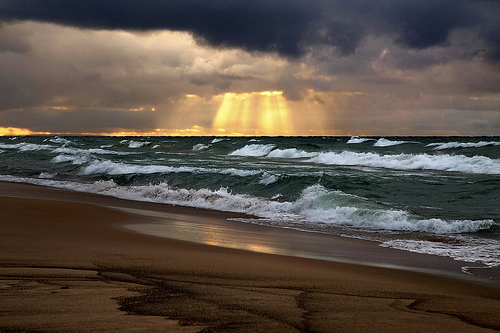
A Celebration of Lake Superior

Heaven's Light

Heaven’s Light, photo by n.weaver.

This weekend (Apr 3-5, 2009), the Superior Water Festival takes place in Marquette. It’s a celebration of Lake Superior and the rest of our water in Michigan and the world that unites organizations and thinkers about water with musicians, artists, students and citizens.

Water is what makes Michigan, Michigan, and the Water Festival is a great and ongoing celebration and dialogue on how we care for our liquid legacy.

You can see other photos of the UP and the Pictured Rocks National Lakeshore in Neil’s U.P. set (slideshow). You can also drill down to Twelve Mile Beach or go get some of your own at Twelve Mile Beach.