Moonstruck by Lightning

moonandbarn

moonandbarn, photo by Aunt Owwee.

Spring is storm season in Michigan, and where there’s storms, there’s often lightning. One of my favorite blogs, The Everyday Adventurer, has a post about lightning rods that I’ve been meaning to feature. I was waiting for a nice spring storm to rumble through but it looks like the April showers are sleeping in this year.

Wikipedia’s Lightning rod entry explains Ben Franklin’s US invention of the lightning rod (which appears to have been invented in Russia 20 some years before). Like many new inventions, it drew criticism. Here’s what Rev. Thomas Prince, the rector of Old South Church in Boston, said in his 1755 sermon titled Earthquakes the Works of God and Tokens of His Just Displeasure:

“…the more points of Iron are erected round the Earth, to draw the Electrical Substance out of the Air; the more the Earth must needs be charged with it. And therefore it seems worthy of Consideration whether any part of the Earth, being fuller of the terrible Substance, may not be exposed to more shocking Earthquakes. In Boston are more erected than anywhere else in New England; and Boston seems to be more dreadfully Shaken. O! there is no getting out of the mighty Hand of God! If we think to avoid it in the Air, we cannot in the Earth: Yea it may grow more fatal…

Check out this Michigan lightning slideshow from Flickr and be sure to check this out bigger.

Here’s hoping your buildings remain lightning free!

meteoric: 2009 Leonid Shower & the sound of meteors

meteoric

meteoric, photo by postpurchase.

The other day I saw this sweet video of the meteor that fell to earth near Edmonton, Alberta. When Gmail tossed me a link to this report on Space.com that the 2009 Leonid Meteor Showers are predicted to be stronger in 2009, I checked it out, clicking on to Top 10 Leonids facts. That had some pretty cool stuff including the 1833 Leonids which were so bright and sustained that they lit up the sky and the assertation that you’re more likely to be struck by lightning seven times in a row than to be hit by a meteor (whew).

One that especially caught my eye was the Scary Sounds of Meteors. Sounds have been reported along with meteors for millenia, and while Sir Edmund Halley (he of the comet) wrote it off in the 1700s as imagination:

Australian researcher Colin Keay uses the term to describe a theory he developed in the early 1980s.

As the theory goes, when a space rock plunges earthward, friction caused by the atmosphere creates a trail of electrically charged particles, or plasma, in which Earth’s invisible but potent magnetic field lines become trapped, tangled and twisted like strings of cooked spaghetti.

This magnetic spaghetti is thought to generate very low frequency radio waves, says Keay, a researcher at the University of Newcastle who, though not famous like Halley, does have an asteroid named after him.

Read more from NASA and Colin Keay’s pages on Geophysical Electrophonics. Tying this all back to Michigan, this whole things struck me because I noticed a faint hissing sound in association with the Perseid shower this summer that I wrote off to Halley’s imagination.

Thankfully, the Absolute Michigan pool has a few sky watchers, and Ann Arbor’s postpurchase recently uploaded a beauty! View more of postpurchase’s amazing night sky photography and see this photo larger in his slideshow.

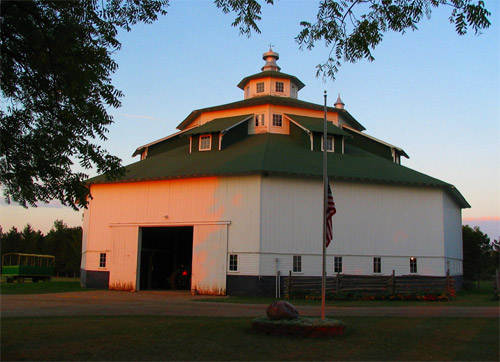
Gagetown – Michigan’s Thumb Octagon Barn

Gagetown - Michigan's Thumb Octagon Barn, photo by coloneljohnbritt

Gagetown – Michigan’s Thumb Octagon Barn, photo by coloneljohnbritt

John writes that this enormous, eight-sided barn in Gagetown is an agricultural museum open to the public during the warmer months.

Check out thumboctagonbarn.org for details including the answer to a question: Why an octagon barn?

Besides the fact that Mr. Purdy (the owner of the barn) was taken up by the uniqueness of this shape of barn, it was during this period that the agricultural community was promoting an octagon or round barn as the building of the future for agriculture. It was felt that this shape of building would be handier to work out of and that it would replace three or four buildings on the farm, i.e. hog house, horse barn, grainery, etc.).

At this same time Sears Roebuck & Co. listed a number of different sized octagon barn packages in their catalogue. You could order a barn “kit” and it was loaded on a flat car in Chicago and shipped all over the country.

It is obvious that if an octagon barn was the building of the future for agriculture there would have been more of them dotting our landscape. In talking to men who worked on the Purdy Farm as boys, they said that it was not as handy to work in and it was a more costly building to build.

Their photos page has some neat images including a photo of the Purdy Farm and barn from 1924.

Lighthouse Wanna Be

Lighthouse Wanna Be

Lighthouse Wanna Be, photo by Rudy Malmquist.

Because really, who DOESN’T want their own lighthouse?

UP in Late Winter

Barn6637

Barn6637, photo by ETCphoto.

This photo of a barn near Paulding is part of Terry’s great Easter UP Trip ’08 set of photos (slideshow).

Terry took the trip to see some places he hadn’t seen in winter like Bond Falls, Houghton, Eagle Harbor, Marquette and Grand Island.

Do the slideshow if you have the time!

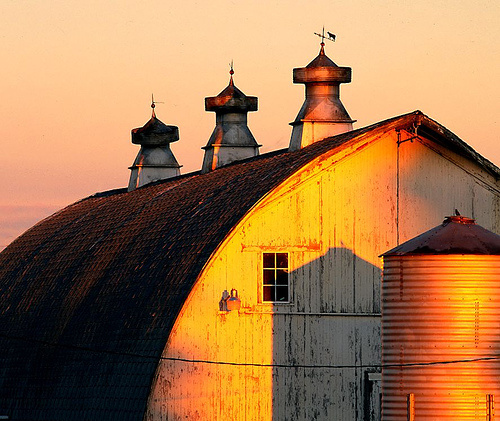
barn in morning light, Allegan, MI

Barn in Alleghan Michigan

barn in morning light, Allegan, MI, photo by Mike O’C.

Sometimes, there’s nothing you can add.

Have a great weekend folks … and try to keep each other warm.

Anatomy of a Sun Dog

EDITOR’S NOTE: SEPTEMBER 22, 2012: Greetings from the future, people of January 2008! I think that this is the first post that I’ve ever re-done. The photos here were really cool but they were removed from Flickr. I probably would have waited for winter but as today’s post about rainbows refers here, I figured I’d do it now! Also, this post is in the new science category that I created today. If you have suggestions for other posts from Michigan in Pictures to be included, post a comment on them!

bluffsundogcaron-vi

bluffsundogcaron-vi, photo by MILapse

Sundogs, Parhelia, Mock Suns on the fantastic website Atmospheric optics says:

Sundogs, parhelia, are formed by plate crystals high in the cirrus clouds that occur world-wide. In cold climates the plates can also be in ground level as diamond dust.

The plates drift and float gently downwards with their large hexagonal faces almost horizontal. Rays that eventually contribute their glint to a sundog enter a side face and leave through another inclined 60° to the first. The two refractions deviate the ray by 22° or more depending on the ray’s initial angle of incidence when it enters the crystal. The condition where the internal ray crossing the crystal is parallel to an adjacent face gives the minimum deviation of about 22°.

Red light is refracted less strongly than blue and the inner, sunward, edges of sundogs are therefore red hued.

Rays passing through plates crystals in other ways form a variety of halos.

Head over to Atmospheric Optics for more about sundogs & other halos and definitely don’t miss their staggering sundog & moondog photo gallery. Also see sun dogs on Wikipedia.

Check this photo from the Sleeping Bear Dunes National Lakeshore on black and see a couple more shots of the sundog in Mr Jay’s Summer Vacation 08 slideshow.

More science on Michigan in Pictures!

The Octagon House

wash up

wash up, photo by n.elle.

Nicole writes:

a few of us from exposure detroit took a road trip up to the northern burbs and further. some poked fun that i wanted to stop at the octagon house, but i think it’s a pretty cool building.

tucked behind the octagon house were a few old barns. sitting out it front of one of them was this old claw foot tub and sink. just in case you need to wash up.

The Friends of the Loren Andrus Octagon House say that in 1828, Loren traveled with his father to find a new home in the Territory of Michigan, settling in Washington Township in Macomb County. In 1858 with the help of prominent architect and brother-in-law David Stewart and using Orson Squire Fowler’s book about the wonders of 8-sided houses, A Home For All, Andrus built the Octagon House as his entry in a home-for-show contest between several families to see who could build the most unusual house. He won.

The Octagon House is Italianate in style, surrounded on six sides by a Corinthian-columned porch. A cedar shake shingled roof, with elegant scrolled brackets, supports the octagonal cupola. The house has eight sides with eight-foot windows letting daylight fill the interior. The interior is centered around a dramatic, 55-step cantilevered spiral staircase which winds from the first floor to the third story cupola.

The Friends of the Loren Andrus Octagon House was formed to preserve this structure (which is on the National Register and you can learn a lot more about it, see a slideshow and help them to save the old barns.

Here’s an entry for The Octagon House on the Absolute Michigan map of Michigan.

stony creek, barny holga, welcome to Holgaland

2006.10.15 - stony creek - barny holga by ercy

2006.10.15 – stony creek – barny holga, photo by ercy

ercy relates that this is a cross-processed holga; scanned print with no post processing. She also says that she just loves holgas for their dreaminess and vivid color. I think you will just love her holga*land set (slideshow).

We’ve seen a number of Holga images on Michigan in Pictures, but I realize that everyone may not know just what a Holga is. Wikipedia’s entry on the Holga camera says:

The Holga is an inexpensive, medium format 120 film toy camera, originating in China, that later came to be appreciated for its low-fidelity aesthetic. The Holga’s cheap construction and simple meniscus lens often yields pictures that display vignetting, blur, light leaks, and other distortions.

If that’s making you yawn, try the Holga pages at lomography.com, where they present the history and ethic of the camera in much more exciting, detailed and illustrated fashion and explain:

The lack of options with the Holga makes it an unpredictable and very exciting camera to use. You will find yourself asking whether a shot is in focus, or correctly exposed, or whether you remembered to wind the film forward or even take the lens cap off. More importantly, you will question whether you even care! After you use the Holga for a while – if you don’t give up on it – you will become used to how it works and even adapt to how it sees, but you will never fully understand it.

You may also be interested in the Holga FAQ, Squarefrog Holga and the Holga gallery at holga.net (all three of these have Holga purchasing info).

Michigan Fall Wallpaper series

Star Trails, the Perseid Meteor Shower and the Tears of St. Lawrence

662px-Perseid_Meteor

2009 Update: The best time to watch the Persied meteor shower in Michigan is TONIGHT (August 11-12, 2009).

The peak of the annual Perseid meteor shower was last night. Postpurchase says he had intended to catch the peak of the perseid meteor shower last night but (alas) the clouds decided not to cooperate. Although last night was the peak, you can see them tonight and I saw a bunch early this morning! (in fact, there was a recent report of Northern Lights at our Northern Lights Log on Absolute Michigan)

SPACE.com has this (and more) to say about the Perseid meteor shower:

Every August, when many people are vacationing in the country where skies are dark, the best-known meteor shower makes its appearance…

The event is also known as “The Tears of St. Lawrence.”

Laurentius, a Christian deacon, is said to have been martyred by the Romans in 258 AD on an iron outdoor stove. It was in the midst of this torture that Laurentius cried out: “I am already roasted on one side and, if thou wouldst have me well cooked, it is time to turn me on the other.”

The saint’s death was commemorated on his feast day, Aug. 10. King Phillip II of Spain built his monastery place the “Escorial,” on the plan of the holy gridiron. And the abundance of shooting stars seen annually between approximately Aug. 8 and 14 have come to be known as St. Lawrence’s “fiery tears.”

Wikipedia’s Persied entry adds viewing tips:

The shower is visible from mid-July each year, with the greatest activity between August 8 and 14, peaking about August 12. During the peak, the rate of meteors reaches 60 or more per hour. They can be seen all across the sky, but because of the path of Swift-Tuttle’s orbit, Perseids are mostly visible on the northern hemisphere.

To experience the shower in its full, one should observe in the dark of a clear moonless night, from a point far outside any large cities, where stars are not dimmed by light pollution. The Perseids have a broad peak, so the shower is visible for several nights. On any given night, activity starts slowly in the evening but picks up by 11 p.m., when the radiant gets reasonably high in the sky. The meteor rate increases steadily through the night as the radiant rises higher, peaking just before the sky starts to get light, roughly 1½ to 2 hours before sunrise.