
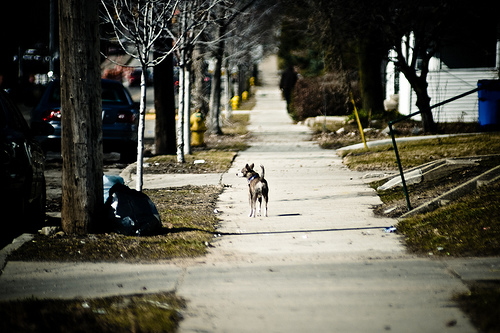
Hydrant Heaven | Bow-Wow!, photo by docksidepress.
Sometimes it’s the little things that make a day special.
Part of Matt’s March 2009 set (slideshow).
Hydrant Heaven | Bow-Wow!, photo by docksidepress.
Sometimes it’s the little things that make a day special.
Part of Matt’s March 2009 set (slideshow).

Untitled, photo by ( Jennifer )
Jennifer took this shot a few weeks ago at the annual Kalkaska Winterfest. She has some great photos of the sled dog racing that yu can check out in her Winterfest set (slideshow).
Hope you get a chance to get out and run around this weekend!

Got My Nut . . . I’m Outta’ Here, photo by Matt Kedzior.
Wikipedia’s Fox Squirrel entry says that the Fox Squirrel (Sciurus niger) is the largest species of tree squirrel native to North America and are also sometimes referred to as the Stump-eared Squirrel, Raccoon Squirrel, or Monkey-faced Squirrel.
Fox Squirrels depend primarily on tree seeds for food, but they are generalist eaters and will also consume buds and fruits, cultivated grain, insects, birds’ eggs, and small lizards … In their regular diet of nuts, fox squirrels are classic scatter-hoarders that bury caches of nuts in dispersed locations, some of which are inevitably left unretrieved to germinate. (Matt says he watched this little guy dig around for a couple seconds in the snow and he came up with a nut that I assume he buried earlier)
Fox Squirrels are strictly diurnal, non-territorial, and spend more of their time on the ground than most other tree squirrels. They are still, however, agile climbers…
They are gregarious and apparently playful, often chasing each other up and down trees and across yards and clearings. They have a large vocabulary, consisting most notably an assortment of clucking and chucking sounds, not unlike some “game” birds, and they warn the listening world of approaching threats…
Fox Squirrels are also known for being living fossils, skeletally very similar to remains of the oldest-known squirrel, Protosciurus, from the late Oligocene and early Miocene epochs.
For more, check out the Animal Diversity Web pages on the Fox Squirrel and also Michigan DNR’s page on Michigan squirrels.
You can see this bigger in Matt’s slideshow.

What’s the forecast Mr. Wooly Bear?, photo by reddeviltj
Wikipedia says that the banded woolly bear caterpillar is the larva of the Isabella tiger moth. As every schoolchild knows, the wooly bear is the Farmer’s Almanac of insect kingdom:
Folklore of the eastern United States holds that the relative amounts of brown and black on the skin of a wooly bear caterpillar (commonly abundant in the fall) are an indication of the severity of the coming winter. It is believed that if a woolly bear caterpillar’s brown stripe is thick, the winter weather will be mild and if the brown stripes are narrow, the winter will be severe. In reality, hatchlings from the same clutch of eggs can display considerable variation in their color distribution, and the brown band tends to grow with age; if there is any truth to the aphorism, it is minimal.
While the wooly bear may not be pushing Al Roker for a job, the wooly bear does produce its own anti-freeze (page also includes some extreme closeups – of the caterpillar, not Roker). If you’re interested in detailed instructions for how to keep wooly bears over the winter, check the Michigan Entomology Society. If you’re interested in simple instructions for how to keep wooly bears with a soundtrack, check here.

Piglet, photo by Aaron Fortin
Aaron took this photo of the newborn piglet at the Miracle of Life Exhibit at this summer’s Michigan State Fair. You can see it bigger in his Pets & Animals slideshow (full set).

The next Exposure.Detroit show opens tomorrow night (Friday, November 14) from 7-10 PM at the Bean and Leaf Cafe in Royal Oak. In addition to Aaron, the photographers are:
Rebecca Gutierrez (Luna’s Eyes)
Poster designed by Ajit.

The Owl on the Roof, photo by .jowo..
Joel writes:
When Joan opened the curtains this morning she found this fella sitting on the telephone pole. An hour or so later, it moved to the top of the house, where it stayed for a couple more hours.
This shot from the back yard. The bird kept its eye on me, but obviously wasn’t concerned about me. Never had an owl in our yard before. Very impressive.
Be sure to check it out bigger, this other view and Joel’s Birds slideshow.
The Owl Pages’ page for the Snowy Owl (Bubo scandiacus) has great info on the Snowy Owl, which was classified in 1758 by famed Swedish naturalist Carolus Linnaeus (the guy who laid the foundations for taxonomy & ecology). The “scandiacas” is a Latinised word referring to Scandinavia. Other names include Arctic Owl, Great White Owl, Ghost Owl, Ermine Owl, Tundra Ghost, Ookpik and (my personal favorite) White Terror of the North. The average female weighs 5 pounds and is 26″ tall with a 50-60″ wingspan, making it one of the larger owls.
The Call of the Wild Museum page on snowy owls says:
The Snowy Owl is a beautiful, majestic Bird of Prey. It is one of the most
recognized birds to visit Michigan in the winter – they actually fly south
from Northern Canada and Alaska in October and November, then fly back
north in March and April – just as it starts to warm up. Only the males will
be completely white, the females are generally larger, but their feathers
are white with dark spotting or barring. These large white, tuftless owls
are found primarily in wide open inland spaces – this includes farmlands,
marshlands and even airports! Any of these habitats in Michigan resemble
their northern tundra homes.Being a bird of open land, some of their favorite resting spots are on the
ground, a lamp post, or a rooftop; they hardly ever sit up in a tree. In their
breeding grounds, found far north, the lemming are their primary food
source. When the lemming population is on a decline in the tundra, the
snowy owl flies further south to supplement their hunger. This leads to an
occasional influx in the number of birds in Michigan, in fact studies have
shown that this happens every 4 -5 years. the most recent invasion
happened during the winter of 1991-92. More than 100 owls were reported
seen from over half of Michigan’s 83 counties!
Also see the Snowy Owl from All About Birds (has some sounds of the snowy owl too), Nyctea scandiaca (snowy owl) from Animal Diversity Web and Wikipedia’s Snowy Owl entry.
Finally, here’s a cool YouTube video of a snowy owl in Wayne County!

Female Snapping Turtle, photo by MTU_Flickr.
Regular readers may recall TurtleGate ’08. Some of you may have even been consumed by worry that this terrapin tangle would go unresolved. Fear not, for thanks to a happy find while researching the Seney National Wildlife Refuge, I can finally put the michpics universe back on firm & factual footing.
MTU Flickr says that this little lady was looking for a good place to lay some eggs in the Seney Wildlife Refuge during sunset. It’s part of their excellent Nature Made set, a collection of photos “mostly set in the Upper Peninsula” that should probably be viewed as a slideshow.
The common snapping turtle (Chelydra serpentina) and probably (other than the elusive cougar), the Michigan animal you most want to be wary of. From the U of M Animal Diversity Web’s page on the common snapping turtle:
Snapping turtles are not social creatures. Social interactions are limited to aggressive interactions between individuals, usually males. Many individuals can be found within a small range; snapping turtle density is normally related to the amount of available food. Snapping turtles can be very vicious when removed from the water, but they become docile when placed back into the water. Snapping turtles sometimes bury themselves in mud with only their nostrils and eyes exposed. This burying behavior is used as a means of ambushing prey.
Snapping turtles will eat nearly anything that they can get their jaws around. They feed on carrion, invertebrates, fish, birds, small mammals, amphibians, and a surprisingly large amount of aquatic vegetation. Snapping turtles kill other turtles by decapitation. This behavior might be territoriality towards other turtles or a very inefficient feeding behavior.
You can read much more about these agressive amphibians from the link above and also the Michigan DNR and Wikipedia. Also check out this video of a common snapper attacking a camera to get an idea of how fast they can move if they want to!
You may want to go back and read the other post too as it now has information about the wood turtle in Michigan.

Seney, MI, photo by lilrhgerl.
lilrhgerl took this Holga photo – do yourself a favor and check out her Holga slideshow. She writes that Seney is the most amazing place, and anyone who has spent time there would probably agree.
The Seney National Wildlife Refuge encompasses nearly 100,000 acres in the central Upper Peninsula. Seney was established in 1935 for the protection and production of migratory birds and other wildlife. It supports a variety of wildlife including a profusion of birds: bald eagles, common loons, trumpeter swans, Canada geese, hooded mergansers, mallards, black ducks, ring-necked ducks, wood ducks and sandhill cranes. Animals include black bear, white-tailed deer, coyote, river otter and beaver. There’s also black flies, deer flies, and mosquitoes during warmer months.
The wetlands, which are also known as the Great Manistique Swamp provide a great haven for all these animals and birds have their roots when:
…Over a century ago, lumbering operations altered the landscape of the Upper Peninsula’s great forests. The ring of the lumberman’s axe echoed through the forests as local mills depleted the region’s valuable supply of red and white pine. After the pine forests were cut, mill owners turned their axes and saws to the Refuge’s northern hardwood and swamp conifer communities.Following the lumbering operations, fires were often set to clear away the debris. These fires burned deep into the rich organic soil, damaging its quality and killing the seeds that would have produced a new forest. On many areas of the Refuge, the scars from these lumbering operations remain visible to this day.
After the fires, a land development company dug many miles of drainage ditches throughout Seney. This drained acreage was then sold using extravagant promises of agricultural productivity. But the new owners quickly learned that these promises were unfounded. One by one, the farms were abandoned, and the exploited lands reverted to state ownership.
In 1934, the Michigan Conservation Department recommended to the Federal Government that the Seney area be developed for wildlife. This proposal was accepted and Seney National Wildlife Refuge was established in 1935.
Check out Seney National Wildlife Refuge on the Absolute Michigan map and click for the Seney slideshow from the Absolute Michigan pool!

Acorns, photo by StormchaserMike.
StormchaserMike says that he gathered these up because he heard that blue jays like them.
Hope everyone gets a chance to put away a few golden moments of summer before it slips away!

a little closer, photo by gerrybuckel.
Gerry was watching these wasps at work and got a little closer to the nest to take this photo, but had to back off as they got closer too!
I thought Gerry was wrong to refer to these “bees” as wasps, but in digging a little deeper, I realized that I was the one in error.
Wikipedia has a lot to say about yellowjackets & hornets. One good thing to know is not to mess with a nest as wasps aren’t limited to a single sting!
Hornets, like many social wasps, can mobilize the entire nest to sting in defense: this is highly dangerous to humans. The hornet alarm pheromone is used to raise alarm of nest attack, and to identify prey, for example bees. It is not advisable to kill a hornet anywhere near a nest, as the distress signal can trigger the entire nest to attack. Materials that come in contact with pheromone, such as clothes, skin, dead prey or hornets, must be removed from the vicinity of the hornets nest. Perfumes, and other volatile chemicals can be falsely identified as pheromone by the hornets and trigger attack.
My bee guy told me that you can neutralize hornet & yellowjacket venom with “Shout” – I have no idea whether or not that is true!
I still can’t tell what particular breed these wasps are, but the most common breed in our region is now the German yellowjacket. The Yellowjacket & Hornets through a Lens at bugguide.net might hold the answer!
 Michigan in Pictures