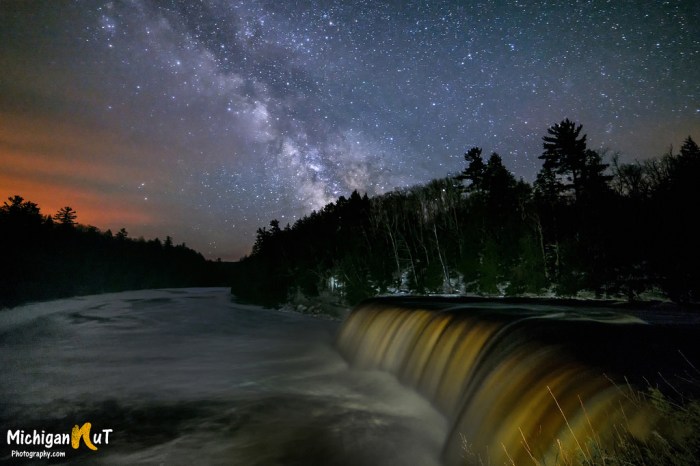
Waterfall Wednesday: Milky Way over Tahquamenon Falls

Milky Way over Tahquamenon Falls

Milky Way over Tahquamenon Falls, photo by John McCormick / Michigan Nut Photography

The Tahquamenon Falls State Park says:

Tahquamenon Falls State Park encompasses close to 50,000 acres stretching over 13 miles. Most of this is undeveloped woodland without roads, buildings or power lines. The centerpiece of the park, and the very reason for its existence, is the Tahquamenon River with its waterfalls. The Upper Falls is one the largest waterfalls east of the Mississippi. It has a drop of nearly 50 feet and is more than 200 feet across. A maximum flow of more than 50,000 gallons of water per second has been recorded cascading over these falls.

…This is the land of Longfellow’s Hiawatha – “by the rushing Tahquamenaw” Hiawatha built his canoe. Long before the white man set eyes on the river, the abundance of fish in its waters and animals along its shores attracted the Ojibwa Indians, who camped, farmed, fished and trapped along its banks. In the late 1800’s came the lumber barons and the river carried their logs by the millions to the mills. Lumberjacks, who harvested the tall timber, were among the first permanent white settlers in the area.

Rising from springs north of McMillan, the Tahquamenon River drains the watershed of an area of more than 790 square miles. From its source, it meanders 94 miles before emptying into Whitefish Bay. The amber color of the water is caused by tannins leached from the Cedar, Spruce and Hemlock in the swamps drained by the river. The extremely soft water churned by the action of the falls causes the large amounts of foam, which has been the trademark of the Tahquamenon since the days of the voyager.

Click through for maps and more.

View John’s photo bigger, follow him at Michigan Nut Photography on Facebook, and settle back for his Michigan Waterfalls slideshow.

Lots more Tahquamenon Falls on Michigan in Pictures.
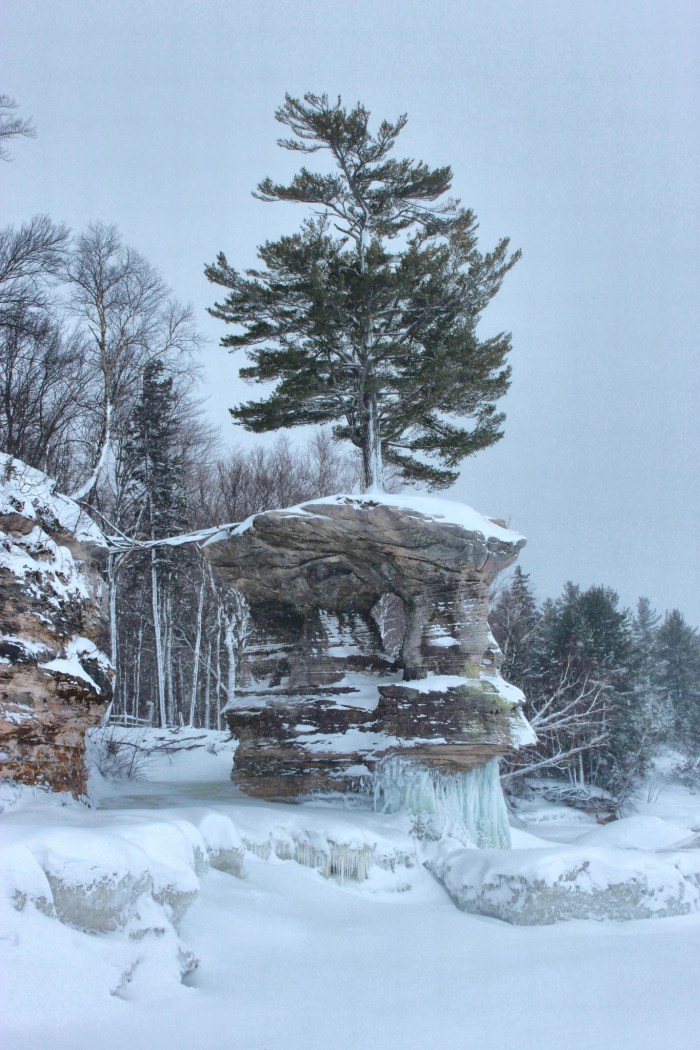
Chapel Rock in Winter

Chapel Rock in Winter

Live Anywhere, photo by Jay

When you think about it, it’s not only miraculous that the white pine on Chapel Rock in the Pictured Rocks National Lakeshore survives with barely any soil, but also that it endures winter after winter in the teeth of Lake Superior.

Jay took this shot on February 20th last year. View it background bigtacular and jump into his slideshow for some more spectacular winter photos from the Pictured Rocks.

The Soul of the Yoop

The Soul of the Yoop

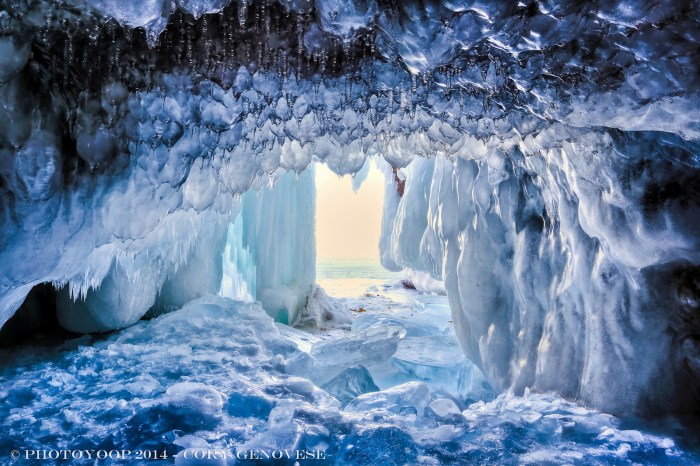
Soul of the Yoop, photo by Cory Genovese

While our Great Lakes shoreline still holds some cool formations this winter, unlike the last two years this winter hasn’t had the very cold days coupled with high winds that combine to form truly spectacular ice caves. Thankfully, we can look back … and hope for a wintry turn in the weather!

Cory took this photo of one of his favorite little Lake Superior ice caves in a spring thaw in April of 2014. View the photo bigger, see more in his Yoop Life slideshow, and definitely follow him on Facebook at PhotoYoop for more great shots of life on the edge in Michigan’s Upper Peninsula!

More ice caves on Michigan in Pictures, and please consider becoming a patron of Michigan in Pictures.

Celebratory Sunset … and 10,000 Fans for Michigan in Pictures

Celebratory Sunset

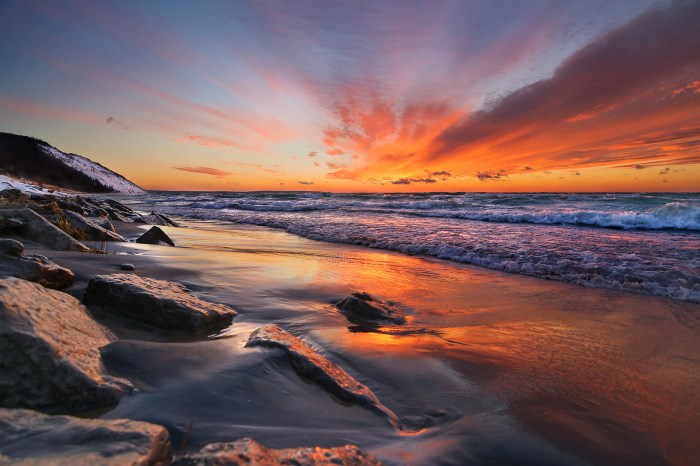
Celebratory Sunset, photo by Heather Higham

For the tenth anniversary of Michigan in Pictures last week, I asked for the 200+ fans needed to take the Michigan in Pictures Facebook past the 10,000 fan milestone. With your help, it’s blown way past that mark – thank you all so much for your support!!!

View Heather’s photo from Empire Beach in the Sleeping Bear Dunes National Lakeshore bigger, see more in her Winter slideshow, and definitely follow her at Snap Happy Gal Photography on Facebook for much more.

More Michigan in Pictures milestones in the archives.

Fantastic Friday: Tahquamenon Falls, take two

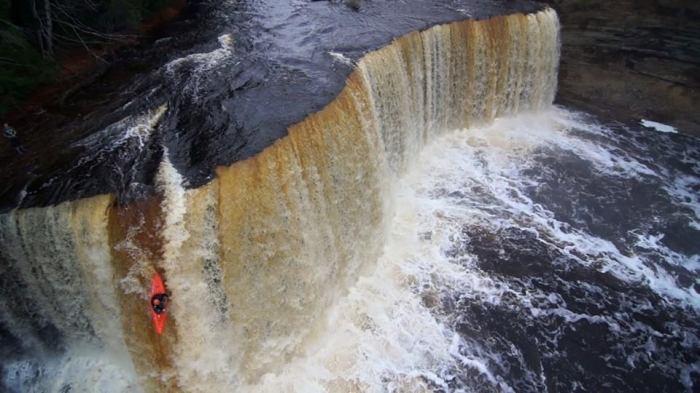
I had no idea on Wednesday that we’d be back at Tahquamenon Falls so soon. I guess I have to add a safety warning that if you’re not a crazy amazing kayaking legend like Marcelo Galizio, you probably shouldn’t do this. Also it might be illegal. Also if you tell me I shouldn’t post photos like this, I will probably tell you you shouldn’t follow my blog because I am 100% in favor of people being amazing.

Tahquamenon Falls revisited with Marcelo Galizio

Tahquamenon Falls revisited, photo by Aerial Vantage Productions

Here’s an aerial photo of Marcelo Galizio’s drop over Tahquamenon Falls yesterday!!  Look for a link to a video soon in the comments or at Aerial Vantage Productions on Facebook. Also be sure to check out their work at aerialvantageproductions.com and follow Dan Englund on Instagram!

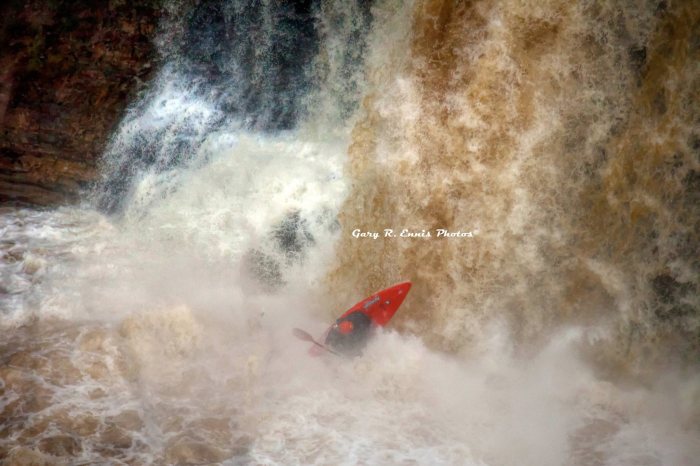
Because this is so awesome, and also because I learned about it through Gary Ennis, here’s another photo from Marcelo’s Tahquamenon Falls adventure:

Into the Falls Marcelo Galizio a

Be sure to click to check out Gary’s photos of Marcelo’s entire drop!

Autumn’s Chapel

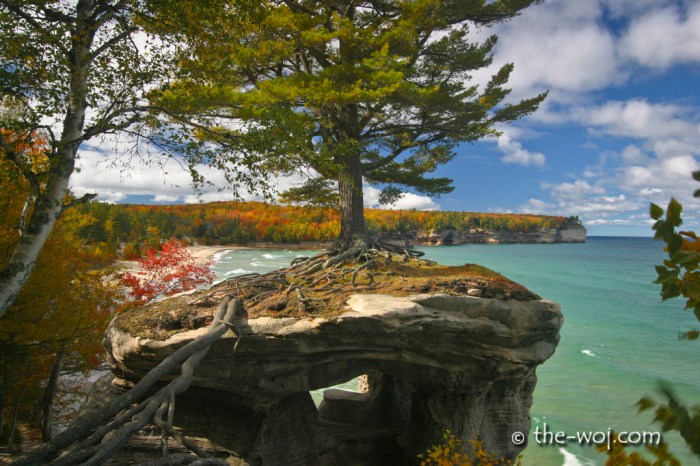
Chapel Rock in Fall

chapel rock, photo by Paul Wojtkowski

Here’s a cool picture from way back in 2006 of what I think is definitely one of the 7 wonders of Michigan: Chapel Rock in the Pictured Rocks National Lakeshore.

The Lucky Tree of Chapel Rock features quite a number of photos that I think can give you a pretty good understanding of this marvelous Michigan miracle.

Chapel Rock on Lake Superior has a single tree perched atop its column. By rights the tree should not be there: the small surface area of land on the top of the rock is insufficient to sustain a tree of this size.

There is hardly any topsoil, certainly not enough for an obviously thriving tree. How then does it flourish?

Look a little closer and you will see the answer – that rope on the right of the picture is not, in fact a rope. It is a system of roots, extending and stretching over the edge of the rock to the main bluff where there are nutrients and water aplenty.

Yet how on earth did the root extend over to the mainland? Did it slither in some triffid like way until it reached the other side? Is there a Little Shop of Horrors thing happening here?

Click through for the answer and some pics that make things clearer – including to my surprise one of my own! – from Kuriositas which looks like a pretty cool site.

View Paul’s photo bigger and see this and more in his slideshow.

More Pictured Rocks on Michigan in Pictures? You bet!

Otter Creek Aurora

Otter Creek Aurora

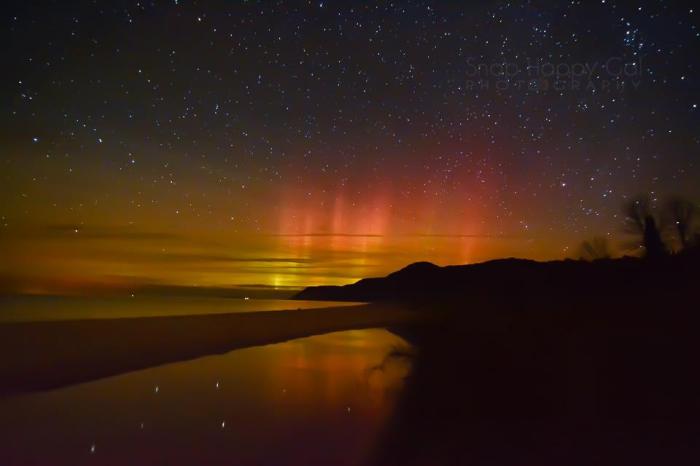
Otter Creek Aurora, photo by Snap Happy Gal Photography

This is one shot from an incredible video that Heather made of the northern lights as seen from Esch Road Beach in the Sleeping Bear Dunes National Lakeshore. That’s Otter Creek in the foreground.

Click to view bigger, follow Snap Happy Gal on Facebook, and definitely watch that video – meteors!!

Lots more northern lights on Michigan in Pictures.

The Science of Sand Waves, Silver Lake Dunes Edition

Sand Waves

Sand Waves, photo by Charles Bonham

Confession: I probably don’t give Silver Lake Dunes State Park enough love. What an incredible place.

In Scientific American Robert S. Anderson, associate professor of earth sciences at the University of California at Santa Cruz explains why regular, wavelike shapes form when the wind blows over the sand on the beach for a long time:

Ripples in sand, found on both beaches and dunes, are one of nature’s most ubiquitous and spectacular examples of self-organization. They do not result from some predetermined pattern in the wind that is somehow impressed on the surface, but rather from the dynamics of individual grains in motion across the surface. They arise whenever wind blows strongly enough over a sand surface to entrain grains into the wind. The subsequent hopping and leaping of these grains is called saltation. Saltating grains travel elongated, asymmetric trajectories: Rising relatively steeply off the bed, their path is then stretched downwind as they are accelerated by drag forces. They impact the sand surface centimeters to tens of centimeters downwind, typically at a low angle, around 10 degrees. It is this beam of wind-accelerated grains impacting the sand surface at a low angle that is responsible for ripples.

“An artificially flattened sand surface will not remain flat for long. (Try it on the beach or on the upwind side of a dune and see for yourself.) Small irregular mottles in the sand surface, perhaps a couple centimeters in wavelength, rapidly arise and grow once the wind starts to blow hard enough to initiate saltation. They then slowly organize themselves into more regular waves whose low crests are aligned perpendicular to the wind direction and begin to march slowly downwind. Typical ripple spacing is about 10 centimeters, whereas the typical height of the crests above the troughs is a few millimeters. The pattern is never perfect, but instead the ripple crests occasionally split or terminate, generating a pattern that looks remarkably like one’s fingerprint.

Read on for a whole lot more including Michigan Sea Grant educator Walt Hoagman explaining how the speed of wind (and water) over sand influences the waves.

View Charles’s photo background bigilicious and definitely check out his incredible Silver Lake Dunes photos.

More science, more dunes and more summer wallpaper on Michigan in Pictures.

Waterspout at Muskegon State Park

Lake-Michigan-Waterspout Muskegon Beach

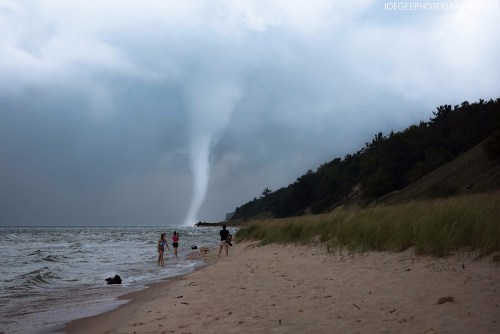
Waterspout at Muskegon State Park, photo by Joe Gee Photography

Summer of 2015 has definitely featured some wild weather. Photographer Joe Gee captured this dramatic photo last Monday at Muskegon State Park. mLive featured Joe’s waterspout photo along with an explanation of the phenomenon by meteorologist Mark Torregrossa:

This is the waterspout season on the Great Lakes, but tonight’s waterspout did not occur in the classic waterspout weather pattern.

Waterspouts form mostly due to a large temperature difference between the water surface and the air a few thousand feet above. So the classic waterspout weather pattern would have a large, cold upper level storm system moving over the Great Lakes. That storm system is still well to our west, and won’t pass through until Wednesday.

This waterspout still most likely formed due to a temperature difference between the water and the air. The cold air aloft wasn’t really detectable because it was so isolated.

The other weather feature probably contributing to the development of this waterspout was a lake breeze or even possibly an “outflow boundary” from another storm. The lake breeze blows a different wind direction into the storm and can cause additional rotation. An outflow boundary coming off another thunderstorm can do the same thing.

So this waterspout is a less threatening rotation as compared to a tornado. Usually these waterspouts dissipate before they come onshore.

This time of year is the typical time for waterspouts because of two weather features. First, the Great Lakes water temperatures are usually warmest right now. Secondly, we have to mention the word fall. Cooler, fall-like air starts to move in at this time of year. The temperature difference is largest now through September.

You can purchase a print right here and follow Joe and his work at joegeephotography.com and on Facebook.

More wild weather on Michigan in Pictures!

Sea Cave on Superior

Sea Cave by Craig

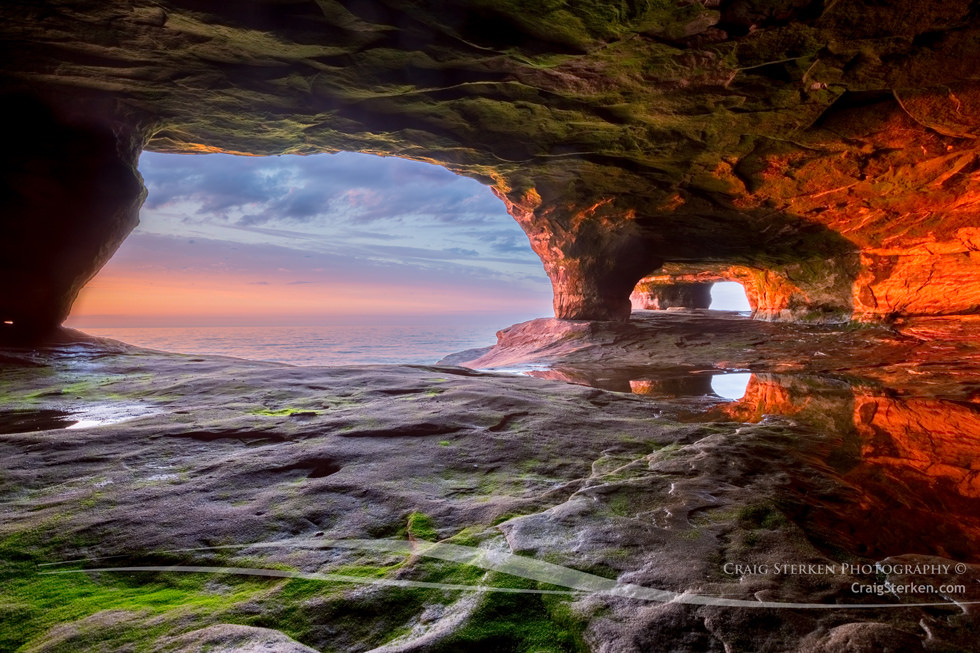
Sea Cave on Lake Superior, photo by Craig

The Pictured Rocks National Lakeshore geology page says (in part) that:

During the Nipissing “high stand,” Chapel Rock and Miners Castle as well as many less prominent features (such as perched sea caves near Little Beaver Lake Campground) were carved into the Cambrian sandstone by wave action.

Quite the whittling job by Gitche Gumee!

View Craig’s photo bigger on his Facebook page and see more jaw-dropping Lake Superior pics on Craig’s Flickr.

Enjoy your weekend everyone!