
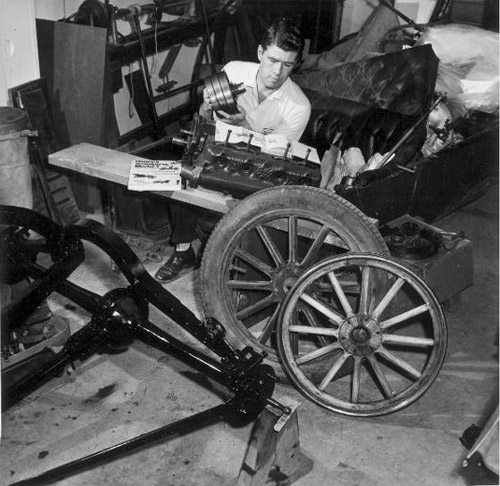
Assembling the Model T, photo courtesy Archives of Michigan
The September 2008 Image of the Month from the Archives of Michigan (click through for more pictures) says that the first production Model T was completed Sept. 27, 1908, at Ford’s Piquette Avenue plant in Detroit.
…Henry Ford wanted a car that the average American could afford. The Model T initially sold for $850. The price continued to drop as Ford’s assembly line technology improved production efficiency. According to Willis F. Dunbar and George S. May’s third revised edition of Michigan: A History of the Wolverine State, a Model T touring car cost only $360 by 1916.
The Model T also proved remarkably easy to maintain. Dunbar and May note, for example, that it “was so easy to repair that almost anyone could fix something … with a pair of pliers and a screwdriver.” Gasoline seldom proved an onerous expense, either. On page 45 of The Ford Century author Russ Bahnam notes that the Model T averaged twenty-five miles per gallon – with a gallon of gas typically costing only twenty cents!
The Ford Motor Company produced over 15 million Model Ts between 1908 and 1927. According to The Henry Ford of Dearborn, Mich., the Volkswagen Beetle is the only model with a greater production record!
For more in the Model T check out the Model T Automotive Heritage Complex, Inc. (aka the T-Plex) and the Model-T Centennial exhibit at The Henry Ford.
 Michigan in Pictures
I always loved the whole story of Henry Ford and the Model T. I first read about it when I was a kid in junior high. I always thought that’s what America is all about. Your story brought back fond memories.
I’m glad I found this site. It’s good to read other things from Michigan than just my own.
LikeLike
Henry Ford: Hitler’s First Foreign Backer
On December 20, 1922 the New York Times reported4 that automobile manufacturer Henry Ford was financing Adolph Hitler’s nationalist and anti-Semitic movements in Munich. Simultaneously, the Berlin newspaper Berliner Tageblatt appealed to the American Ambassador in Berlin to investigate and halt Henry Ford’s intervention into German domestic affairs. It was reported that Hitler’s foreign backers had furnished a “spacious headquarters” with a “host of highly paid lieutenants and officials.” Henry Ford’s portrait was prominently displayed on the walls of Hitler’s personal office:
The wall behind his desk in Hitler’s private office is decorated with a large picture of Henry Ford. In the antechamber there is a large table covered with books, nearly all of which are a translation of a book written and published by Henry Ford.5
The same New York Times report commented that the previous Sunday Hitler had reviewed,
The so-called Storming Battalion.., 1,000 young men in brand new uniforms and armed with revolvers and blackjacks, while Hitler and his henchmen drove around in two powerful brand-new autos.
The Times made a clear distinction between the German monarchist parties and Hitler’s anti-Semitic fascist party. Henry Ford, it was noted, ignored the Hohenzollern monarchists and put his money into the Hitlerite revolutionary movement.
These Ford funds were used by Hitler to foment the Bavarian rebellion. The rebellion failed, and Hitler was captured and subsequently brought to trial. In February 1923 at the trial, vice president Auer of the Bavarian Diet testified:
The Bavarian Diet has long had the information that the Hitler movement was partly financed by an American anti-Semitic chief, who is Henry Ford. Mr. Ford’s interest in the Bavarian anti-Semitic movement began a year ago when one of Mr. Ford’s agents, seeking to sell tractors, came in contact with Diedrich Eichart, the notorious Pan-German. Shortly after, Herr Eichart asked Mr. Ford’s agent for financial aid. The agent returned to America and immediately Mr. Ford’s money began coming to Munich.
Herr Hitler openly boasts of Mr. Ford’s support and praises Mr. Ford as a great individualist and a great anti-Semite. A photograph of Mr. Ford hangs in Herr Hitler’s quarters, which is the center of monarchist movement.6
Hitler received a mild and comfortable prison sentence for his Bavarian revolutionary activities. The rest from more active pursuits enabled him to write Mein Kampf. Henry Ford’s book, The International Jew, earlier circulated by the Nazis, was translated by them into a dozen languages, and Hitler utilized sections of the book verbatim in writing Mein Kampf.7
We shall see later that Hitler’s backing in the late 20s and early 30s came from the chemical, steel, and electrical industry cartels, rather than directly from individual industrialists. In 1928 Henry Ford merged his German assets with those of the I.G. Farben chemical cartel. A substantial holding, 40 percent of Ford Motor A.G. of Germany, was transferred to I.G. Farben; Carl Bosch of I.G. Farben became head of Ford A.G. Motor in Germany. Simultaneously, in the United States Edsel Ford joined the board of American I.G. Farben. (See Chapter Two.)
Henry Ford Receives a Nazi Medal
A decade later, in August 1938 — after Hitler had achieved power with the aid of the cartels — Henry Ford received the Grand Cross of the German Eagle, a Nazi decoration for distinguished foreigners. The New York Times reported it was the first time the Grand Cross had been awarded in the United States and was to celebrate Henry Ford’s 75th birthday.8
The decoration raised a storm of criticism within Zionist circles in the U.S. Ford backed off to the extent of publicly meeting with Rabbi Leo Franklin of Detroit to express his sympathy for the plight of German Jews:
My acceptance of a medal from the German people [said Ford] does not, as some people seem to think, involve any sympathy on my part with naziism. Those who have known me for many years realize that anything that breeds hate is repulsive to me.9
The Nazi medal issue was picked up in a Cleveland speech by Secretary of Interior Harold Ickes. Ickes criticized both Henry Ford and Colonel Charles A. Lindbergh for accepting Nazi medals. The curious part of the Ickes speech, made at a Cleveland Zionist Society banquet, was his criticism of “wealthy Jews” and their acquisition and use of wealth:
A mistake made by a non-Jewish millionaire reflects upon him alone, but a false step made by a Jewish man of wealth reflects upon his whole race. This is harsh and unjust, but it is a fact that must be faced.10
Perhaps Ickes was tangentially referring to the roles of the Warburgs in the I.G. Farben cartel: Warburgs were on the board of I.G. Farben in the U.S. and Germany. In 1938 the Warburgs were being ejected by the Nazis from Germany. Other German Jews, such as the Oppenheim bankers, made their peace with the Nazis and were granted “honorary Aryan status.”
LikeLike
How many people from history had scandals of some sort associated with them? The story of Henry Ford’s association with Hitler should never be forgotten; but I prefer to focus on what the idea of the Model T did for America.
LikeLike