Along the Hiawatha Water Trail

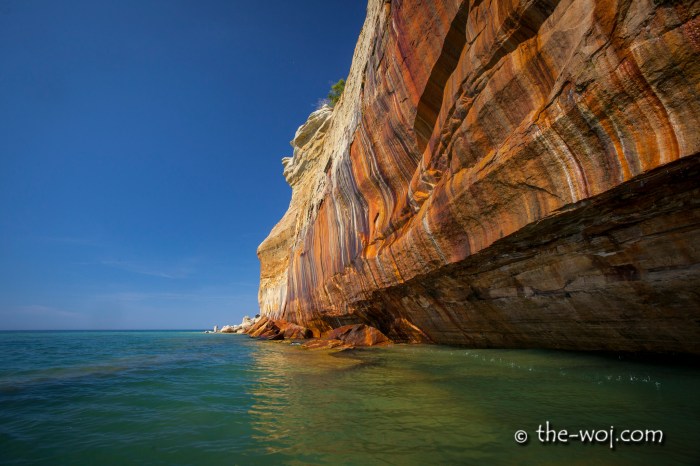
Pictured Rocks National Lakeshore from Water

Pictured Rocks National Lakeshore, photo by Paul Wojtkowski

Sorry this is a little late today and apologies to anyone who’s on Lake Superior/UP overload – today is my birthday and the Pictured Rocks National Lakeshore is my favorite place in Michigan!

One of the items on my Michigan bucket list is to paddleboard or kayak the stretch of the Hiawatha Water Trail that passes through Pictured Rocks – or the whole thing! They say:

Gitche Gumee, the Ojibwa (Native American) name for Lake Superior, has inspired all who have stood on her shore or paddled her waters. Running 120 miles from Big Bay to Grand Marais Michigan on Lake Superior’s south shore, the Hiawatha Water Trail (HWT) follows a shoreline paddled by Native Americans, Voyageurs and early European explorers. Experience some of the most scenic paddling available in the Midwest at places such as Pictured Rocks National Lakeshore, Grand Island National Recreation Area, Hiawatha National Forest and other public lands. Stopping in at the communities of Big Bay, Marquette, Munising and Grand Marais, a paddler finds places filled with history and friendly people.

View Paul’s photo background bigtacular and see more in his slideshow.
Dancing in the Air: Birding Trails & Bird Sanctuaries in Michigan

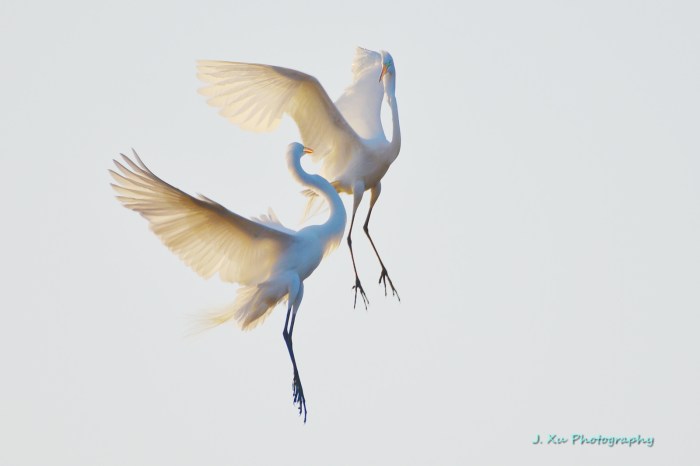
Egrets Dancing in the Air

Dancing in the Air, photo by Jiafan(John) Xu

I’m pretty sure that these are Great Egrets (Ardea alba) but would appreciate confirmation from any birders in the audience.

On the Pure Michigan blog, Mallory King of the Michigan Audubon Society writes that birding is currently the second fastest growing hobby in the United States after gardening with over 47 million people identifying as birdwatchers. She shares some great Michigan birding trails and sanctuaries to help you get going with birding:

The Superior Birding Trail: This trail covers 150 miles in the Upper Peninsula from the Seney National Wildlife Refuge to Whitefish Point; you can observe over 300 bird species here.

The Sleeping Bear Birding Trail: The SBBT West which the trial is commonly referred too, includes 123 miles from Manistee to Traverse City along the scenic M-22 highway and Lake Michigan shoreline; here over 250 bird species can be observed.

The Beaver Island Birding Trail: Located entirely on Lake Michigan’s largest island, encompasses over 100 miles of road and 12,000 acres of natural habitat; over 250 bird species can be spotted on this adventurous trail.

The Saginaw Bay Birding Trail: Also known as SBBT East, takes travelers 142 miles along the Lake Huron shoreline from Port Crescent State Park to Tawas Point State Park, the trail is home to over 200 bird species and an abundance of quaint Michigan towns.

Read on for a list of the sanctuaries and more at Pure Michigan.

John took this last month, presumably in the Keweenaw area. View his photo bigger and see more in his slideshow.

Lots more Michigan birds on Michigan in Pictures!

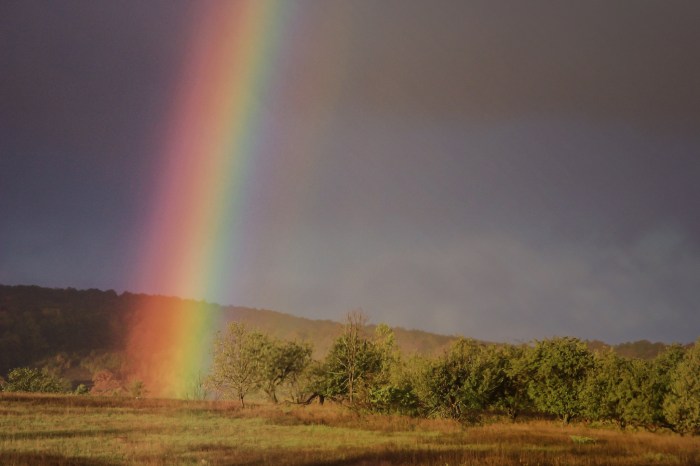
End of the Rainbow along the Breezeway

The End of the Rainbow

The End of the Rainbow, photo by T P M

Thomas says that he got to the end of the rainbow, but no Pot ‘O Gold. He took it along the Breezeway in northwest lower Michigan near East Jordan Michigan. According to the Breezeway website, which Thomas is involved with and links to from his Flickr profile:

The “Breezeway” – a rural ride along C-48 from Atwood (U.S. 31) through Ellsworth & East Jordan, and ending in Boyne Falls (U.S. 131) – boasts scenic overlooks, great motorcycle & bicycle rides, recreational amenities galore, working farms & orchards, artist galleries & studios, resale shops, lodging facilities (cottages, campgrounds, B&Bs, motels, and a resort), retail and service businesses with superb customer service, and an epicurean’s selection of dining choices along the route.

View his photo background bigtacular and see more in his Sites Along the Breezway slideshow.

Lots more about rainbows on Michigan in Pictures!

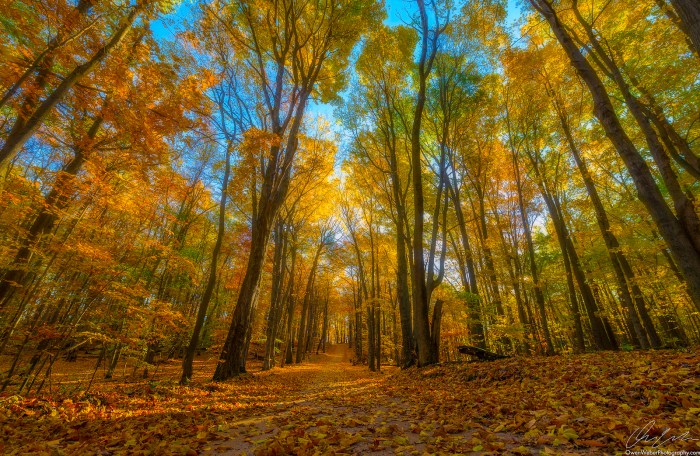
Walking into an Autumn Rainbow

Walking into an Autumn Rainbow

Walking into an Autumn Rainbow, photo by Owen Weber

Perfect title!

I feel like I didn’t get a chance to say farewell to fall, so I’ll do it this week. The first is from my backyard, on the trail that leads to the Empire Bluffs in the Sleeping Bear Dunes National Lakeshore.

View the photo bigger, see more in Owen’s Michigan slideshow. and also check out his website at owenweberphotography.com to view & purchase prints.

More fall color on Michigan in Pictures.

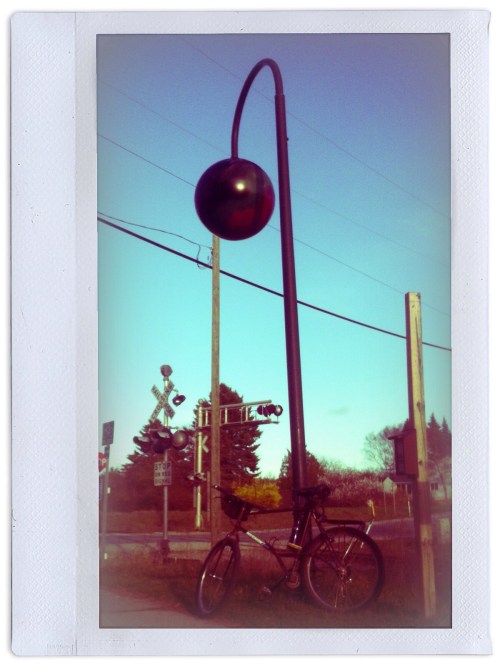
Passing Pluto

Charons Crossing aka Pluto

Charon’s Crossing, photo by Andrew McFarlane

Anyone remember Hipstamatic? This is a shot of Pluto in Dave Kirby’s cool installation of the planets along the TART trail in Traverse City (created prior to the de-planetization of Pluto). I don’t usually feature my own photos here, but I had to find something to celebrate NASA’s historic 3,000,000,000 mile journey to Pluto:

After a decade-long journey through our solar system, New Horizons made its closest approach to Pluto Tuesday, about 7,750 miles above the surface — roughly the same distance from New York to Mumbai, India – making it the first-ever space mission to explore a world so far from Earth.

“I’m delighted at this latest accomplishment by NASA, another first that demonstrates once again how the United States leads the world in space,” said John Holdren, assistant to the President for Science and Technology and director of the White House Office of Science and Technology Policy. “New Horizons is the latest in a long line of scientific accomplishments at NASA, including multiple missions orbiting and exploring the surface of Mars in advance of human visits still to come; the remarkable Kepler mission to identify Earth-like planets around stars other than our own; and the DSCOVR satellite that soon will be beaming back images of the whole Earth in near real-time from a vantage point a million miles away. As New Horizons completes its flyby of Pluto and continues deeper into the Kuiper Belt, NASA’s multifaceted journey of discovery continues.”

Read on for more and definitely check out the New Horizons Mission at NASA for lots more about our mission to explore Pluto, its moons and the Kuiper Belt at the furthest reaches of our solar system.

More science on Michigan in Pictures.

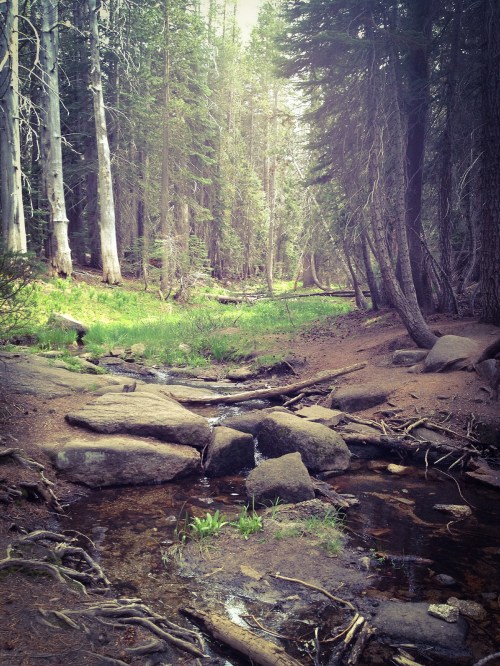
Welcome to May

Untitled

Untitled, photo by Amy Holley

Hope your May brings you promise and new growth.

Amy took this photo on May 1st last year. View it background big and see more wide-ranging goodness in her Outdoors slideshow.

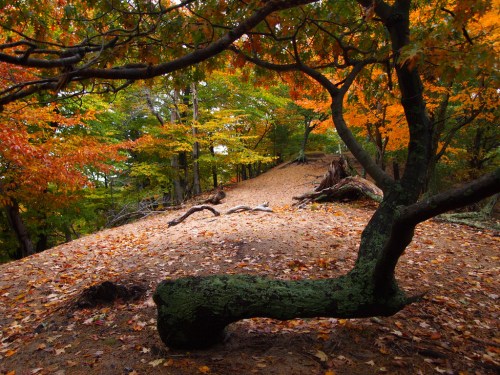
Fall on the Ludington State Park Ridge Trail

Ludington State Park Ridge Trail

Ludington State Park, Ridge Trail, photo by otisourcat

If it seems to you that fall colors are more erratic this year than usual, it’s not all in your head! The Great Lakes Echo feature by Juliana Moxley titled Last winter’s cold legacy: Fall colors slower to peak explains (in part) that last winter’s extreme cold is the culprit:

The harsh 2014 winter is partly to blame, said Bert Cregg, a professor in the department of horticulture at Michigan State University.

We are still having a good fall color season in Michigan, but we are likely to see some trees in full color while others are just beginning to turn, he said.

“As you’ll recall, last winter was extremely cold — one of the coldest winters on record,” Cregg said. “The winter stress delayed leaf-out for many trees, and then the tree’s timing was further delayed by a cold rather than normal spring.”

A warming climate can also affect fall color, said Howard Neufeld, a professor in the department of biology at Appalachian State University in North Carolina. Higher temperatures, altered timing and/or amounts of precipitation, changes in humidity, changes in cloud cover, increases in the length of the growing season and higher levels of nitrogen inputs in the ecosystem can all affect fall color variance.

“Increased precipitation means that light levels are most likely lower, and trees will do less photosynthesis,” Neufeld said. “With less photosynthesis, there are fewer sugars in the leaves. Warmer temperatures mean higher respiration rates, and more sugars will be metabolized.”

You can read on for lots more including an explanation of the scientific processes that impact color change.

The photo above by otisourcat shows that patchy color well. See it bigger and see more in their slideshow. More about the trail and park in the Ludington State Park guide.

More Michigan trails and more science on Michigan in Pictures!

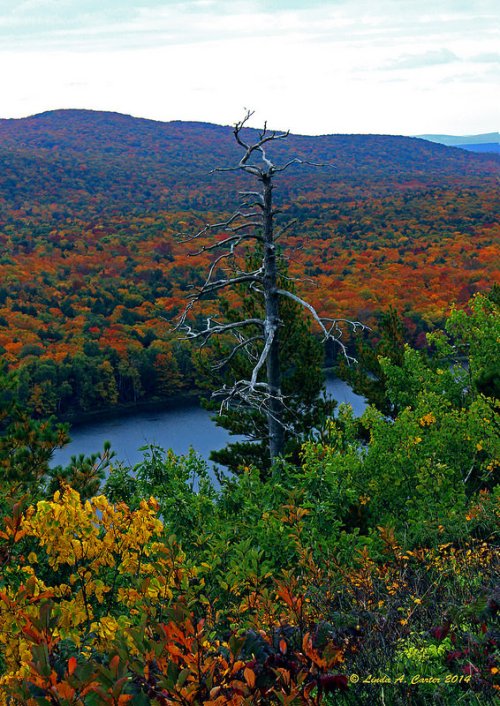
Lake of the Clouds from the Escarpment Trail

Lake of the Clouds from the Escarpment Trail, Porcupine Mountains

Lake of the Clouds from the Escarpment Trail, Porcupine Mountains, photo by Linda Carter

Linda writes that this photo is taken about 400 feet above Lake of the Clouds on the Escarpment Trail, which starts at Lake of the Clouds Overlook. She says that if you go the whole loop it’s 8 miles, but 2 or 3 miles along the trail you get the most beautiful views of the Lake.

Agreed!

View her photo bigger and see more in her Porkies slideshow.

There’s at the Porcupine Mountain State Park website including a map of the Escarpment Trail & Lake of the Clouds area and more Lake of the Clouds on Michigan in Pictures!