TBT: Columns of Ice at the Eben Ice Cave

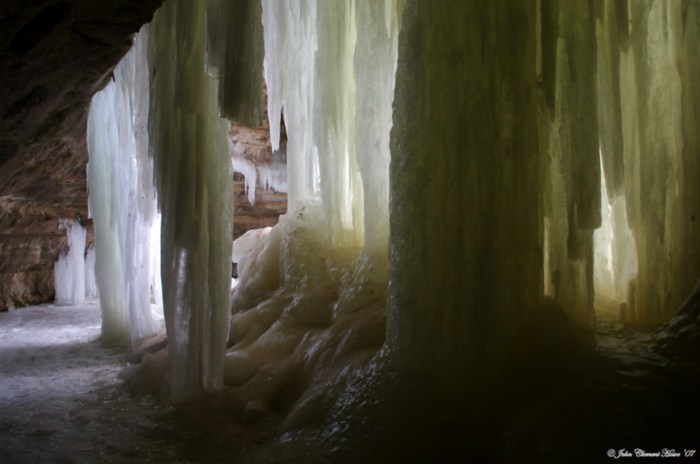
Eben Ice Caves March 19, 2007

Columns of Ice, Eben Ice Cave, photo by John Clement Howe.

EDITOR’S NOTE: With the rise of coronavirus, it seems to me that we could all use a little reconnection with our lovely state of Michigan, so I’m going to try to dig out some old photos and share some new ones to help keep you close to Mama Michigan as you socially distance!

This photo originally appeared March 20, 2007 and is one of a nice set titled At the Ice Cave of Eben taken in March of 2007 at the Eben Ice Caves in the Upper Peninsula near Munising. My friend Dr. John Anderton of the Northern Michigan University Department of Geography who has since passed away explained their formation:

The Eben Ices Caves are located just a few miles north of the little town of Eben, within the Rock River Canyon Wilderness Area (RRCW). The RRCW, which became a Wilderness in 1987 as a part of the Michigan Wilderness Act, is located approximately 15 miles west of the town of Munising, MI, within the Munising Ranger District of the Hiawatha National Forest. It comprises 4,460 acres and contains outstanding natural features including Rock River, Silver Creek and Ginpole Lake. Within its interior there are two short user-developed trails (totaling about 1.75 miles) leading to Rock River Falls and the Eben Ice Caves. An estimated 1,700 people visit the area annually (USFS records) …

The Ice Caves are not true caves at all. They consist of walls or vertical sheets of ice that form across the face of overhanging rock outcrops. In the summer, small unimpressive waterfalls and groundwater seeps may found along the overhangs. In the winter, however, the water hits the cold air, drips downward under the influence of gravity and freezes, creating spectacular ice caves. Each winter they look a little different, but typically there are openings in the ice that allow you to walk behind the ice walls.

The rock overhangs, where the ice caves form, consist of outcrops of Munising Formation (Cambrian) with a capstone of AuTrain Formation (Ordovician). The outcrops are found along the south side of the valley of Silver Creek, which is part of a network of secondary glacial drainage channels that formed during the Marquette Advance (about 10,000 years ago). Theses secondary drainage channels flowed easterly into the AuTrain-Whitefish Channel, a primary glacial meltwater channel that flowed south to the Lake Michigan basin. Groundwater naturally seeps from these rocks, providing the water necessary to form the ice caves in the winter.

For directions and more info, check out  Munising Ice Climbing from Travel Marquette!
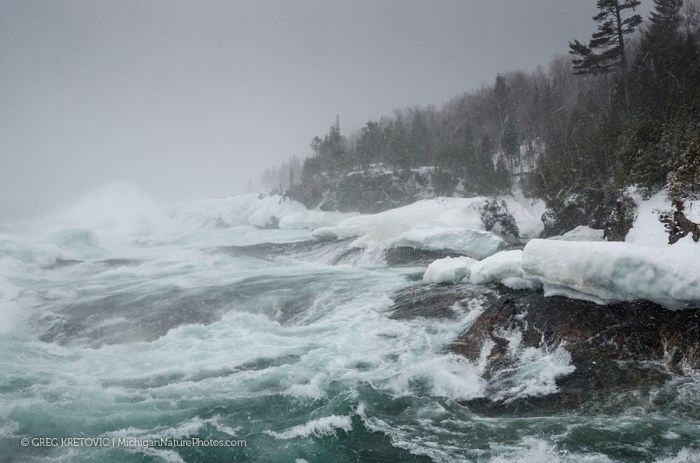
#TBT Spring Storm on Superior

Spring Storm on Superior, photo by Greg Kretovic

Here’s a great Throwback Thursday of big waves on Lake Superior back on Friday, April 19 of 2013 at the Black Rocks in Marquette’s Presque Isle Park.

Lots more of Greg’s Lake Superior photos right here and more Lake Superior pics on Michigan in Pictures too!

#TBT Miners Castle Loses a Turret

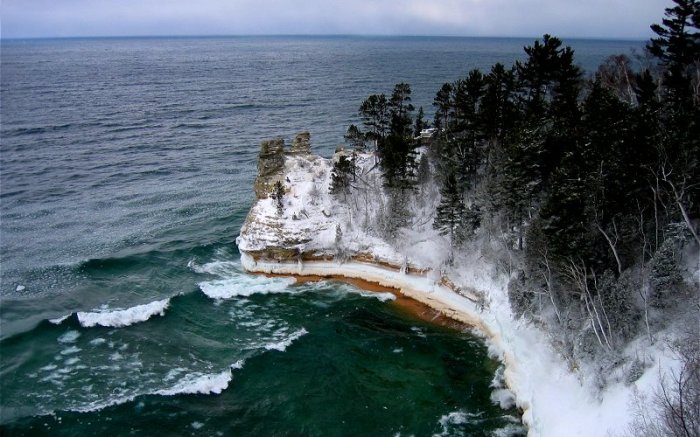
Freezing, photo by Lars Jensen

Here’s a throwback Thursday post with an article originally published April 14, 2006 on Absolute Michigan…

The Pictured Rocks National Lakeshore reports that one of the two turrets on Miner’s Castle is no more:

On Thursday morning, April 13, 2006, the northeast turret of Miners Castle collapsed. One turret remains on Miners Castle, the best-known feature of Pictured Rocks National Lakeshore. The collapse was reported via cell phone by fisherman in the area, according to chief ranger Larry Hach.Most of the rock fell north and into Lake Superior, and there were no injuries. The lower overlook platform near Miners Castle appears to be unaffected.

While the rockfall at Miners Castle on April 13 was startling, such events are not rare along the Pictured Rocks escarpment. At least five major falls have occurred over the past dozen years: 1) two different portions of Grand Portal Point, 2) the eastern side of Indian Head just east of Grand Portal Point, 3) Miners Falls just below the (now modified) viewing platform, and 4) beneath the lip of Munising Falls (along the former trail that went behind the cascade).

All the rockfalls involved the same rock unit, the Miners Castle Member of the Munising Formation. Rock units are named for places where they were first technically described. The Miners Castle Member consists of crumbly cross-bedded sandstone that is poorly cemented by secondary quartz, according to U.S. Geological Survey Research Ecologist Walter Loope.

More from Lars in his Michigan album.

#TBT: Beating the Winter Blues

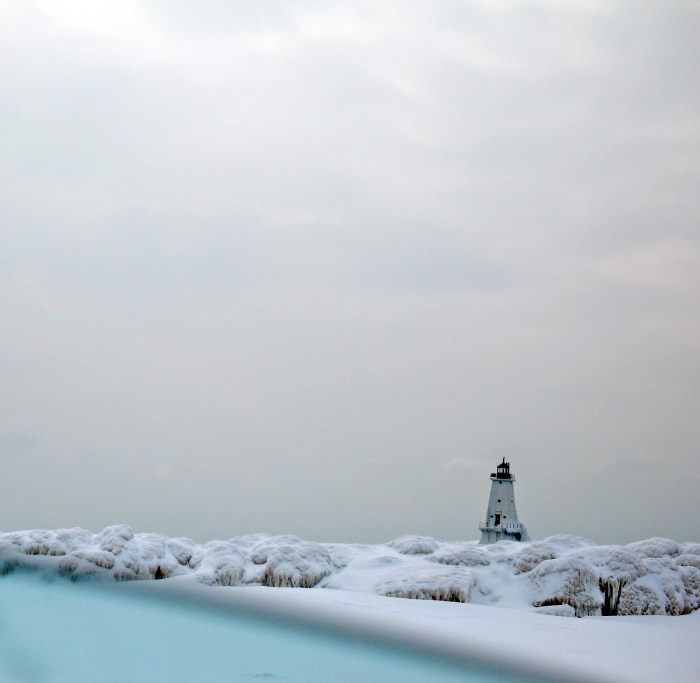
Winter Blues by simply, Diann.

If you’ve followed Michigan in Pictures for a long time, you’ll recognize this photo of the Ludington North Breakwater Light from 10 years ago. I love the photo so much that I thought I’d bring it back for an encore.

If you click the link above, you can read about the lighthouse, and if you head over to The Atlantic, you can learn about how Scandinavian countries are combatting seasonal affective disorder (SAD):

First described in the 1980s, the syndrome is characterized by recurrent depressions that occur annually at the same time each year. Most psychiatrists regard SAD as being a subclass of generalized depression or, in a smaller proportion of cases, bipolar disorder.

Seasonality is reported by approximately 10 to 20 percent of people with depression and 15 to 22 percent of those with bipolar disorder. “People often don’t realize that there is a continuum between the winter blues—which is a milder form of feeling down, [sleepier and less energetic]—and when this is combined with a major depression,” says Anna Wirz-Justice, an emeritus professor of psychiatric neurobiology at the Center for Chronobiology in Basel, Switzerland. Even healthy people who have no seasonal problems seem to experience this low-amplitude change over the year, with worse mood and energy during autumn and winter and an improvement in spring and summer, she says.

Why should darker months trigger this tiredness and low mood in so many people? There are several theories, none of them definitive, but most relate to the circadian clock—the roughly 24-hour oscillation in our behavior and biology that influences when we feel hungry, sleepy or active. This is no surprise given that the symptoms of the winter blues seem to be associated with shortening days and longer nights, and that bright light seems to have an anti-depressive effect. One idea is that some people’s eyes are less sensitive to light, so once light levels fall below a certain threshold, they struggle to synchronize their circadian clock with the outside world. Another is that some people produce more of a hormone called melatonin during winter than in summer—just like certain other mammals that show strong seasonal patterns in their behavior.

Read on for some of their solutions – maybe you’ll find some ideas if you suffer from SAD. I will say that I’ve found regular hikes and walks during the daylight hours in wintertime are key!!

Diann writes What I’m really wondering is whether or not its a good idea to edit out the blue shadows that often show up in winter shots when the sun is behind the camera. She offers this shot for comparison and discussion. She also has a bunch more photos of Ludington’s lighthouse.

#TBT with the Oldest Ship on the Great Lakes

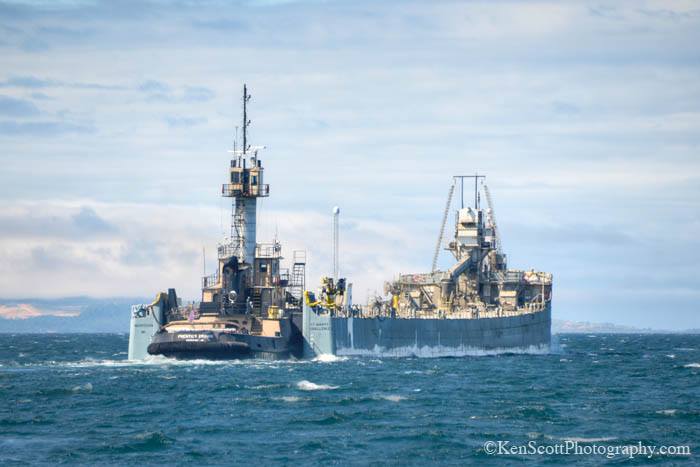
Lake Michigan … barge pushing, photo by Ken Scott Photography

Here’s a shot of a familiar vessel, the St. Marys Challenger. As this article on the conversion of the Challenger says, eventually, age catches up with you:

St. Marys Challenger lived up to its name by defying that assertion longer than its counterparts. But after 107 years, the laker was taken out of service in November 2013 to be converted to a barge. Built in 1906, Challenger was the oldest operating freighter on the Great Lakes.

The decision to convert the 551-foot cement carrier followed a series of upgrades spanning several decades, including extensive hull rebuilding, installation of a self-unloading cargo system and a myriad of other structural upgrades. In the end, the owner was left with a Skinner Marine Uniflow four-cylinder reciprocating steam engine burning heavy fuel oil, outdated DC electric and an aged mechanical propulsion system that made operating the boat an ever-increasing expense.

…Port City Marine, based in Muskegon, Mich., considered its alternatives, including retrofitting Challenger with a diesel engine. Not only would that have cost about $20 million — nearly double the barge conversion project — but it would have saddled the company with ongoing expenses. And while a crew of 25 was needed to operate Challenger, the articulated tug-barge (ATB) can operate with 11.

Read on for lots more!

View Ken’s photo bigger on Facebook, follow Ken Scott Photography on Facebook and visit kenscottphotography.com to view & purchase photos!

#TBT Happy 100th Birthday to the Michigan State Police

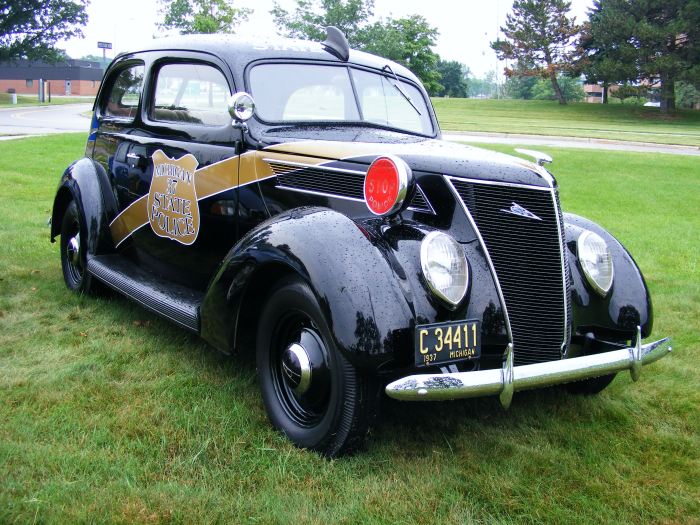
State of Michigan State Police, photo by glory be me


A belated happy 100th birthday to the Michigan State police, who are 100 years and a day old today:

Since April 19, 1917, the Michigan State Police has proudly served the citizens of Michigan. From a cavalry of 300 men to a full-service police agency of more than 2,900 members, the Michigan State Police has proven itself as a world-class leader in law enforcement.

The Michigan Department of State Police began as a temporary, wartime emergency force for the purpose of domestic security during World War I. On April 19, 1917, Governor Albert Sleeper created the Michigan State Troops Permanent Force, (also known as the Michigan State Constabulary). With Colonel Roy C. Vandercook as the first commanding officer, this new force consisted of five Troops of mounted, dismounted and motorized units, totaling 300 men. On March 26, 1919, Public Act 26 reorganized the Constabulary as the permanent, peace-time Michigan State Police.

Michigan adopted a new Constitution in 1963, authorizing up to 20 departments. Public Act 380 of 1965 reorganized the Michigan Department of State Police as one of these departments. The Director holds the rank of Colonel and is appointed by the Governor.

Today, the Michigan State Police consists of a modern-day force of law enforcement professionals, using the latest up-to-date training and technology to protect the citizens of Michigan. What was once a cavalry of 300 men now has evolved into one of the leading police agencies of the United States.

View the photo of what I believe is a 1937 Ford Model 74 patrol car background big and see more in glory be me’s Untitled Set slideshow.

More #TBT (Throwback Thursdays) on Michigan in Pictures.

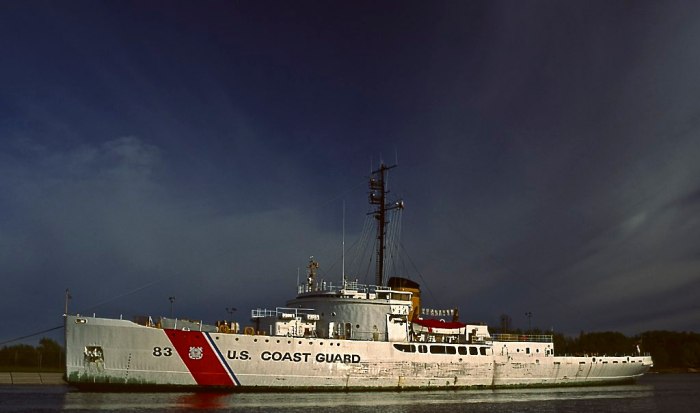
#TBT: Shining in Cheyboygan with the Coast Guard Cutter Mackinaw

USCG Mackinaw, Cheybogan

Shining in Cheyboygan, photo by Bill Johnson

Here’s a neat “Throwback Thursday” (TBT), a photo of the United States Coast Guard Cutter Mackinaw on May 25, 1993 when she was still in service. Bill writes:

This is the original Coast Guard Cutter Mackinaw, WAGB 83, wearing its silvery whitish colors, in its home port of Cheboygan, MI. This beauty was built in 1944 to aid the war effort by keeping the Great Lakes open during the winter. The cutter was intentionally built too wide to get through the Saint Lawrence Seaway in order to keep her in the Great Lakes. She was moved to Mackinaw in June of 2006, decommissioned, and turned into a museum at the Chief Wawatam docks. Today, she wears the red hull that she was retired in.

You can see the current look of the Icebreaker Mackinaw and get information about visiting on the Icebreaker Mackinaw Maritime Museum website.

View Bill’s photo background big and see more in his Boats, Ships, and Stuff That Floats slideshow.

More Throwback Thursdays on Michigan in Pictures.

#TBT Jungle Love in Prehistoric Michigan

Jungle Love, photo by Matt Stangis

The Rapidian has a feature on prehistoric Michigan’s tropical seas, jungles and inhabitants that’s a great read and the ultimate Throwback Thursday! Here’s a small slice:

After about 60 million years, warm, shallow seas came down again from the Arctic and covered Michigan during the Silurian period. At this time the land would have been in a subtropical climate that gave rise to large coral reefs across the state. Fossil findings show that the largest and oldest reef extends through the center of the Upper Peninsula. A species of coral that lived during this time period would eventually become fossilized and become what we refer to as Petoskey Stones.

The seas retreated over time, leaving a desert scattered with fossilized remains that eventually formed the limestone that is located over one hundred and twenty feet below us today. The sections of this exposed limestone is what created the Grand Rapid’s famous rapids. Much of the salt deposits that were left from retreating seas of this period are still mined in Detroit.

The Devonian period around 400 million years ago saw the rise of vertebrates in Michigan. North America was covered with up to 40 percent of water. There were a great number of fish swarming the salt and fresh water seas. The Ganoid species were in a crude state of evolution. Many of them had armor plating with two of their relatives, the Gar Pike and the Sturgeon, still existing in Great Lakes today. Primitive plants, such as the seed fern, developed from marine algae. On land the Tiktaalik, the link between finned fish and early amphibians, started to use its muscular fins to drag itself around land.

…At the end of the Carboniferous Period, known as the Pennsylvanian subperiod, Michigan was a semi-tropical jungle featuring primitive vegetation. Ferns without bark, some of which bloomed scentless unattractive flowers, grew to almost 100 feet. Millions of generations of trees grew and died in the jungle. The trees that fell in the swampy parts of the jungle were covered up by water and soil that became rock over time. The forces of time and pressure on these trees would eventually see this prehistoric jungle become the coal basin that sits underneath a large area of the U.S. including the upper northeast part of Kent county.

In the sky above one foot long dragon flies swarmed in droves on the ground and cockroaches the size of a man’s palm crawled around. Reptiles started to appear, evolving from amphibians, not dependent on water to lay their amniotic eggs. Towards the end of this period the rain forests gave way to deserts which decreased the amphibian populations and caused an evolutionary shift in reptiles.

Definitely click through for more – there are some cool links as well!

I’m pretty sure Matt took this photo at ArtPrize in 2013. View it background bigilicious and see more in his slideshow.

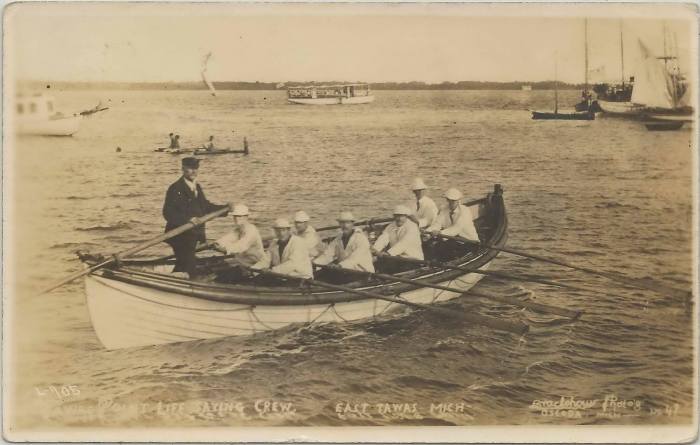
#TBT Tawas Point US Lighthouse Service Crew Training

Tawas Point Lighthouse USLSS Life Saving Service Crew Training on Tawas Bay

Tawas Point Lighthouse Crew Training, photo by UpNorth Memories

The U.S. Life-Saving Service Heritage Association has an excellent history of the U.S. Life-Saving Service that says in part:

In 1878 the growing network of lifesaving stations was finally organized as a separate agency of the Treasury Department and named the U.S. Life-Saving Service. Sumner I. Kimball was chosen as the General Superintendent of the Service. Kimball held tight reign over the Service and, in fact, remained the only General Superintendent of the organization. The law which created the U.S. Coast Guard in 1915, also provided for the retirement of Kimball. The Service’s reputation for honest, efficient, and non-partisan administration, plus performance of duty, can be largely attributed to the efforts of this one man.

The stations of the Service fell into three broad categories: lifesaving, lifeboat, and houses of refuge. Lifesaving stations were manned by full-time crews during the period when wrecks were most likely to occur. On the East Coast this was usually from November to April, and was called the “active season.” By the turn of the century, the active season was year-round. Most stations were in isolated areas and crewmen had to be able to perform open beach launchings. That is, they were required to launch their boats from the beach into the surf. Before the turn of the century, there were very few recreational boaters and most assistance cases came from ships engaged in commerce.

Lifeboat stations were located at or near port cities. Here, deep water, combined with piers and other waterfront structures, allowed the launching of heavy lifeboats directly into the water by marine railways on inclined ramps. In general, lifeboat stations were located on the Great Lakes, but some lifesaving stations were situated in the more isolated areas of the lakes. The active season on the Great Lakes stretched from April to December.

…The U.S. Life-Saving Service had two means of rescuing people on board ships stranded near shore: by boat and by a strong line stretched from the beach to the wrecked vessel. The Service’s boats were either a 700 to 1,000 pound, self-bailing, self-righting surfboat pulled by six surfmen with twelve to eighteen foot oars, or a two to four ton lifeboat. The surfboat could be pulled on a cart by crewmen, or horses, to a site near a wreck and then launched into the surf. The lifeboat, following a design originated in England, could be fitted with sails for work further offshore and was used in very heavy weather. Some crews, at first, viewed the lifeboat with skepticism because of its great weight and bulk. The skepticism soon changed and crews began to regard it as “something almost supernatural,” for it enabled them to provide assistance “when the most powerful tugs and steam-craft refused to go out of the harbor. …”

Terry Pepper’s Seeing the Light has a bunch of information and photos of the Tawas Point Lighthouse.

This photo shows the crew of the Tawas Point Lighthouse participating in USLSS crew training on Tawas Bay. Check it out bigger and join the Northern Michigan Photo Postcards – Our History and Heritage group for more great old photos from Don and others.

More history from Michigan in Pictures.

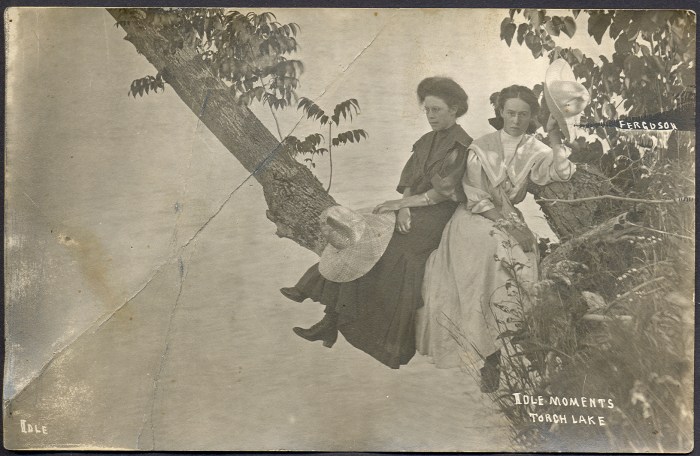
#TBT Idle Moments on Torch Lake

Idle Moments on Torch Lake

Idle Moments – Torch Lake, photo courtesy Don Harrison/UpNorth Memories

I think the woman on the right is really glad that cell phones hadn’t been invented yet.

View Don’s photo background big, check out his slideshow, and definitely follow UpNorth Memories on Facebook!

More Throwback Thursdays and more funny business on Michigan in Pictures!