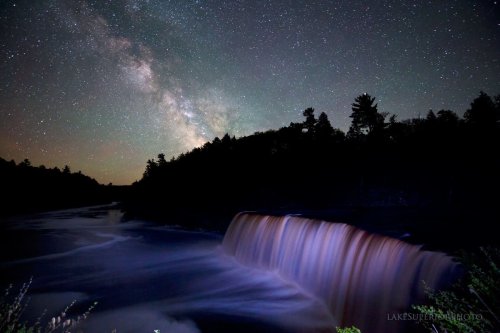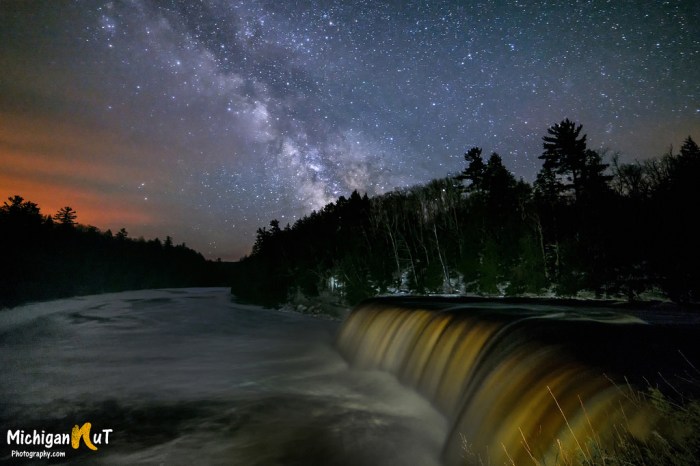
Waterfall Wednesday: Milky Way over Tahquamenon Falls

Milky Way over Tahquamenon Falls

Milky Way over Tahquamenon Falls, photo by John McCormick / Michigan Nut Photography

The Tahquamenon Falls State Park says:

Tahquamenon Falls State Park encompasses close to 50,000 acres stretching over 13 miles. Most of this is undeveloped woodland without roads, buildings or power lines. The centerpiece of the park, and the very reason for its existence, is the Tahquamenon River with its waterfalls. The Upper Falls is one the largest waterfalls east of the Mississippi. It has a drop of nearly 50 feet and is more than 200 feet across. A maximum flow of more than 50,000 gallons of water per second has been recorded cascading over these falls.

…This is the land of Longfellow’s Hiawatha – “by the rushing Tahquamenaw” Hiawatha built his canoe. Long before the white man set eyes on the river, the abundance of fish in its waters and animals along its shores attracted the Ojibwa Indians, who camped, farmed, fished and trapped along its banks. In the late 1800’s came the lumber barons and the river carried their logs by the millions to the mills. Lumberjacks, who harvested the tall timber, were among the first permanent white settlers in the area.

Rising from springs north of McMillan, the Tahquamenon River drains the watershed of an area of more than 790 square miles. From its source, it meanders 94 miles before emptying into Whitefish Bay. The amber color of the water is caused by tannins leached from the Cedar, Spruce and Hemlock in the swamps drained by the river. The extremely soft water churned by the action of the falls causes the large amounts of foam, which has been the trademark of the Tahquamenon since the days of the voyager.

Click through for maps and more.

View John’s photo bigger, follow him at Michigan Nut Photography on Facebook, and settle back for his Michigan Waterfalls slideshow.

Lots more Tahquamenon Falls on Michigan in Pictures.
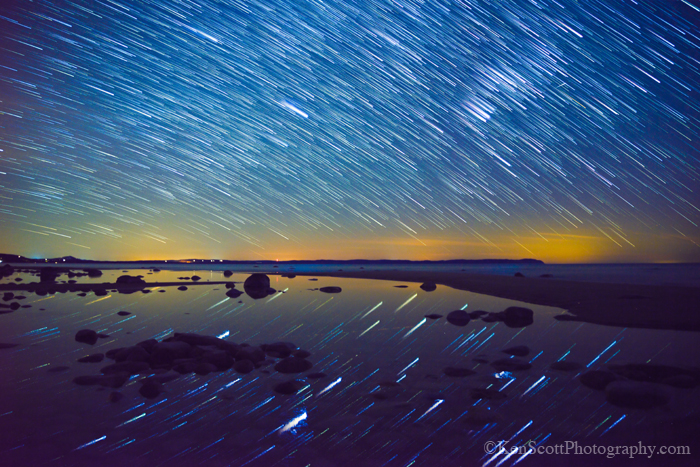
Check ignition, and may God’s love be with you

photo date/id to order a print: click the pic to view on black
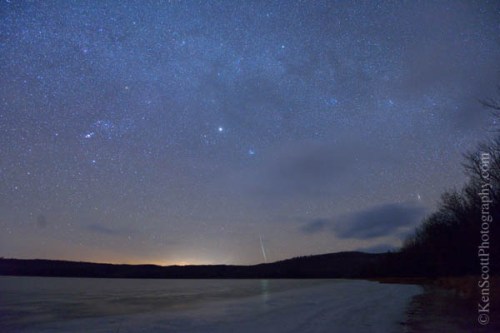
Good Harbor Bay starry night, photo by Ken Scott Photography

“If you’re ever sad, just remember the world is 4.543 billion years old and you somehow managed to exist at the same time as David Bowie.”
~Dean Podestá

When I was a kid my parents had a kicking stereo, and the album we decided was the most rocking was Space Oddity. We would turn the title track up to 11, turning the windows of the old farmhouse into a crazy bass reverberator and dance around and sing. Probably because of the science fiction/fantasy feel of the album, Bowie was my first rock idol, and he’s always remained a favorite for giving voice to the struggle of fitting into a world that doesn’t always fit you and the need reinvent yourself again and again.

View Ken’s photo bigger, see more in his massive Skies Above slideshow and be sure to follow him on Facebook.

Now here’s a video of Space Oddity … I find I don’t care that he’s probably lip synching.

Dipping into October … and October’s Full Moon

Dipping into October

Dipping into October, photo by Aaron Springer

Keith’s Moon Names page says that the October full moon was known as the Hunter’s Moon by Colonial Americans, the Harvest Moon by the Cherokee and ancient Celts and the Blood Moon in Medieval England.

The Farmer’s Almanac says that October’s moon is full on the 27th at 8:05 AM and adds:

Many moons ago, Native Americans named this bright moon for obvious reasons. The leaves are falling from trees, the deer are fattened, and it’s time to begin storing up meat for the long winter ahead. Because the fields were traditionally reaped in late September or early October, hunters could easily see fox and other animals that come out to glean from the fallen grains. Probably because of the threat of winter looming close, the Hunter’s Moon is generally accorded with special honor, historically serving as an important feast day in both Western Europe and among many Native American tribes.

View Aaron’s photo bigger and see more in his slideshow.

Lots more moon lore on Michigan in Pictures!

Storming the Harbors of Darkness: DH Day Barn Edition

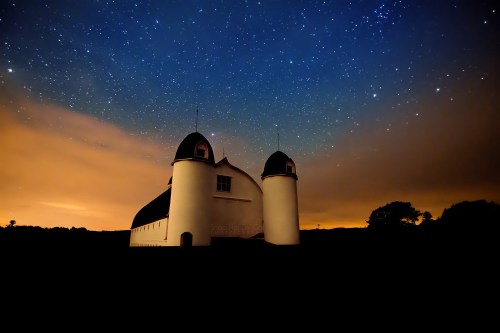
Night and DH Day Barn

Night and DH Day Barn, photo by Heather Higham

This shot of the iconic D.H. Day barn in the Sleeping Bear Dunes National Lakeshore from a couple of days ago is beautiful, dramatic and … wrong. While the orange looks cool against the deep blue, it’s a very visible reminder that our night skies suffer from serious light pollution, even in our most preserved spaces. I encourage everyone to learn about night-sky friendly outdoor lighting options and to advocate in your community for better lighting decisions.

On a less preachy note, if you’re in the Traverse City/Sleeping Bear area tonight, the National Lakeshore is hosting the latest in their “Find Your Park After Dark” night sky events from 9-11 PM at the Pierce Stocking Scenic Drive #3 Overlook. They write:

All sky programs offered by the National Lakeshore are free. Participants need only purchase the Park Entrance Pass or have an Annual Pass displayed in their vehicle to join in the fun. Programs will be cancelled if the sky is not visible due to weather conditions. The decision to cancel is usually made three hours in advance. Please call 231-326-4700, ext. 5005, for a voicemail message with the decision. For all evening astronomy events, bring a flashlight for the walk back to your car and bug spray, if needed. Park rangers and Grand Traverse Astronomical Society (GTAS) staff will wear red glow bracelets at the events.

Each special event takes place at a different location throughout the National Lakeshore to take advantage of strategic viewing opportunities. You can come for star-gazing, eclipses, meteor showers, solar viewing, and storytelling. These events are the perfect opportunity to Find Your Park in the stars. Starry night skies and natural darkness are important components of the special places the National Park Service protects. National parks hold some of the last remaining harbors of darkness and provide an excellent opportunity to experience this endangered resource.

“Harbors of darkness” – what a cool turn of phrase! Head over to the National Lakeshore’s website for more about this and upcoming events.

Over at her blog, the Rapid City Recess, Heather writes about her experience shooting at night with two other photographers – I encourage you to read it.

View Heather’s photo bigger, see more in her Night Sky slideshow and definitely follow her at Snap Happy Gal on Facebook!

More night photography and more Michigan barns on Michigan in Pictures.

Milky Way, Otter Creek & Sally Ride

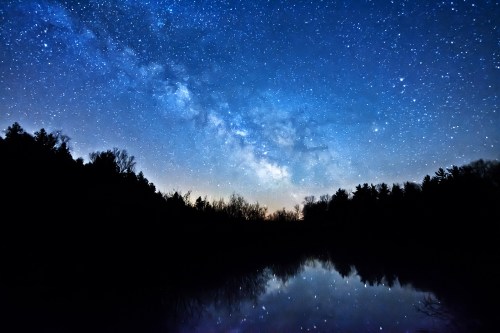
Milky Otter

Milky Otter, photo by Heather Higham

The stars don’t look bigger, but they do look brighter.
~Sally Ride

Google reminded me this morning that today would have been astronaut & physicist Sally Ride’s 64th birthday. The Wikipedia entry for Sally Ride says that on June 18, 1983, she became the first American woman in space. Along with her NASA career, Ride also wrote a number of books aimed at encouraging children to study science, something I strongly believe that all of us should remember to do with the young girls & boys who look up to us.

To put a Michigan bow on this, be sure to check out the Women in Aviation and Space exhibit at the AirZoo in Portage. The exhibit honors women including astronaut Sally Ride and aviation pioneer Amelia Earhart. It includes original uniforms, a visual history mural, photo collages, a timeline and a unique mosaic, which includes each of the 1,102 WASP plus Jacqueline Cochran, founder of the Women in Aviation and Space organization.

Heather took this incredible shot at Otter Creek in the Sleeping Bear Dunes National Lakeshore. View her photo bigger and see more in her Night Sky slideshow.

PS: If you want to get your Night Sky fix at the Sleeping Bear Dunes National Lakeshore, check out their Your Park After Dark program this summer!

Geminid Meteor Showers this weekend!

Geminid Meteor ...

Geminid Meteor…, photo by Ken Scott

As you’re making plans for this weekend, consider including some offbeat nightlife. EarthSky has everything you need to know about this weekends Geminid Meteor Shower:

The peak night of the 2014 Geminid meteor shower will probably occur on the night of December 13 (morning of December 14). The night before (December 12-13) may offer a decent sprinkling of meteors as well. Geminid meteors tend to be few and far between at early evening, but intensify in number as evening deepens into late night. A last quarter moon will rise around midnight, but Geminid meteors are bright! This shower favors Earth’s Northern Hemisphere.

…In a year when moonlight doesn’t obscure the view, you can easily see 50 or more Geminid meteors per hour on the peak night. However, in 2014, the waning moon will dampen the display in the peak viewing hours. Don’t let the moonlight discourage you. A good percentage of these yellow-colored Geminid meteors are quite bright and will overcome the moonlit skies.

The moon will rise quite late on December 13 and 14, creating a window of darkness for watching the Geminid shower in the evening. Keep in mind that the moon will rise about an hour earlier on December 13 than it will on December 14. Click here for custom sunrise/set calendar. Check boxes for moonrise/set times..

Even as the moon rises, however, it will be sitting low in the east. If possible, find a hedgerow of trees, a barn or some such thing to block out the moon. Sit in a moon shadow but at the same time, find an expansive view of sky. Or simply look away from the moon.

Read on for all kinds of viewing tips and all kinds of info about about this December meteor shower including the chance of seeing an earthgrazer meteor, a slow-moving, long-lasting meteor that travels horizontally across the sky.

View Ken’s photo from December 14, 2012 bigger and see more in his massive Skies Above slideshow.

More meteors on Michigan in Pictures!

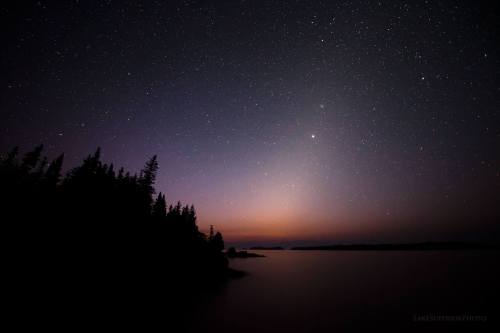
Zodiacal Light on Isle Royale

Zodiacal Light by Shawn Malone

Zodiacal Light on Isle Royale, photo by Shawn Stockman Lightseeker/Lake Superior Photo

The Earth Science Picture of the Day is pretty much my favorite photo blog. Regarding the Zodiacal Light, Rudi Dobesberger and blog curator Jim Foster wrote:

Zodiacal light is now thought to be caused by dust particles scattering sunlight in the orbits of comets. In both hemispheres it’s best observed in late winter/early spring after sunset and late summer/early fall before sunrise. However, it can be detected before astronomical twilight (morning) or after astronomical twilight (evening) at other times of the year as well, providing that the sky is quite dark.

Head over to the EPOD for more and definitely subscribe!

The photo above is from Shawn’s recent journey to Isle Royale. Follow her at Lake Superior Photo on Facebook and view and purchase many more photos – including a gallery of Isle Royale pictures –  on her website.

The Upper Peninsula Night Sky

Tahquamenon Falls by LakeSuperiorPhoto

Tahquamenon Falls, by LakeSuperiorPhoto

It’s certainly no secret that one of my favorite Michigan photographers is Shawn Stockman Malone of Lake Superior Photo. The latest national outlet to recognize her work is Huffington Post Detroit, which assembled a collection of her UP Night Sky photos in a nice feature that says (in part):

Stockman-Malone runs photography gallery LakeSuperiorPhoto in Marquette, Michigan, a bustling college and former mining town on the Lake Superior coast.

…While Stockman-Malone does monitor sun weather to try to catch views of the Northern Lights, much of her work is guided by chance — and by being ready to photograph at any time. Once, her dog was scared and woke her up when lightning struck, and she caught a shot of the Northern Lights over the storm.

“You never know what Mother Nature has up her sleeve, and just hope you catch it,” Stockman-Malone said about her night photography practice in an email to The Huffington Post. “The Milky Way moves across the sky and can be found rising and setting in different directions throughout the year, so there will always be new perspectives in new locations. Same thing goes for moonrises and moonsets. Then there’s meteor showers, conjunction of planets, appearance of comets, etc. so there’s always something new happening.”

Click through for more and lots more incredible night shots!

View this photo and more bigger at Huffington Post Detroit, purchase prints at lakesuperiorphoto.com and get your daily dose of Upper Peninsula Amazing through the Lake Superior Photo Facebook.

Ready for the Fourth

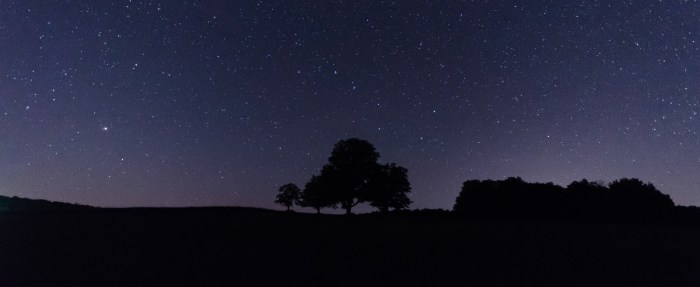
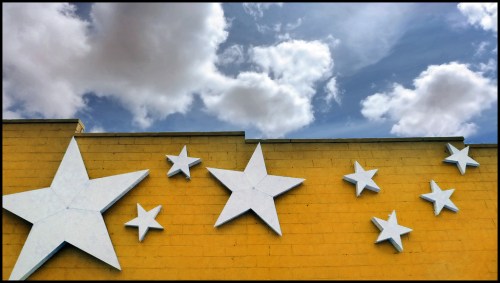
Starry Sky

Starry Sky, photo by Steve

BBQ items? Check! Fireworks plan? Check!! Wall o’ stars? Check!!! Have a happy 4th of July weekend everyone!!!!

View Steve’s photo bigger and see more in his LX7 slideshow.

PS: Check out Detroit News feature 50 fun things to do for the Fourth.

First of its kind: Camelopardalids Meteor over DH Day

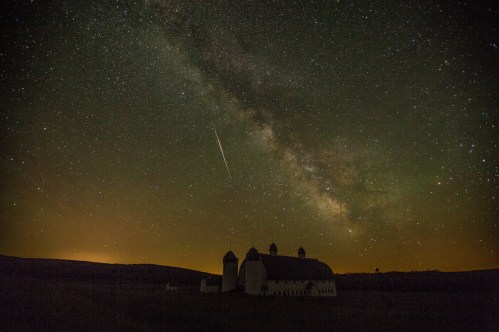
Cameleopard Meteor over DH Day Barn

DH Day at Night, photo by Rudy Malmquist

Like many, Rudy stayed up really late to see what the new May Camelopardalids meteor shower would deliver. The answer was “Not a whole lot.” One thing they say is that predictions might have been a bot off and they will put on a show tonight. You can read about the whys and wherefores on EarthSky, but I’d like to make a couple of points.

One is that (as you can see from the photo) the skies last night were jaw-droppingly clear, providing some of the most amazing star gazing in recent memory.

The second (and I think the real payoff) is that those hardy folks who stayed up or dragged themselves out of bed saw an the first act of an event that could take recur for millennia. Having a chance to see the birth of something that operates on a cosmic timescale is pretty darned cool!

View Rudy’s photo of the DH Day Barn in the Sleeping Bear Dunes National Lakeshore bigger and see more in his slideshow.

More meteors on Michigan in Pictures!