The Orionids are considered a major meteor shower based on the amount of visible meteors that can be seen racing toward inevitable doom during its active period, which runs roughly from the first week of October to the first week of November.
The show is already active and the American Meteor Society forecasts that a handful of meteors per hour may be visible over the next several days, leading up to the peak on Oct. 20 and Oct. 21, when the number could increase to 20 per hour.
The Orionids are really just bits of dust and debris left behind from famed Comet Halley on its previous trips through the inner solar system. As our planet drifts through the cloud of comet detritus each year around this time, all that cosmic gravel and grime slams into our upper atmosphere and burns up in a display we see on the ground as shooting stars and even the occasional fireball.
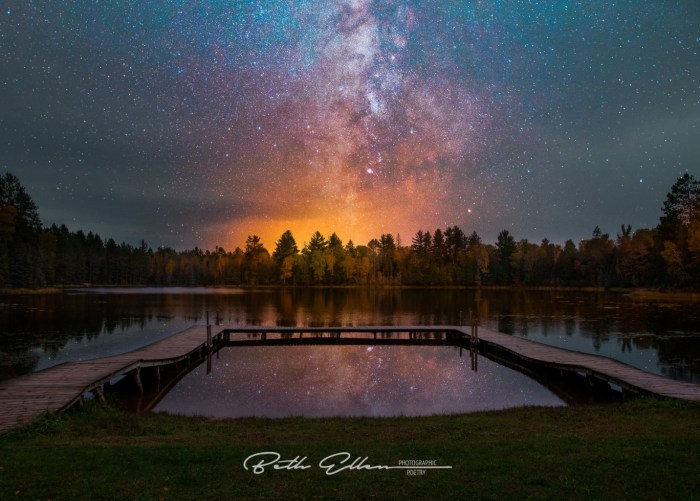
Here’s another gorgeous photo & thought from Beth. See more in her Explore gallery on Flickr!
No matter where you live worldwide, the 2020 Perseid meteor shower will probably produce the greatest number of meteors on the mornings of August 11, 12 and 13. On the peak mornings in 2020, the moon will be at or slightly past its last quarter phase, so moonlight will somewhat mar this year’s production. Still, there are some ways you can minimize the moon and optimize your chances for a good display of Perseids this year. Here are some thoughts:
The Perseids tend to be bright, and a good percentage of them should be able to overcome the moonlight. Who knows? You still might see up to 40 to 50 meteors per hour at the shower’s peak, even in the light of a bright moon. Will you see over 100 per hour, as in some years? Not likely. Still …
Try to watch after midnight but before moonrise. If fortune smiles upon you, the evening hours might offer you an earthgrazer – a looooong, slow, colorful meteor traveling horizontally across the evening sky. Earthgrazer meteors are rare but memorable. Perseid earthgrazers appear before midnight, when the radiant point of the shower is close to the horizon.
Watch in moonlight, but place yourself in the moon’s shadow.
Consider watching after the peak. People tend to focus on the peak mornings of meteor showers, and that’s entirely appropriate. But meteors in annual showers – which come from streams of debris left behind in space by comets – typically last weeks, not days. Perseid meteors have been streaking across our skies since around July 17. We’ll see Perseids for 10 days or so after the peak mornings on August 11, 12 and 13, though at considerably reduced numbers. Yet, each day as the moon wanes in the morning sky, less moonlight will obtrude on the show. Starting on or around August 17, moon-free skies reign all night long.
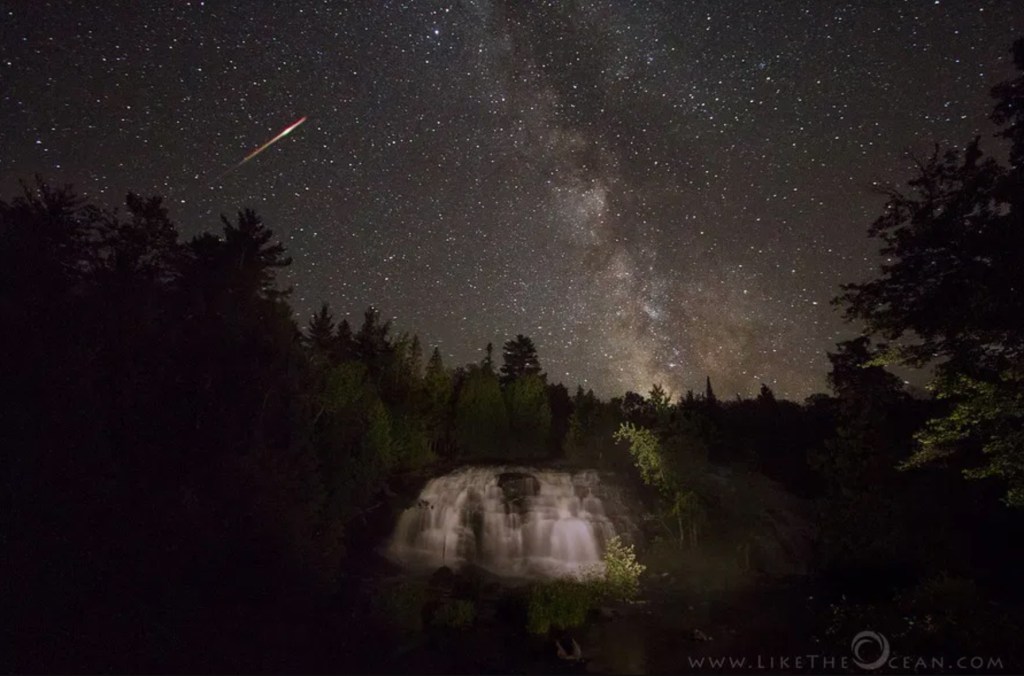
You can read about the taking of this photo & purchase a print from Sathya in Chasing the Perseids at his blog Like the Ocean & see more in his awesome Showcase album on Flickr.
May 4th is known as Star Wars Day – May the Fourth be with you – an annual celebration of one of our shared modern stories. If you’re up before dawn tomorrow, you can step out to see if you can see Eta Aquariid meteors in the east. Earthsky notes that the forecast calls for the greatest number of Eta Aquariid meteors to fall before dawn on (or near) May 5. However, this shower has a rather broad maximum, so just as many meteors may be flying on the mornings after.
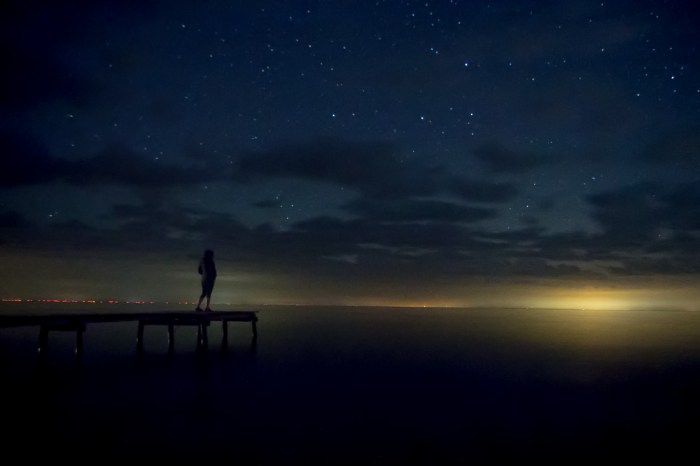
While the lights of distant Bay City across Saginaw Bay from Point Lookout make for a beautiful photo, I feel for the photographer who wishes they’d shut them off at night.
Emmet County’s International Dark Sky Park at the Headlands won the distinguished recognition of the state’s premier Pure Michigan campaign at the annual Governor’s Conference on Tourism Tuesday when they won the Pure Award for 2017. The Pure Award, which has only been awarded twice in the 10 years of the Pure Michigan campaign, recognizes best practices in stewarding and preserving Michigan’s natural, cultural, and heritage-based resources.
“This award helps us further realize our goal of safeguarding the community’s natural and direct encounter with Northern Michigan’s unique and exceptional environment, both by day and by night,” said Headlands Program Director Mary Stewart Adams.
…The Headlands International Dark Sky Park is a 600-acre park on the Straits of Mackinac, two miles west of downtown Mackinaw City, at 15675 Headlands Road. The park is free and open to the public every day. While no camping is allowed, visitors are welcome to stay overnight to observe the dark sky overhead. The Headlands became the 6th International Dark Sky Park in the U.S. and the 9th in the world in May 2011, as designated by the International Dark Sky Association (www.darksky.org), and each month free programs are held for the public.
The shower starts around the second week in December, but, in a bit of bad timing, full moon comes on the peak night (December 13-14) this year. Still, these meteors are known for being bright, so some Geminid meteors may well overcome this year’s moonlit glare. Watch on the evening of December 13 until dawn December 14. The nights before and after might be good as well. Geminid meteors tend to be few and far between at early evening, but intensify in number as evening deepens into late night.
…Your local peak will typically be centered at about 2 a.m. local time, no matter where you are on the globe. That’s because the constellation Gemini – radiant point of the shower – will reach its highest point for the night around 2 a.m. (your local time). As a general rule, the higher the constellation Gemini climbs into your sky, the more Geminid meteors you’re likely to see.
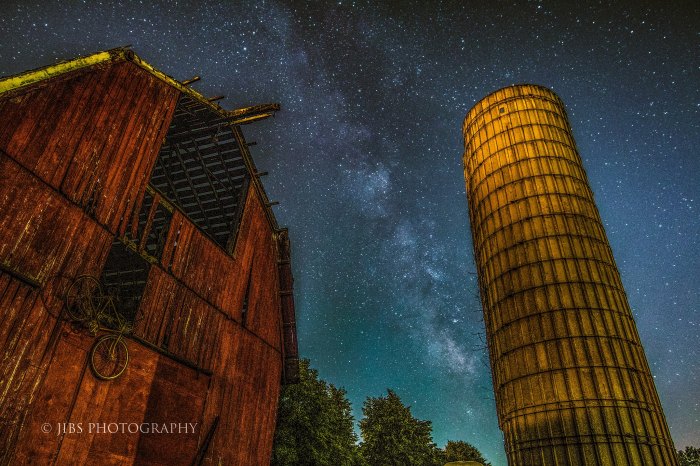
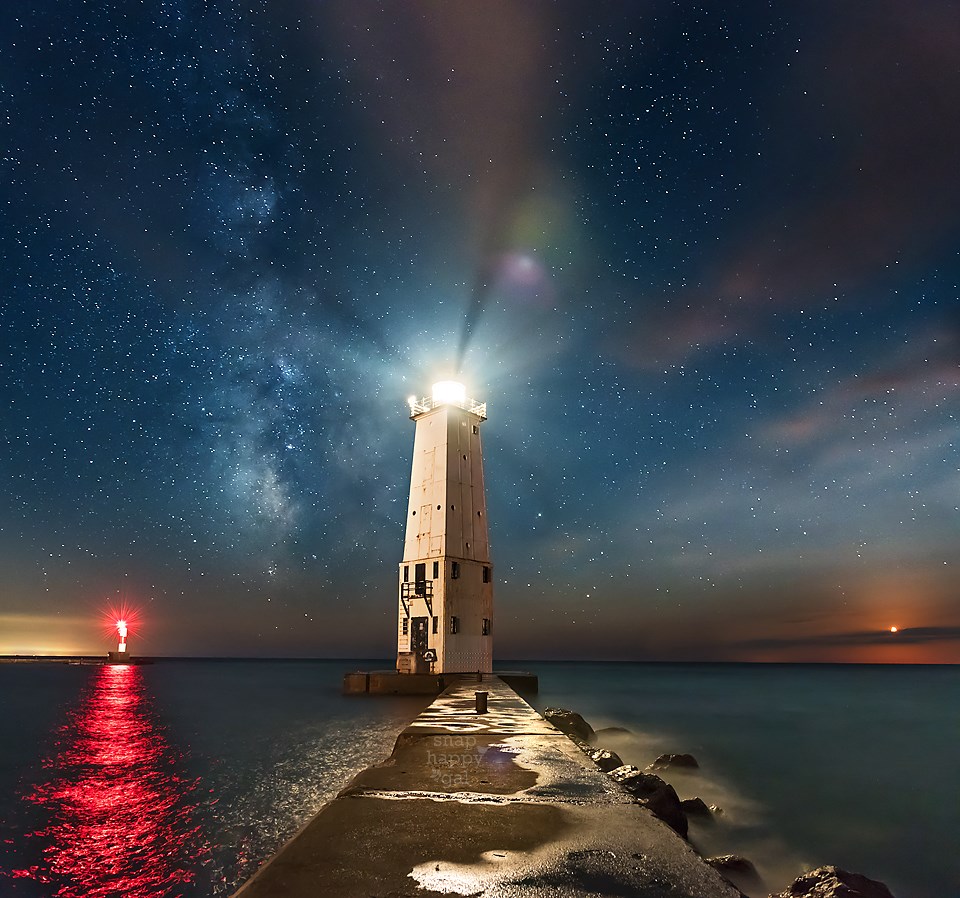
Heather took this photo in September of 2016, and there’s FOUR meteors!! View it bigger, see more in her Night Sky slideshow, and view & purchase photos at snaphappygal.com!
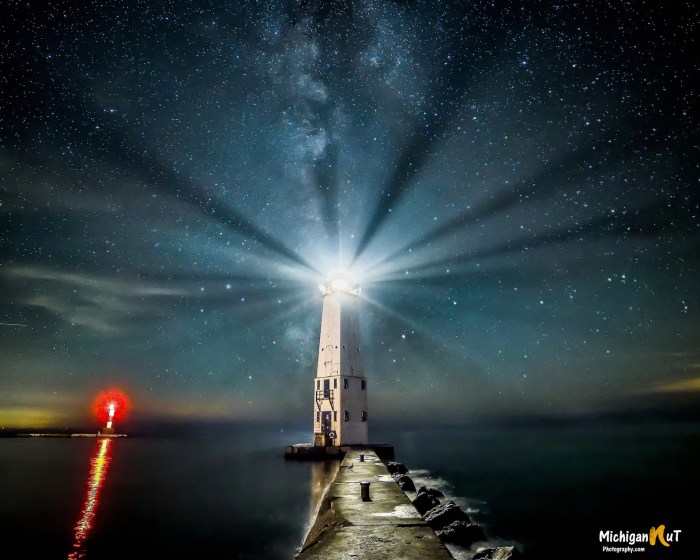
What can you say about an astonishing photo like this? Heather writes:
I went to Frankfort a couple nights ago to shoot the Milky Way at the lighthouse. As I walked out the long pier in the darkness, I passed two groups of swimmers heading home (at 11:30), and then had the entire thing to myself for over an hour. Just enough haze hung in the air to create the light rays from the lighthouse, and the waves splashed just high enough to douse the outside edge of the wall. The setting crescent moon balancing out the south breakwall light was a nice bonus.
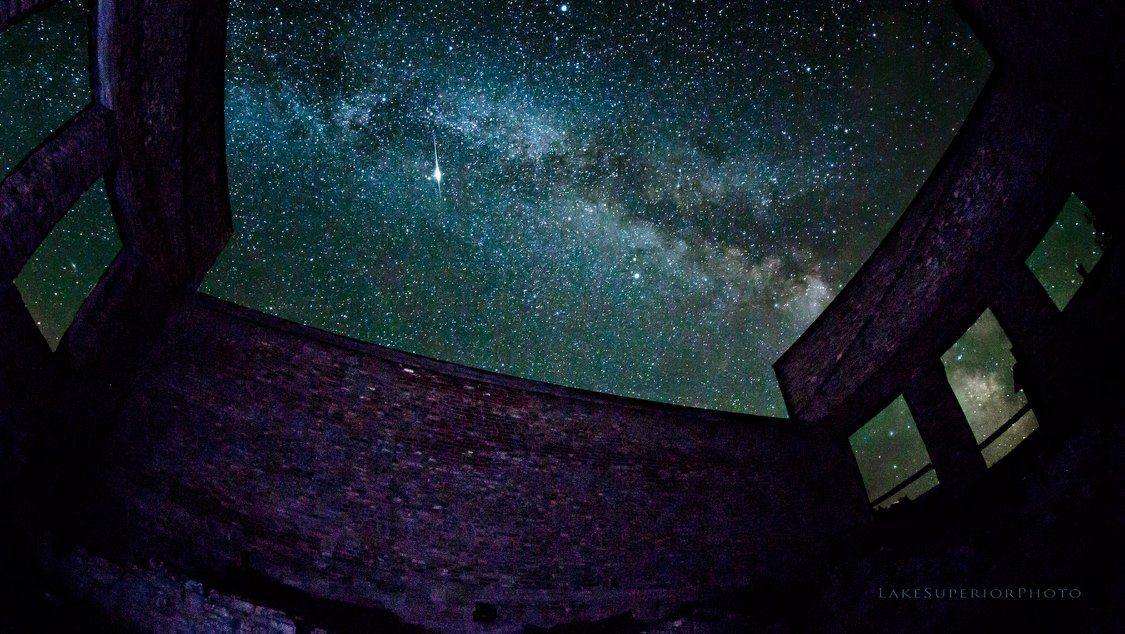
Fayette Historic State Park blends nature and history with a Historic Townsite, a representation of a once-bustling industrial community. Visitors can learn about the town through guided tours and information from the Visitor Center, or simply by walking through the townsite and exploring on their own. Walk through restored buildings like the town hotel and a cabin, built to replicate the homes in which residents of Fayette used to live. Interpretive panels provide information to transport visitors back in time and tell the story of the town.
On the second Saturday of August, the park is transformed back to its glory days with period displays, food and music at the annual Heritage Day.


 Michigan in Pictures