
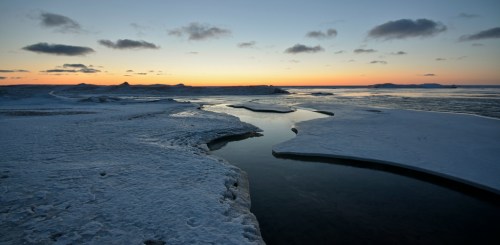
Running Out of Ice, photo by Aaron Springer
Probably wishful thinking, but I’m guessing that’s better than wishless thinking. Enjoy your weekend everyone!
View Aaron’s photo bigger and see more in his Northern Michigan slideshow.
Running Out of Ice, photo by Aaron Springer
Probably wishful thinking, but I’m guessing that’s better than wishless thinking. Enjoy your weekend everyone!
View Aaron’s photo bigger and see more in his Northern Michigan slideshow.
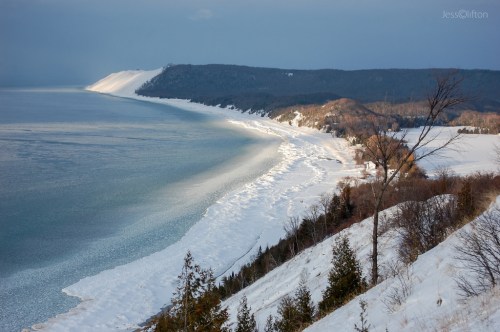
Sun Spill, Empire Beach, photo by jess_clifton
Recently Michigan in Pictures regular Jess Clifton and her family made a wintertime excursion to Empire in the heart of the Sleeping Bear Dunes National Lakeshore. She writes (in part):
At Empire, the beach was already sprinkled with about 10-15 other folks and the scene was surreal. Kids were crawling in and out of caves carved into the thick, massive ice formations built up along the water’s edge. Clouds intermittently descended and receded, offering up dramatic skies that beckoned you out.
…Once I finally convinced myself the beach was “safe” to venture out onto after watching about 14 other people successfully make the trek, I was off cresting mini ice mountains at a snails pace until I could finally peer into the water.
It was there that I finally got a sense of just how still the water was. Pancake ice floated gently on the barely breathing lake. The revelation of something so calm in such a harsh environment was almost jarring. (In a really good way.)
Read on for more and lots of stunning photos in her Why Michigan? blog.
View Jess’s photo background bigtacular and see more in her Winter in Northern Michigan slideshow. She also has a comparison photo from last year.
Lots more winter wallpaper on Michigan in Pictures.
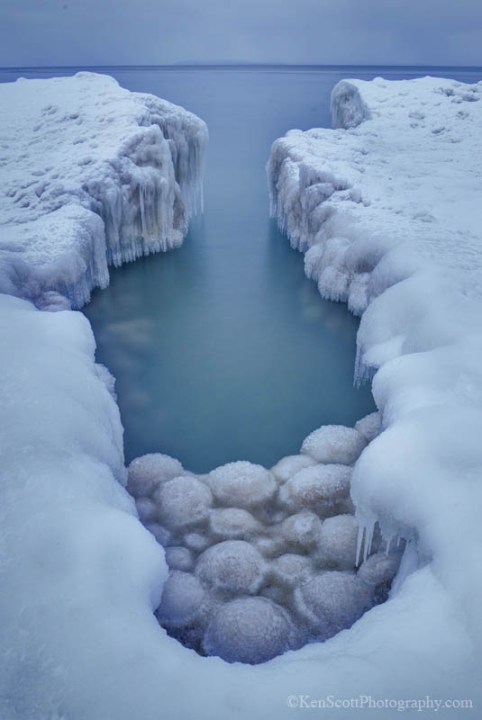
Lake Michigan … ice balls III, photo by Ken Scott
You may recall the Lake Michigan ice balls that were seen at the Sleeping Bear Dunes lakeshore last March. Well, they’re baaaaack. You can see a great video of the ball ice at Accuweather. Here’s the explanation of how balls ice form that I put together from AIR PHOTO INTERPRETATION OF GREAT LAKES ICE FEATURES by Ernest W. Marshal & Frazil ice at Wikipedia:
Ball ice consists of roughly spherical masses of slush and frazil ice that accrete in turbulent water. Frazil ice is a collection of loose, randomly oriented needle-shaped ice crystals that form in open, turbulent, supercooled water. Lumps that form in the less turbulent zones are typically flattened discs, while those formed in the extremely turbulent zone near the shoreline ice where wave action is strongest form into spheres.
The author explains that ball ice is a feature common to all of the Great Lakes and can occur at any time during the winter where water turbulence breaks up a slush layer. You can read more about this in Great Lakes Ice Features.
View Ken’s photo bigger, check them out in his ice balls slideshow and see this shot with Ken in it for a sense of the scale.
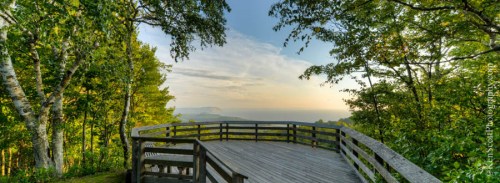
North Bar Lake … overlook by Ken Scott
A taste of the Shutdown’s impact on Michigan via Leelanau.com…
The TC Ticker reports that the federal government shutdown that began at midnight has closed portions of the Sleeping Bear Dunes National Lakeshore:
A park representative said gates will be closed on the park’s campgrounds, bathrooms and popular Pierce Stocking Scenic Drive until the shutdown ends, though visitors may still access the park’s hiking trails and lakeshore. (our emphasis)
Sleeping Bear Dunes is one of five national parks in Michigan affected by the shutdown, a move that comes at an unfortunate time for tourism-dependent parks nearing the end of their operating seasons. The Leelanau County attraction, which will operate with a skeleton crew of emergency-only personnel until the shutdown has ceased, normally averages 2,300 visitors a day during the fall season, according to park reports.
The Freep reports that a similar scenario will unfold at other Michigan National Parks with Isle Royale & River Raisin Battlefield Park closing early for the season. Let me stress that you can still enjoy the majority of our parks and trails. In other Michigan-specific news, about 900 Michigan National Guard members are bracing for a furlough notice and training for another 12,000 will be put on hold. More details on the shutdown’s impact on Michigan at mLive.
Check Ken’s photo – taken at a location that will be inaccessible – out bigger and see more in his massive Panoramas slideshow.
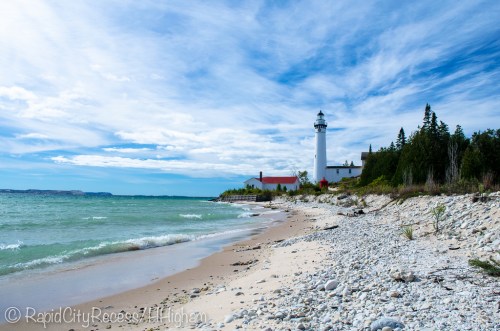
South Manitou Lighthouse, photo by HLHigham
Terry Pepper’s Seeing the Light is a tremendous resource for Michigan lighthouse information. His entry on the South Manitou Island Lighthouse begins:
Located just off the mainland coast of Lake Michigan’s east coast, a group of islands known as the Beaver Archipelago form a chain which marked the western edge of a tight passage along the coast. Known as the “Manitou Passage,” vessel masters taking this narrow passage were able to reduce the travel distance between the ports of Lake Michigan’s southern shore and the Straits of Mackinac by sixty miles, as opposed to taking the more circuitous route through open water to the west of the islands. As the most southerly of this chain of islands, South Manitou also featured one of the areas safest natural harbors, and with 5,260-acres of fine timber growth covering the island, it is not surprising that a few enterprising settlers arrived during the mid 1830’s to sell firewood to steamers taking shelter in the harbor when things turned sour out in the lake. By the late 1830’s it was commonplace to find upward of fifty vessels crowded into the harbor seeking refuge and taking-on supplies when things turned sour out in the lake.
Lying a scant few miles west of Sleeping Bear Point, mariners were hard pressed to locate the southern entrance to the busy passage at night or in times of thick weather, and a cry arose throughout the maritime community to light the southern entrance to the passage. Taking up their call on February 19, 1838, Michigan State Representative Isaac Crary entered a motion before the House of Representatives to erect a lighthouse on South Manitou, and fully cognizant of the vital role played by maritime commerce in the area, Congress responded quickly with an appropriation of $5,000 for the station’s construction on July 7 of that same year.
You can read on at Seeing the Light for the troubled saga of this light which saw high keeper turnover and some tragedy in its long tenure before being decommissioned in 1958. There’s also historical photos like this one showing the structure in full operation.
The light & South Manitou Island are now part of the Sleeping Bear Dunes National Lakeshore. Click that link for visitor information and also check out this satellite view of the South Manitou Light!
Check this out background bigtacular and see more shots of the light and the island in Heather’s South Manitou Island slideshow.
Many more lighthouses on Michigan in Pictures!

Ghost Forest, photo by Neil Weaver Photography
Walk silently through the haunting landscape of the ghost forest of Sleeping Bear Point Trail
and wind spirits whisper to you and chatter among the skeletons of long dead cedars.
If you do not hear them you are not listening.
I am sure the Anishinaabek knew the song in their day on Sleeping Bear.
~Jonathan Schechter, Earth’s Almanac
Jonathan Schechter who runs the very cool blog Earth’s Almanac at the Oakland Press penned these lines about the Ghost Forest on the Sleeping Bear Dunes (thanks SleepingBearDunes.com for the link). Click through for a photographic account of his visit!
The Sleeping Bear Dunes National Lakeshore page on the Sleeping Bear Dunes Overlook explains how the ghost forest was created:
The Sleeping Bear Dune is estimated to be about two thousand years old and has a fascinating history. It is classified as a perched dune because it is perched on top of a plateau, high above the lake. When the dune was forming, it was not at the edge of the bluff, but somewhat inland.Wind carried sand from the upper portion of the Lake Michigan bluff inland and deposited it to form the Sleeping Bear Dune.
Notice the skeletons of dead trees within the eroded bowl of the dune. This called a ghost forest and tells a story of alternating stability and change. After an initial phase of active sand accumulation, a period of stability followed when trees began to grow on the dune. Later, more sand moved in and buried the trees. Two layers of buried soil within the dune indicate that there was a second period of stability and tree growth, followed by another period of sand build-up and then the final growth of the trees and shrubs that now cover the sheltered portions of the dunes.
For a long time, the sleeping Bear Dune stood at about 234 feet high with a dense plant cover. However, trough most of the twentieth century, erosion has prevailed.
By 1961, the dune was only 132 feet high, and by 1980, it was down to 103 feet. The process is a continuing one. The major cause of the dune’s erosion was wave action wearing away the base of the plateau on which the dune rests. As the west side of the dune loses its support, it cascades down the hill. The wind, too, is a major agent of erosion, removing sand and destroying the dune’s plant cover. What does the future hold? It seems that the present trend will continue and it is only a matter of time until the Bear disappears completely.
See Neil’s photo bigger and see more in his Sleeping Bear Dunes slideshow. You can see a bunch more shots from Sleeping Bear for viewing & purchase on his website!
More dunes on Michigan in Pictures.
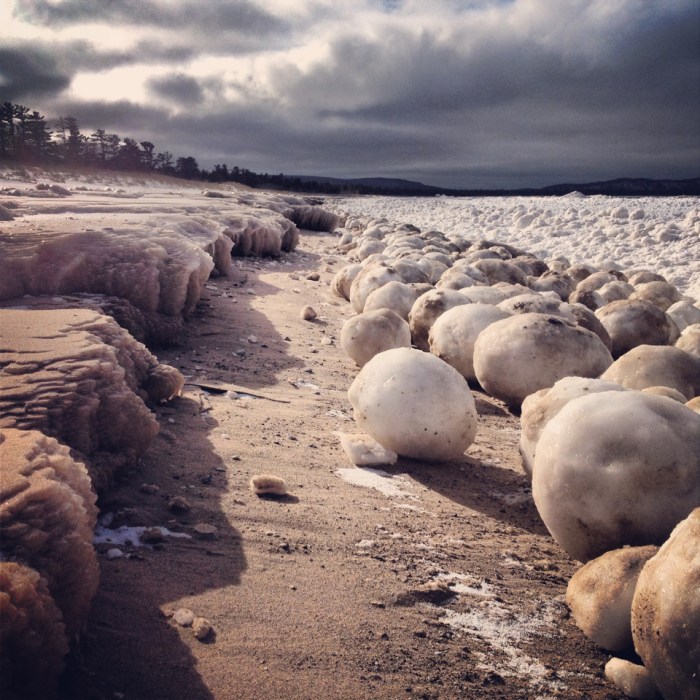
Lake Michigan Ice Boulders, photo by Leda Olmsted
Todays post is from the “Ain’t it Cool” Department. A couple of weeks ago Leelanau County resident Leda Olmsted was walking the Lake Michigan shore in the Sleeping Bear Dunes National Lakeshore when she came across this incredible scene. TV 7&4 reports in Ice boulders roll onto shores of Lake Michigan that Leda took some photos, uploaded to the news station’s Facebook and:
Leda says she was shocked by the response. Olmsted explains, “From there it got like 800 shares and thousands of likes and overnight I had Good Morning America and The Weather Channel calling me, so it has been a really crazy weekend!”
Deputy Superintendent from the Sleeping Bear Dunes National Lakeshore Tom Ulrich says, “It’s not that it never happens and this is a once in a decade thing, it happens more often than that, but these are very large and got bigger than they normally get.”
The ice balls or boulders along the shores of Lake Michigan are about the size of giant beach balls or basketballs and weigh up to 50 pounds.
Click to watch the video from UpNorthLive with Leda.
I looked a little further into the phenomenon and found and AIR PHOTO INTERPRETATION OF GREAT LAKES ICE FEATURES by Ernest W. Marshall in the Great Lakes Digital Library at the University of Michigan. With the help of Marshall’s information, here’s an explanation of how ball ice forms:
Ball ice consists of roughly spherical masses of slush and frazil ice that accrete in turbulent water. Frazil ice (via Wikipedia)is a collection of loose, randomly oriented needle-shaped ice crystals that form in open, turbulent, supercooled water. Lumps that form in the less turbulent zones are typically flattened discs, while those formed in the extremely turbulent zone near the shoreline ice where wave action is strongest form into spheres.
The author explains that ball ice is a feature common to all of the Great Lakes and can occur at any time during the winter where water turbulence breaks up a slush layer. You can read more about this in Great Lakes Ice Features.
 Michigan in Pictures