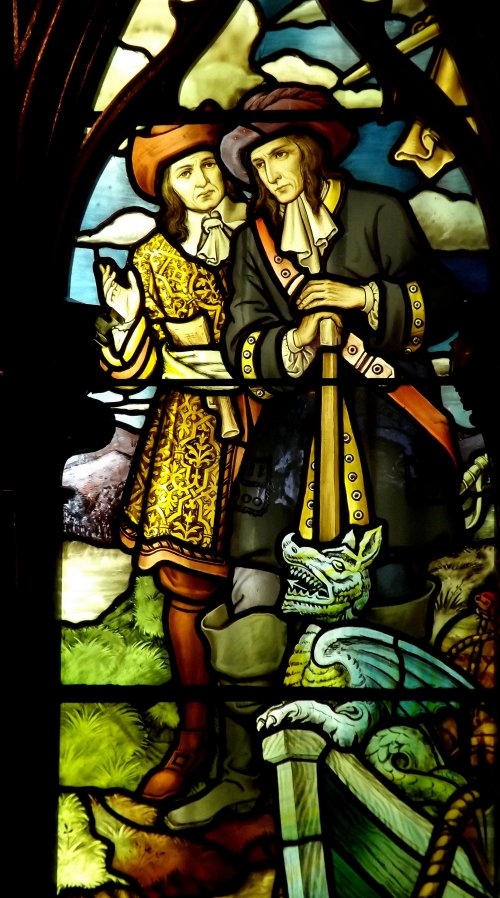
Detail: The LaSalle Stained Glass Window, Installed at Dossin Great Lakes Museum, Belle Isle Park–Detroit MI, photo by pinehurst19475
John Flesher of the Associate Press has a feature on NBC News about the possible discovery of the Holy Grail of Great Lakes shipwrecks, Le Griffon, the ship of French explorer Rene-Robert Sieur de La Salle. The article says (in part):
A wooden beam embedded at the bottom of northern Lake Michigan appears to have been there for centuries, underwater archaeologists announced Tuesday, a crucial finding as crews dig toward what they hope is the carcass of a French ship that disappeared while exploring the Great Lakes in the 17th century.
Expedition leaders still weren’t ready to declare they had found a shipwreck or the long-lost Griffin. The ship, commanded by the French explorer La Salle, was never seen again after setting sail in September 1679 from an island near the entrance of Green Bay, in what is now northern Wisconsin, with a crew of a six and a cargo of furs.
…Scientists and divers began excavating last week at the base of the wooden beam, hoping to determine whether it is part of the Griffin. Steve Libert, a diver and shipwreck enthusiast who has searched three decades for the Griffin, discovered the timber in 2001 and recently obtained state and federal permits to probe beneath the muddy surface.
Read on for more. Libert is president of Great Lakes Exploration Group started the Lasalle-Griffon Project with the state of Michigan and the Republic of France in July of 2010. He’s definitely obsessed with finding the ship, and their Expedition page explains:
If the wreck Libert has found is Le Griffon, it will be a find of tremendous historical significance. Le Griffon was built by Rene-Robert Sieur de La Salle, one of the first French explorers of the Great Lakes Region. He would later claim the Mississippi River watershed for France, a vast expanse of land that extended from the Allegheny Mountains to the Rocky Mountains and North of the Great Lakes, a portion of which became what is presently known as the Louisiana Purchase.
Exploration and study of the ship will tell us much about the history of our country and how our ancestors lived. “The ship is a time capsule that will fill the missing gaps of La Salle’s early exploration of North America,” says Libert. In particular, the wreck is a record of ship construction of that period, about which relatively little is known. La Salle constructed Le Griffon on the banks of the Niagara River, about three miles above the falls. There is strong documentation to support the view that Le Griffon was built on what is now the U.S. side of the Falls. If the wreckage is Le Griffon, however, it may be possible to use samples to establish definitively which side it was built on.
The fact that Le Griffon was built in the wilderness, as opposed to a shipyard, will reveal the circumstances La Salle and his men faced and the tools and technology they possessed. The ship was built with timber cut on site. The exact dimensions of the vessel are not known. It is however known to have been a 40 tun* vessel with three masts, a foremast, main and mizzen, and several square sails.
*Tun is an old French word for a large cask used in shipping wine, equivalent to 33.7 cubic feet or 252 gallons. Read on for a whole lot more.
Regarding the stained glass above, pinehurst19475 writes:
This is a full view of part of a panel that depicts two cavaliers in discussion. They are part of a scene that depicts Robert Cavalier Sieur de la Salle’s voyage through the Detroit River in 1678-9. The small boat in the foreground is the “Griffon,” the vessel that made the voyage.
The five-part stained glass window was originally installed in the Gothic Room of the “City of Detroit III.” At the time it was built (1912), it was the world’s largest side-wheeler. The Edward F. Lee Glass Company of Detroit designed the stained glass window.
View his photo background big and see more in his Stained Glass slideshow.
Share Michigan in Pictures:

 Michigan in Pictures