Foggy Morning on Portage Lake and the Tyndall Effect

Foggy morning, photo by Jiqing Fan

Wikipedia says that Portage Lake is part of the Keweenaw Waterway, a partly natural, partly artificial waterway that cuts across the Keweenaw Peninsula to provide access for shipping from Lake Superior. If you click the link you can get an aerial view.

View Jiqing Fan’s photo bigger and see more in his massive Houghton & UP MI slideshow. He writes:

Saw the fog on Lake Portage from my apartment window after I woke up today. I knew the potential this fog can bring so I darted down to the lake shore. But the fog was so heavy that the foliage on the other bank were completely blocked. Just when I was about to give up and head back for school, the fog started to break as the sun rises. And then the magic started to unfold before my eyes. Soon the fog lifted and fill the campus uphill, the entire campus was bathed in soft morning light and there were Tyndall effect everywhere! I can not think of a better way to start a day of work.

What’s the Tyndall effect you ask? The UC Davis ChemWiki explains that the Tyndall effect was identified by 19th Century Irish scientist John Tyndall.

Because a colloidal solution or substance (like fog) is made up of scattered particles (like dust and water in air), light cannot travel straight through. Rather, it collides with these micro-particles and scatters causing the effect of a visible light beam. This effect was observed and described by John Tyndall as the Tyndall Effect.

The Tyndall effect is an easy way of determining whether a mixture is colloidal or not. When light is shined through a true solution, the light passes cleanly through the solution, however when light is passed through a colloidal solution, the substance in the dispersed phases scatters the light in all directions, making it readily seen.

For example, light is not reflected when passing through water because it is not a colloid. It is however reflected in all directions when it passes through milk, which is colloidal. A second example is shining a flashlight into fog or smog; the beam of light can be easily seen because the fog is a colloid.

Yay science!

The Beauty of My Nemesis: Snowflake Edition

The Beauty of My Nemesis

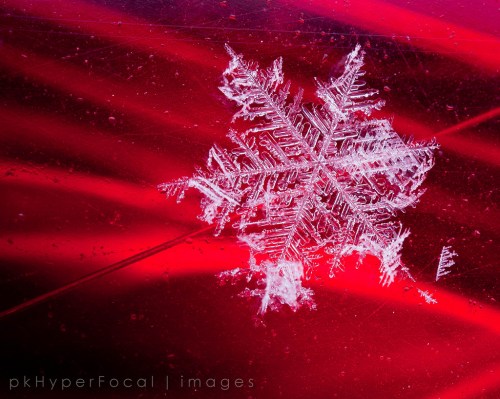
The Beauty of My Nemesis, photo by pkHyperFocal

Waaaay back when I started out on the capital “I” Internet with an online publication called the Northern Michigan Journal. For over five years I edited NMJ, producing around 4 issues a year that featured some interesting work from a wide range of writers & artists.

Two of these were my friends Jerry Dennis and Glenn Wolff, a writer/artist duo who collaborated on several books.  Their first was called It’s Raining Frogs & Fishes: Four Seasons of Natural Phenomena and Oddities of the Sky, a fascinating romp through the oddities and beauties of the natural world through Jerry’s captivating prose and Glenn’s engaging drawings. You can click that link to learn more about the book from Jerry’s website. Trust me, it’s the perfect gift for the nature lover or scientist in your life!

Glenn & Jerry shared a chapter from the book with me that I published to the inaugural issue of NMJ. Here’s the beginning of Nature Baroque: Snowflakes & Crystals:

There is more to the birth of a snowflake than Aristotle’s assertion that “when a cloud freezes there is snow.” Snow is not merely frozen rain. Rain occasionally freezes, falling to the ground as sleet or freezing rain, but snow originates independent of atmospheric drops of water. Individual ice crystals for high in the atmosphere when water vapor freezes around dust or other particulates. Without particles to serve as condensation nuclei, water vapor can be cooled to -40 degrees Fahrenheit before freezing occurs. A supercooled cloud of this sort seeded with a few particles often escalates into a snowstorm. The individual crystals collect additional molecules of water vapor one at a time, building on one another symmetrically in a rapidly growing, widening circle. Temperature, wind, humidity, and even barometric pressure will determine the growth and ultimate form of the crystal. Large and elaborate crystals for at higher temperatures and humidity while, while the small, basic crystals such as those common in polar regions form when temperature and humidity are very low. As the crystals fall they bump against each other, breaking off pieces of ice that in turn serve as nuclei for new crystals. As they pass through warmer layers of air they adhere to one another, congregating into snowflakes that may contain a thousand or more crystals.

Snowflakes, then, are aggregates of snow crystals. When the temperature is near or slightly above freezing, snowflakes become wet, adhere to other flakes, and grow to two or three inches in diameter. On very rare occasions, they can grow larger yet. According to a report in a 1915 issue of Monthly Weather Review, a snowfall on January 28, 1887 dropped flakes “larger than milk pans,” measuring fifteen inches in diameter by eight inches thick across several square miles near Fort Keogh, Montana.

Only when the temperature remains consistently below freezing will complete, individual crystals fall to the ground. If the temperature of the cloud they form in and the air they descend through is warmer than 27 degrees Fahrenheit, the crystals tend to be flat and hexagonal. Between 27 and 23 degrees, they tend to be needle-shaped. Between 23 and 18 they are likely to be hollow and columnar, with prismatic sides. At temperatures below 18 they can be columnar, hexagonal, or fernlike. Virtually all have six sides. That hexagonal tendency is something of a mystery, although some scientists suggest it is produced by electrical charges in the crystals, while others say it is basic to the molecular structure of water molecules. The atoms in a molecule of H20 are arranged, in physicist Hans C. von Baeyer’s graphic description, “with two little hydrogens stuck onto a big oxygen like ears on a Mickey Mouse’s head.” Scientists like von Baeyer believe that the angle at which the hydrogen molecules protrude from the oxygen atom–about 120 degrees–causes snow crystals to grow to a six-pointed symmetry that repeats the molecular structure of water.

Read on for much more including whether or not two snow crystals are alike, heavy snowfalls and snow words & myths.

View this photo background bigtacular and see more in pk’s really, really cool Chromatic Progression slideshow.

More snow, sciencewinter wallpaper on Michigan in Pictures!

Ball Ice and the Ice Boulders on Lake Michigan

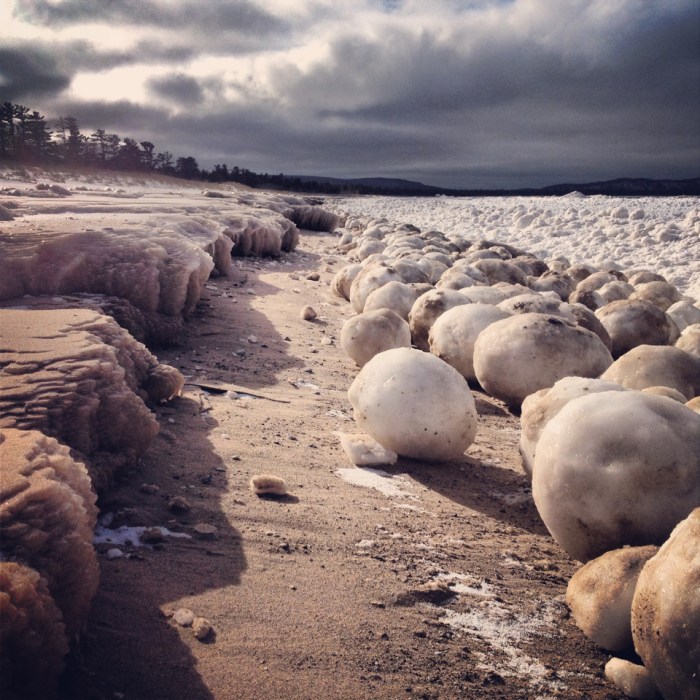
Ice Boulders by Leda Olmstead
Lake Michigan Ice Boulders, photo by Leda Olmsted

Todays post is from the “Ain’t it Cool” Department. A couple of weeks ago Leelanau County resident Leda Olmsted was walking the Lake Michigan shore in the Sleeping Bear Dunes National Lakeshore when she came across this incredible scene. TV 7&4 reports in Ice boulders roll onto shores of Lake Michigan that Leda took some photos, uploaded to the news station’s Facebook and:

Leda says she was shocked by the response. Olmsted explains, “From there it got like 800 shares and thousands of likes and overnight I had Good Morning America and The Weather Channel calling me, so it has been a really crazy weekend!”

Deputy Superintendent from the Sleeping Bear Dunes National Lakeshore Tom Ulrich says, “It’s not that it never happens and this is a once in a decade thing, it happens more often than that, but these are very large and got bigger than they normally get.”

The ice balls or boulders along the shores of Lake Michigan are about the size of giant beach balls or basketballs and weigh up to 50 pounds.

Click to watch the video from UpNorthLive with Leda.

I looked a little further into the phenomenon and found and AIR PHOTO INTERPRETATION OF GREAT LAKES ICE FEATURES by Ernest W. Marshall  in the Great Lakes Digital Library at the University of Michigan. With the help of Marshall’s information, here’s an explanation of how ball ice forms:

Ball ice consists of roughly spherical masses of slush and frazil ice that accrete in turbulent water. Frazil ice (via Wikipedia)is a collection of loose, randomly oriented needle-shaped ice crystals that form in open, turbulent, supercooled water. Lumps that form in the less turbulent zones are typically flattened discs, while those formed in the extremely turbulent zone near the shoreline ice where wave action is strongest form into spheres.

The author explains that ball ice is a feature common to all of the Great Lakes and can occur at any time during the winter where water turbulence breaks up a slush layer. You can read more about this in Great Lakes Ice Features.

More science, winter and amazing on Michigan in Pictures!

Ice Machine: How Shoreline Ice Forms on the Great Lakes

Lake Michigan Ice by Tim Wenzel

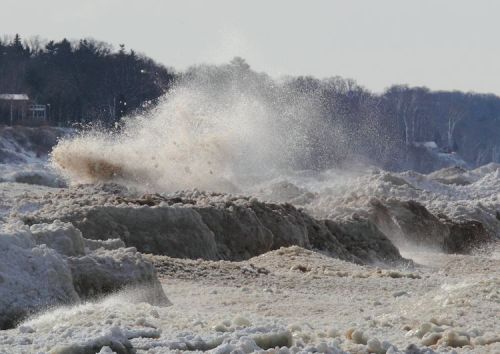
Snowball Fight Anyone?, photo by Timothy Wenzel

One of my favorite photo blogs is the Earth Science Picture of the Day from NASA. In Wednesday’s blog, Timothy wrote:

This photo, taken on January 24, 2013, illustrates how ice on Lake Michigan’s eastern shore can achieve heights of many feet; by accretion of floating snowball-size ice balls thrown upward by wave action. The maximum wave height (crest to trough) on Lake Michigan on this day was approximately 6 ft (2 m). What results is a landscape that looks almost volcanicClick here to see video of this phenomenon. Note that the lake itself is a slurry of ice and water.

Definitely check Tim’s video out! See the photo background bigtacular and see more in Timothy’s work including more photos from the day in his Weather Underground gallery.

More EPOD awesomeness on Michigan in Pictures!

Judas Carp

Club Carp by docksidepress

Club Carp, photo by docksidepress

Judas test: Will carp betray their own? on the Great Lakes Echo says that University of Minnesota researchers are working to put a new tool in the arsenal of those seeking to thwart the voracious and invasive Asian carp.

The researchers are fitting common carp, or “Judas fish,” with transmitters to lead them to other, larger schools of common carp, the station reports.

“(Carp) seem to be actually exceptionally social, they really hang out together,” researcher Peter Sorensen told the station. “We have to confirm that, but it sure looks that way.”

Watch the report from CBS Minnesota to learn how researchers hope to use the same technique to locate Asian carp populations for extermination.

Check out Matt’s photo on black and see more from Matt on Michigan in Pictures.

More fish on Michigan in Pictures.

Great Lakes Ice at near-record lows

Winter 2011 - Lake Ice

Winter 2011 – Lake Ice, photo by danbruell

The Great Lakes Echo reports that:

composite map of the Great Lakes produced by NOAA’s CoastWatch organization shows near-historic low ice coverage across the region.

The map, known as the Great Lakes Surface Environmental Analysis, is a composite of data taken from NOAA satellites orbiting the earth’s poles and radar scans of the lakes by the National Ice Center. The resulting image shows surface water temperature and ice coverage, important data for region scientists, fishermen and boaters. The map’s data is updated daily.

“Previously, the lowest ice coverage year was 2002,” CoastWatch manager George Leshkevich said. “2012 came very close to 2002, and this year is looking very similar to last year.”

Lack of ice cover leads to increased water evaporation, a serious concern in light of already-low lake levels.

You can read more about last year’s ice cover and impacts on Absolute Michigan.

Check Dan’s photo out background bigtacular and see more in his Lake Ice slideshow.

More winter wallpaper on Michigan in Pictures!