Doubling down: What makes a double rainbow and other rainbow science

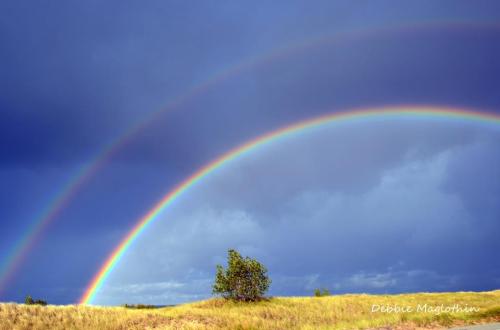
This morning north of Ludington, photo by Debbie Maglothin

It seems only fitting to follow up waterspouts with rainbows. The National Center for Atmospheric Research has an incredibly comprehensive page about rainbows. After explaining the optics behind rainbows (complete with diagrams), they delve into double rainbows:

Sometimes we see two rainbows at once, what causes this? We have followed the path of a ray of sunlight as it enters and is reflected inside the raindrop. But not all of the energy of the ray escapes the raindrop after it is reflected once. A part of the ray is reflected again and travels along inside the drop to emerge from the drop. The rainbow we normally see is called the primary rainbow and is produced by one internal reflection; the secondary rainbow arises from two internal reflections and the rays exit the drop at an angle of 50 degrees° rather than the 42°degrees for the red primary bow. Blue light emerges at an even larger angle of 53 degrees°. This effect produces a secondary rainbow that has its colors reversed compared to the primary, as illustrated in the drawing, adapted from the Science Universe Series Sight, Light, and Color.

It is possible for light to be reflected more than twice within a raindrop, and one can calculate where the higher order rainbows might be seen; but these are never seen in normal circumstances.

You may have noticed that the sky is brighter inside the rainbow above. They explain why the sky is brighter inside both single & double rainbows:

Notice the contrast between the sky inside the arc and outside it. When one studies the refraction of sunlight on a raindrop one finds that there are many rays emerging at angles smaller than the rainbow ray, but essentially no light from single internal reflections at angles greater than this ray. Thus there is a lot of light within the bow, and very little beyond it. Because this light is a mix of all the rainbow colors, it is white. In the case of the secondary rainbow, the rainbow ray is the smallest angle and there are many rays emerging at angles greater than this one. Therefore the two bows combine to define a dark region between them – called Alexander’s Dark Band, in honor of Alexander of Aphrodisias who discussed it some 1800 years ago!

Read on for much more about rainbows including supernumerary arcs, why we don’t often see rainbows in winter and even lunar rainbows! If you want to go rainbow crazy, head over to Atmospheric Optics for tons more rainbow information & photos.

Check this photo out bigger on Facebook and see more at Debbie’s Cha Bella Photography page.

See more rainbows on Michigan in Pictures. Also, I’ve added a new “science” category to Michigan in Pictures. I’ll tag past posts like the post about sundogs, rainbow-like formations you often see in winter. If anyone has a favorite, just post a comment on it mentioning that it would be a good fit for science!
Rainbow Wheel over Lake Charlevoix

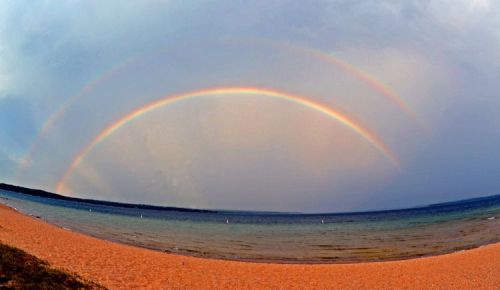
Rainbow Wheel over Lake Charlevoix, photo by Julie Christiansen

Regular Michigan in Pictures contributor Julie Christiansen was featured yesterday on one of my favorite blogs, NASA’s Earth Science Picture of the Day aka EPOD. The blog showcases earth science topics through photographs from all over the globe with a short summary and lots of links to help you dig deeper. Every so often, the feature is from Michigan as is the case with Julie’s rainbow wheel:

The photo above shows a beautiful double rainbow consisting of primary and secondary rainbows as well as an infrequently seen rainbow wheel. It was taken from Lake Charlevoix, Michigan in the early evening of May 28, 2012. A rainbow wheel can be observed near sunset or sunrise when anticrepuscular rays merge with a rainbow – the rays are the spokes of the wheel. Both rainbows and anticrepuscular rays have theantisolar point as their focus. If a rainbow is visible high in the sky, look closely to see if might contain curious “spokes.”

Click over to EPOD to see it bigger and see more of Julie’s photos from the area in her Charlevoix slideshow!

Fogbow: a White Rainbow over Big Red

fogbow-at-big-red-by-steven-karsten

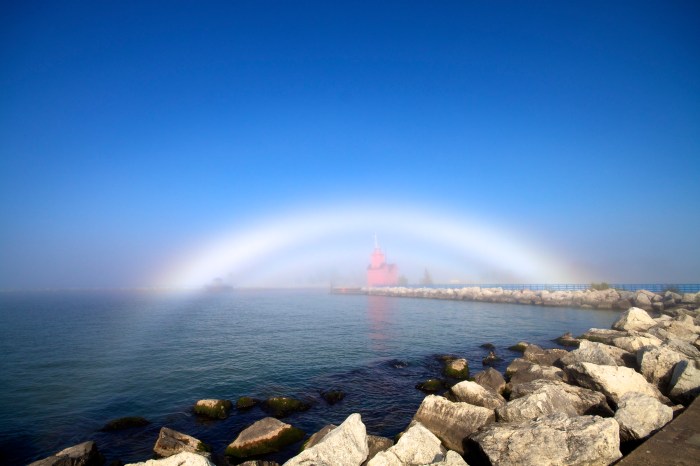
White Rainbow, photo by stevedontsurf.

Today’s photo shows a fogbow. According to the Fogbow entry from Atmospheric Optics:

Fogbows form in the same way as rainbows. A small fraction of the light entering droplets is internally reflected once and emerges to form a large circle opposite the sun.

But… …beyond that there are major differences. Rainbows are formed by raindrops which are so large that rays passing through them follow well defined ‘geometrical optics’ paths. Fogbows are formed by much smaller cloud and fog droplets which diffract light extensively.

…Fogbows are almost white with faint reds on the outside and blues inside. The colours are so washed out because the bow in each colour is very broad and the colours overlap.

Read on for more, including some photos and get a little more at Wikipedia’s page on fog bows.

Steven shot this at the Holland Harbor Lighthouse aka Big Red and writes that he’s still amazed he was able to stumble upon one of these. Check his photo out big as the sky and in his Holland slideshow.

Rainboat … aka the State of Michigan

Sorry about the bad link this morning…

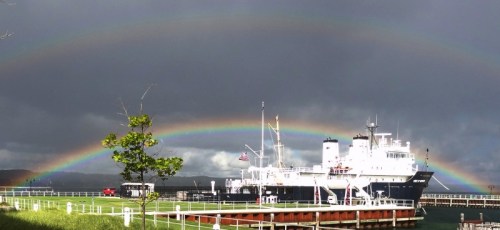
Traverse City 9-15-2011, by Mark O’shaughnessy

It was quite the double rainbow last Thursday in the Traverse City area. I was off to the right end of the bow in Suttons Bay but I couldn’t fit it all in in any of my photos.

The boat is the State of  Michigan at the Great Lakes Maritime Academy in Traverse City, a  training ship that allows cadets to put into practice the theory and skill sets taught in the classroom. The vessel is a:

…224-foot former Navy submarine surveillance ship Persistent, which is now T/S State of Michigan. The vessel is relatively new, having been built in 1986 as part of a series of 18 Stalwart-class T-AGOS vessels designed to tow highly sensitive sonar arrays for the tracking of Soviet submarines. As the Soviet threat diminished in the 1990s, the Navy decided to decommission the T-AGOS fleet, and in 1998 Persistent and sister ship Vindicator were transferred to the U.S. Coast Guard for primary use in drug interdiction.

See the specs and check it – and Grand Traverse Bay – out on their webcam!

See this photo bigger on Facebook and see more from Mark on his photography website.

About Lake Huron … and a double rainbow

double rainbow

double rainbow, photo by Morganshev.

Wikipedia’s entry for Lake Huron says that Lac Huron was named by early French explorers after the Huron people inhabiting the region. Lake Huron is the second largest of the Great Lakes and the third largest fresh water lake on earth with a surface area of 23,010 sq mi, a volume of 850 cubic miles and a shoreline length of 3,827 mi.

The Great Lakes Information Network page on Lake Huron pegs it as the 5th largest lake in the world and adds:

  • It has the longest shoreline of the Great Lakes, counting the shorelines of its 30,000 islands.
  • It contains Manitoulin Island, largest freshwater island in the world.
  • Georgian Bay and Saginaw Bay are the two largest bays on the Great Lakes.
  • Huron was the first of the Great Lakes to be discovered by European explorers. Since its French discoverers knew nothing as yet of the other lakes, they called it La Mer Douce, the sweet or fresh-water sea. A Sanson map in 1656 refers to the lake as Karegnondi, simply meaning “lake” in the Petan Indian language.

I found a cool site by the Lake Huron Lore Marine Society that has a great page on early steamships and sailing vessels on the Lake. Check it out!

See this out bigger in Morgan’s slideshow or see it in the Lake Huron Rolls Group slideshow!

Hope you find that pot of gold today and check out more at absolutemichigan.com/Lake Huron and explore Lake Huron on Michigan in Pictures.

Pot O Gold

Pot O Gold

Pot O Gold, photo by southarmstudio.

Rain, rain, bring us a rainbow and a pot of gold now please.

Anatomy of a Sun Dog

EDITOR’S NOTE: SEPTEMBER 22, 2012: Greetings from the future, people of January 2008! I think that this is the first post that I’ve ever re-done. The photos here were really cool but they were removed from Flickr. I probably would have waited for winter but as today’s post about rainbows refers here, I figured I’d do it now! Also, this post is in the new science category that I created today. If you have suggestions for other posts from Michigan in Pictures to be included, post a comment on them!

bluffsundogcaron-vi

bluffsundogcaron-vi, photo by MILapse

Sundogs, Parhelia, Mock Suns on the fantastic website Atmospheric optics says:

Sundogs, parhelia, are formed by plate crystals high in the cirrus clouds that occur world-wide. In cold climates the plates can also be in ground level as diamond dust.

The plates drift and float gently downwards with their large hexagonal faces almost horizontal. Rays that eventually contribute their glint to a sundog enter a side face and leave through another inclined 60° to the first. The two refractions deviate the ray by 22° or more depending on the ray’s initial angle of incidence when it enters the crystal. The condition where the internal ray crossing the crystal is parallel to an adjacent face gives the minimum deviation of about 22°.

Red light is refracted less strongly than blue and the inner, sunward, edges of sundogs are therefore red hued.

Rays passing through plates crystals in other ways form a variety of halos.

Head over to Atmospheric Optics for more about sundogs & other halos and definitely don’t miss their staggering sundog & moondog photo gallery. Also see sun dogs on Wikipedia.

Check this photo from the Sleeping Bear Dunes National Lakeshore on black and see a couple more shots of the sundog in Mr Jay’s Summer Vacation 08 slideshow.

More science on Michigan in Pictures!

Double Rainbow over the Immaculate Conception Ukrainian Catholic Church

roygbiv + icucc

roygbiv + icucc, photo by maproomsystems.

I don’t know if there really was a double rainbow over the Immaculate Conception Ukrainian Catholic Church in Hamtramck, Michigan. While the photo wasn’t posted until yesterday, it was taken on April 1st (another photo from Brett posted below says probably so). Who knows! In any case, it makes a perfect photo for today.

Detroit1701.org – a tremendously informative web site I just found – has an entry on Hamtramck’s Immaculate Conception Ukrainian Catholic Church:

Ukrainians began coming to metropolitan Detroit shortly after 1900. A large number settled in southern Hamtramck, especially on Grayling between Lumpkin and Joseph Campau. The first Immaculate Conception Ukrainian Catholic Church was a wooden structure on Grayling opened in 1913. By 1936, this parish operated a complete elementary school. As the congregants prospered, they were able to build the massive church that you see above. The cornerstone for this church was laid in 1942 but it was some years before the building was completed.

Seriously, this is an amazing web site with nearly 100 entries for religious buildings alone as well as hundreds of pages on everything from Detroit statues and public art to noted Detroit-area residences.

Visit detroit1701.org!