Delivering a Winter Storm

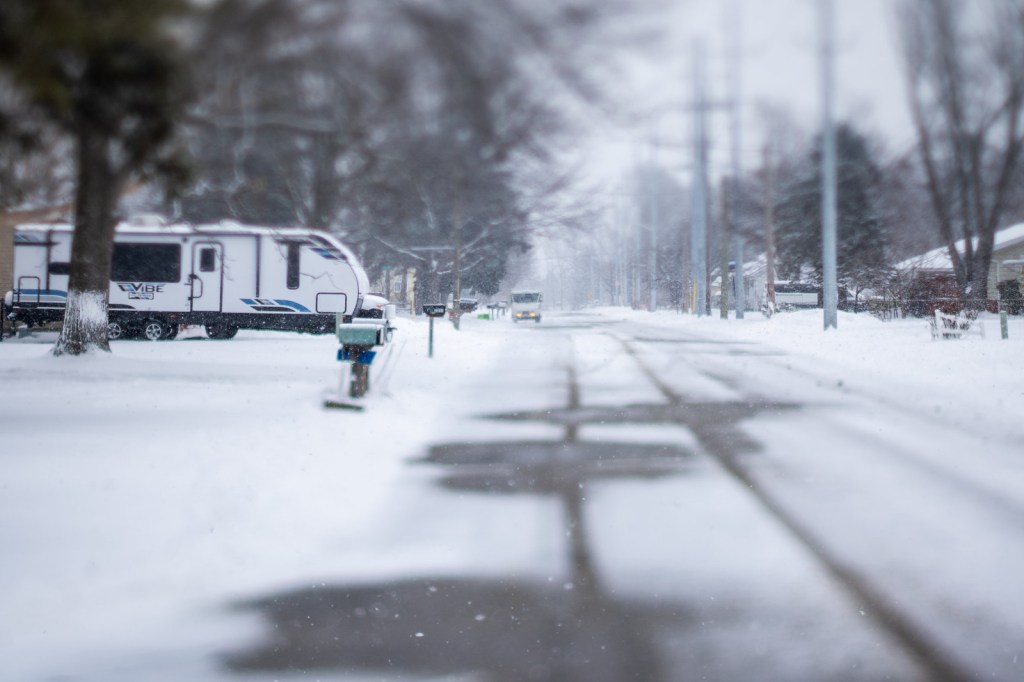
Winter Mail by Mike Vogel

Winter Mail by Mike Vogel

mLive’s Mark Torregrossa shares that the winter storm bearing down on Michigan overnight is expected to bring a solid band of freezing rain from Jackson to Ann Arbor to Detroit and south to Michigan’s southern border that could have up to one-tenth of an inch of ice accumulation. Based on radar, the iciness will be worst from 4am – 9am Thursday

Mike captured this great shot of a mail truck delivering in Port Huron on a winter day with a Nikon Zfc & TTArtisan 50mm Tilt shift lens 1.4. I hadn’t heard of this lens befor which the manufacturer says transforms ordinary scenes into captivating ‘Lilliput’ landscapes with selective focus and beautiful bokeh.

See more in Mike’s Winter 2025 gallery & for sure follow him on Flickr.

Support Michigan in Pictures with Patreon

Blue Water Bridge(s)

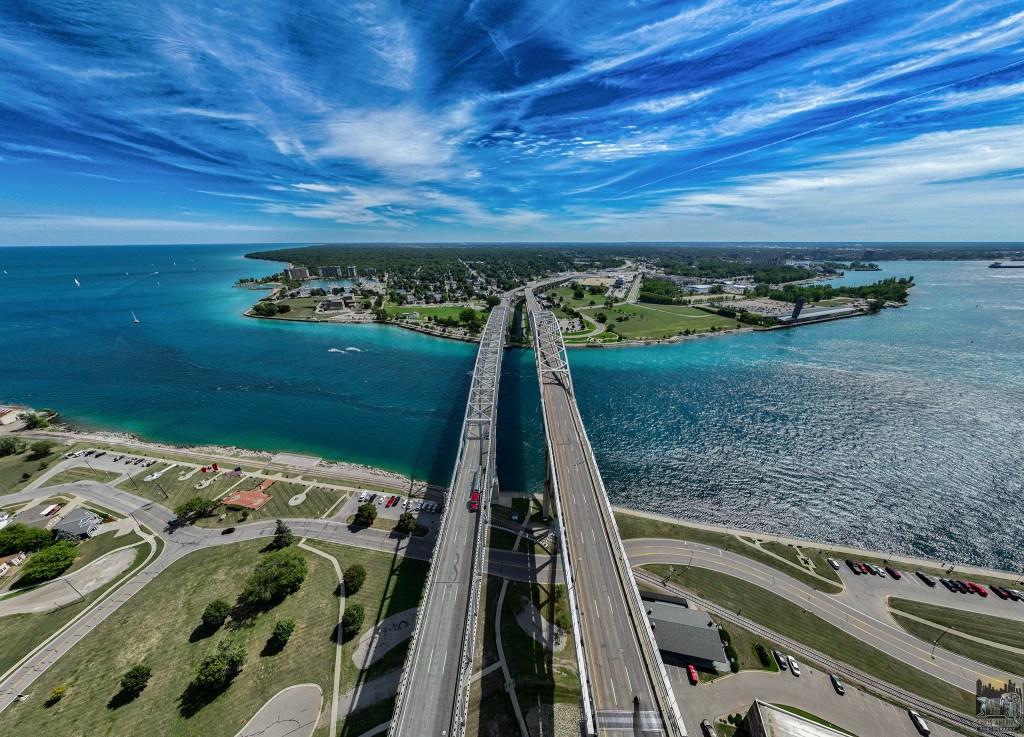
Blue Water Bridge(s) by Chris Ahern Photography

The Gordie Howe Bridge is (rightfully) getting a lot of attention these days, but another beautiful span connwcting Michigan with Canada is the Blue Water Bridge across the St. Clair River at the southern end of Lake Huron from Port Huron to Sarnia, Ontario. The Blue Water Bridge Authority shares:

The first bridge was opened to traffic on October 10, 1938. The lead engineer was Ralph Modjeski. This bridge originally had two lanes for vehicles as well as sidewalks; the latter were removed in the 1980s to make room for a third lane for automobiles. The third lane for each direction started from the apex of the bridge in order to accommodate long lineups entering each sides’ respective border crossings.

…In the early 1990s, bridge authorities decided to add a second arch in order to accommodate the high traffic. During the debate over the form of the second span, five possible designs were purposed from 1994-95. Over half of public opinion had mostly favored a duplicate of the first bridge, while the cable-stayed bridge came in second with around 21%. The Blue Water Bridge Authority had rejected both designs, due to the duplicate creating a false sense of history, while the cable-stayed option was feared to overshadow the existing bridge. Another cost-effective but unpopular design was the parallel truss. The continuous-tied arch design, which was a distant third place in polls, was chosen for two reasons. One was that it blends in with the original span yet stands out on its own, and the other is lower maintenance costs because fewer spans are involved.

Chris Ahern is a professional photographer & licensed commercial drone pilot who works in and around Detroit. Follow him on Facebook or Instagram & for sure check out his website.

Support Michigan in Pictures with Patreon

A Tale of Two Bridges: History of Port Huron’s Blue Water Bridge

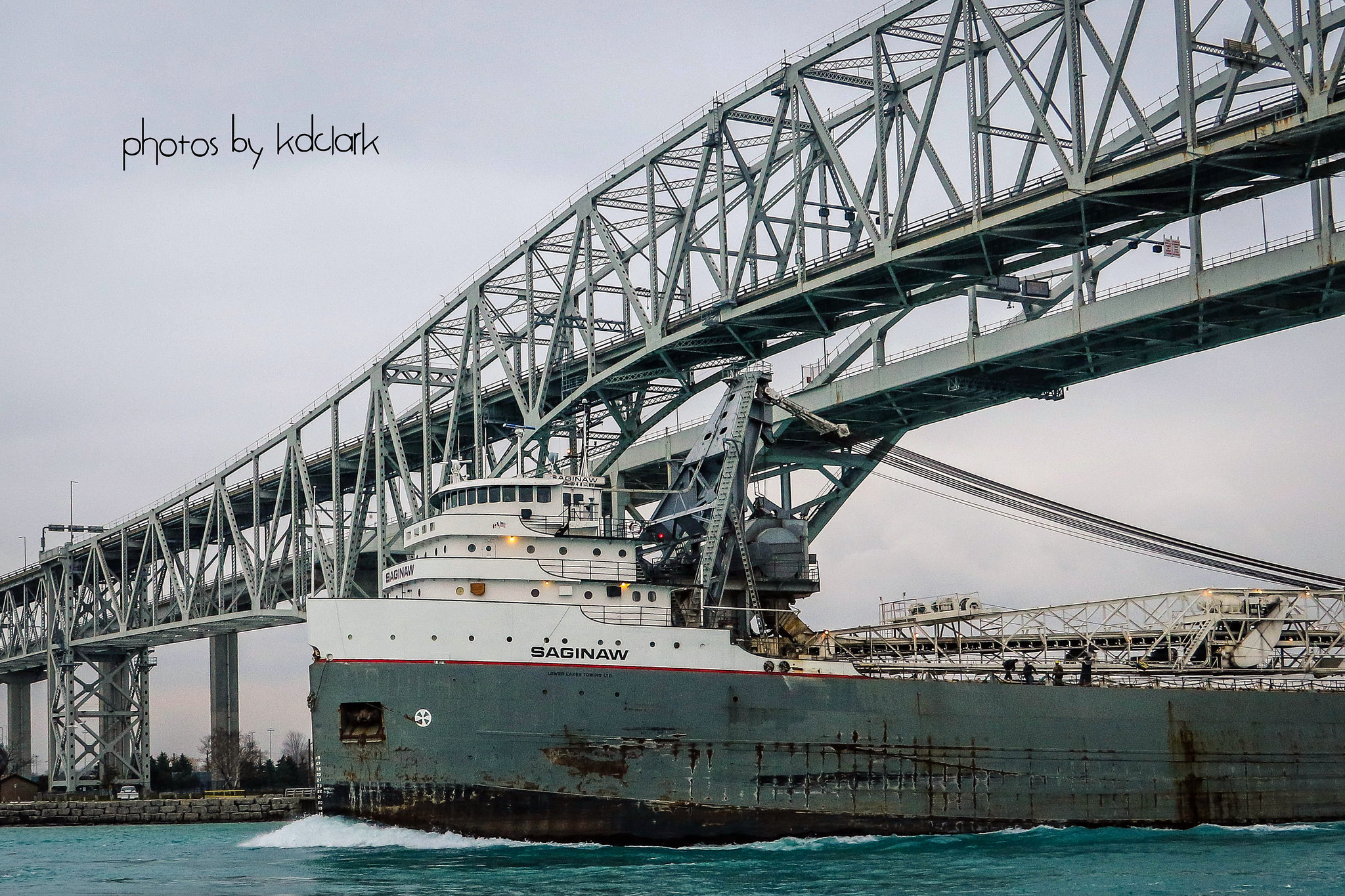
Freighter Saginaw Under the Blue Water Bridge

Untitled, photo by Diane

The website Michigan History was produced by someone at MSU. While I have no idea who or why they gave up on what was shaping up to be a cool website, the history checks out. The page on Port Huron’s Blue Water Bridge says:

Perhaps Port Huron’s greatest claim to fame is the Blue Water Bridge, a historic arcing bridge that serves as a means of transportation between Canada and the United States. The bridge is located over the St. Clair River, and connects Port Huron, Michigan, to Sarnia, Ontario. In 2013 the Blue Water Bridge celebrated its 75th anniversary, and a closer look at its history show why Port Huron residents take pride in the structure.

The original Blue Water Bridge was constructed in 1938, and was built by the American Bridge Company of New York, and the Hamilton Bridge Company of Ontario. The original bridge is an arch cantilever bridge, which was designed to not only support large amounts of traffic, but also to have an aesthetic arching look. In the late 1980s the border crossing became so popular that plans for a new bridge were brought up. However, instead of demolishing the old bridge, a new one was built in 1997 beside the old bridge, to support eastbound traffic.

The Michigan cost for building the new bridge, and renovating the old one was $62.6 million dollars. (Michigan Department of Transportation) The project was considered an enormous success and won awards from the American Society of Civil Engineers, the Ontario Institution of Steel Construction, and the Federal Highway Administration. For Port Huron residents the bridge signifies the close connection with Canada, and the willingness of the two sides to work closely together.

Click for more about the history of Port Huron. If you want to get really in depth, The Construction History of the Blue Water Bridge (pdf) is an excellent account that details the political maneuverings and construction challenges of both bridges.

View Diane’s photo of the freighter Saginaw passing under the Blue Water Bridge background bigtacular and see more in her Freighters and the St. Clair River slideshow.

There’s more Michigan bridges on Michigan in Pictures, and since you’ve read this far, Boatnerd’s page on the Saginaw has everything you’ll want to know about the self-unloading bulk carrier that was launched May 9th, 1953 as the John J. Boland. It’s one of three near sister vessels built by this shipyard: The John G. Munson which is still plying the lakes and the Detroit Edison that suffered a career-ending grounding in Lake Michigan in December of 1980.

Ice Harvesting in Michigan

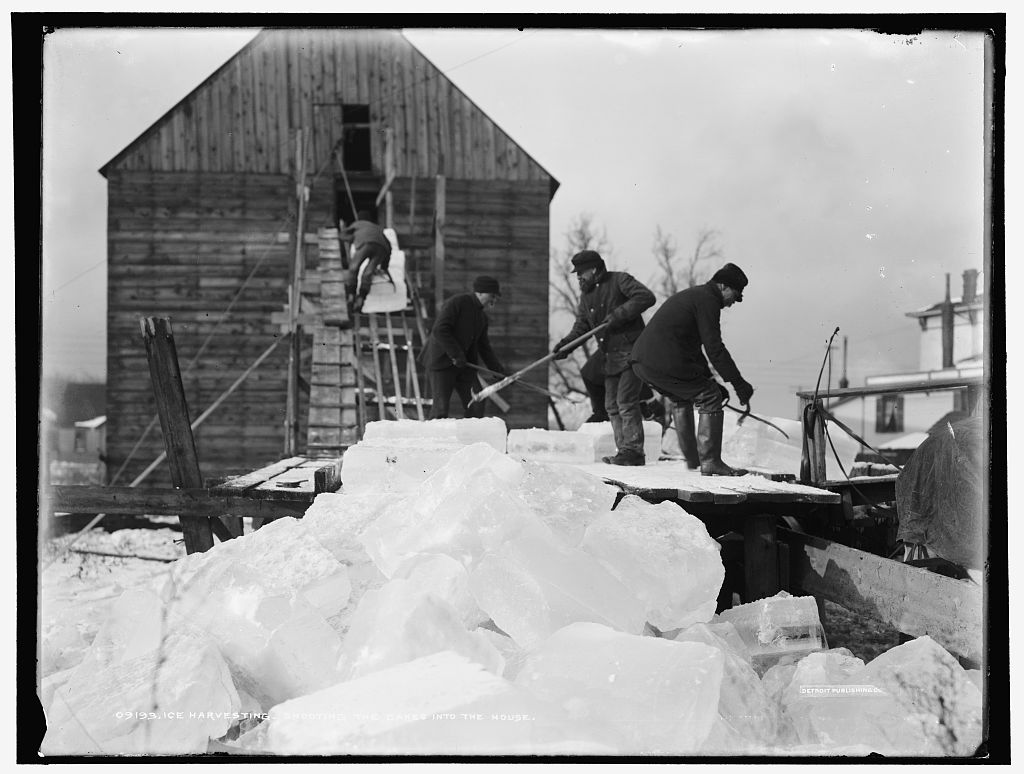
Ice Harvesting, Shooting Cakes into the House

Ice Harvesting, Shooting Cakes into the House, photo courtesy Detroit Publishing Co / Library of Congress

Today’s feature comes via eatdrinkTC, and you can head over there for some photos of ice harvesting in Traverse City and a cool video!

There was a time when the winter ice harvest was as critical as any other harvest, allowing folks in Michigan and elsewhere to enjoy & keep fresh food in summertime. Knowlton’s Ice Museum of North America in Port Huron is dedicated to chronicling what was once a huge industry for Michigan that is now almost forgotten. They explain:

Michigan was one of the main sources of ice harvesting because in those times people cherished the clear hard ice harvested from the beautiful Great Lakes. In the winter months farmers would make money to feed their families by working on the ice fields (rivers, ponds and lakes). Using primitive ice tools they would scrape snow off of the field, measure ice thickness, and saw ice cakes or blocks of ice.

The 300 lb. blocks would then be loaded onto horse drawn flat-bed type wagons and moved off the ice field. The horses hauled the load to stick built ice houses created along rivers and lakes where the ice was stored until the summer months when it could be sold. The ice was stacked and packed inside the ice house. Sawdust was used for insulation and placed in between layers of ice. Some ice houses stored over 1,600 ton of ice. The work these men did each long day was dangerous and cold. Once a luxury, ice became a common household and business commodity by 1900. The ice delivery man would weigh ice blocks and deliver ice by horse drawn covered wagon to homes and businesses. Each order was carried into the home and placed into the top shelf of an ice box to keep food fresh.

We found the above photo from the Detroit Publishing Company via Emily Bingham’s excellent Found Michigan website that has a really nice article about ice harvesting in Michigan.  Also check out an article about ice harvesting and ice saws from the Greater West Bloomfield Historical Society.