know these things: Cities & Rain

know these things

know these things, photo by .brianday

Michigan Radio’s Stateside program interviewed Dr. Larissa Larsen of the Urban and Regional Planning Program at the University of Michigan about how our warming climate & heavier rains impacts how we plan & manage cities. It’s an interesting concept and another financial eventuality we’ll need to include in our long-term planning … assuming we ever do any of that.

This photo is from Brian’s fantastic Time Traveler Series. See it bigger and see more in the time traveler slideshow.

More weather on Michigan in Pictures.

New owner for Irish Hills Towers

Irish Hills Towers from Route 12 (View 1)

Irish Hills Towers from Route 12 (View 1), photo by DarrylW4

The Adrian Daily Telegram reports that ownership of the Irish Hills Towers has formally been transfered to the Irish Hills Historical Society, a 501(c)(3) nonprofit. The towers have been stabilized and are being evaluated, and it appears that the IHHS would need about $300,000 to restore this attraction. Keep up with their progress at the Irish Hills Historical Society Facebook.

This page on the Irish Hills Towers notes that the top of the towers is 1400 feet above sea level, which makes them the highest point in southeastern Michigan. On a clear day (if they were open) you could see for seven miles with a ten lakes visible.  Michigan in Pictures has more shots of these iconic landmarks including the history of the towers and a crazy cool photo by Matt Callow.

Darren took the photo and suggests that he’d like to see the towers restored and converted to a museum for Michigan’s Roadside Attractions. Check it out on black and see more in his Irish Hills Towers slideshow.

Spring Bokeh

Untitled

Untitled, photo by Brooke Pennington

I refuse to give the ice storm that’s outside my door any power.

Brooke takes some great shots of flowers – check this out on black, see more in his slideshow or here on Michigan in Pictures.

More about bokeh.

Give me a home, where the dinosaurs roam

blah blah blah about being bigger than oneself

blah blah blah about being bigger than oneself, photo by hardyc

Is it just me or has the cloning of extinct species gone too far?

Check this out big as a brachiosaur and see more in Chris’s slideshow!

More April 1 fun on Absolute Michigan today!

Belle Isle Bolt!

Belle Isle View1D

Belle Isle View1D, photo by TroyMich (fferriolo)

BLAM!! Who’s ready for some spring storms? FYI, this is actually not a lighthouse off Belle Isle, it’s the Detroit Waterworks Intake Crib. You can have a look at on Google Maps.

Check this out big as the sky and in see more Frank’s slideshow.

More wicked weather on Michigan in Pictures!

Sunset & Sequestration

"Lake Michigan Overlook" Pierce Stocking Scenic Drive - Sleeping Bear Dunes National Lakeshore

“Lake Michigan Overlook” Pierce Stocking Scenic Drive, photo by Michigan Nut

The other day on Leelanau.com I posted Sequestration and the Sleeping Bear Dunes detailing cuts that will be made at the Sleeping Bear Dunes National Lakeshore to meet their 5% budget requirement. The Pictured Rocks National LakeshoreIsle Royale and the Keweenaw National Historical Park will all be forced to trim budgets as well. Due to the fact that the NPS fiscal year ends in September, the cuts end up being closer to 10% than 5%.

All of the officials quoted stress that the parks remain open and (mostly) accessible, but when Michigan is spending millions of dollars promoting Pure Michigan nationwide with these parks at the center of our offerings, there’s no question that this is bad news for tourism!

John took this photo about a year ago – view it bigger and see more in his Sleeping Bear Dunes National Lakeshore slideshow. He is a frequent guest on Michigan in Pictures – view more of his posts right here.

Four Silo Barn

DSC02860_1_2_3_tonemapped

DSC02860_1_2_3_tonemapped, photo by ansonredford

Donald writes that he’s never seen a quad-silo barn before he came across this one – me neither!!

Check this out big as a barn and see several more looks at this barn in his Barns & Silos slideshow.

More barns on Michigan in Pictures.

A Michigan groundhog for Groundhog Day

Standing Guard

Standing Guard, photo by James Marvin Phelps

Today (February 2nd) is Groundhog Day, the day halfway between the Winter Solstice and the Spring Equinox. The most famous groundhog in the world, Punxsutawney Phil, didn’t see his shadow this morning. Apparently, Michigan has its own official woodchuck weather forecaster, Woody. She lives at the Howell Nature Center and also didn’t  see her shadow. If you put your trust in celebrity rodents, that means we’re in for an early spring.

Michigan has native groundhogs, also known as woodchucks, whistle-pigs, or land-beavers. The University of Michigan Animal Diversity Web entry for Marmota monax (woodchuck) explains in part that:

Woodchucks are stocky in appearance and often stand up on their hind legs, making them look tall. Their pelage varies greatly in color but ranges from gray to cinnamon to dark brown. Their body is covered with white-tipped guard hairs giving them a grizzled appearance. Their paws vary in color from a typical black to dark brown in most subspecies. However, one subspecies has paws that appear pink. Their short bushy tail is often black to dark brown and is 20 to 25% their total body length. They weigh from 2 to 6 kg, range from 415 to 675 mm in total length, and have tails that range from 100 to 160 mm in length. Although males and females are the same color, males are larger than females. Woodchucks have white teeth, which is uncharacteristic of rodents, and a dental formula of 1/1, 0/0, 2/1, 3/3, for a total of 22 teeth. They have rounded ears that can cover the external auditory canal which prevents dirt from entering the ear canal while burrowing.

…Woodchucks are diurnal, solitary animals … Woodchucks are burrowing mammals and generally construct summer and winter dens. These dens generally have several entrances (including an escape hole) and many chambers and tunnels. Woodchucks usually feed twice daily during the summer, with each feeding session lasting no more than 2 hours. They are often found sunning themselves in the middle of the day during summer.

…Abandoned woodchuck dens are used by a number of different species, including rabbits, skunks, raccoons, opossums, foxes, weasels, ground squirrels, river otters, chipmunks, meadow voles, short-tailed shrews, house mice, pine voles, white-footed mice, lizards, snakes, and arthropods.

You can read more and see photos at ADW and also at Wikipedia.

James took this photo at the Lake Erie Metro Park in August of 2009. See it bigger and see more in his Michigan Groundhog slideshow.

More Michigan animals on Michigan in Pictures.

Know Your Michigan Waterfalls: Morgan Falls Edition

Calming Currents - Morgan Falls (Marquette, MI)

Calming Currents – Morgan Falls (Marquette, MI), photo by Aaron C. Jors

GoWaterfalling’s page on Morgan Falls explains that:

Morgan Creek tumbles 20 feet into the Carp River, creating this small wild waterfall. This is one of the more accessible of the Marquette waterfalls. The more impressive, but much hard to visit Carp River Falls are half a mile away.

Morgan Falls is located about two miles south of the city of Marquette. Of the many waterfalls in Marquette county this is one of the easier to visit, especially if you have four wheel drive. The waterfall is located at the confluence of Morgan Creek and the Carp River. The creek cascades down 20 feet to join up with the Carp.

…There is some disagreement about the name of this falls. According to some Morgan Falls is actually a cascade further upstream, and this is just an unnamed waterfall. This is the more distinctive and photogenic of the two features.

Read on for more information including directions.

You can view this photo on black. Aaron has several more great waterfall shots on Michigan in Pictures and even more in his Michigan waterfalls slideshow.

There are even more Michigan waterfalls on Michigan in Pictures too!

Eben Ice Caves in the Rock River Wilderness

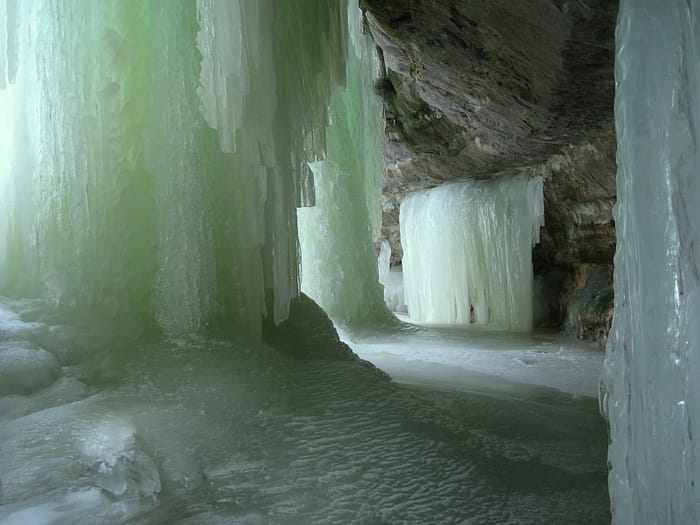
A Healthy Green Glow

A Healthy Green Glow, photo by nasunto

I know it’s wintertime when I start seeing a lot of people asking about the Eben Ice Caves. Like many of the subjects on Michigan in Pictures, I don’t know much more than what I write on the blog. Recently, however, a good-hearted soul created the Eben Ice Caves Facebook page to serve as a hub for information about this wintertime wonder of Michigan.

Nina Asunto writes one of my favorite blogs, Black Coffee at Sunrise, a delightful wander through some of Michigan’s most fascinating places. Nina’s feature on the Eben Ice Caves explains that they are located in the Rock River Wilderness in the western section of Hiawatha National Forest.

Rock River Canyon is 150 feet deep and lined with sandstone outcrops, which have been eroded to form concave overhangs. During winter, ground water seeps over the edge and down through the sandstone where it freezes, creating huge curtains of ice and closing off the front of the outcrops to form caves.

In winter it is possible to access the ice caves from the south side of the wilderness area. A few miles north of Eben Junction, visitors can park their cars by the side of the road and cross an open field to the forest. The field is private property, but the owner allows for its use in winter to access the ice caves…

We had both seen a few photos of the ice caves, but none of them really captured the size of this phenomenon…

What we weren’t able to capture, however, was the amazing sound inside the cave. The drips of water falling from above created wonderful echoes and added to the cave atmosphere. There is much variation of color and texture to the ice in different parts of the cave. Some formations were smooth and clear, others were bumpy and hollow-sounding, and there were some columns that looked like dripping candle wax.

Read on for many more photos. You can also view this photo background bigtacular and see more in her fantastic Eben Ice Caves slideshow on Flickr!

More Eben Ice Caves on Michigan in Pictures.