Under the Sign of the Lion

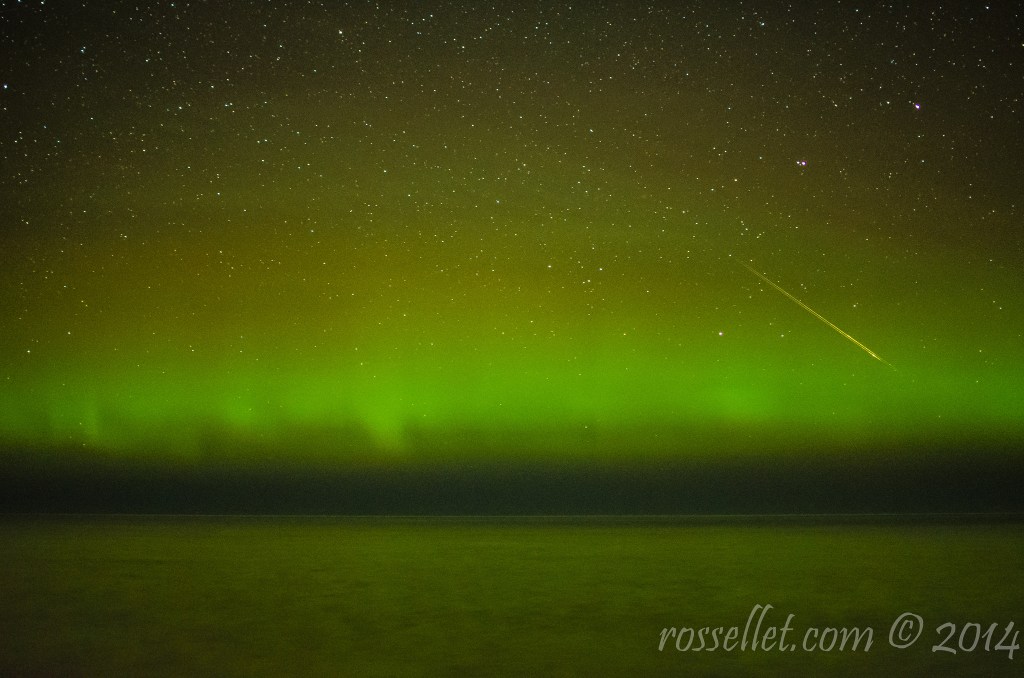
Aurora Fireball by Ross Ellet

I featured this photo 8 years again, but with the incredible run of northern lights we’ve been having and the massive spike in interest in getting out under the night sky coupled with the rise of the Detroit Lions as an NFL superpower, it’s a great time to bring back this feature from Space.com on How to Watch the Leonids Meteor Shower:

The Leonid meteor shower will be active from Nov. 3 to Dec. 2 this year and will peak overnight from Nov. 17 to 18. The Leonids are produced when Earth passes through the debris left behind by comet 55P/Tempel-Tuttle during its highly elliptical orbit around the sun every 33 years. The Leonids are considered some of the fastest meteors, zipping through the sky at 44 miles (71 kilometers) per second, according to NASA. They can also result in impressive fireballs producing long, bright and colorful meteor streaks.

The Leonids’ radiant is located in the sickle-shaped head of the constellation Leo, the lion. Leonid meteor hunting can be incredible, or a total bust. It all depends on where its parent body, Comet 55P/Tempel-Tuttle, will be in its orbit and the kind of debris clumps that will be around when our planet passes through this comet’s orbit. The Leonids put on big shows in 1966, 1999 and 2001, according to AMS, when the comet was making its closest approach to the sun. It will be several years until observers get a big show from the Leonids.

Ross took this photo ten years ago in late September of 2014 and shared:

The sky was cloudy most of the night, but at 3:30am there wasn’t a cloud in the sky. We made our way to the lakeshore and sure enough the northern lights were dim on the northern horizon. At one point you could hear the howl of a distant wolf pack while the northern lights were out. Then moments later a slow move fireball flashed across the sky. It lasted a couple seconds and the brightness pulsed as it moved through the atmosphere. After that the aurora faded, but several more meteors (some very bright) streaked above us.

Ssee more in his Porcupine Mtns gallery on Flickr, and definitely check out Ross Ellet’s Picturesque Adventures for much more!!

Support Michigan in Pictures with Patreon

How to see Comet A3

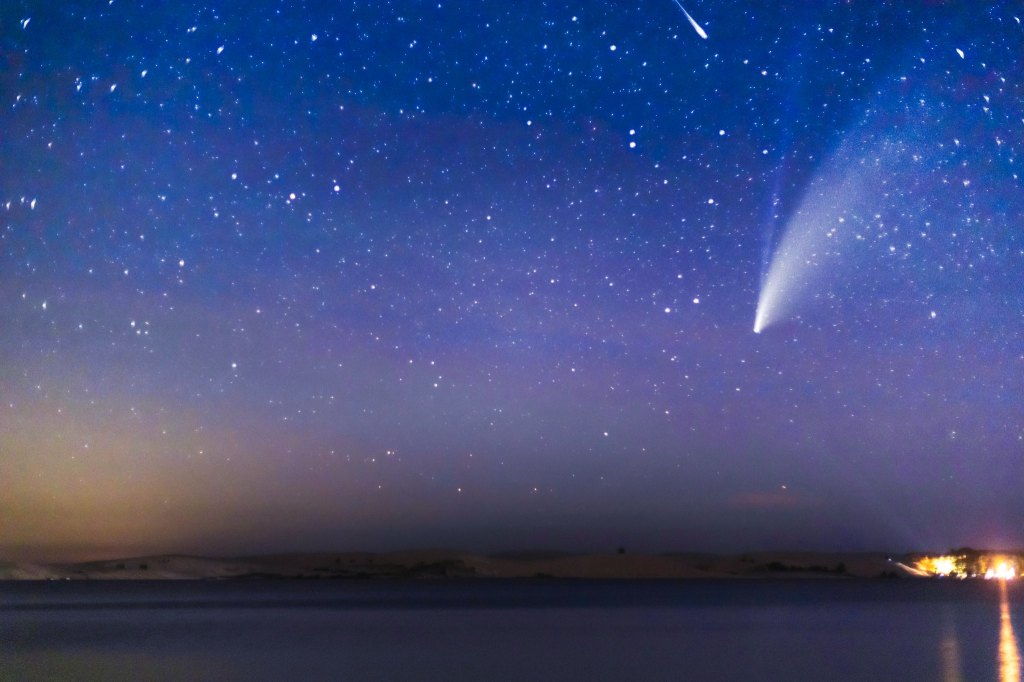
Neowise and meteor by Gary Syrba

There were hopes that Comet C/2023 A3 Tsuchinshan–ATLAS aka Comet A3 would be the comet of the century. While it is not quite that, it does appear that it will be visible for the next couple of weeks just after sunset, even to the naked eye! The good folks at EarthSky offer a helpful checklist to spot Comet A3:

  1. Be sure you’re looking at the correct direction and time. Comet A3 will be visible low in the west after sunset beginning around October 14.
  2. You need a dark, unobstructed sky. Start looking when the sky is dark, but close to sunrise or sunset. Make sure there aren’t hills, trees or buildings blocking your view.
  3. If you can’t see the comet with your eye, try your phone. Most cell phone cameras provide a night or low-light mode. But capturing an image of the comet will require that you hold the camera firmly – or lean against a fixed object like a tree – to avoid shaky or blurred image.
  4. AFTER you’ve located the comet, use binoculars or your eyes to sweep in that area in the sky.

Gary took this shot of Comet Neowise back in July of 2020. See more in his Night Skies gallery on Flickr and view & purchase his work on his website.

Support Michigan in Pictures with Patreon

Earth to get an extra moon on Sunday!

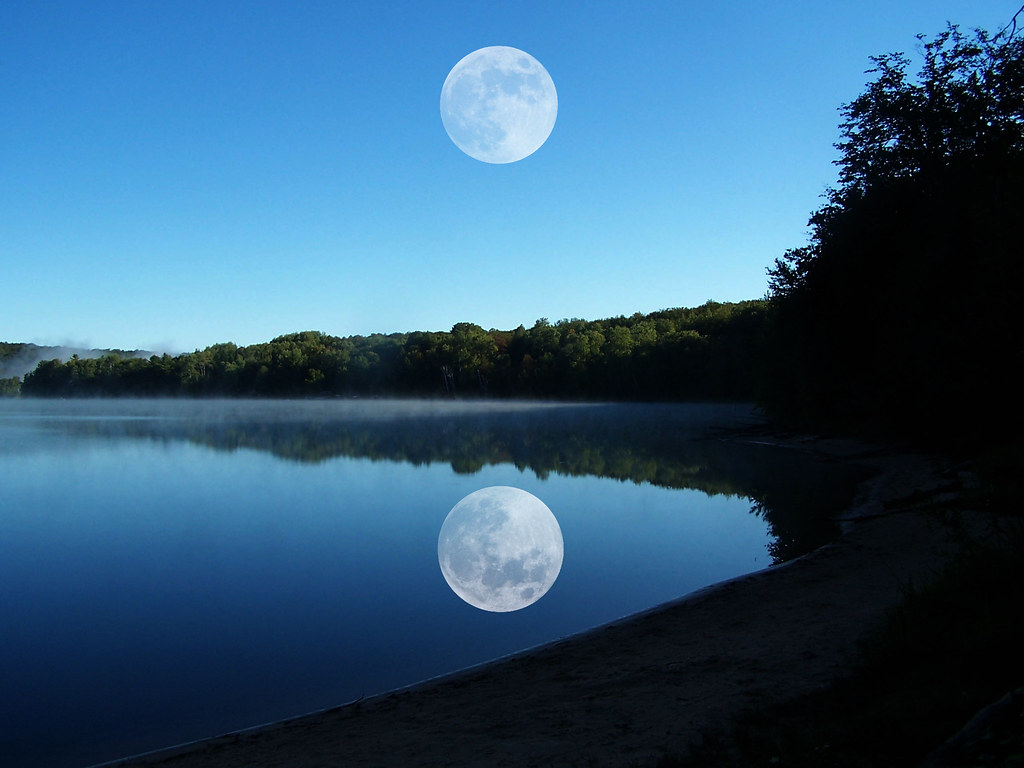
He leads me beside the still waters… by Kathy

CNN shares that the Earth will (briefly) be getting a “mini-moon” on Sunday:

The newly discovered asteroid, named 2024 PT5, will temporarily be captured by Earth’s gravity and orbit our world from September 29 to November 25, according to astronomers. Then, the space rock will return to a heliocentric orbit, which is an orbit around the sun.

…The space rock could be anywhere between 16 and 138 feet (5 and 42 meters) in diameter, potentially larger than the asteroid that entered Earth’s atmosphere over Chelyabinsk, Russia in 2013 … But as a mini-moon, Asteroid 2024 PT5 isn’t in any danger of colliding with Earth now or over the next few decades, de la Fuente Marcos said. The space rock will orbit about 2.6 million miles (4.2 million kilometers) away, or about 10 times the distance between Earth and the moon.

Kathie shares that Thumb Lake in Charlevoix County was foggy and lovely when she took this back in October of 2009. See more in her Top 40 gallery on Flickr. Also I get that we’re all worked up about AI, but please look at the 2009 date of the photo ;)

Support Michigan in Pictures with Patreon

Solstice Strawberry Moon

Lake Michigan … strawberry moon by Ken Scott Photography

Lake Michigan … strawberry moon by Ken Scott Photography

Just like back in 2016 when Ken took this photo of the full moon over Sleeping Bear Bay, we will once again be staring at a big & beautifully full Strawberry Moon close to the summer solstice. According to the Farmer’s Almanac who popularized moon names in the 1930s, “strawberry moon” comes from the Native Algonquian tribes who lived in the northeastern US. The Ojibwe, Dakota & Lakota marked it as the full moon to be harvesting wild strawberries.

European names include the Honey Moon and the Mead Moon. Since June is named after the Roman goddess of marriage, Juno, you gotta believe this is where honeymoon comes from!! This year the moon will be full at 9:08pm tonight (Friday, June 21st).

See lots more at Ken Scott Photography on Facebook & for sure view and purchase his work on his website.

Perseverance: New Mars Rover Lands Today

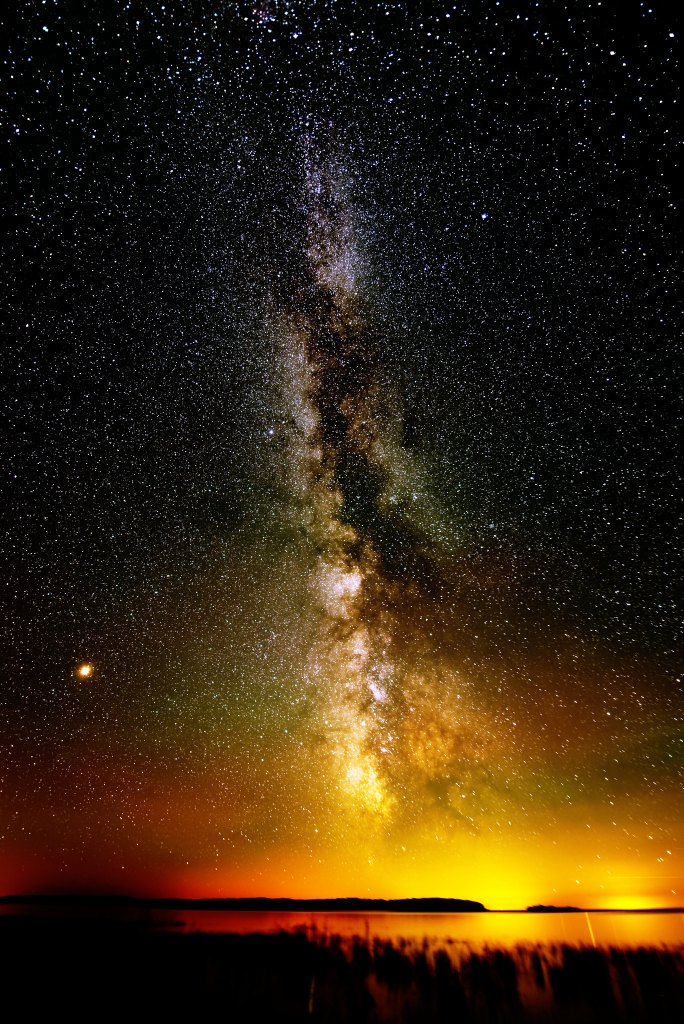
Milky Way + Mars viewed from Garden Peninsula MI by Daniel Sandin

Milky Way + Mars viewed from Garden Peninsula MI by Daniel Sandin

NASA’s Perseverance Rover will land on the surface of Mars today, Feb. 18, 2021 in a search for ancient life that will test the next generation of exploration tools:

Perseverance is the most sophisticated rover NASA has ever sent to the Red Planet, with a name that embodies NASA’s passion, and our nation’s capability, to take on and overcome challenges. It will collect carefully selected and documented rock and sediment samples for future return to Earth, search for signs of ancient microbial life, characterize the planet’s geology and climate, and pave the way for human exploration beyond the Moon.

Perseverance is also ferrying several cutting-edge technologies to the surface of Mars – including a helicopter named Ingenuity, the first aircraft to attempt powered, controlled flight on another planet.

The landing takes place just before 4 PM EST & you can watch online at NASA.

Daniel took this photo back of Mars in July of 2018 on the UP’s Garden Peninsula. See more great night photography on his Flickr & for sure check out his website – he looks like a very interesting guy!

Here’s NASA’s YouTube stream which goes live around 2 PM today.

Support Michigan in Pictures with Patreon

#TBT: Remembering the Crew of Apollo 1

Remembering the Crew of Apollo 1

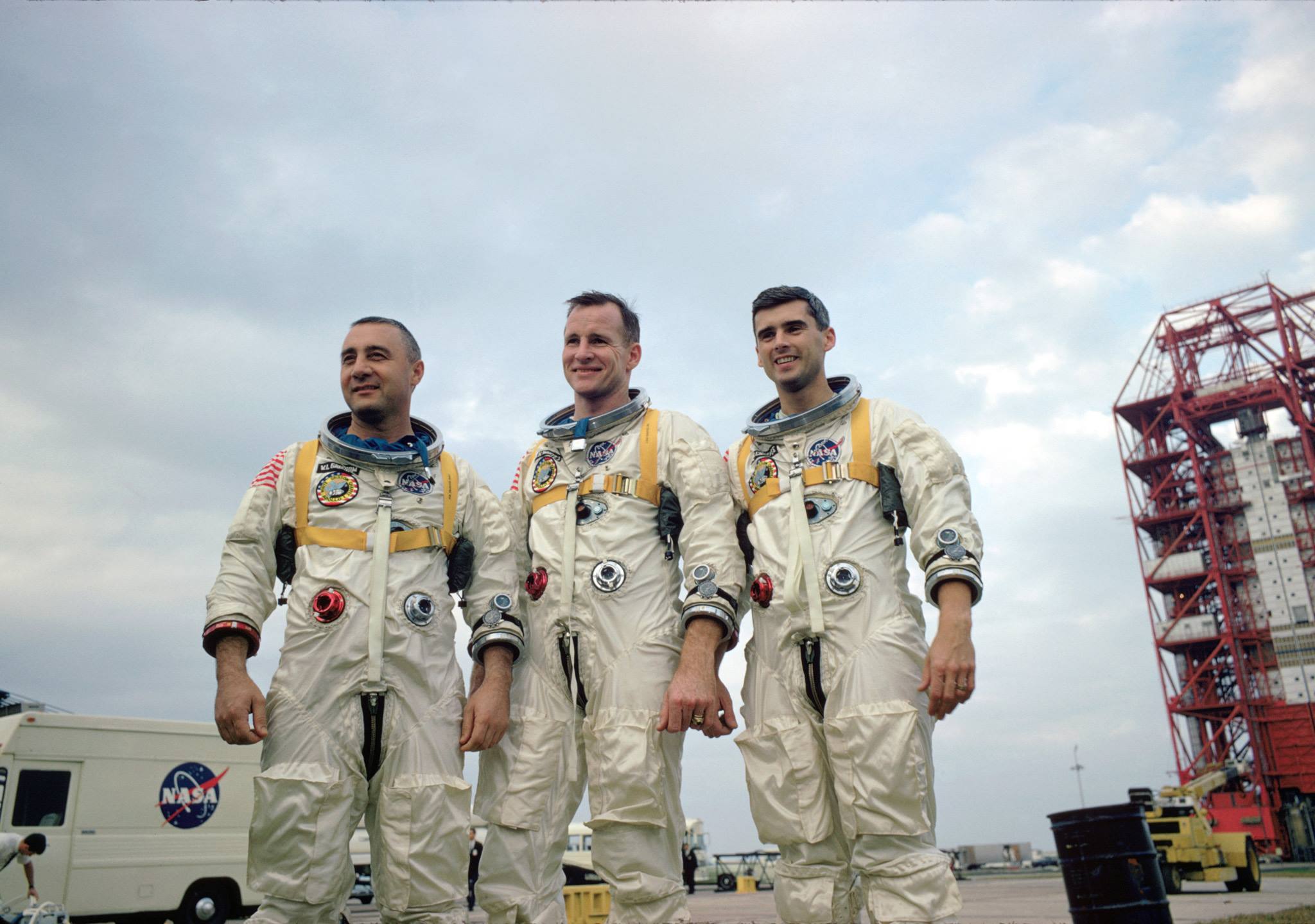
Remembering the Crew of Apollo 1, photo by NASA

“You’ll be flying along some nights with a full moon. You’re up at 45,000 feet. Up there you can see it like you can’t see it down here. It’s just the big, bright, clear moon. You look up there and just say to yourself: I’ve got to get up there. I’ve just got to get one of those flights.”
-Roger Chaffee (The New York Times, January 29, 1967, p. 48.)

Thanks to longtime Michigan in Pictures contributor Rudy Malmquist for the find on this. By total coincidence, Rudy will be back tomorrow with a photo!!

The National Air & Space Museum at the Smithsonian shared this photo yesterday, saying:

Remembering the crew of Apollo 1. On January 27, 1967, astronauts Virgil I. “Gus” Grissom, Edward H. White II, and Roger B. Chaffee perished in a fire during a pre-launch test for what was to be the first crewed Apollo mission.

Rudy pointed out that Chaffee was from Grand Rapids, and you can read a very detailed biography on Roger B. Chaffee from NASA’s History Office.  Here’s a few choice bits about his early life … and here’s hoping that Michigan in Pictures readers can do their best to instill a love of service, science and following ones dreams in the young folk in their lives:

“On my honor, I will do my best…” are the first eight words of the Scout Oath for the Boy Scouts of America. Individually, the words are short and simple. Collectively, however, they speak volumes and serve to inspire millions of boys to strive for excellence. Lieutenant Commander Roger Bruce Chaffee was a Scout for whom the Oath was more than just mere words. He took the pledge to heart and accepted the challenge to fully live the words of the Oath. Whether he was meticulously hand crafting items from wood or training to be the youngest man ever to fly in space, Chaffee always did his best by putting one hundred percent of himself into the effort.

…Earlier in his career, Don Chaffee had been a barnstorming pilot who flew a Waco 10 biplane. He was a regular sight at fairgrounds and made a bit of extra money on the side by transporting passengers. He also piloted planes for parachute jumpers. Later, Don worked for Army Ordnance in Greenville and in 1942, he was transferred to the Doehler-Jarvis plant in Grand Rapids, Michigan where he served as Chief Inspector of Army Ordnance.

Don shared his love of flying with his son and at the age of seven, Roger enjoyed his first ride in an airplane when the family went on a short excursion over Lake Michigan. Although it was a relatively brief flight, Roger was absolutely thrilled. To satisfy his continued interested in planes, Don set up a card table in the living room where he and Roger would create model airplanes piece by piece. By the time he was nine, Roger would point to a plane flying overhead and predict, “I’ll be up there flying in one of those someday”.

…By the time Roger was fourteen, he had developed an interest in electronics engineering and tinkered with various radio projects in his spare time. In high school, he received excellent grades and maintained a 92 average. Vocational tests showed that Roger’s strongest abilities were in the area of science. He also scored high mechanically and artistically. Mathematics and science were his favorite subjects, with chemistry being particularly appealing. Once the family switched to a gas heating system, Roger transformed the outdated coal bin area into his own private workshop where he spent countless hours experimenting with his chemistry set. By the time he was a junior in high school, he was leaning toward a career as a nuclear physicist. As a senior, he established a lofty goal for himself: he wanted to someday have his name written in history books. Before the world’s super powers took their first halting steps into space, Roger Chaffee had shared his dream of being the first man on the moon with his closest friends.

Here’s an article about the fire, and if you’re in Grand Rapids, check out the Roger B Chaffee Planetarium at the Grand Rapids Museum.

Into the cold clear night with Shawn Malone … and NASA

Shawns Comet

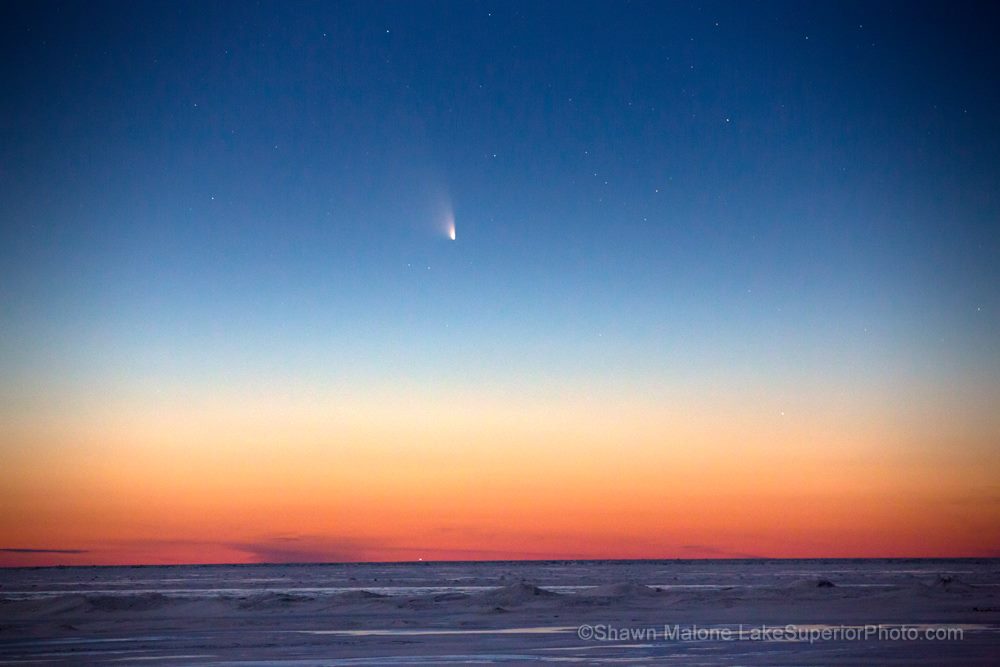
Comet Pan-Starrs over Headlands International Dark Sky Park, photo by Shawn Malone/Lake Superior Photo

Michigan in Pictures regular Shawn Malone of Lake Superior Photo is one of the best photographers of the Michigan night sky around, and on the evening of November 22nd , you have a chance to learn from her at a Night Sky Workshop. She writes:

The Upper Peninsula of Michigan is a wonderful place to discover the magic of night sky photography, due to the abundance of easily accessible dark sky locations. These night sky workshops are designed for those looking for a basic understanding of the equipment and technique necessary for capturing the night sky.

Photography workshops will take place at LakeSuperiorPhoto- gallery/studio on 211 S. Front, Marquette Mi. 49855. There will be an hour class at the studio where I will cover techniques for capturing night sky photos, from basic camera set up and settings, to a brief discussion of post processing to helpful websites and software to help you come away with great night sky photos.

During this workshop we will concentrate on the techniques necessary to capture low light and night sky photos. Hopefully the weather cooperates and we have a chance to photograph the stars or maybe even possibly the northern lights. No matter what weather conditon – we will conduct the workshop and you will come away with everything you need to know about capturing great night sky images.

She has 4 spaces left – click here to register!

You can purchase this photo of Comet Panstars at Lake Superior Photo. Be sure to follow her at Lake Superior Photo on Facebook and see more of Shawn’s photos on Michigan in Pictures.

Speaking of comets, NASA’s Rosetta Mission is going to go all Bruce Willis on a comet THIS MORNING! EarthSky reports:

The Philae (fee-LAY) lander is scheduled to touch down on Comet 67P/Churyumov-Gerasimenko on November 12, 2014 at 10:35 a.m. EST (15:35 UTC). We on Earth – 300 million miles (500 million km) away – won’t know the lander has set down successfully until a signal is received back at about 11:02 a.m. EST (16:02 UTC). Both NASA and ESA will provide live online coverage of this first-ever attempted landing on a comet.

Rosetta spacecraft will do the equivalent of transferring an object from one speeding bullet to another, when it tries to place its Philae lander on its comet. Read more about the mission’s dramatic attempt to land on a comet here.

After landing, Philae will obtain the first images ever taken from a comet’s surface. It also will drill into the surface to study the composition and witness close up how a comet changes as its exposure to the sun varies.

Philae can remain active on the surface for approximately two-and-a-half days. Its “mothership” – the Rosetta spacecraft – will remain in orbit around the comet through 2015. The orbiter will continue detailed studies of the comet as it approaches the sun for its July 2015 perihelion (closest point), and then moves away.

Click through for more and follow it live from NASA right here!

NASA turns 55

Milky Way - Silos

Milky Way – Silos, photo by eddy.matt

“To reach for new heights and reveal the unknown so that what we do and learn will benefit all humankind.”
~NASA’s Vision

On July 29, 1958, President Dwight D Eisenhower signed the  National Aeronautics and Space Act that established the National Aeronautics and Space Administration aka NASA. While I don’t think that we’ve seen quite the advances we expected after making it to the moon in just over a decade, NASA has evolved into a science agency that is engaged in an incredible range of operations from theoretical research (warp drive is my current favorite) to monitoring our planet, solar system and the visible universe (measuring Northern Lights and roving Mars) to a permanent presence in space (I watched NASA TV live from the International Space Station this morning) and plans for a manned Mars mission.

Check Matthew’s photo out bigger and see more in his slideshow. This photo is a still from a gorgeous time-lapse on the Leelanau Peninsula that he did last year in July.

More space on Michigan in Pictures!