
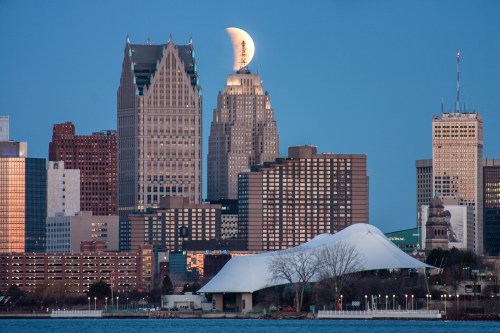
Lunar Eclipse at the Penobscot, photo by Tom Hughes
Sorry that I missed highlighting last weekend’s eclipse. Please accept Tom’s photo as a substitute!
View it bigger on Flickr and see more in his Detroit slideshow.
Lunar Eclipse at the Penobscot, photo by Tom Hughes
Sorry that I missed highlighting last weekend’s eclipse. Please accept Tom’s photo as a substitute!
View it bigger on Flickr and see more in his Detroit slideshow.
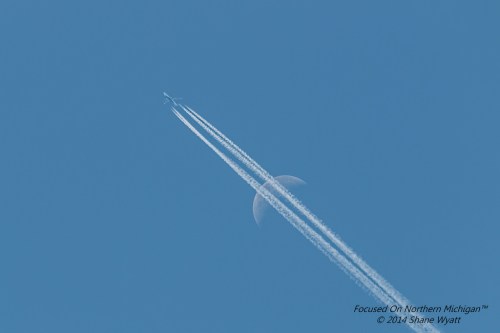
Something Special in the Air, photo by Shane Wyatt
A reminder that The Lunar Express boards early tomorrow morning for a total eclipse of the October full moon. The partial umbral eclipse begins at 5:15 AM EDT on October 8, with the total eclipse starting at 6:25 AM, peaking at 6:55 and ending at 7:24.
Get all the details on the Super Hunter’s Blood Moon in eclipse from Michigan in Pictures!
View Shane’s photo bigger and see more of Shane’s moon photos right here.
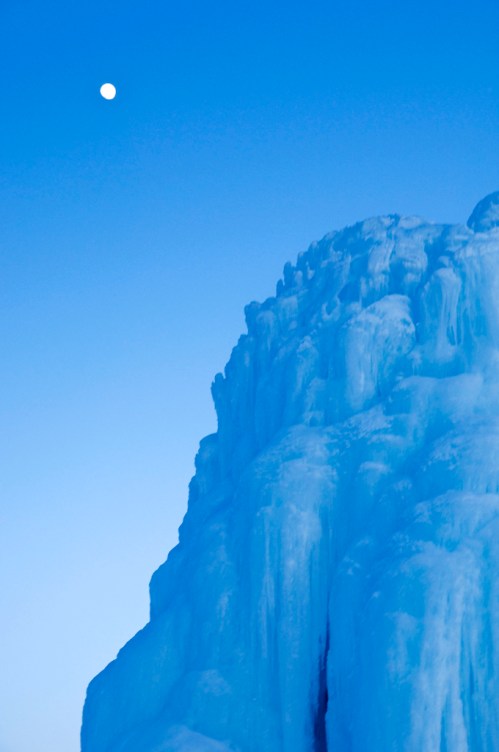
The Moon and the Ice Blob, photo by Cherie
One of the cool things about having a Michigan photo group with nearly 200,000 photos to draw from is that I can find a photo for pretty much any post. Thanks all of you who share in the Absolute Michigan photo group!
Bruce McClure and Deborah Byrd have a nice feature on one of my favorite blogs EarthSky titled What is a Supermoon? It begins:
We in astronomy used to call them perigean new moons or perigean full moons, that is, new or full moons closely coinciding with perigee – the moon’s closest point to Earth in its orbit. But, in accordance with the rapidly evolving skylore of the modern world, we now enjoy calling them supermoons. The name supermoon was coined by an astrologer, Richard Nolle, over 30 years ago. It was popularized and came to be the accepted term for most people only in the past few years.
Are supermoons hype? In our opinion … gosh, no, just modern folklore. And they can cause real physical effects, such as larger-than-usual tides. The year 2014 has a total of five supermoons. They are the two new moons of January, and the full moons of July, August and September. Next supermoon: July 12.
Read on for more about tonight’s supermoon and supermoons in general.
Of course, the supermoon isn’t the only natural phenomenon enjoying hype this weekend, because our old friend the Polar Vortex is returning for an encore. Or not, according to Dr Jeff Masters of Weather Underground in the Freep:
It is not, however, the second coming of a polar vortex, something the National Weather Service says it regrets tweeting earlier this week.
Weather Underground meteorology director Jeff Masters says the weather pattern is similar to those dreaded words, but the key difference is that the chilly air mass isn’t coming directly from the arctic.
Masters says that Typhoon Neoguri in Japan altered the path of the jet stream and allowed polar air to spill out of Canada. That means next week’s temperatures will be as much as 15 degrees cooler than normal in the Midwest and could reach 90 in the normally temperate Pacific Northwest.
More at the Freep and also check out mLive meteorologist Mark Torregrossa’s take on the battle between El Nino and the Polar Vortex. He talks about El Nino’s chances to push the jet stream northward. If it’s not strong enough, winter 2015 could be ruled by the polar vortex again. Go El Nino, Go El Nino!
Cherie took this photo in February of 2009 on Belle Isle. See it bigger on Flickr and see more in her Belle Isle Slideshow.
More supermoons and more polar vortex on Michigan in Pictures!
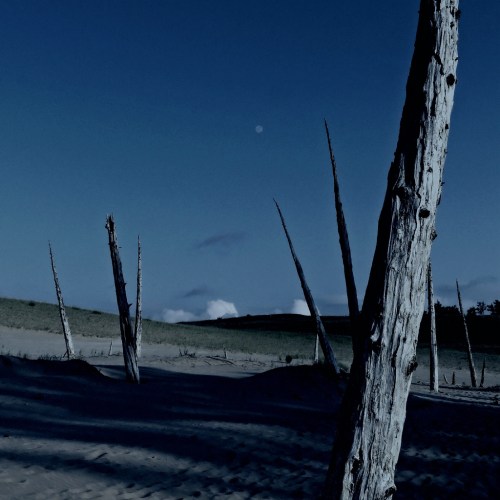
Inside the Ghost Forest, photo by jimflix!
There’s an eclipse of the full moon tonight! It begins at 2 AM Eastern time with the total eclipse lasting 78 minutes and starting about 3 AM. While the forecast is not great, it looks like there’s a chance that those brave souls who trade sleep for a shot at viewing the eclipse won’t be disappointed.
Eastern Daylight Time (April 15, 2014)
Partial umbral eclipse begins: 1:58 a.m. EDT on April 15
Total eclipse begins: 3:07 a.m. EDT
Greatest eclipse: 3:46 a.m. EDT
Total eclipse ends: 4:25 a.m. EDT
Partial eclipse ends: 5:33 a.m. EDT
If you’re up in the Sleeping Bear Dunes area, they are having a star party tonight. If anyone knows of other viewing gatherings, post them in the comments! If the eclipse ends up getting clouded out locally, you can always take to the net and watch via the live stream from the Griffith Observatory. As I wrote about last week, this eclipse is the first of four total eclipses without a partial in between known as a Lunar Tetrad.
This photo is of the ghost forest on Sleeping Bear Point created when sand of the world’s largest shifting sand dune covered living trees.
View Jim’s photo background bigtacular and see more in his Sleeping Bear Dunes slideshow.
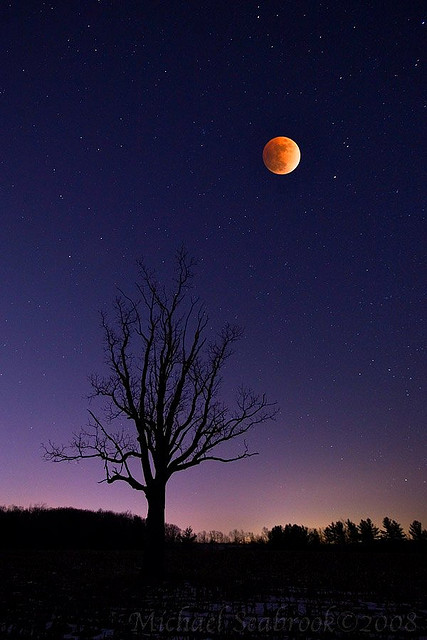
Shadow Moon, photo by Michael Seabrook
For as long as we know, celestial signs have been read to signify calamity and change, and apparently the total lunar eclipse in the early morning hours of April 15, 2014 that kicks off a two-year tetrad of lunar eclipses is no exception.
In What is a Blood Moon? on one of my favorite blogs, EarthSky, Bruce McClure and Deborah Byrd explain (in part) a subject you might be hearing about this week:
We’ve been receiving a number of inquiries about Blood Moons in 2014 and 2015. The Blood Moons most people are asking about are not part of astronomy. Their origin is religious, at least according to Christian pastor John Hagee, who wrote a 2013 book about Blood Moons. However, both astronomers and some proponents of Christian prophesy are talking about the upcoming lunar tetrad – a series of total lunar eclipses – which begins on the night of April 14-15, 2014. We at EarthSky don’t have any special knowledge about the purported Blood Moons of Biblical prophesy. But, since they’re moons, and since people are asking us, we wanted to reply.
The full moon nearly always appears coppery red during a total lunar eclipse. That’s because the dispersed light from all the Earth’s sunrises and sunsets falls on the face of the moon at mid-eclipse. Thus the term blood moon can be and probably is applied to any and all total lunar eclipses…
Both astronomers and followers of certain Christian pastors are talking about the lunar tetrad of 2014-2015. What is a tetrad? It’s four successive total lunar eclipses, with no partial lunar eclipses in between, each of which is separated from the other by six lunar months (six full moons)
We’re not experts on prophecy of any kind. But we’ll tell you what we know about the new definition for Blood Moon that has raised so many questions recently.
From what we’ve been able to gather, two Christian pastors, Mark Blitz and John Hagee, use the term Blood Moon to apply to the full moons of the upcoming tetrad – four successive total lunar eclipses, with no partial lunar eclipses in between, each of which is separated from the other by six lunar months (six full moons) – in 2014 and 2015. John Hagee appears to have popularized the term in his 2013 book Four Blood Moons: Something is About to Change.
As if we didn’t have enough to look forward to on April 15th! Read on for lots more. The four eclipses are this one, October 8 2014 and April 4 & September 28, 2015. Here’s the eclipse viewing times for Michigan – times for other time zones can be found on EarthSky.
The April 15th eclipse begins at 2 AM Eastern time when the edge of the moon first enters the amber core of Earth’s shadow. Totality occurs during a 78 minute interval beginning around 3 o’clock in the morning on the east coast, midnight on the west coast. Weather permitting, the red moon will be easy to see across the entirety of North America.
Eastern Daylight Time (April 15, 2014)
Partial umbral eclipse begins: 1:58 a.m. EDT on April 15
Total eclipse begins: 3:07 a.m. EDT
Greatest eclipse: 3:46 a.m. EDT
Total eclipse ends: 4:25 a.m. EDT
Partial eclipse ends: 5:33 a.m. EDT
Michael took this photo of the lunar eclipse on February 20, 2008. View it bigger and see more in his The Moon slideshow.
More of the moon on Michigan in Pictures!
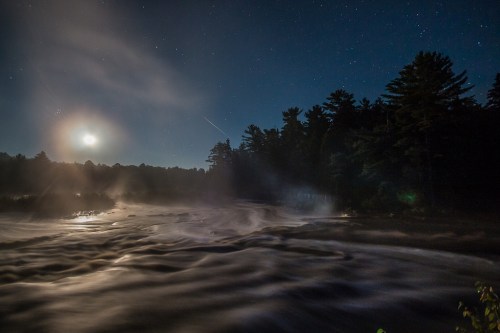
Misty Moonrise, photo by ShaneWyatt
Here’s a gorgeous shot of the moon rising over the mist of Lower Taquamenon Falls – Shane caught a shooting star too!
View his photo bigger and see more including another night shot at the falls in Shane’s stars slideshow.
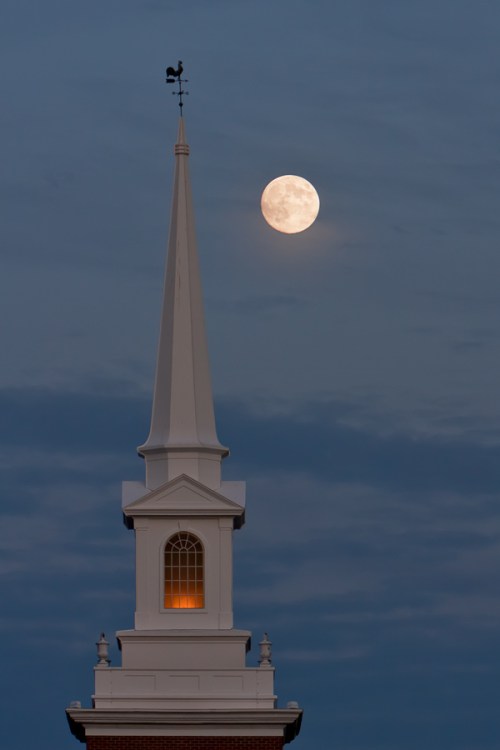
Church of the Hunter’s Moon, photo by Kevin’s Stuff
Deborah Byrd is the founder of one of my favorite sites , EarthSky. Her article Everything you need to know: Hunter’s Moon 2013 explains:
If you’re in the Northern Hemisphere, look for the moon to be bright and full-looking for several nights around October 18, 19 and 20. Around all of these nights, you’ll see a bright round moon in your sky, rising around the time of sunset, highest in the middle of the night. This procession of moonlit nights is what characterizes a Hunter’s Moon.
…the full moon after the Harvest Moon, which is the full moon nearest the autumnal equinox. In the Northern Hemisphere, the Harvest Moon sometimes falls in September and sometimes falls in October. So the Hunter’s Moon sometimes falls in October and sometimes in November.
But the Hunter’s Moon is also more than just a name. Nature is particularly cooperative around the time of the autumn equinox to make the full moonrises unique around this time. Here’s what happens. On average, the moon rises about 50 minutes later each day. But when a full moon happens close to the autumnal equinox – either a Harvest or a Hunter’s Moon – the moon (at mid-temperate latitudes) rises only about 30 to 35 minutes later daily for several days before and after the full moon.
Why? The reason is that the ecliptic – or the moon’s orbital path – makes a narrow angle with the evening horizon around the time of the autumn equinox. The narrow angle of the ecliptic results in a shorter-than-usual rising time between successive moonrises around the full Hunter’s Moon. These early evening moonrises are what make every Hunter’s Moon special. Every full moon rises around sunset. After the full Hunter’s Moon, you’ll see the moon ascending in the east relatively soon after sunset for a few days in a row at northerly latitudes.
Read on for more and definitely subscribe to their email!
Kevin is our go-to guy for all things astronomical. Check his photo out bigger and see more in his The Moon slideshow.
Lots more moon fun on Michigan in Pictures!
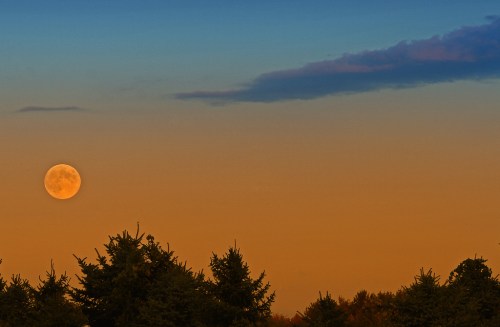
Harvest Moon, photo by eyesontheskies
Shine on, shine on harvest moon up in the sky,
I ain’t had no lovin’ since January, February, June or July
Snow time ain’t no time to stay outdoors and spoon,
So shine on, shine on harvest moon, for me and my gal.
~Shine On Harvest Moon, Nora Bayes and Jack Norworth (1903)
The best known moon of the year (probably in large part due to that song) is the Harvest Moon. It’s the full moon nearest the autumnal equinox and is full the night of September 18th. EarthSky.org has a nice article about the Harvest Moon that explains that for all its mystique, the Harvest Moon is just an ordinary full moon:
Still, you might think the Harvest Moon looks bigger or brighter or more orange. That’s because the Harvest Moon has such a powerful mystique. Many people look for it shortly after sunset around the time of full moon. After sunset around any full moon, the moon will always be near the horizon. It’ll just have risen. It’s the location of the moon near the horizon that causes the Harvest Moon – or any full moon – to look big and orange in color.
The orange color of a moon near the horizon is a true physical effect. It stems from the fact that – when you look toward the horizon – you are looking through a greater thickness of Earth’s atmosphere than when you gaze up and overhead. The atmosphere scatters blue light – that’s why the sky looks blue. The greater thickness of atmosphere in the direction of a horizon scatters blue light most effectively, but it lets red light pass through to your eyes. So a moon near the horizon takes on a yellow or orange or reddish hue.
…The shorter-than-usual time between moonrises around the full Harvest Moon means no long period of darkness between sunset and moonrise for days in succession. In the days before tractor lights, the lamp of the Harvest Moon helped farmers to gather their crops, despite the diminishing daylight hours. As the sun’s light faded in the west, the moon would soon rise in the east to illuminate the fields throughout the night.
You can read on for more.
Check this photo from September 2012 out bigger and see more in eyesontheskies’ Phases slideshow.
More about the harvest moon on Michigan in Pictures!

Over the moon, photo by TBPICKS
The 1896 book Myths and Legends of our Own Land by Charles M. Skinner relates a rather gruesome version of the tale of the origin of Whitefish, which this photo reminded me of.
An Indian who lived far in the north was so devoted to the chase that he was never at home for the whole of a day, to the sorrow of his two boys, who liked nothing so much as to sport with him and to be allowed to practise with his weapons. Their mother told them that on no account were they to speak to him of the young man who visited the lodge while their father was away, and it was not until they were well grown and knew what the duty of wives should be that they resolved to disobey her. The hunter struck the woman dead when he learned of her perfidy. So greatly did her spirit trouble them, however, that they could no longer abide in their old home in peace and comfort, and they left the country and journeyed southward until they came to the Sault Sainte Marie.
As they stood beside the falls a head came rolling toward them on the earth—the head of the dead woman. At that moment, too, a crane was seen riding on the surface of the water, whirling about in its strongest eddies, and when one of the boys called to it, “O Grandfather, we are persecuted by a spirit; take us across the falls,” the crane flew to them. “Cling to my back and do not touch my head,” it said to them, and landed them safely on the farther shore.
But now the head screamed, “Come, grandfather, and carry me over, for I have lost my children and am sorely distressed,” and the bird flew to her likewise. “Be careful not to touch my head,” it said. The head promised obedience, but succumbed to curiosity when half-way over and touched the bird’s head to see what was the matter with him. With a lurch the crane flung off his burden and it fell into the rapids. As it swept down, bumping against the rocks, the brains were pounded out and strewn over the water. “You were useless in life,” cried the crane. “You shall not be so in death. Become fish!” And the bits of brain changed to roe that presently hatched to a delicate white fish, the flesh whereof is esteemed by Indians of the lakes, and white men, likewise. The family pitched a lodge near the spot and took the crane as their totem or name-mark. Many of their descendants bear it to this day.
The version I read in one of my all-time favorite books, Lore of the Great Turtle : Indian Legends of Mackinac Retold by Dirk Gringhuis is pretty dark as well. Michigan in Pictures has a post with all the information about Sandhill Cranes in Michigan, and you can also check out Sandhill Crane (Grus canadensis) from the Michigan DNR.
View this out on black and see more in Todd’s slideshow.
More birds on Michigan in Pictures.
 Michigan in Pictures