#TBT Jungle Love in Prehistoric Michigan

Jungle Love, photo by Matt Stangis

The Rapidian has a feature on prehistoric Michigan’s tropical seas, jungles and inhabitants that’s a great read and the ultimate Throwback Thursday! Here’s a small slice:

After about 60 million years, warm, shallow seas came down again from the Arctic and covered Michigan during the Silurian period. At this time the land would have been in a subtropical climate that gave rise to large coral reefs across the state. Fossil findings show that the largest and oldest reef extends through the center of the Upper Peninsula. A species of coral that lived during this time period would eventually become fossilized and become what we refer to as Petoskey Stones.

The seas retreated over time, leaving a desert scattered with fossilized remains that eventually formed the limestone that is located over one hundred and twenty feet below us today. The sections of this exposed limestone is what created the Grand Rapid’s famous rapids. Much of the salt deposits that were left from retreating seas of this period are still mined in Detroit.

The Devonian period around 400 million years ago saw the rise of vertebrates in Michigan. North America was covered with up to 40 percent of water. There were a great number of fish swarming the salt and fresh water seas. The Ganoid species were in a crude state of evolution. Many of them had armor plating with two of their relatives, the Gar Pike and the Sturgeon, still existing in Great Lakes today. Primitive plants, such as the seed fern, developed from marine algae. On land the Tiktaalik, the link between finned fish and early amphibians, started to use its muscular fins to drag itself around land.

…At the end of the Carboniferous Period, known as the Pennsylvanian subperiod, Michigan was a semi-tropical jungle featuring primitive vegetation. Ferns without bark, some of which bloomed scentless unattractive flowers, grew to almost 100 feet. Millions of generations of trees grew and died in the jungle. The trees that fell in the swampy parts of the jungle were covered up by water and soil that became rock over time. The forces of time and pressure on these trees would eventually see this prehistoric jungle become the coal basin that sits underneath a large area of the U.S. including the upper northeast part of Kent county.

In the sky above one foot long dragon flies swarmed in droves on the ground and cockroaches the size of a man’s palm crawled around. Reptiles started to appear, evolving from amphibians, not dependent on water to lay their amniotic eggs. Towards the end of this period the rain forests gave way to deserts which decreased the amphibian populations and caused an evolutionary shift in reptiles.

Definitely click through for more – there are some cool links as well!

I’m pretty sure Matt took this photo at ArtPrize in 2013. View it background bigilicious and see more in his slideshow.
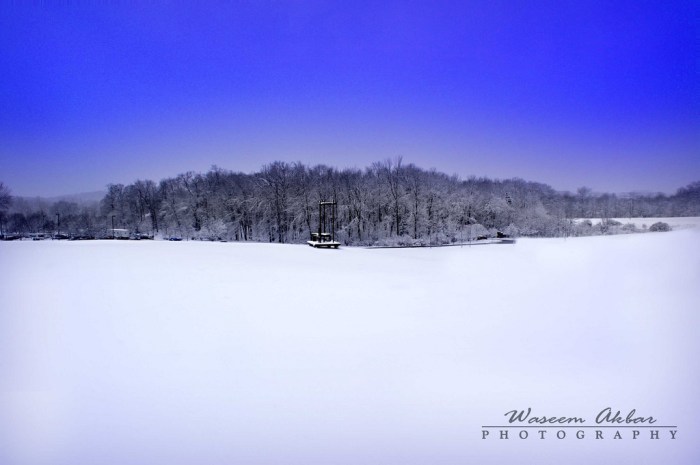

Of winter & spring

Winters, photo by Waseem Akbar

“If we had no winter, the spring would not be so pleasant: if we did not sometimes taste of adversity, prosperity would not be so welcome.”
-Anne Bradstreet

Am I the only one who feels like Winter really mailed it in this year? Still, I am not going to stand in the way of the cycle of the seasons – bring on the Spring!

View Waseem’s photo bigger and see more in his slideshow.
22-Degree Radius Halo

22 degrees at Van’s Beach, photo by Andrew McFarlane

Atmospheric Optics is an excellent resource for rainbows and similar phenomena. Their page on 22-degree halos says:

22º radius halos are visible all over the world and throughout the year. Look out for them (eye care!) whenever the sky is wisped or hazed with thin cirrus clouds. These clouds are cold and contain ice crystals in even the hottest climes.

The halo is large. Stretch out the fingers of your hand at arms length. The tips of the thumb and little finger then subtend roughly 20°. Place your thumb over the the sun and the halo will be near the little finger tip. The halo is always the same diameter regardless of its position in the sky. Sometimes only parts of the complete circle are visible.

Much smaller coloured rings around the sun or moon are a corona produced by water droplets rather than ice crystals.

Lots more at Atmospheric Optics!

See the photo bigger and view more on my Instagram.

More rainbows, sundogs, etc. on Michigan in Pictures – seriously cool stuff in here folks!

A Little Light Changes Everything

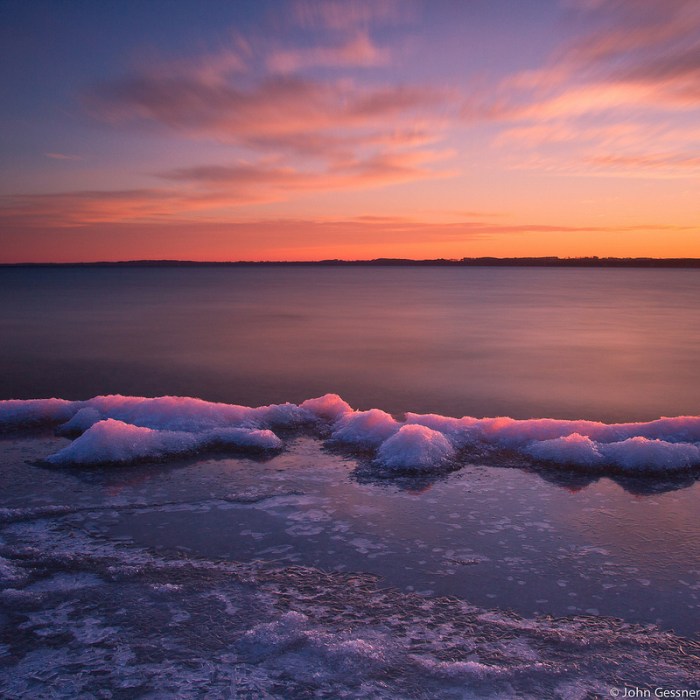
A Little Light Changes Everything, photo by John Gessner

I hope that you get a chance to get out there this weekend and let the sunlight in!

View John’s photo bigger and see more in his Michigan Water slideshow.

May you find your pot of gold on St Patrick’s Day

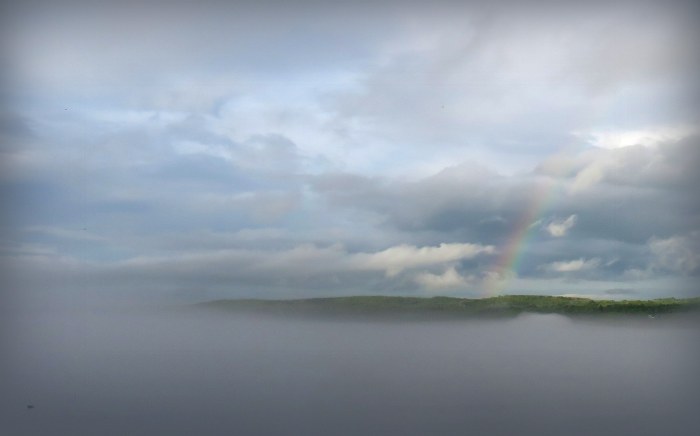
Rainbow and fog bank over the Pictured Rocks National Lakeshore, photo by Ann Fisher

May you have all the happiness
And luck that life can hold
And at the end of your rainbows
May you find a pot of gold.
~ Old Irish Blessing

A very happy St. Patrick’s Day and health & good fortune to you all!

View Ann’s photo background bigtacular and see more in her 2016 UP slideshow.

Lots more St. Patrick’s Day on Michigan in Pictures!

Michigan Tough: Daffodil Edition

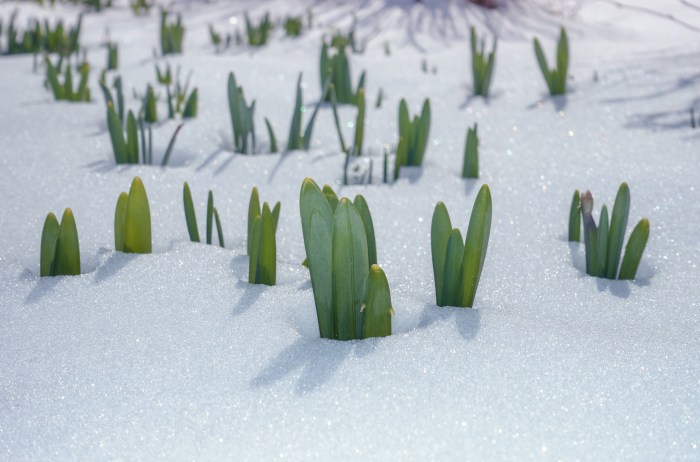
Hopefully the daffodils are tougher than I am, photo by Bill Dolak

Bill took this shot yesterday at Celery Flats Park in Portage where it got down into the teens the night before.

View the photo background bigilicious and see more in his Portage, Michigan slideshow.

More spring wallpaper on Michigan in Pictures.

Mission: Possible

Will do ANYTHING for corn, photo by Julie A Christiansen

Dare to dream!

View Julie’s photo bigger on Facebook and see more including what looks to be a shot of the landing in her Wildlife slideshow.

Speed limits (and probably fatalities) going up in Michigan

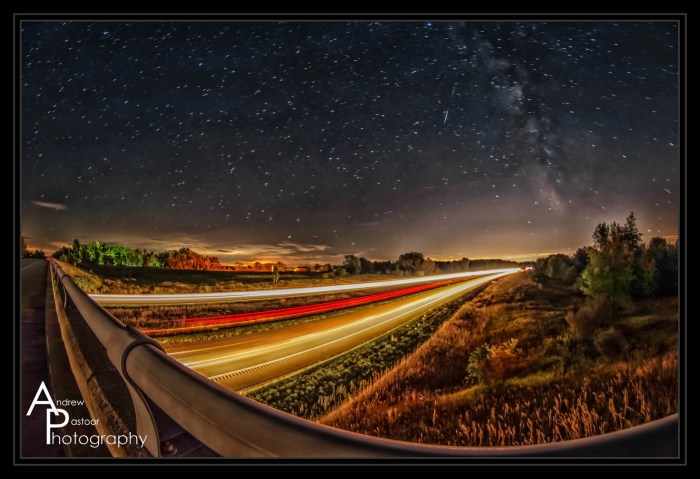
September 13 – Stars and Cars Part 4, photo by Andrew Pastoor

I was on the fence about posting this, but after I found this cool photo I just had to! Michigan Radio reports that a new law directing the Michigan Department of Transportation to increase speed limits to 75 miles an hour on up to 600 miles of rural highways in the state will have consequences:

Russ Rader of the Insurance Institute for Highway Safety says there’s decades of research proving that more people will die as a result. For every five miles’ increase in the speed limit on interstates and highways, says Rader, fatal crashes increase 8%.

He says Michigan is not alone; many other states are also raising speed limits. He says very high speeds cancel out the life-saving features on cars like seat belts and front air bags.

“In 2013 alone, speed limit increases resulted in about 1900 additional deaths,” says Rader. “That would essentially cancel out the number of lives saved that year from front air bags.”

Read on for more and get more about the law from mLive, It will go into effect following studies.

View the photo bigger and see more in Andrew’s Project 365 | 2014 slideshow,

Michigan House at SXSW

Flint Eastwood, photo by Joel Williams

A big thing that’s happening right now is the South By Southwest festival in Austin, Texas. SXSW celebrates the convergence of the interactive, film, and music industries and is ground zero for the future of media. I was gratified to learn through my friend Seth Bernard (who’s at SXSW) that a number of Michigan artists, organizations and companies have partnered for Michigan House, an effort spearheaded by Creative Many Michigan. Creative Many is a statewide organization focused on developing creative people, creative places and the creative economy for a competitive Michigan.

They have some cool things on the schedule including a Michigan music showcase featuring Flint Eastwood and the Go Rounds, so if you’re in Austin, definitely drop by and in any case, check out the folks who are taking Michigan messages to the world!

View Joel’s photo bigger and see more in his Favorites slideshow.


Detroit’s Immigrant Workers

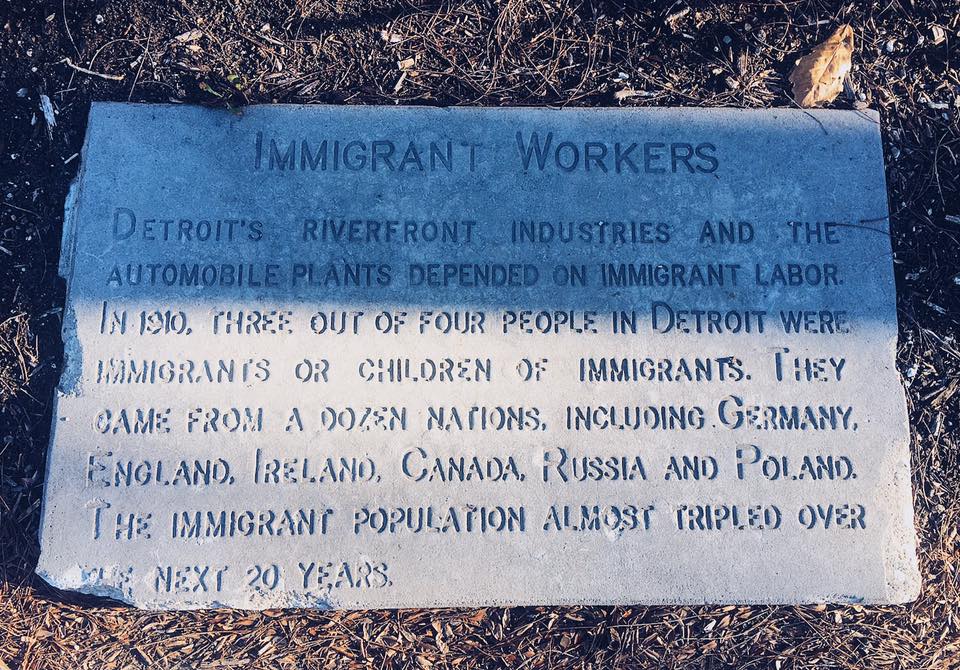
Immigrant Workers, photo by Ryan Southen

3 out of 4 people in 1910 were immigrants or the children of immigrants. Wow. Ryan shared this photo on Facebook and wrote:

I stumbled upon this stone along the riverfront this afternoon. This region is what it is today because people came here seeking opportunity, or refuge and we are absolutely better for it. Something to ponder the next time you find yourself discussing immigration.

As the descendent of immigrants to the Detroit area, I completely agree. Crain’s Detroit Business has a nice feature by about how foreign-born workers have been an integral part of Detroit’s history, economy. It says in part:

Detroit once was the third-largest U.S. settlement for immigrants, said Kurt Metzger, the retired founder of Data Driven Detroit who spent nearly 40 years compiling information and statistical analysis locally.

“In 1930, the foreign-born accounted for almost 30 percent of Detroit’s population. The data show that more immigrants settled in Detroit between 1900 and 1920 than any other city but Chicago and New York,” Metzger said via email.

“The makeup of Detroit — European (Poles, Germans, Ukrainians, etc.) was heavily influenced by the national quota system that either forbid certain groups (Asians, for instance) or maintained extremely small quotas.”

The second, much broader and more diverse wave of immigration began around 1970 after Washington relaxed the quota system on a wide variety of groups, he said.

“We began to see large flows of Chaldeans from Iraq, Muslims from Lebanon and other areas of the Middle East, Asians from Taiwan, India, the Philippines, Albanians, Puerto Ricans and Mexicans,” he said. “Since that time, we have added, through war and displacement, Hmong, Cambodian and Vietnamese, Chaldeans, Syrians, Yemeni, and many more.

…Foreign-born workers and their families helped swell Detroit’s population to nearly 2 million people at its 1950 peak.

Ryan doesn’t have this pic on his Flickr, but you can see a lot of great shots from Detroit and elsewhere there and by following Ryan Southen Photography on Facebook.