
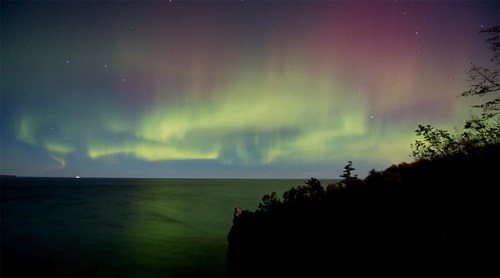
Northern Lights, photo by gkretovic
Michigan in Pictures has a whole lot on the Northern Lights.
The aurora borealis are one of the world’s most rare and wonderful sights and Michigan – especially the Upper Peninsula – is blessed with more than a few nights every year when this elusive phenomenon makes an appearance.
The Library of Congress page What Are the Northern Lights? calls on NASA’s Dr. Sten Odenwald, author of The 23rd Cycle, Learning to Live with a Stormy Star, to provide insight to how northern lights are formed:
The origin of the aurora begins on the surface of the sun when solar activity ejects a cloud of gas. Scientists call this a coronal mass ejection (CME). If one of these reaches earth, taking about 2 to 3 days, it collides with the Earth’s magnetic field. This field is invisible, and if you could see its shape, it would make Earth look like a comet with a long magnetic ‘tail’ stretching a million miles behind Earth in the opposite direction of the sun.
When a coronal mass ejection collides with the magnetic field, it causes complex changes to happen to the magnetic tail region. These changes generate currents of charged particles, which then flow along lines of magnetic force into the Polar Regions. These particles are boosted in energy in Earth’s upper atmosphere, and when they collide with oxygen and nitrogen atoms, they produce dazzling auroral light.
We focus on the beauty, but as he explains:
“Aurora are beautiful, but the invisible flows of particles and magnetism that go on at the same time can damage our electrical power grid and satellites operating in space. This is why scientists are so keen to understand the physics of aurora and solar storms, so we can predict when our technologies may be affected.”
Dr. Odenwald’s book is out of print but he has made it available online. There’s some interesting stuff in there, and be sure to check out his Astronomy Cafe site too.
One benefit from the economic & security concerns of predicting space weather is that you can get some great northern light forecasts. My favorite is NOAA’s Space Weather Service. They reported a G1 storm on March 1st – it’s the lowest intensity on the Space Weather Scales but as you can see is still able to produce auroral activity!
Greg took this photo Saturday night just before midnight at Presque Isle in Marquette – check it out on black and in his slideshow. You can see more of Greg’s work on Michigan in Pictures, at michigannaturephotos.com and definitely follow him at Michigan Nature Photos on Facebook.
Share Michigan in Pictures:





 Michigan in Pictures
