Spraymasters Water Ski Club: Skis Optional

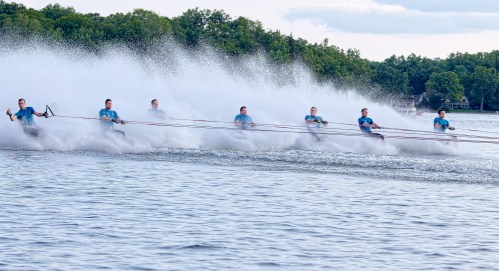
Barefoot Ski Line

Barefoot ski line, photo by Mark Zacks

This looks like fun. The Spraymasters Water Ski Club says:

Our team was founded in 1987 by Bob Dowling. We have continued to grow and perform since then. For anyone unfamiliar with show skiing, it is made up of exciting acts that are not normally seen in recreational water skiing. These acts include barefooting, ballet line, doubles, swivel skiing, and pyramids up to four tiers high.

Throughout the summer, we perform our themed shows at our home site on Big Lake in Davisburg, Michigan. We also perform numerous shows for other lake associations and organizations around the state. Furthermore, Spray Masters is a part of the National Show Ski Association (NSSA). The team competes in several tournaments each summer as a team as well as individual performances.

The team starts preparing for each season before the ice is even off the lake. Beginning in February we practice in a gym learning the new moves we are going to perform that year. We practice pyramid climbing, doubles, trios, showmanship and dances. We usually start water practices in May and practice twice a week on Tuesdays and Thursdays throughout the summer. Our first show is usually in late June, and continue through late August.

Head over to their website for a calendar of their performances.

View Mark’s photo background big and see more of his lake photos on Flickr.

More summer wallpaper on Michigan in Pictures.
A Conflagration of Storms: The March 13, 1989 Solar Storm

Conflagration of Storms

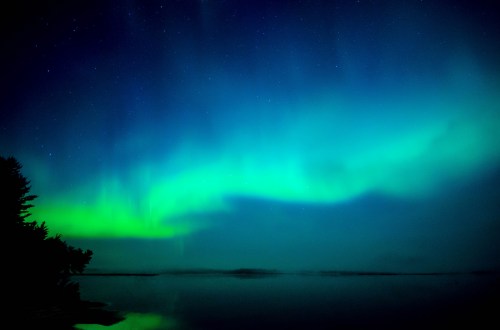
Northern Lights, photo by Stephen Tripp

Intense colors from the rare Great Aurora painted the skies around the world in vivid shapes that moved like legendary dragons. Ghostly celestial armies battled from sunset to midnight. Newspapers that reported this event considered the aurora, itself, to be the most newsworthy aspect of the storm. Seen as far south as Florida and Cuba, the vast majority of people in the Northern Hemisphere had never seen such a spectacle. 
~Dr. Sten Odenwald

I like to revisit this March 13, 1989 incident documented by Dr. Odenwald in A Conflagration of Storms. In addition to being an amazing display of the aurora borealis, this solar storm took down Quebec’s power network and very nearly much more:

In many ways, the Quebec blackout was a sanitized calamity. It was wrapped in a diversion of beautiful colors, and affected a distant population mostly while they slept. There were no houses torn asunder, or streets flooded in the manner of a hurricane or tornado. There was no dramatic footage of waves crashing against the beach. There were no cyclonic whirlwinds cutting a swath of destruction through Kansas trailer parks. The calamity passed without mention in the major metropolitan newspapers, yet six million people were affected as they woke to find no electricity to see them through a cold Quebec wintry night. Engineers from the major North American power companies were not so blasé about what some would later conclude, could easily have escalated into a $6 billion catastrophe affecting most U.S. East Coast cities. All that prevented 50 million more people in the U.S. from joining their Canadian friends in the dark were a dozen or so heroic capacitors on the Allegheny Power Network.

The Media seemed to have missed one of the most human impacts of the beautiful aurora they so meticulously described in article after article. Today the March 1989 ‘Quebec Blackout’ has reached legendary stature, at least among electrical engineers and space scientists, as an example of how solar storms can adversely affect us. It has even begun to appear in science textbooks. Fortunately, storms as powerful as this really are rather rare. It takes quite a solar wallop to cause anything like the conditions leading up to a Quebec-style blackout. When might we expect the next one to happen? About once every ten years or so, but the exact time is largely a game of chance.

Call it the ultimate Friday the 13th! The whole book The 23rd Cycle:Learning to live with a stormy star is available online, and you can read a lot more from Dr. Odenwald at his website, The Astronomy Cafe or at facebook.com/AstronomyCafe.

View Stephen’s photo bigger and see more in his excellent Northern Lights slideshow.

A whole lot more northern lights on Michigan in Pictures!

PS: Keep an eye on solar storminess and get heads up notifications when the northern lights might be visible at NOAA’s Space Weather Prediction Center.

North Bar Lake

North Bar Lake by Sarah Hunt

North Bar Lake, photo by Sarah Hunt

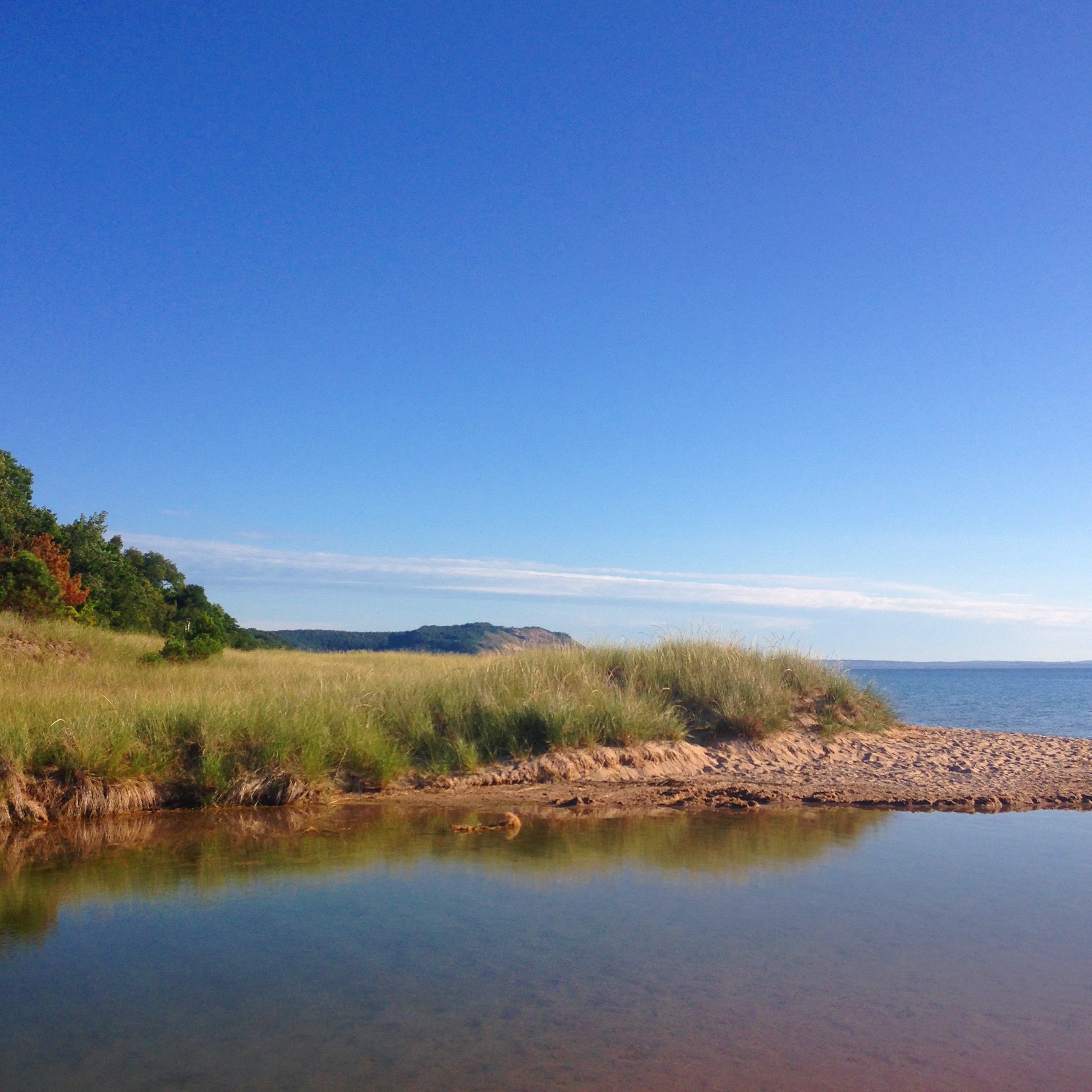
Who’s ready for a break from snow & ice? The Sleeping Bear Dunes National Lakeshore page on the North Bar Lake Overlook says (in part):

The name describes how the lake formed: it is ponded behind a sand bar. At times, the sand bar builds up and separates North Bar Lake from Lake Michigan. At other times, a small connecting channel exists between the two lakes. North Bar Lake occupies part of a former bay on Lake Michigan. This ancient bay was flanked by headlands on both sides: Empire Bluffs on the south and Sleeping Bear Bluffs on the north. Shorelines have a natural tendency to become straighter with time. Wave action focuses on the headlands and wears them back, while shoreline currents carry sediment to the quiet bays and fill them in. Deeper parts of the bay are often left as lakes when sand fills in the shallower parts.

The same process that formed North Bar Lake also formed many of the other lakes in northern Michigan: Glen, Crystal, Elk and Torch Lakes, for example.

Here’s more about the geology of the Sleeping Bear and more about North Bar Lake, to which I’d add that the lake is a great place for skim boards because the channel between North Bar & Lake Michigan is only a few inches deep!

Sarah took this photo last summer. Click it to view background bigalicious and check out lots more of her incredible and adventurous photography at instagram.com/oni_one_.

PS: If you’re still not full-up on winter and ice, might I suggest this pic she took in this area of Sleeping Bear last week!

Fall color on Grand Sable Lake

Fall Colors On Grand Sable Lake

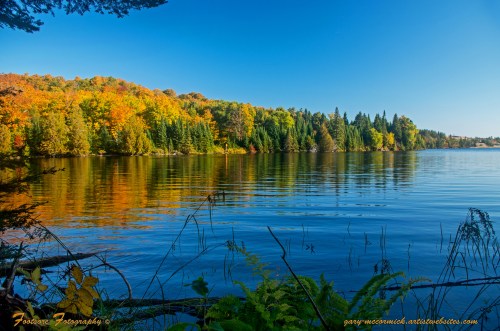
Fall Colors On Grand Sable Lake, photo by Gary McCormick

Gary took this back in September at Grand Sable Lake in the Pictured Rocks National Lakeshore.

Get it background bigtacular and see more in his Grand Marais, MI slideshow.

More Fall wallpaper & more Pictured Rocks on Michigan in Pictures.

Fall Morning

Fall Morning

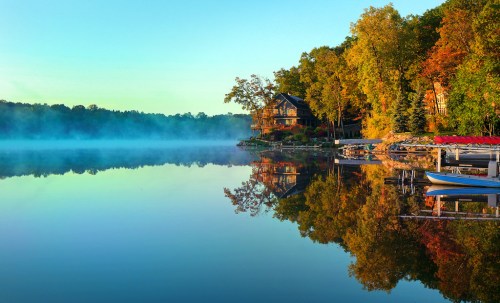
Fall Morning, photo by Steve

I bet your day starts out pretty well with a view like this.

View Steve’s photo bigger and see more in his LX7 slideshow.

When a young man’s fancy turns to …

I guess it really IS spring . . .

I guess it really IS spring…, phoot by Dr. Farnsworth

Thing number 757 about Michigan that I think is cool: you can ride bikes on lakes.

Dale writes:

…AHH Spring, when a young man’s fancy turns towards . . . riding around the lake ON the lake! Still very much frozen solid in western Michigan! Temps tonight well below freezing, a few inches of snow predicted, and people are riding on the ice on fat bikes! Have a good “spring” week Facebook and Flickr friends!

View his photo from Twin Lakes on his map, background big and see more in massive Best of West Lake slideshow.

More winter wallpaper and more biking on Michigan in Pictures.

Bete Gris blaze

Bete Gris

Bete Gris, photo by tinettip

Peter writes: Grey Wolf in French. Bête Gris is part of the Keweenaw Peninsula in Upper Michigan. Check his photo out background bigtacular and jump into his slideshow for more!

More from Bete Gris on Michigan in Pictures.

Algae Blooms threaten Lake Erie

like an oil slick

like an oil slick, photo by 1ManWithACamera

I’d like to offer an apology of sorts for this photo. It goes like this: “I’m really, really sorry that I sometimes have to blog photos of the ugly things that threaten what’s beautiful in Michigan. I wish I didn’t have such a good reason to!”

Michigan has only the tiniest sliver of Lake Erie shoreline, so little that we sometimes forget that it is one of the lakes that define our Great Lakes State. Lake Erie served once at the canary in the coal mine for pollution of the Great Lakes, and it may once again be sounding a warning call. A recent front page of the New York Times featured scary news about algae blooms on Lake Erie:

For those who live and play on the shores of Lake Erie, the spring rains that will begin falling here soon are less a blessing than a portent. They could threaten the very future of the lake itself.

Lake Erie is sick. A thick and growing coat of toxic algae appears each summer, so vast that in 2011 it covered a sixth of its waters, contributing to an expanding dead zone on its bottom, reducing fish populations, fouling beaches and crippling a tourism industry that generates more than $10 billion in revenue annually.

…Dead algae sink to the lake bed, where bacteria that decompose the algae consume most of the oxygen. In central Lake Erie, a dead zone now covers up to a third of the entire lake bottom in bad years.

“The fact that it’s bigger and longer in duration is a bad thing,” said Peter Richards, a senior research scientist at the National Center for Water Quality Research at Heidelberg University in Ohio. “Fish that like to live in cold bottom waters have to move up in the thermocline, where it’s too warm for them. They get eaten, and that tends to decrease the growth rates of a lot of the fish.”

Read on for a whole lot more including how farming practices are intersecting with invasive zebra mussels and climate change to magnify the dangers.

Larry’s photo is from Lake Huron and shows a different kind of algal bloom. I got some similar ones on Lake Michigan, and the folks at Michigan Sea Grant have a whole album of them.

See it on black, view happier shots in his Caseville & Port Austin slideshow and see more of Larry’s work on Michigan in Pictures.

More Lake Erie on Michigan in Pictures.

Weird Wednesday: South Arm Nessie

South Arm Nessie

South Arm Nessie, photo by Cvx_Wx

Absolute Michigan has been known to hold Weird Wednesdays on the last Wednesday of every month. Our Michigan Sea Monsters post featured two denizens of the deep courtesy Linda Godfrey’s Weird Michigan, the Sea Monster of the Straits and the Lake Leelanau Monster:

The story of an early 20th Century sea monster sighting was sent to The Shadowlands Web site by a reader whose great-grandfather was the witness. The boy was fishing for perch one day in 1910 in the shallows of Lake Leelanau in Leelanau County. The lake had been dammed in the late 1800’s to provide water power for the local mill and to enable logging. The dam also flooded much surrounding area, turning it into swamps and bogs punctuated by dead, standing trees.

On that particular day, the young great-grandfather, William Gauthier, rowed out to a new fishing spot near the town of Lake Leelanau. Looking for good perch habitat, he paddled up close to a tree that he estimated to stand about five feet tall above the water, with a six-inch trunk. He was in about seven feet of water, and after deciding this would be a good place to stop and cast a line, began tying the boat to the tree.

That’s when young William discovered the tree had eyes. They were staring him dead in the face at about four feet above water level. The boy and serpent exchanged a long gaze, then the creature went, “Bloop” into the water. Gauthier said later that the creature’s head passed one end of the boat while the tail was still at the other end, though it was undulating very quickly through the water. The writer noted that Gauthier always admitted to having been thoroughly frightened by his encounter, and that the event caused him to stay off that lake for many years.

The writer added that his great-grandfather came from a prominent area family and was very well-educated, and that he knew others who would admit privately but not publicly that they, too, had seen the creature. No sightings have been reported in recent times, but who knows how many people have believed they were passing by a rotting old cedar when in fact they had just grazed the Leelanau lake monster?

Could the South Arm of Lake Charlevoix hold similar creatures? Check this out big as a beastie and see more in Ed’s My Neighborhood slideshow.

More weird Michigan on Michigan in Pictures!

Pairs Skating, Swan Edition

pairskating

pairskating, photo by mozy54

Lynn writes that she didn’t see this pair in the national ice skating finals. Check it out on black and see a couple more shots of these swans in her slideshow.

More birds on Michigan in Pictures!