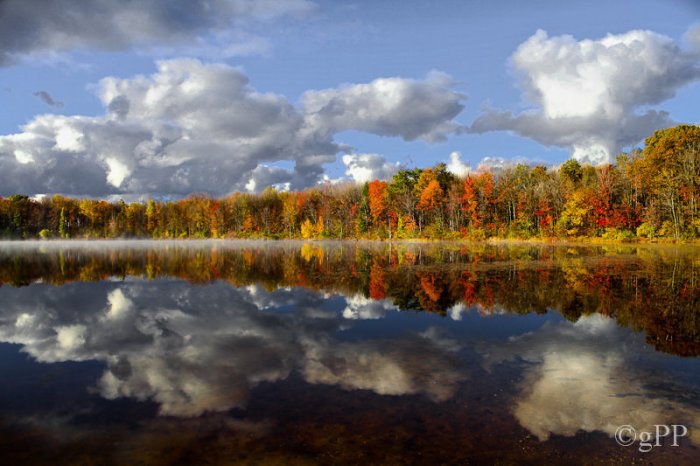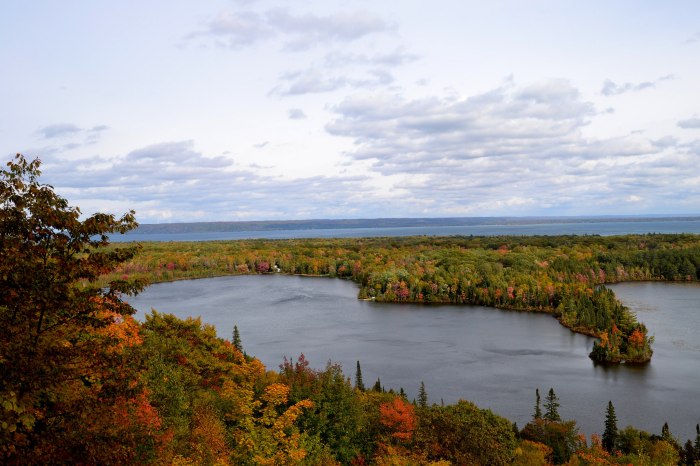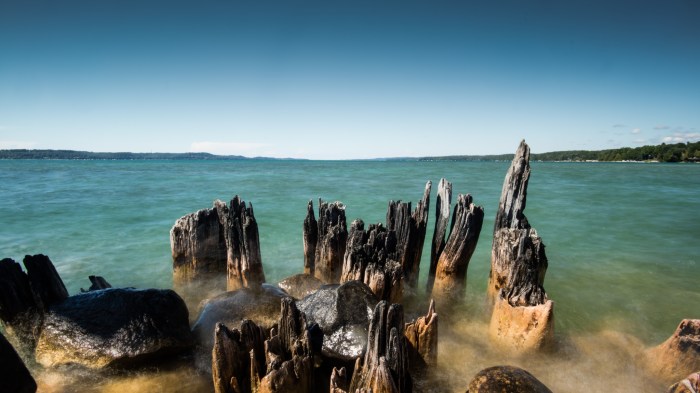
Torch Lake is pretty big

Torch Lake by James Kral

Torch Lake, photo by James Kral

I figured I should follow up Thursday’s Torch Lake photo with more about the lake that is both Michigan’s longest and deepest inland lake. Wikipedia’s Torch Lake entry says (in part):

Torch Lake at 19 miles (31 km) long is Michigan’s longest inland lake and at approximately 18,770 acres (76 km²) is Michigan’s second largest inland lake … Several villages and hamlets lie along its shore, including Alden, Eastport, Clam River, and Torch Lake. The lake is about 17 miles (27 km) northeast of Traverse City and is separated by narrow strips of land from both Grand Traverse Bay on the northwest and Elk Lake at the southwest end. The lake is about two miles (3.2 km) wide and is centered at 44°59′00″N 85°18′30″W. It has a maximum depth of 315 feet (96 m) just off the east end of Campbell Rd. (Milton Twp.) and an average depth of 111 feet (34 m), making it Michigan’s deepest inland lake. It is a popular lake for fishing, featuring lake trout, rock bass, yellow perch, smallmouth bass, muskellunge, Pike, ciscoes, brown trout, rainbow trout, and whitefish.

The name of the lake is not due to its shape, rather, is derived from translation from the Ojibwa name Was-wa-gon-ong meaning “Place of the Torches”, referring to the practice of the local Native American population who once used torches at night to attract fish for harvesting with spears and nets. For a time it was referred to by local European settlers as “Torch Light Lake”, which eventually was shortened to its current name.

View James’ photo background bigtacular and see more in his slideshow.

More Michigan lakes and more summer wallpaper on Michigan in Pictures.
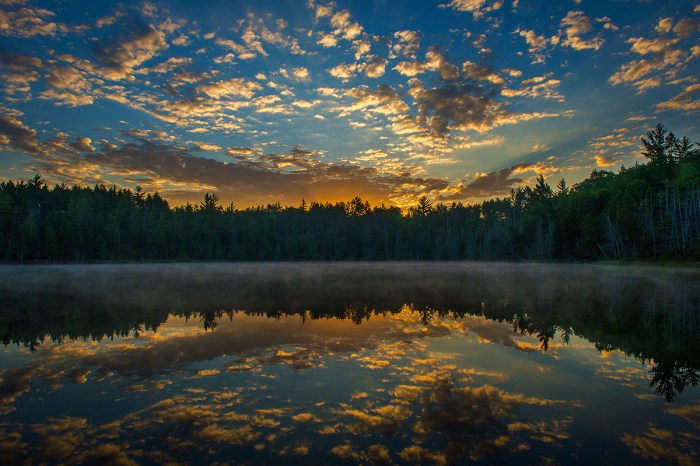
Glory Lake Sunrise and Kettle Lakes

Glory Lake Sunrise

wGlory sunrise 1, photo by Jeff Caverly

The Michigan DNR’s page on Bright and Glory Lakes near Grayling includes maps. They say that both lakes have floating piers & boat launches for fishing – species include largemouth bass, rainbow trout, smallmouth bass, sucker, sunfish, yellow perch:

These lakes are called Kettle Lakes as they are shaped like tea kettles. They are roundish and deep in the center (more than 40 feet). The lake bottom is marl, so wading and swimming are prohibited as people would sink in the marl.

Here’s more about Kettle Lakes from MSU’s Geology department:

Kettles are depressions left behind after partially-buried ice blocks melt. Many are filled with water, and are then called “kettle lakes”. Most lakes in Michigan could be described as kettle lakes, and the term “kettle lake” describes the way the lake basin was formed. Kettle lake basins were formed as the glaciers receded. While this was happening, a block of ice broke off the glacier, and just sat there. As the glacier continued to melt, the debris from the glacier (soil, rocks, stones, gravel, etc.) filled in around the block of ice. When the block of ice finally melted, all the debris surrounding it fell into the hole, creating the kettle type basin, which when filled with water, became a lake as we know it.

Many of our small, deep lakes in Michigan are kettle lakes. Some have since been infilled with vegetation and plant matter, to form bogs. Even some of our larger, deep lakes, like Higgins Lake and Walled Lake, are kettles.

View Jeff’s photo background big, see more including another view of the sunrise in his slideshow, and follow Jeff Caverly Photography on Facebook.

North Bar Lake in Sleeping Bear Dunes

North Bar Lake Sleeping Bear Dunes

North Bar Lake, Sleeping Bear Dunes, photo by jdehmel

The Sleeping Bear Dunes National Lakeshore pages on North Bar Lake and the North Bar Lake Overlook say (in part):

The small lake below is North Bar Lake. The name describes how the lake formed: it is ponded behind a sand bar. At times, the sand bar builds up and separates North Bar Lake from Lake Michigan. At other times, a small connecting channel exists between the two lakes. North Bar Lake occupies part of a former bay on Lake Michigan. This ancient bay was flanked by headlands on both sides: Empire Bluffs on the south and Sleeping Bear Bluffs on the north. Shorelines have a natural tendency to become straighter with time. Wave action focuses on the headlands and wears them back, while shoreline currents carry sediment to the quiet bays and fill them in. Deeper parts of the bay are often left as lakes when sand fills in the shallower parts. The same process that formed North Bar Lake also formed many of the other lakes in northern Michigan: Glen, Crystal, Elk and Torch Lakes, for example.

…North Bar Lake is one of the most popular beaches in the Lakeshore because it has shallow, clear water over a sandy bottom makes for warmer swim than in Lake Michigan. But for those who like the refreshing cool water and wave action of the big lake, you can walk across the low dunes that separate the two lakes in just a couple of minutes. The beaches of pure sand and the small outlet to Lake Michigan is ideal for the kids to play.

View jdehmel’s photo background bigilicious and see more in his Sleeping Bear Dunes slideshow.

More dunes and more summer wallpaper on Michigan in Pictures.
Sailor’s Delight on Crispell Lake

Sailors Delight

Sailor’s Delight, photo by Maury Page

Maury shares:

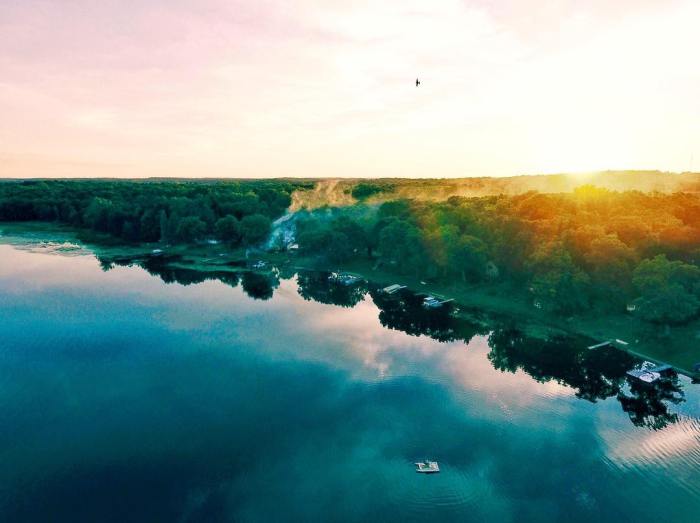
This photo was taken at Crispell Lake in Clarklake, MI on a calm, summer evening. I couldn’t capture the sun rays from where I was standing, so it seemed like a perfect opportunity to get out my new drone. There were only a couple boats on the lake and it was a nice quiet night. When I was capturing this scene it just so happened that a bird flew into the frame at the perfect moment.

Regarding Crispell Lake, Lake Link says:

Crispell Lake is located in Jackson County, Michigan. This lake is 82 acres in size. It is approximately 25 feet deep at its deepest point. Anglers can expect to catch a variety of fish including Black Crappie, Bluegill, Brown Trout, Grass Pickerel, Largemouth Bass, Sunfish, Walleye and Yellow Perch.

View Maury’s photo bigger,  check out more on his Instagram at mopage19 and also on his website.

More lakes on Michigan in Pictures.

The Last Stand at Kensington Metropark

The Last Stand

The Last Stand, photo by Jacqueline Verdun

Huron-Clinton Metroparks explains that Kensington Metropark – a place I used to visit with my grandmother a lot – is one of the most popular parks in Michigan:

Kensington’s 4,481 sprawling acres of wooded, hilly terrain surrounds beautiful Kent Lake, and is home to an abundance of wildlife and waterfowl. Kensington Metropark offers a multitude of recreational activities throughout the year, from biking and boating to cross-country skiing and tobogganing. In addition to striking sunrises and sunsets, 1,200-acre Kent Lake offers plenty of fun activities: swim at Martindale or Maple beaches, get soaked at the Splash ‘n’ Blast, or just spend the day fishing, boating or picnicking along the water. Take a tour of the lake aboard the Island Queen II in the summer and fall. Or, enjoy a winter day ice-fishing or skating on frozen lake waters.

This first-class recreational area also features an 18-hole regulation golf course, 27-hole disc course, nature center, farm center, beautiful picnic areas and scenic hiking and biking trails for hours of enjoyment. With two and a half million visitors every year Kensington Metropark is a favorite place to enjoy Michigan’s natural treasures.

More info, activities, and a map on their website.

View Jacqueline’s photo bigger, see more in her My Best Landscapes slideshow, and also check out her website for more photos.

More Michigan parks and more sunsets on Michigan in Pictures.

Anticipation

Anticipation

Anticipation, photo by Doug Jonas

Who’s looking forward to summer. Anyone?

View Doug’s photo background bigtacular and see more of his spring photos.

Without a doubt warmer

Fancy Anvil

Fancy Anvil, photo by Liz Glass

Every time I talk about things that some find political, there are readers who get uncomfortable/upset. I’m OK with that, especially in regards to today’s subject which I personally feel has moved beyond the realm of opinion and into fact. Your mileage may vary. 

One thing that struck me is that it doesn’t really matter what is causing the warming temperatures – we know that dumping carbon into the atmosphere increases the temperature, so we know how to combat it.

NASA’s Earth Observatory reported that February 2016 was the warmest month in 136 years of modern temperature records in that it deviated more from normal than any month on record since reliable, global records began in 1880. For what this means, let’s turn to Mashable for the implications of this fiery February:

The 1.35-degree Celsius temperature anomaly in February beat the anomaly recorded in January, which itself was a record high departure from average for any month. This means that temperatures in February 2016 had the largest departure from average of any month in NASA’s records since 1880. To put it more plainly, February stands out for its unusual heat more than any other month in the modern climate record.

…As Penn State climate scientist Michael Mann has pointed out via social media, the NASA February temperature findings are especially significant when compared to preindustrial temperatures. Before humans began pumping carbon dioxide into the air from burning fossil fuels like coal and oil, global average surface temperatures were far cooler.

When compared to those conditions, Mann says, February was probably about 2 degrees Celsius, or 3.6 degrees Fahrenheit, above the preindustrial average for the globe.

You can read on for lots more … or not.

View Liz’s photo bigger and see more in her 500+ Views slideshow.

PS: Apologies to Liz for once again using her photo in a possibly controversial post. She’s the owner of Lake Street Market in Boyne City and (as far as I know) not at all controversial! ;)

Red Jack Lake Sunrise

Red Jack Lake Sunrise

Red Jack Lake Sunrise, photo by John Dykstra

View John’s photo background bigilicious and see more in his Michigan slideshow.

Here’s a map to Red Jack Lake near Munising and here’s more Michigan lakes and more fall wallpaper on Michigan in Pictures.
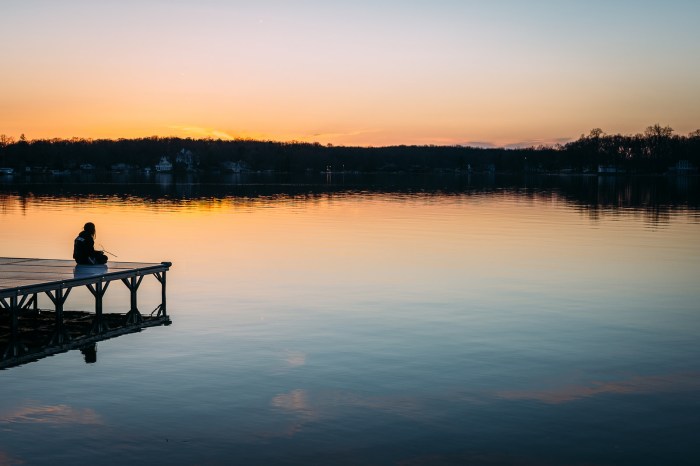
PS: Trying out Facebook’s new photo carousel on the Michigan in Pictures Facebook


Healy Lake Reflections

Healy Lake Fall Color

Healy Lake Reflections, photo by Dorn Gallatin

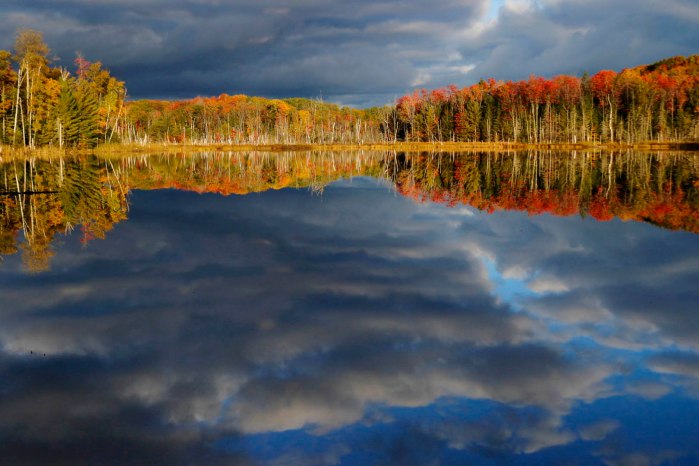
Hope everyone has a great weekend and gets out there to take a big bite out of autumn before winter eats it all!

Here’s a map to Healy Lake, located not far from Onekama. Lake Link’s entry for Healy Lake says:

Healy Lake is located in Manistee County, Michigan. This lake is 39 acres in size. It is 50.00 feet deep at its deepest point. Anglers can expect to catch a variety of fish including Bluegill, Largemouth Bass, Northern Pike, Sunfish and Yellow Perch.

Click to view it bigger and see more in Dorn’s Fall slideshow.

More Michigan lakes on Michigan in Pictures.

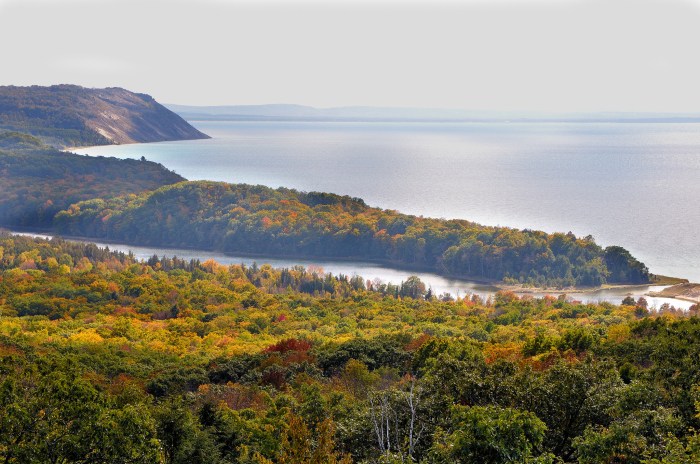
Mission Hill, Spectacle Lake & Fall Color 2015

Mission Hill View Upper Peninsula Michigan

Mission Hill 3, photo by Susan H

Here’s a look-in on the current state of fall color in the northeastern Upper Peninsula. DWHIKE has this to say about the Mission Hill trail, which also affords views of Spectacle Lake & Monocle Lake:

Monocle Lake sits just inland from Lake Superior about a half hours’ drive west of Sault Ste. Marie. Along its south shore is a nice National Forest campground which serves as the trailhead for the days adventure. The Monocle Lake Trail heads east from the swimming area at the south end of the lake for little more than a quarter mile where it splits north and south in to the North Country Trail and the Mission Hill Trail respectively…

Directions to Trailhead: -Take Highway 221 north from M-28 west of Sault Ste. Marie. -Follow Hwy 221 for 2.5 miles, through Brimley, to Lakeshore Drive. -Turn left on Lakeshore Drive, follow it 5 miles to Tower Road on the left. -Follow Tower Road (which changes to dirt as you climb the hill) 1.5 miles to overlook and trailhead on the right.

Click above for a map where you can need both lakes and get more about the Monocle Lake Trail from the DNR.

Susan took this photo on Sunday. View it big as the sky and see more in her UP slideshow.

Lots more Fall wallpaper on Michigan in Pictures!