The Sky Walker of Huron

"Winter Moon" Sturgeon Point , Lake Huron

“Winter Moon” Sturgeon Point, Lake Huron, photo by Michigan Nut

Myths and Legends of our Own Land by Charles M. Skinner (1896) has some incredible stories from Michigan’s first people. Here’s The Sky Walker of Huron:

Here is the myth of Endymion and Diana, as told on the shores of Saginaw Bay, in Michigan, by Indians who never heard of Greeks. Cloud Catcher, a handsome youth of the Ojibways, offended his family by refusing to fast during the ceremony of his coming of age, and was put out of the paternal wigwam. It was so fine a night that the sky served him as well as a roof, and he had a boy’s confidence in his ability to make a living, and something of fame and fortune, maybe. He dropped upon a tuft of moss to plan for his future, and drowsily noted the rising of the moon, in which he seemed to see a face. On awaking he found that it was not day, yet the darkness was half dispelled by light that rayed from a figure near him—the form of a lovely woman.

“Cloud Catcher, I have come for you,” she said. And as she turned away he felt impelled to rise and follow. But, instead of walking, she began to move into the air with the flight of an eagle, and, endowed with a new power, he too ascended beside her. The earth was dim and vast below, stars blazed as they drew near them, yet the radiance of the woman seemed to dull their glory. Presently they passed through a gate of clouds and stood on a beautiful plain, with crystal ponds and brooks watering noble trees and leagues of flowery meadow; birds of brightest colors darted here and there, singing like flutes; the very stones were agate, jasper, and chalcedony. An immense lodge stood on the plain, and within were embroideries and ornaments, couches of rich furs, pipes and arms cut from jasper and tipped with silver. While the young man was gazing around him with delight, the brother of his guide appeared and reproved her, advising her to send the young man back to earth at once, but, as she flatly refused to do so, he gave a pipe and bow and arrows to Cloud Catcher, as a token of his consent to their marriage, and wished them happiness, which, in fact, they had.

This brother, who was commanding, tall, and so dazzling in his gold and silver ornaments that one could hardly look upon him, was abroad all day, while his sister was absent for a part of the night. He permitted Cloud Catcher to go with him on one of his daily walks, and as they crossed the lovely Sky Land they glanced down through open valley bottoms on the green earth below. The rapid pace they struck gave to Cloud Catcher an appetite and he asked if there were no game. “Patience,” counselled his companion. On arriving at a spot where a large hole had been broken through the sky they reclined on mats, and the tall man loosing one of his silver ornaments flung it into a group of children playing before a lodge. One of the little ones fell and was carried within, amid lamentations. Then the villagers left their sports and labors and looked up at the sky. The tall man cried, in a voice of thunder, “Offer a sacrifice and the child shall be well again.” A white dog was killed, roasted, and in a twinkling it shot up to the feet of Cloud Catcher, who, being empty, attacked it voraciously.

Many such walks and feasts came after, and the sights of earth and taste of meat filled the mortal with a longing to see his people again. He told his wife that he wanted to go back. She consented, after a time, saying, “Since you are better pleased with the cares, the ills, the labor, and the poverty of the world than with the comfort and abundance of Sky Land, you may return; but remember you are still my husband, and beware how you venture to take an earthly maiden for a wife.”

She arose lightly, clasped Cloud Catcher by the wrist, and began to move with him through the air. The motion lulled him and he fell asleep, waking at the door of his father’s lodge. His relatives gathered and gave him welcome, and he learned that he had been in the sky for a year. He took the privations of a hunter’s and warrior’s life less kindly than he thought to, and after a time he enlivened its monotony by taking to wife a bright-eyed girl of his tribe. In four days she was dead. The lesson was unheeded and he married again. Shortly after, he stepped from his lodge one evening and never came back. The woods were filled with a strange radiance on that night, and it is asserted that Cloud Catcher was taken back to the lodge of the Sun and Moon, and is now content to live in heaven.

Check John’s photo out bigger and see more in his Lake Huron slideshow.

More Lake Huron on Michigan in Pictures.
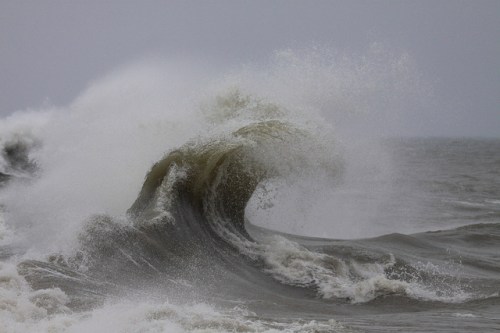
Hurricane Huron: September 11-15th, 1996

Massive Wave at Port Sanilac

September Storm: Port Sanilac, photo by StormchaserMike

Hurricanes in Michigan?? from NOAA looks at several hurricane force storms and has this to say about “Hurricane Huron”:

While this storm was not from remnants of a tropical system, its development over Lake Huron had many uncanny likenesses to tropical systems…

The first likeness was its timing, forming over the Great Lakes right at the height of the typical hurricane season, September 11-15th, 1996. What started as a typical core-cold 500 MB low pressure system evolved into a warm-core system as it settled over the relatively warm waters of the Great Lakes, in particular, Lake Huron. The low pressure system actually had moved past Lake Huron but then retrograded, or was “drawn back”, to the relatively warm waters of Lake Huron. (Similar to the tropics, the Great Lakes usually reach their warmest water temperatures late August into mid September.) The storm then deepened and intensified at the lower levels of the atmosphere compared to aloft, typical of a warm-core low. It is believed that the warm waters of Lake Huron and associated low level instability over the lake were, to a large extent, the major contributing factors in this storm’s evolution. The storm went on to form a broad cyclonic circulation, including the “spiral bands and eye”, typically seen in hurricanes! At one point, the cyclone produced tropical storm force winds (39 – 73 mph) and some of the spiral bands even had rainfall exceeding 10 cm (better than four inches), causing some flooding.

This “Hurroncane” reached its maximum intensity during the day on September 14th, when a central pressure of 29.34 inches (993 MB) was recorded in the late morning by a Lake Huron buoy that fortunately was positioned, at one point, in the “eye”. By 2 PM, that “eye” measured close to 20 miles across and had a ring of tall convective clouds surrounding it, strongly resembling that of an “eye wall”. The convective showers encircled the “eye” well out over 300 miles.

You can read on for more including a satellite photo of the distinctive storm, check out Wikipedia’s entry on the 1996 Lake Huron cyclone, or go straight to the very detailed academic paper on Hurricane Huron that this article draws from.

Check Mike’s photo out bigger and see more in his awesome September Gale on Lake Huron slideshow. Mike also has a cool video of the storm on YouTube!

More hurricane-like weather on Michigan in Pictures.

Turnip Rock Sunrise

Turnip Rock Sunrise (3 of 3)

Turnip Rock Sunrise by David Frey

You may recognize this photographer from his photo of Chapel Rock last month. Turnip Rock has been featured a few times on Michigan in Pictures, but this is definitely the most dramatic photo of it! He writes:

Taking these pictures of “Turnip Rock”, located near Port Austin at the tip of Michigan’s thumb region, was a bit of an adventure. I had seen day time pictures of it before, but thought that it would look its best at sunrise. I decided to make a project of it during the 4th of July weekend. I traveled to Port Austin and in talking to folks there confirmed what I had already read – since it is located just offshore a large private property the only way to visit it is by kayak (about 7 miles round trip). I hesitated a bit since it was my first time in the area and I have not kayaked in decades. Also, in order be there by sunrise meant I would have to paddle out there in the pre-dawn darkness. Having a chance to see it at sunrise turned out to be too tempting, so after finding a hotel room 20 miles away in Bad Axe (closest one available because of the holiday), I put my alarm clock on for 3:45am.

I was on the water by about 4:30am and arrived at Turnip Rock just before the sky started to light up. I have had several outings before where the weather didn’t cooperate, but this time I was lucky and despite the clouds there were some nice colors in the sky. I am pleased with the pictures, but the experience of kayaking out on Lake Huron in the early morning hours is something I will always remember. Look forward to other outings like this, which is one of the reasons I have enjoyed taking up photography again.

Indeed! Your camera is like a dog – it will make you get outside and see cool things! Check this out background bigtacular and see a couple more shots from his kayaking adventure in his slideshow.

Beaches? Sunrises? Lake Huron? Summer wallpaper? Tons more on Michigan in Pictures. Enjoy your holiday weekend!

Turnip Rock in Lake Huron

Turnip Rock

Turnip Rock, photo by SimsShots Photography

A page about the Point Aux Barques – Turnip Rock geocache had the best information I found about this Lake Huron Landmark. The author explains:

This cache is accessible by a kayak, canoe, jet ski or boat on Lake Huron. Port Austin is the closest harbor which is approximately three miles west. The land around this feature is a gated community. I must stress that this cache is only accessible by a water craft via Lake Huron. If you are not comfortable navigating the waters of Lake Huron, do not attempt to do this cache. Lake Huron can be dangerous at times for small water craft such as kayaks or canoes.

…Everyone that received their grade school education in Michigan learned that glaciers pushed their way over Michigan several times. The result is glacial drift averaging 200 to 300 feet deep covering on top of the bedrock. The thickness of drift has measured over 1,000 feet in a few Michigan locations. Rarely can we see exposed bedrock that has been sculptured by non glacier forces. This is one of the locations in southern Michigan where the sandstone bedrock is exposed at the surface. The amount of shoreline that has exposed sandstone is about one mile, but a lot of beauty has been sculptured in the stone.

The locals call the main structure here “Turnip Rock”, because of it’s shape. Geologists call it a “Sea Stack”. A definition of a sea stack is an isolated pillar-like rocky island or mass near a cliff shore, detached from a headland by wave erosion assisted by weathering. Waves force air and small pieces of rock into small cracks, future opening them. The cracks then gradually get larger and turn into a small cave. When the cave wears through the headland, an arch forms. Further erosion causes the arch to collapse. This causes a pillar of hard rock standing away from the coast. Generally occurring in sedimentary rocks, sea stacks can occur in any rock type.

Read on for more and also see the Atlas Obscura entry for Turnip Rock has a map and photos. Michigan in Pictures favorite Lars Jensen has some great photos of Turnip Rock as well, and you should definitely check out Jason Glazer’s panoramic photos of Turnip Rock.

Check this out background big and see more in Rob’s Landmarks slideshow.

More Michigan landmarks on Michigan in Pictures.

Pancake Ice

Pancake Ice

Pancake Ice, photo by ChiliFrei64

I believe that Daniel took this photo in Lexington. Check it out background bigtacular and see more in his Water slideshow.

More ice on Michigan in Pictures.

Low Point for the Great Lakes

Low water levels, West Arm Grand Traverse Bay

Low water levels, West Arm Grand Traverse Bay, photo by michiganseagrant

On Michigan in Pictures I usually blog beautiful things, but today I’m featuring an ugly thing that we in Michigan should all be concerned about. Traverse City based Circle of Blue has an in-depth feature on the record-low level of Lake Michigan-Huron:

The latest numbers released by the U.S. Army Corps of Engineers on February 5 show that both lakes Michigan and Huron — which are two connected lakes — are experiencing their lowest point since records began in 1918. Water levels were an average of 175.57 meters (576.02 feet) for the month of January, approximately 2.5 centimeters (1 inch) lower than the previous record set in 1964.

“Not only have water levels on Michigan-Huron broken records the past two months, but they have been very near record lows for the last several months before then,” said John Allis, chief of the Great Lakes Hydraulics and Hydrology Office at the Corps, in a press release. “Lake Michigan-Huron’s water levels have also been below average for the past 14 years, which is the longest period of sustained below-average levels since 1918 for that lake.”

The low water levels, which the Corps attributes to: below-average snowfall during the winter of 2011-2012, last summer’s drought, and above-average evaporation during the summer and fall of 2012, have the potential to hurt the Great Lakes’ shipping industry.

…For the water levels on Lake Michigan-Huron to reach even near-average water levels again, the Corps said it will take many seasons with above average precipitation and below-average evaporation.

Read on at Circle of Blue for much more including the struggles that wildlife are having with the changing climate. You can also view the release from the Army Corps of Engineers and see historic Great Lakes levels back to 1918. From the Army Corps, I learned that at 1 1/2 ft below normal, ships are losing 8-10% of their carrying capacity.

Beyond harm to the multi-billion dollar shipping industry which feeds countless industrial endeavors, the low lake levels are making many of our recreational harbors inaccessible. These feed our multi-billion dollar sport fishing industry and  this has prompted Gov. Snyder to endorse a $21 million emergency dredging plan, $11 million of which would come from Michigan’s general fund. With over a half a million jobs in Michigan alone tied to the health of the Great Lakes, getting a handle on the threats that impact them are likely to be at the center of our policy and spending for a long time.

In a curious bit of synchronicity, you can see just how vital the Great Lakes are to Michigan in Michigan Sea Grant’s reports on Economic Vitality and the Great Lakes. View this photo bigger and see more in their Grand Traverse Bay Low Water slideshow.

Lots more Lake Huron and Lake Michigan on Michigan in Pictures.

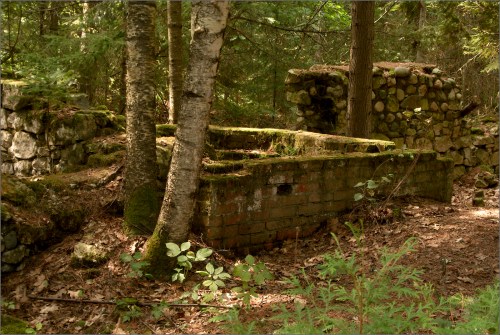
The Ruins of the Cheboygan Point Lighthouse

Cheyboygan Lighthouse

The Cheboygan Point Lighthouse Ruin, photo by joeldinda

Terry Pepper’s Seeing the Light has information about the ruins of the Cheboygan Main Light Station, explaining:

Located directly across the three mile width of the Straits from the southernmost point of Bois Blanc Island, the eastern prominence of Duncan Bay marked a natural turning point for vessels entering the Straits, and the growing bounty of Lake Michigan beyond.

On December 21, 1850, Congress appropriated the sum of $4,000 for the purchase of a 41.13 acre reservation on what would become known as “Lighthouse Point” at the western end of Duncan Bay for the construction of the first Cheboygan light station … The tower was evidently poorly located, as high water was found to be undermining the stone foundation soon after construction. Fearing collapse was imminent, in 1859 the newly-formed Lighthouse Board decided to build a new station and demolish the original tower, only eight years after its construction.

The replacement station, was similar in design to that built at Port Washington the following year, consisting of a combined keeper’s dwelling and tower, with the tower located at the north apex of the hipped roof. The tower stood thirty-one feet above the foundation, and was capped with an octagonal iron lantern into which the Fresnel from the old tower was carefully relocated. The lights’ thirty-seven foot focal plane provided a twelve mile range of visibility, thereby providing coverage throughout the Straits.

Read on the story of how the second lighthouse ultimately met its end and some great old photos of the lighthouse. It’s located in Cheboygan State Park.

Joel writes that they walked the park’s Yellow Trail to the long (2 miles in the park) beach and walked along Lake Huron’s Mackinac Strait. View his photo background bigtacular, see it on his map and check out more great shots in his Cheboygan slideshow.

Many more Michigan lighthouses on Michigan in Pictures.

About Lake Huron … and a double rainbow

double rainbow

double rainbow, photo by Morganshev.

Wikipedia’s entry for Lake Huron says that Lac Huron was named by early French explorers after the Huron people inhabiting the region. Lake Huron is the second largest of the Great Lakes and the third largest fresh water lake on earth with a surface area of 23,010 sq mi, a volume of 850 cubic miles and a shoreline length of 3,827 mi.

The Great Lakes Information Network page on Lake Huron pegs it as the 5th largest lake in the world and adds:

  • It has the longest shoreline of the Great Lakes, counting the shorelines of its 30,000 islands.
  • It contains Manitoulin Island, largest freshwater island in the world.
  • Georgian Bay and Saginaw Bay are the two largest bays on the Great Lakes.
  • Huron was the first of the Great Lakes to be discovered by European explorers. Since its French discoverers knew nothing as yet of the other lakes, they called it La Mer Douce, the sweet or fresh-water sea. A Sanson map in 1656 refers to the lake as Karegnondi, simply meaning “lake” in the Petan Indian language.

I found a cool site by the Lake Huron Lore Marine Society that has a great page on early steamships and sailing vessels on the Lake. Check it out!

See this out bigger in Morgan’s slideshow or see it in the Lake Huron Rolls Group slideshow!

Hope you find that pot of gold today and check out more at absolutemichigan.com/Lake Huron and explore Lake Huron on Michigan in Pictures.