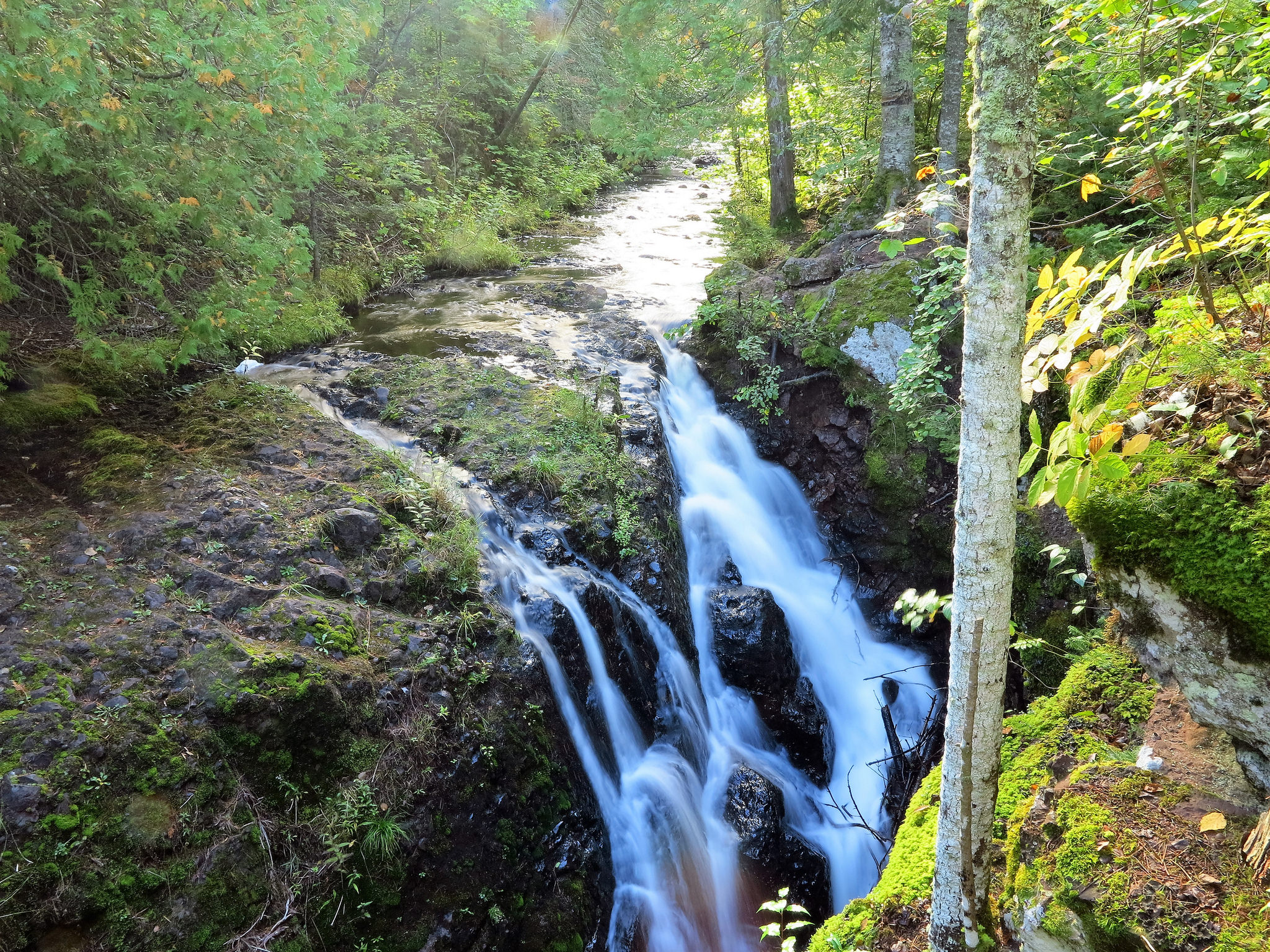
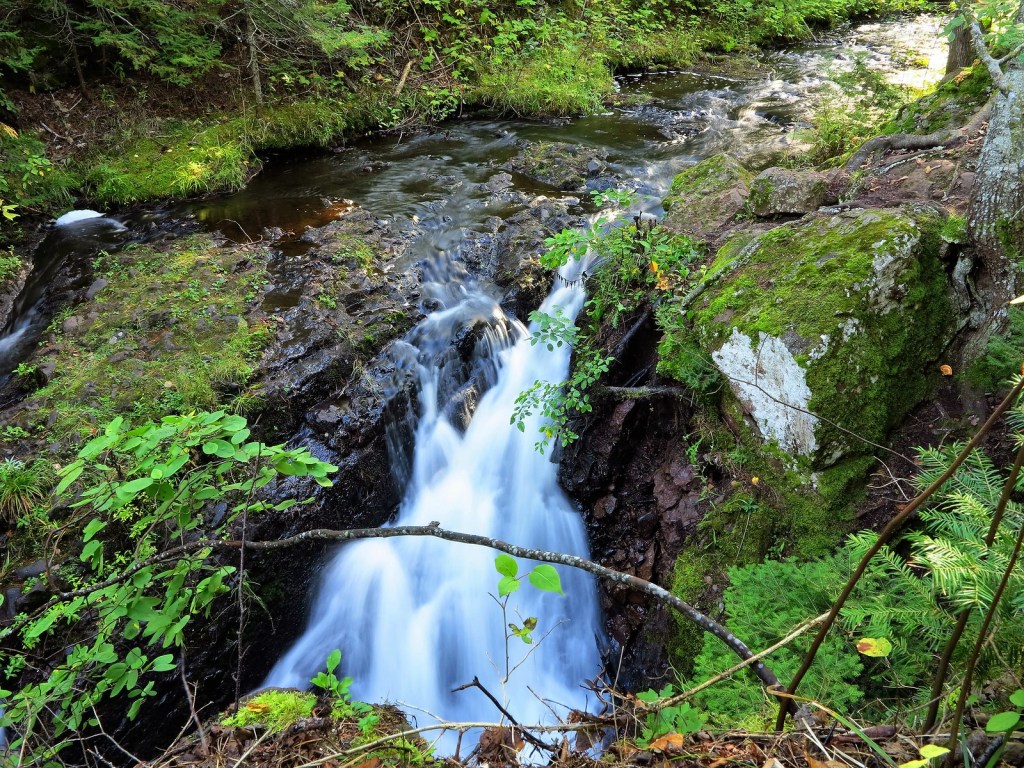
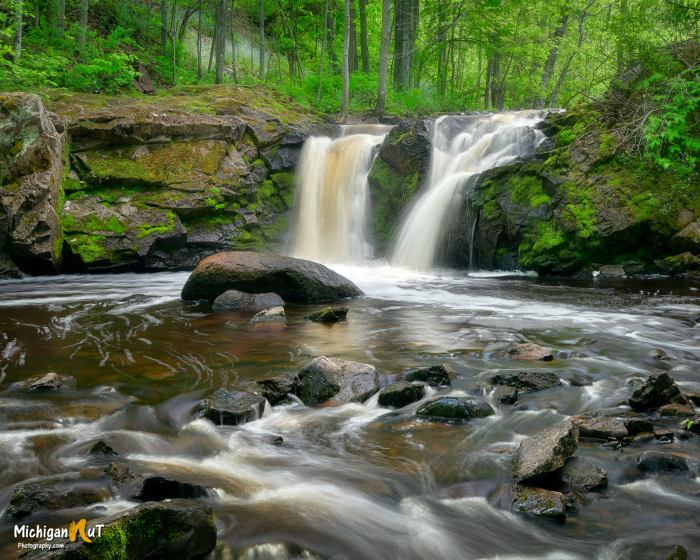
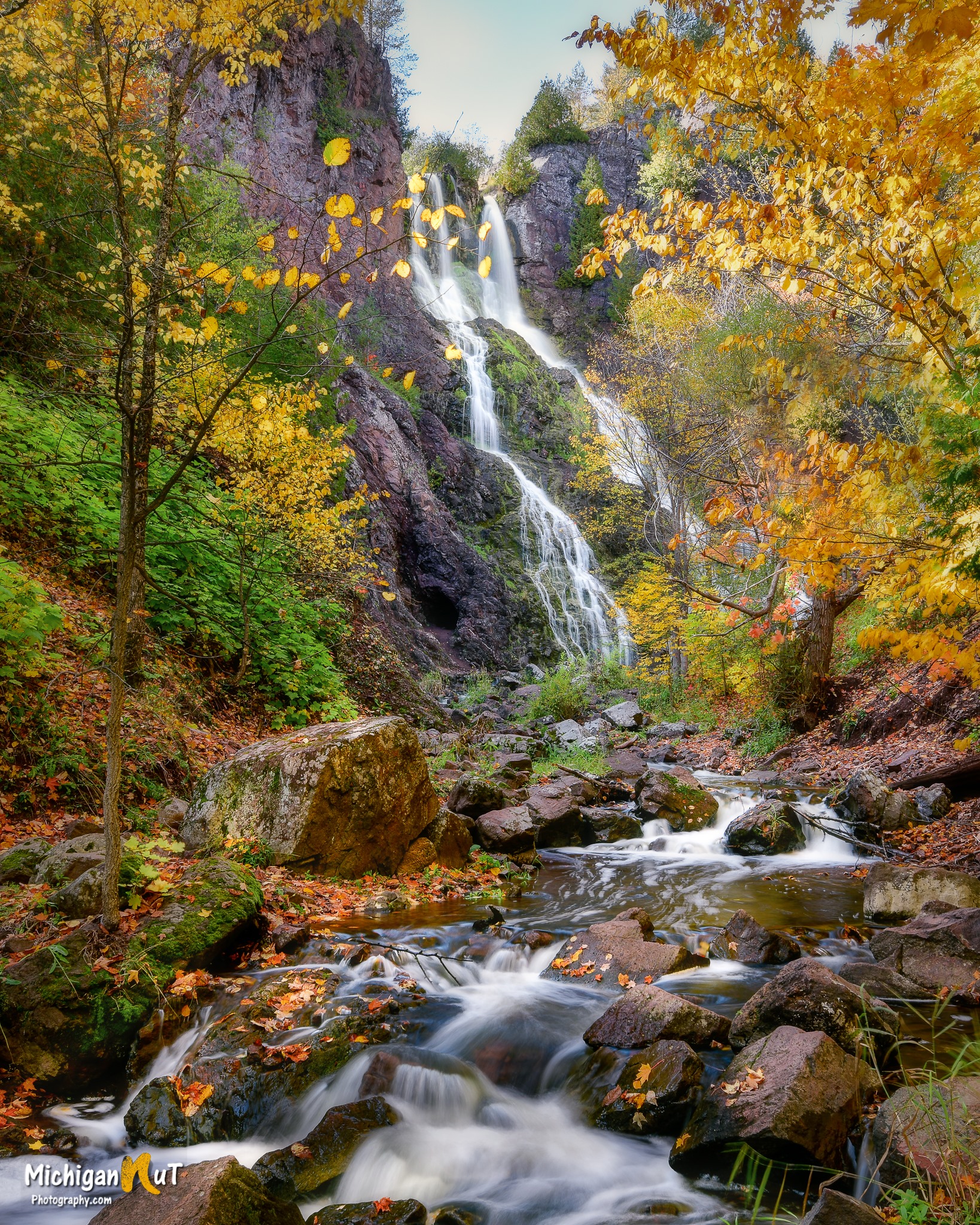
I shared this photo from John nine years ago but came back for a second look! Trip Advisor shares that Manganese Falls are fed by Lake Manganese, a pristine little lake worth visiting too:
The falls are at the mercy of the seasons. The falls run rampant in spring with all the snowmelt (270″ average) and rainfall. Then as the season progresses, they become much less intense ending in fall as not much more than a trickle. The box canyon that surrounds the falls is a beautiful and dramatic 100 foot drop. It is lined with mosses, ferns and other boreal fringe flora, making it worth the stop even in the fall. There is a scenic trail that leads down and over a bridge to the lower end of the falls. It is definitely worth taking if you have the time.
The awesome GoWaterfalling’s page for Manganese Falls has directions & more info!
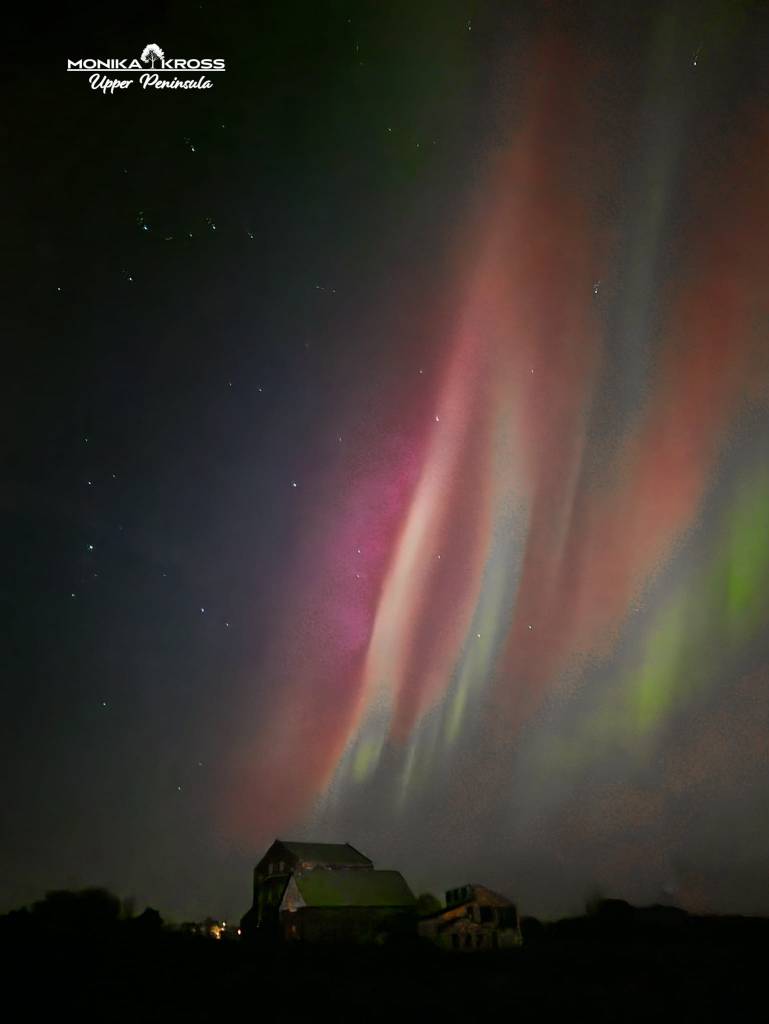
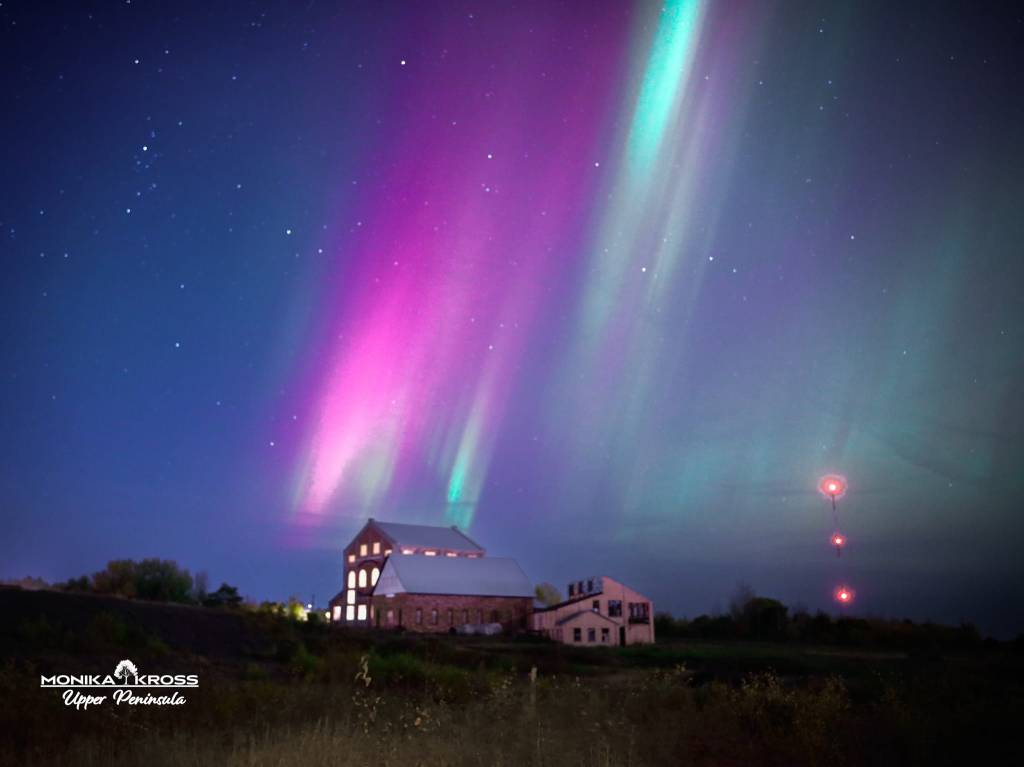
Given the veritable explosion of aurora borealis & nighttime photos due to the fact phone cameras are finally allowing people to take low light pictures, I think it’s important for folks to understand that even though you can’t get results like you see from some of the best northern lights photographers, these photographers aren’t faking or cheating. They are simply working with much more photo data & understanding of how to apply it than most people.
Monika shares “The difference between a phone shot and a camera shot, each taken several minutes apart. I took quite a few phone shots that night, esp as I worked my way up the coast of the Keweenaw in 28mph winds. In each phone shot, I see noise, blown pixels, and black feathering. Shooting on a camera in raw, we have to edit to put the contrast, color, and texture back into it. It looks very milky before editing and it takes a lot of work.
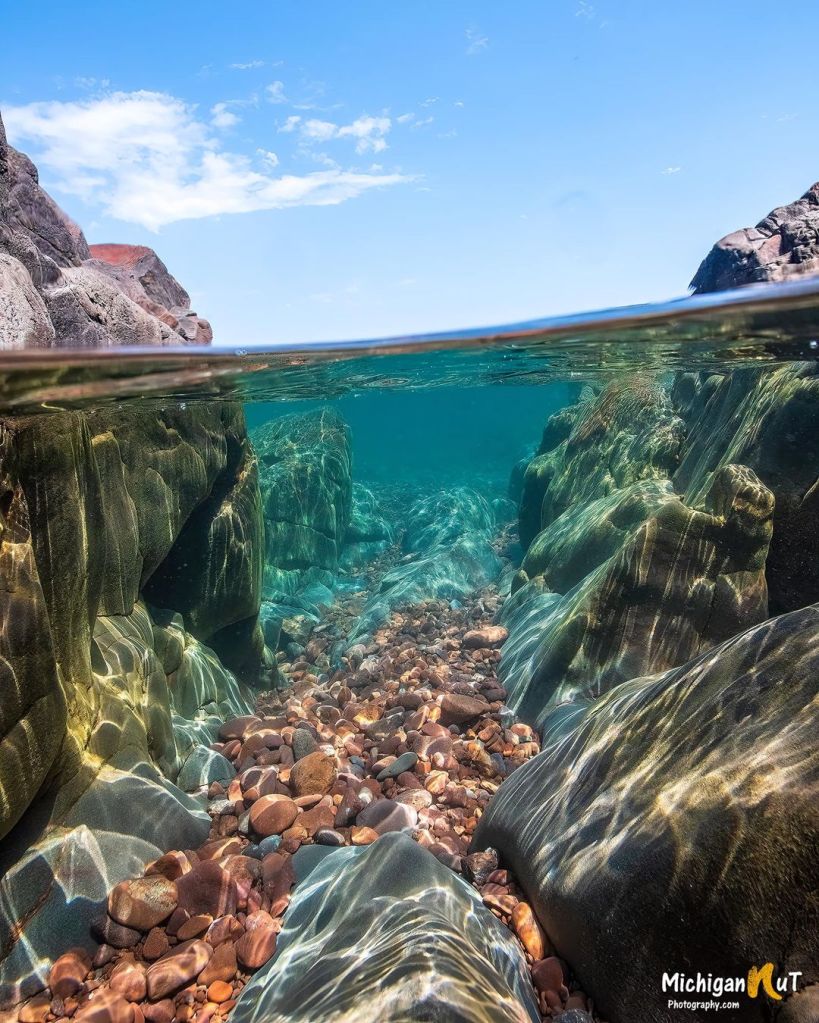
Let’s stay up on the Keweenaw Peninsula today with a look at the crystal clear waters of Lake Superior as seen from under the surface of Copper Harbor! For almost all my life, Lake Superior has been the cleanest & clearest of the five Great Lakes. Imagine my surprise to learn that in 2017, Lake Michigan & Lake Huron were found to be more clear than Lake Superior:
While Lake Superior has not gotten any dirtier, lakes Huron and Michigan have gotten significantly clearer in the past 20 years or so, a study published earlier this year in the Journal of Great Lakes Research found.
Anecdotally, scientists knew water clarity was improving in those lakes. But it hadn’t been quantified.
“What surprised us was the magnitude of the change,” said Robert Shuchman, a study co-author and co-director of the Michigan Tech Research Institute. “We had no idea the data was going to tell us that Huron and Michigan have surpassed the water clarity in Lake Superior. That was the startling piece.”
Scientists analyzed satellite images of the lakes captured between 1998 and 2012. Over that period, they found, the depth that light could penetrate down into the water — known as the photic zone — increased by about 20 percent in lakes Michigan and Huron.
They attribute part of that change to less phosphorous runoff. Climate change also likely plays a role. But the dominant factor is the explosion of invasive zebra and quagga mussels in the lakes since the late 1990s, researchers concluded.
Some of the highest abundances of quagga mussels in the world are found in Lake Michigan, said Gary Fahnenstiel, a senior research scientist at Michigan Tech and study co-author.
So in the end, not great that Michigan & Huron passed Superior in this. I looked to see if anything had changed in that regard, but it appears not.
The Keweenaw Road Commission shared last week that they’ve recorded over 300 inches of snow this winter. The 25 feet of snow is about 6 feet more than normal. While that’s definitely a whole lot, it’s 356 inches of snow recorded in the winter of 1978–79.
While one of the names for Tahquamenon Falls is “Root Beer Falls, Travel the Mitten shares another waterfall with the same name, Root Beer Falls on Planter Creek:
Few Michigan waterfalls are as easy to visit as Root Beer Falls in Wakefield. This small waterfall can be viewed from the side of the road, and getting a closer view only requires a walk of a few hundred yards. If you’re in the area to see other waterfalls or headed up to the western end of the Porcupine Mountains this is a waterfall you won’t want to miss.
Planter Creek flows under M-28 a few blocks from Sunday Lake. Shortly after passing under the highway it cascades over a small rock ridge, forming a waterfall in a beautiful forested setting. The sudden drop of around six feet that forms this waterfall is a stark contrast to the otherwise quiet setting here as the creek winds its way through the woods.
Dover Creek tumbles overs a series of falls on its way down to Torch Lake. Two of the falls are around 20 feet high, and the last is a 50 foot drop, which is spectacular when the water is flowing. Unfortunately these falls are often nearly dry in the summer.
There are three falls 15 feet or higher on a half mile stretch of Dover Creek, plus a couple of smaller drops. In the spring time, or after some good rains, these waterfalls are very impressive. Unfortunately the creek has a very small watershed, and the falls are often reduced to trickles.
The three main drops are usually referred to as the upper, middle and lower falls. The upper falls is around 20 feet high. The water spills over an irregularly shaped cliff into a small gorge.
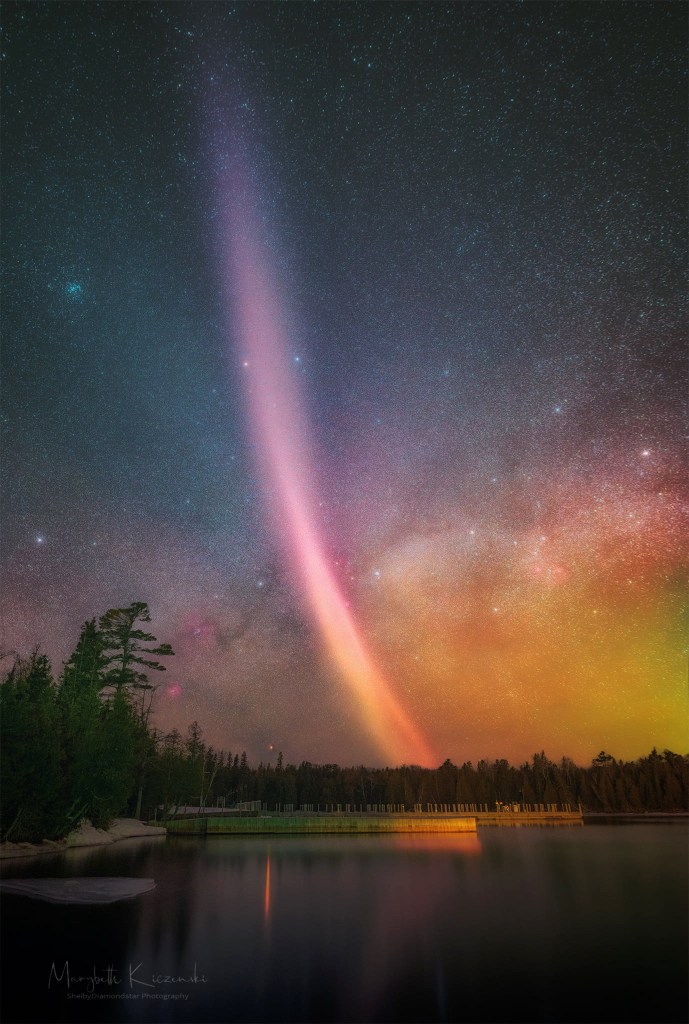
This spring has been big for fans of the aurora borealis. Shelby took created this photo of five, 1-min tracked shots blended with an untracked foreground shot the night of March 13/14th in Copper Harbor. It shows a phenomenon I’d never heard of, a Strong Thermal Emission Velocity Enhancement aka STEVE about which Space.com says (in part):
A typical aurora — sometimes called the northern lights or the southern lights, depending on the hemisphere in which it’s located — occurs when charged particles from the sun interact with Earth’s oxygen and nitrogen molecules. This interaction excites the molecules and causes them to glow.
But STEVE, formally known as Strong Thermal Emission Velocity Enhancement, is different. In the Northern Hemisphere, the phenomenon is visible from areas farther south than a typical aurora, and it looks like a ribbon of pink or mauve light. Sometimes, STEVE even has a “picket fence” appearance, with green columns of light passing through the ribbon. Auroras, by contrast, usually are shimmering green ribbons.
…The new study examined satellite data gathered above STEVE events in April 2008 and May 2016. The measurements included information about Earth’s magnetic and electrical fields in the magnetosphere, the region of Earth’s atmosphere where the planet’s magnetic field is stronger than any influence coming from the sun. Then, scientists compared the satellites’ findings with amateur photos of STEVE taken from the ground at the same time.
When STEVE was on display, the study authors realized, energetic electrons were pouring into Earth’s ionosphere, the layer of the planet’s atmosphere where atoms lose electrons due to solar and cosmic radiation. The friction that flood creates heats particles, which creates the pinkish glow, almost like an incandescent light bulb.
Satellite information further revealed how the “picket fence” aspect of STEVE develops. The data revealed waves moving from Earth’s magnetosphere to the ionosphere. In this region, the waves can both energize electrons and move them out of the magnetosphere, creating the picket-fence appearance, which happens simultaneously in the Northern and Southern hemispheres.
A wildly tall and impressive waterfall, Douglass Houghton Falls was once a popular destination for locals and Michigan Tech students alike. Crumbling cliff walls and numerous accidents, many of them fatal, pushed the land owner to cut off access. While the falls are still reachable by following Hammell Creek upstream from Lake Linden, the danger of a careless visit cannot be understated.
This waterfall is well over a hundred feet with several plunges bouncing off the sharp, volcanic rock. Steep walls make it difficult to reach the small drops in the meadow above, but a great view down towards Torch Lake can be made down the green creek valley. A small exploratory shaft is drilled into the side of the falls only a few feet above the creek. While it’s hard to reach and dangerous to explore, this waterfall is one of the highlights of the Copper Country.
Peak wind speeds reached 68 mph in some areas, causing intense waves along Lake Michigan. Waves at the Ludington buoy peaked at 13.5 feet.
…According to the Consumer’s Energy power outage map, 27,704 were without power across the state as of 5:20 a.m. Monday.
Norton Shores was tops with gusts of 68 MPH, and it was blowing hard in Jackson (64), Grand Rapids (63) & Lansing (54). The Detroit Metro Airport in Romulus recorded a 61 MPH gust as well.


 Michigan in Pictures