Slam Dunk for Old Man Winter

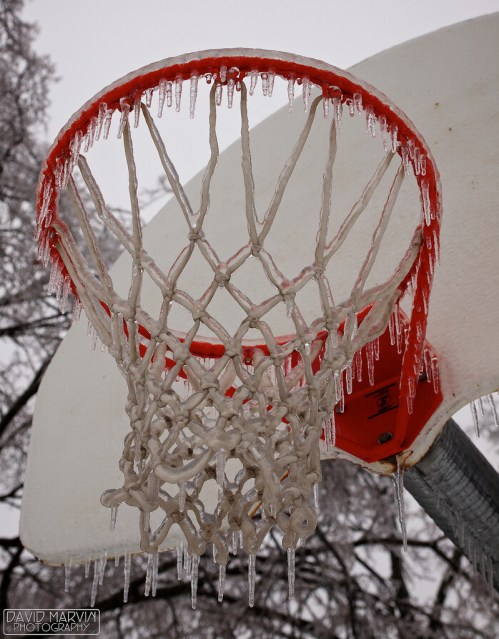
Icy Michigan Morning

Icy Michigan Morning, photo by daveumich

Much like Uncle Drew, Old Man Winter brought his A-game over the weekend, creating havoc across much of the state. The Freep reports that this weekend’s ice storm knocked out power for over 300,000 people. An interesting fact I learned from the article is that a quarter of an inch of ice is the equivalent of 500 pounds of weight on a span of power line. WLNS adds that thousands of people might be out of power through Christmas – here’s hoping that’s wrong!

View David’s photo from Lansing background big and see more shots of the storm in his slideshow.

There’s more ice on Michigan in Pictures, and mLive has a nice gallery of photos from around the state too!

Blue Anticipation

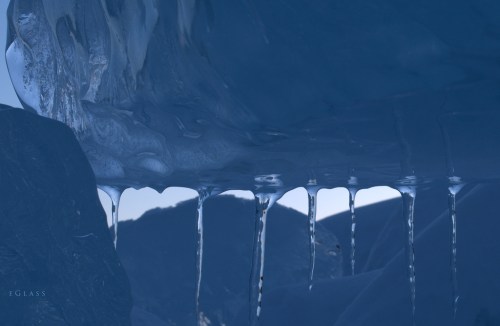
Blue Anticipation

Blue Anticipation, photo by Elizabeth Glass

I dug way back through the over 13,000 winter photos in the Absolute Michigan pool on Flickr for today’s photo.

Liz Glass took it at the Straits of Mackinac in 2011. She says that the color is real and recommends you check it out bigger to see the details on Fluidr. It’s also a cool way to look at her Ice set (or view the slideshow on Flickr).

More ice on Michigan in Pictures.

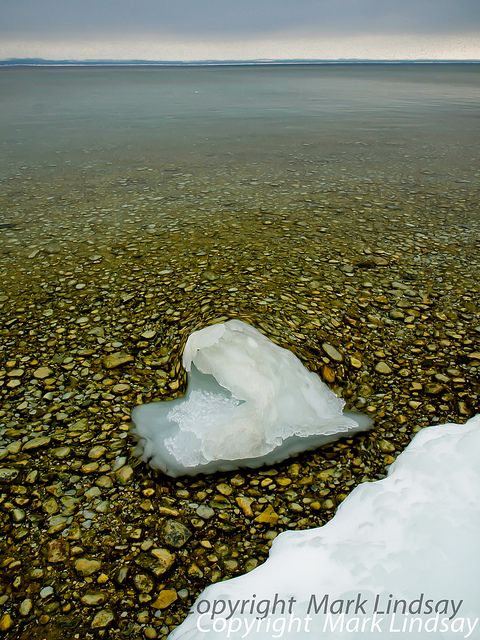
Ice Volcanoes in Michigan

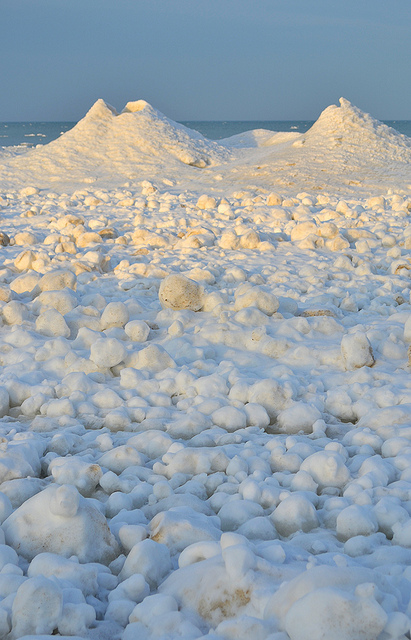
Shore Ice

Shore Ice, photo by timmerschester

The Weather Notebook has this to say about Ice Volcanoes:

Ice volcanoes can form during winter on the Great Lakes. They are not lava-spewing mountains of ice, but water-spouting ice cones.

As winter ice begins to build along the shores of large lakes such as Lake Superior, it is jostled, broken, and shifted by the winds and wave motions on the waters. When winds blow onshore, they can build an ice shelf, a jumble of ice chunks that anchors on the shore but extends some distance back into the water. Amongst the numerous ice blocks comprising a shelf, many open tunnels lead back to the lake waters.

To build a good ice volcano cone, the surface air temperature must be several degrees below freezing and lake waves should be several feet high and breaking onshore. As the waves strike the edge of the ice shelf, pulses of wave energy flow beneath the ice. Upon reaching the open end of a tunnel, the wave forces water to erupt out through the ice. If the hole has been covered with snow, the eruption may spray snow outward like a volcanic gas cloud.

As the ejected water falls back onto the ice, it quickly freezes and begins the formation of an ice cone, a process very similar to the building of a lava cone surrounding a geologic volcanic vent. A study of ice volcanoes on Lake Superior’s southern shore by students from Michigan Tech measured ice cones ranging from three to 25 feet in height.

Like rock volcanoes, ice volcano vents can heal over and become dormant during periods of low wave action. They lie in wait for a strong wave surge to awaken them back to explosive activity.

Also see the Ice Volcanoes page from Michigan Tech and a video of an ice volcano from Great Lakes Echo.

Kathy took this photo on November 29th on Lake Huron in Caseville – pretty early for ice this big! Check it out background bigtacular and see more in her Winter slideshow.

More icy goodness on Michigan in Pictures.

lighthouse snowman

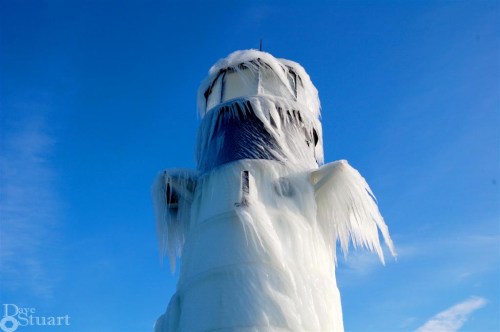
lighthouse snowman

lighthouse snowman, photo by kiwirat

Frosty’s got nothing on the St. Joseph Lighthouse.

View Dave’s photo bigger or in his St. Joseph, MI slideshow.

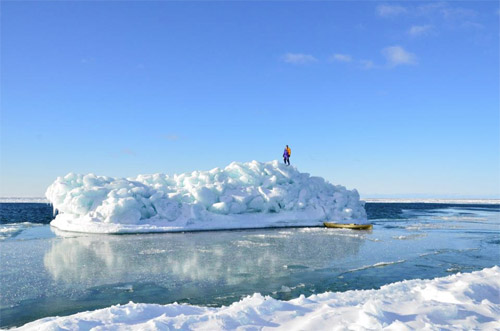
Good Hart Iceberg

Good Hart Iceberg by the Outfitter

Good Hart Iceberg, photo by Molly Baker/The Outfitter

“This year we have been fortunate enough to have cold weather, lots of wind, and combined it builds ice into ice caves, ice mountains.”
~Jim Sutherland, Good Hart General Store Owner

Winter 2013 sure has been dishing up some amazing ice including the ice boulders along the Sleeping Bear shore. UpNorthLive reports on the latest a Lake Michigan iceberg floating offshore at Good Hart north of Harbor Springs.

“It was just a bunch of blocks piled on top of each other and they were welded together with the wind and snow,” Outdoor enthusiast Josh Baker explained.

Over the weekend, Baker and his family stumbled across this giant island floating in Lake Michigan outside of the small town of Good Hart.

Sunday, he decided to climb the jagged, 15-foot ice mountain. Once he made it to the top, he noticed the structure was different on the other side.

“The side facing the lake was almost sheer, it was pretty neat. So the side I was on was all jumbled and the opposite side was just sheer down to the water,” Baker said.

Click through to watch the report!

Check this out bigger on Facebook or scroll through their whole gallery. If you want to visit Molly & Josh for a first-hand account, their store is The Outfitters in Harbor Springs.

More ice on Michigan in Pictures!

Ice Field

ice field

ice field, photo by northernlightphotograph

Check this out on black, see more from Tim on Michigan in Pictures and definitely check out his 2013 Winter Ice slideshow.

Ball Ice and the Ice Boulders on Lake Michigan

Ice Boulders by Leda Olmstead
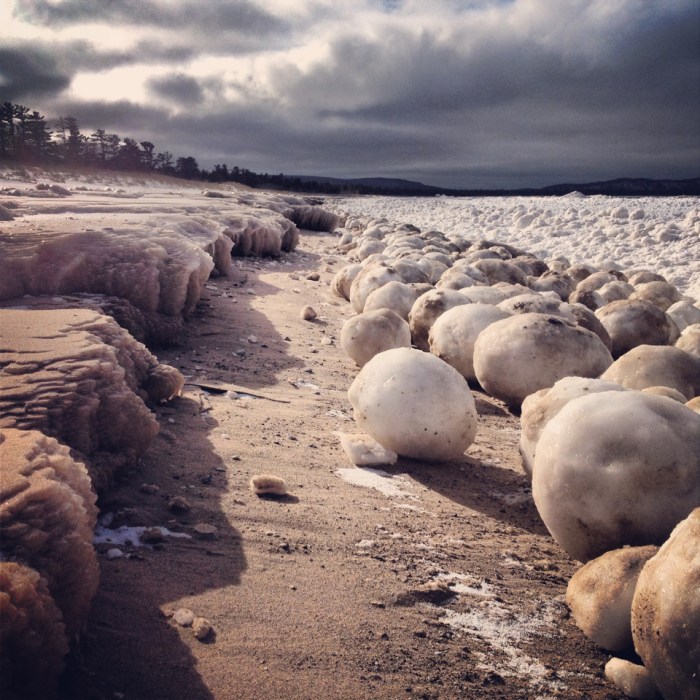
Lake Michigan Ice Boulders, photo by Leda Olmsted

Todays post is from the “Ain’t it Cool” Department. A couple of weeks ago Leelanau County resident Leda Olmsted was walking the Lake Michigan shore in the Sleeping Bear Dunes National Lakeshore when she came across this incredible scene. TV 7&4 reports in Ice boulders roll onto shores of Lake Michigan that Leda took some photos, uploaded to the news station’s Facebook and:

Leda says she was shocked by the response. Olmsted explains, “From there it got like 800 shares and thousands of likes and overnight I had Good Morning America and The Weather Channel calling me, so it has been a really crazy weekend!”

Deputy Superintendent from the Sleeping Bear Dunes National Lakeshore Tom Ulrich says, “It’s not that it never happens and this is a once in a decade thing, it happens more often than that, but these are very large and got bigger than they normally get.”

The ice balls or boulders along the shores of Lake Michigan are about the size of giant beach balls or basketballs and weigh up to 50 pounds.

Click to watch the video from UpNorthLive with Leda.

I looked a little further into the phenomenon and found and AIR PHOTO INTERPRETATION OF GREAT LAKES ICE FEATURES by Ernest W. Marshall  in the Great Lakes Digital Library at the University of Michigan. With the help of Marshall’s information, here’s an explanation of how ball ice forms:

Ball ice consists of roughly spherical masses of slush and frazil ice that accrete in turbulent water. Frazil ice (via Wikipedia)is a collection of loose, randomly oriented needle-shaped ice crystals that form in open, turbulent, supercooled water. Lumps that form in the less turbulent zones are typically flattened discs, while those formed in the extremely turbulent zone near the shoreline ice where wave action is strongest form into spheres.

The author explains that ball ice is a feature common to all of the Great Lakes and can occur at any time during the winter where water turbulence breaks up a slush layer. You can read more about this in Great Lakes Ice Features.

More science, winter and amazing on Michigan in Pictures!

Pancake Ice

Pancake Ice

Pancake Ice, photo by ChiliFrei64

I believe that Daniel took this photo in Lexington. Check it out background bigtacular and see more in his Water slideshow.

More ice on Michigan in Pictures.

Melt a frozen heart on Valentine’s Day

Valentine Ice

Valentine Ice, photo by Happyhiker4

Happy Valentine’s Day to everyone and here’s hoping that love finds its way into your day and life!

Check Mark’s photo out on black and see more magical winter shots on Mark’s Facebook!

View past Valentines Days on Michigan in Pictures.

MNA Memorial Falls aka Twin Falls

Memorial Falls in Winter (pano)

Memorial Falls in Winter (pano), photo by nasunto

GoWaterfalling’s page on Memorial Falls in Munising says:

MNA Memorial Falls is in Munising, off of H-58. Some of the locals refer to this waterfalls as “Twin Falls”. This is a very seasonal waterfall and is often dry. However when the water is flowing, which may only be after a good rain or when the snow is melting, you will be treated to a very pretty gorge with two waterfalls in it. MNA Memorial Falls is owned by the Michigan Nature Association and it is open to the public.

…Two streams empty into this gorge, but the second one likely only has water after or during a good rain. One very interesting feature of this gorge is a “window” in the walls between the two falls. You can crawl through this window, or just walk around it. You can see each of the waterfalls through this window.

Another nice thing about this waterfall is its proximity to Tannery Falls. The trail from Nestor streets forks just before it descends into the gorge. The trail to the right leads to the base of the falls. The trail to the left leads to H-58, about 100 feet away from the stairway to Tannery Falls, so you can visit both falls on the same hike.

In the winter both of these falls turn into ice columns that are tackled by the ice climbers. Despite their low volume of water, each of these falls manages to produce a very impressive column. Every winter Munising hosts an ice climbing festival. After the festival the ice columns look like they have been attacked by woodpeckers. There are many other interesting ice formations to see in the area.

Read on for more and definitely click through to see a pic of a person beside the 40′ fall and a shot of the “window”. Also see Memorial Falls at the Waterfall Record.

Check this out background big and see more in Nina’s Michigan Waterfalls slideshow. If you look carefully, you’ll see another photographer in the shadows!

There’s many more waterfalls on Michigan in Pictures including the above-mentioned Tannery Falls.