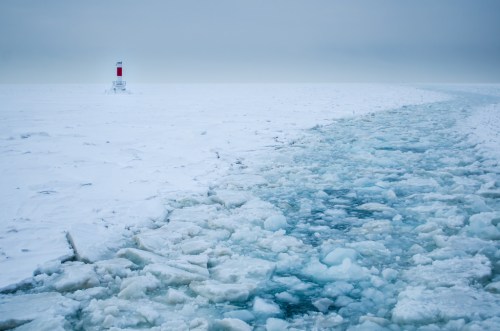
Icebreaking on the Great Lakes with USCG Bristol Bay

Shipping Lane

Shipping Lane, photo by rellet17

Winter 2014 has been a big challenge to keep up with for road crews and homeowners, and it’s a challenge that doesn’t end at the shoreline!

On Friday, Ross got a chance ride aboard the US Coast Guard Icebreaker Bristol Bay as it opened a path for shipping traffic on Lake Saint Clair. The captain told him the ice has only been this dense one other time in the past 30 years! The Coast Guard says:

The USCGC BRISTOL BAY is one of just two Bay-class cutters that work in conjunction with a special barge. BRISTOL BAY the second of the U.S. Coast Guard’s 140-foot icebreaking tugs. She is named after the body of water formed by the Alaskan peninsula which empties into the Bering Sea. BRISTOL BAY was built by the Tacoma Boatbuilding Co. in 1978. She was commissioned in Detroit in 1979.

Designed by U.S. Coast Guard engineers, the BRISTOL BAY’s primary responsibility is opening and maintaining icebound shipping lanes in the Great Lakes. Bay-class tugs are designed to continuously break at least 20 inches of hard, freshwater ice. The ships can break more than 3 feet of ice by backing and ramming. The Bay tugs have a special hull air lubrication system that helps extract the ship from thick ice and improves ice breaking ability at slower speeds.

View Ross’s photo background bigtacular and see more in his ice breaking slideshow.

PS: A few weeks ago I came across this video of more Great Lakes icebreaking action, showing the Icebreaker Mackinaw and others clearing a path from Sault Ste Marie down the St Marys River that you might enjoy. It was shot from the wheelhouse of the CSL Assiniboine.

There’s more ice and more winter wallpaper to be found on Michigan in Pictures!

Early One February Morning at Little Girl’s Point

Early One February Morning (2)

Early One February Morning (2), photo by siskokid

Jim caught a gorgeous sunrise last February on the shore of Lake Superior at Little Girl’s Point. The article Legendary Little Girl’s Point from the Ironwood Daily Globe says it is located about 21 miles north of Ironwood and was used by the Chippewas for fishing, hunting and a camping place during trips to the Porcupine Mountains. As to the name:

According to Burnham, Mary Amoose (Little Bee), an unusually intelligent Chippewa woman of Bad River, told Burnham the story of the lost girl of Little Girl’s Point as she had often heard it told by her grandmother more than a half century ago.

She told Burham how a party of hunters returning from a trip to the Crouching Porcupine rounding the point of land now known as Little Girl’s Point, thought they saw the form of a girl among the trees. She was clad in green. The hunters, thinking that it was some girl that had become lost, beached their canoes, but on climbing the steep shore, only caught one or two glimpses of the green girl, who glided further back among the stately pines, and vanished.

Burham said he was interested in this story for it gave the name to Little Girl’s Point, and it was told to him by this Chippewa woman, much as it had been told to Henry R. Schoolcraft, the historian, and discoverer of the source of the Mississippi River. Burnham said the story was told to Schoolcraft by his half-breed wife, Julia (Jane) Johnson, granddaughter of the great chief Waubojeeg, who lived on the mainland near where Bayfield now stands.

I can’t tell if the “unusually intelligent” is sexist or racist, but there is a lot of interesting historical information to be found if you read on. The article is housed on the Gogebic Range City Directories which looks to be a treasure trove of historical information about the region that includes Michigan’s northwestern corner and Wisconsin’s northeastern.

Check it out bigger and see more in Jim’s Little Girl’s Point slideshow.

There’s more history (and more ice) on Michigan in Pictures.

Lighthouse Punk

DSC07439P

Untitled, photo by Scott Glenn

Kids these days and their crazy hair.

Check Scott’s photo out bigger and see lots more in his Lighthouses slideshow. Also check out a previous photo by Scott on Michigan in Pictures.

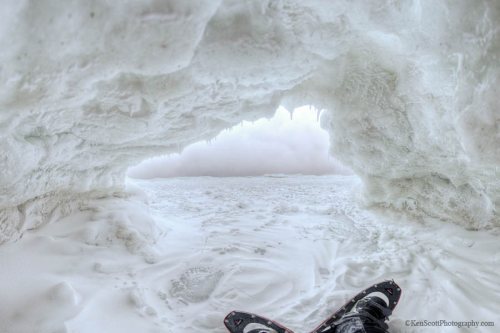
Shoreline Wonders

Winter ... shoreline wonders!

Winter … shoreline wonders!, photo by Ken Scott

As you may have realized from his last photo, Ken enjoys winter quite a lot – a useful trait for a photographer! He says that he crawled in here to get out of the arctic blast yesterday when he was exploring the ice by the Grand Traverse Lighthouse at the tip of the Leelanau Peninsula. If you want to get a sense of what it’s like right now, he also shot a fantastic video!

View his photo bigger, see more in his Winter slideshow and if you’d like to chat with Ken about the photo, check it out on his Facebook page.

PS: I thought this photo was a nice counterpoint to Shawn Malone’s last pic.

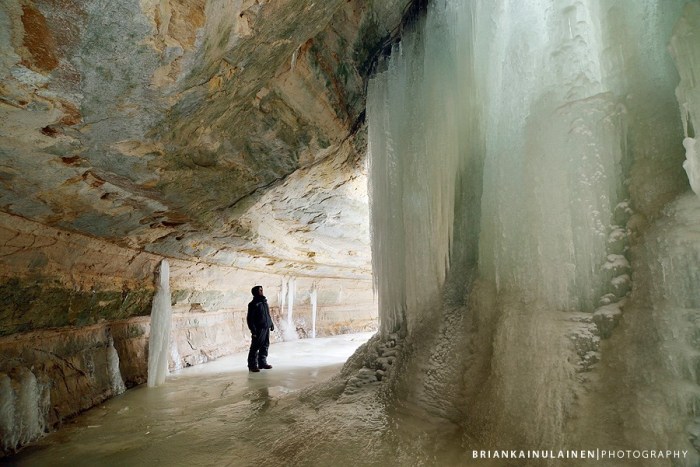
Behind Tannery Falls

Behind Tannery Falls

Behind Tannery Falls, photo by Brian Kainulainen Photography

#40 in Jesse’s 1000 Things to Do in the U.P. is to Check out Tannery Falls:

Tannery Falls (sometimes referred to as Rudy M. Olson Memorial), along with MNA Memorial Falls (sometimes called Twin Falls) often get missed by unknowing visitors who follow the signs to nearby Munising Falls, leaving these two cool waterfalls in their touristy dust. Well, that’s not going to be you.

…It’s a steep uphill climb at first, but it’s short. After a minute or so of uphill walking, you’ll skirt along a sandstone cliff and end up face to face with a very cool waterfall. It’s a serene little area with more than a few little nooks and cranny’s to explore. I took my son there and he had a blast running around, saying “look at this!” a hundred times. At some point I’d like to come back with my wife and have a picnic here. Yes, I’m cheesy like that.

There are no signs urging you to “stay on the trail.” You can walk right up to, behind, and around the falls if you want to. If it’s a hot day, stand right under the thing and cool off! It might not be a bad idea to bring a swimsuit just in case. :)


Not sure about the wisdom of that today though. Read on for more including instructions on how to get there and definitely check out 1000 Things to Do in the U.P.  for lots more ideas about fun in the Upper Peninsula!

Brian shared this on the Michigan in Pictures Facebook page. View it bigger and see more of his work at Brian Kainulainen Photography!

Many (many) more Michigan waterfalls await you on Michigan in Pictures!


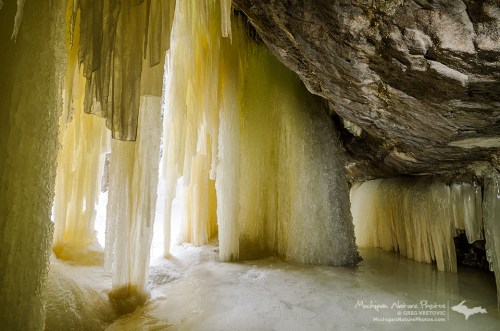
Exploring the Eben Ice Caves

Exploring the Ice Caves

Exploring the Ice Caves, photo by Michigan Nature Photog

View Greg’s photo bigger and see more in his great Winter slideshow. Catch another shot of the ice caves here and here on Facebook. While you’re there, Greg is also holding a contest and giving a print to 2 winners!

Last year I shared a photo feature on the Eben Ice Caves by Nina Asunto. On Black Coffee at Sunrise, her excellent blog of explorations of Michigan’s wild places, she writes (in part):

During winter, ground water seeps over the edge and down through the sandstone where it freezes, creating huge curtains of ice and closing off the front of the outcrops to form caves.

We had both seen a few photos of the ice caves, but none of them really captured the size of this phenomenon. It was difficult to decide where to begin to tackle it photographically, and we immediately began climbing around the hillsides to get a more expansive view, and crouching and crawling around at the base of the ice to see every possible angle…

What we weren’t able to capture, however, was the amazing sound inside the cave. The drips of water falling from above created wonderful echoes and added to the cave atmosphere. There is much variation of color and texture to the ice in different parts of the cave. Some formations were smooth and clear, others were bumpy and hollow-sounding, and there were some columns that looked like dripping candle wax.

Read more on her blog and get lots more on this transitory Michigan wonder on Michigan in Pictures!

2014 Michigan Ice Fest & Ice Climbing in Pictured Rocks

UP Michigan Ice Fest001

UP Michigan Ice Fest, photo by ebaillies

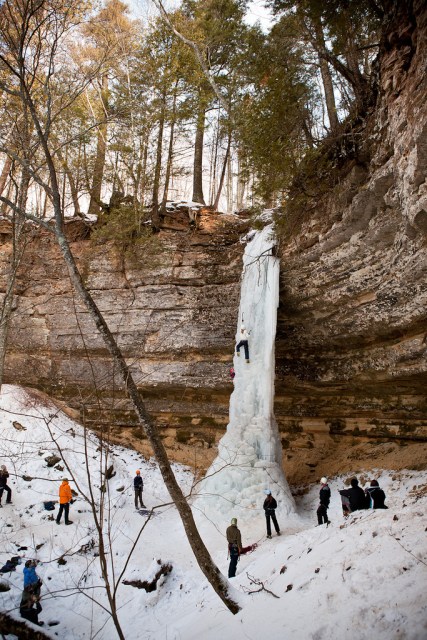
The annual Michigan Ice Fest takes place January 30 – February 2, 2014 in and around Munising. This annual festival takes place the 1st weekend of February every year and gives you a chance to look at and demo the latest and greatest equipment, meet some of the worlds best climbers and see what they’ve climbed all over the world. There’s also climbing socials and even intro to ice climbing classes using the ice climbing paradise that surrounds Munising.

Click the link above and be sure to check out their Michigan Ice Fest photo gallery on Facebook including galleries from 2009, 2010 & 2012 Ice Fests!

As the Ice Fest organizers note, the UP offers as much as 6 months of climbable ice! The Pictured Rocks National Lakeshore Ice Climbing page tells more:

Ice climbing is becoming a popular winter sport at Pictured Rocks National Lakeshore. With ample lake effect snow, numerous waterfalls, porous sandstone cliffs, and the water which seeps out of the rock layers, curtains and columns of ice are common.

Snow and ice are generally present by the second or third week in December and remain until late March. While ice frequently forms along the Pictured Rocks cliffs above Lake Superior, these areas are not recommended for climbing due to hazardous exposure to the lake. The most accessible ice columns are found along the Pictured Rocks escarpment between Munising Falls and Sand Point along Sand Point Road.

Eric took this photo at the Ice Fest in 2012. Check it out bigger and see lots more great shots in his slideshow.

More ice climbing on Michigan in Pictures!

Walking with the Icefoot on Great Lakes beaches

Winter morning on Agate Beach

Winter morning on Agate Beach, photo by Gary of the North(Footsore Fotography)

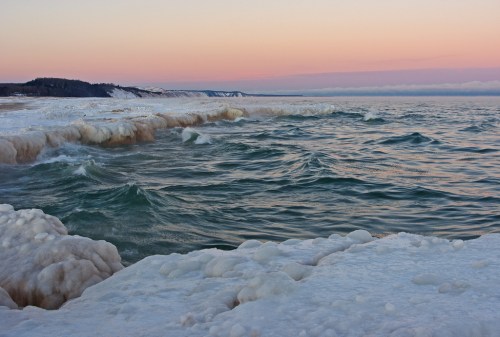
Ernest W. Marshall talks about a common winter feature along considerable stretches of Great Lakes shorelines, the Icefoot:

Air and water temperatures must be sufficiently low before an icefoot begins to form. The conditions favorable for icefoot formation are broad open shorelines gradually sloping below water level, and facing so that wind-blown spray is carried inland toward the shore to freeze. The character of growth of an icefoot differs during different periods of the winter. During the course of the winter the icefoot may suffer periods of denudation alternating with periods of accretion. The development of an icefoot can be held at one stage by the early freezing of fast ice offshore. An icefoot can be composed of any combination of frozen spray or lake water, snow accumulations, brash, stranded icefloes, and sand which is either thrown up on the icefoot by wave action or is blown out from the exposed beaches.

Observations of the icefoot along the shorelines of Lakes Superior and Erie indicated that the moderately steep portions of the shore were characterized by narrow terraces composed of frozen slush and brash thrown up by storm winds. The outer edge of this icefoot was often cusp-like in form, resulting from the mechanical and melting action of the waves. The inner portions of the cusps acted to concentrate the wave action, forming blowholes which threw spray back on the icefoot.

You can click to read more.

Gary took this photo at one of my favorite places in Michigan: Agate Beach on Lake Superior in Grand Marais, Michigan. In the distance is Grand Sable Dunes and the Pictured Rocks National Lakeshore. View his photo big as Lake Superior and see more in his Grand Marais Michigan slideshow including a shot of a staggeringly huge ice mound!

Lots more Grand Sable Dunes, Pictured Rocks National Lakeshore & winter wallpaper on Michigan in Pictures!

Ice Balls on the Sleeping Bear Lakeshore

Lake Michigan ... ice balls III

Lake Michigan … ice balls III, photo by Ken Scott

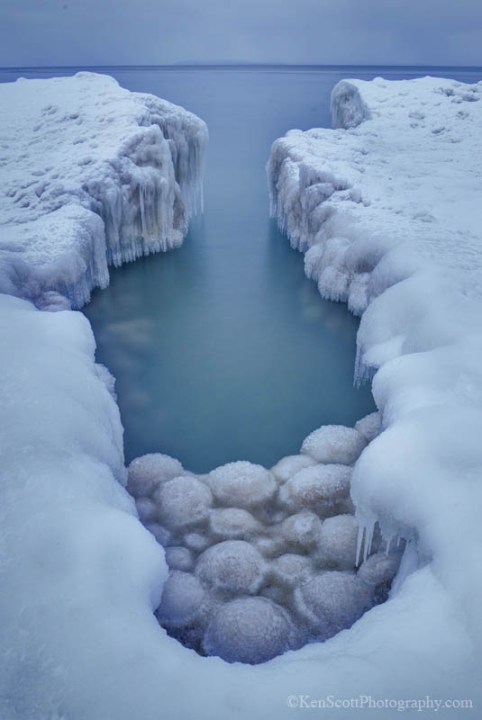
You may recall the Lake Michigan ice balls that were seen at the Sleeping Bear Dunes lakeshore last March.  Well, they’re baaaaack. You can see a great video of the ball ice at Accuweather. Here’s the explanation of how balls ice form that I  put together from AIR PHOTO INTERPRETATION OF GREAT LAKES ICE FEATURES by Ernest W. Marshal & Frazil ice at Wikipedia:

Ball ice consists of roughly spherical masses of slush and frazil ice that accrete in turbulent water. Frazil ice is a collection of loose, randomly oriented needle-shaped ice crystals that form in open, turbulent, supercooled water. Lumps that form in the less turbulent zones are typically flattened discs, while those formed in the extremely turbulent zone near the shoreline ice where wave action is strongest form into spheres.

The author explains that ball ice is a feature common to all of the Great Lakes and can occur at any time during the winter where water turbulence breaks up a slush layer. You can read more about this in Great Lakes Ice Features.

View Ken’s photo bigger, check them out in his ice balls slideshow and see this shot with Ken in it for a sense of the scale.

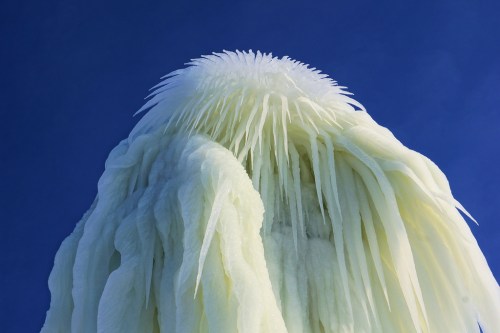
Winter Wonderland at Tahquamenon Falls

winter, upper tahquamenon falls, michigan

winter, upper tahquamenon falls, michigan, photo by twurdemann

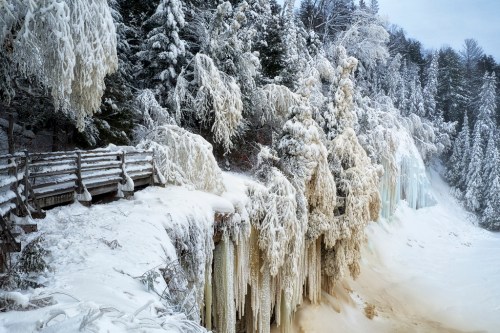
twurdemann writes that this winter wonderland at Tahquamenon Falls State Park is created by freezing spray/mist from the adjacent waterfall and that the brown color is from tannins in the water. One second exposure in the Upper Peninsula. View his photo bigger and see more his awesome winter slideshow.

There’s lots more about Michigan’s largest waterfall on Michigan in Pictures!