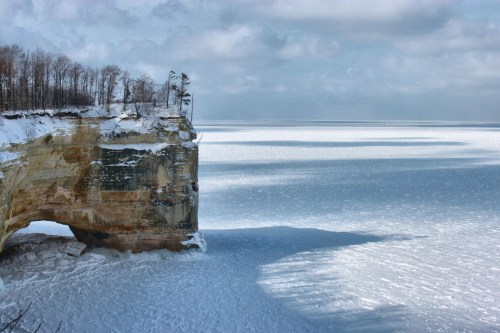
Frozen February: 2015 3rd coldest February for Michigan

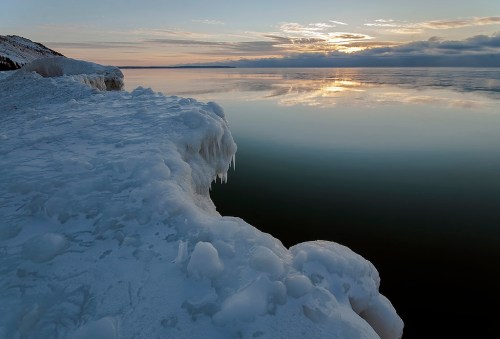
Standing against the biggest lake

Standing against the Greatest Lake, photo by Jay

The Grand Rapids Press reports that February 2015 was the coldest recorded for the city:

If you were alive in 1978, perhaps the similarity was striking.

Grand Rapids’ average temperature last month was 13.3 degrees, making it the coldest February in the city’s recorded weather history — a record dating back 37 years, according to the National Weather Service. The previous record was a balmy 14.3 degrees.

Overnight low temperatures dipped below zero eight times throughout the month, with highs not able to warm too much beyond the teens. In fact, the thermometer touched the 30-degree mark only four times when the seasonal average is just around freezing.

The Great Lakes region can thank the frequent blasts of arctic air for these records. Visitors to area beaches, too, should give the colder than normal conditions credit for some spectacular scenes of ice formations and caves along the shore.

Much of the state saw a near record cold as well, which has also pushed Great Lakes ice coverage near 90%.

View Jay’s photo big as the biggest lake and jump into his slideshow for some absolutely stunning shots from the Pictured Rocks shoreline in mid-February.

More winter wallpaper and also more about the Pictured Rocks.
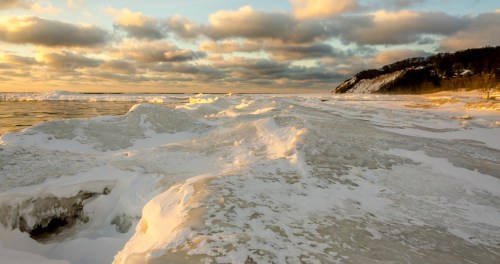
Sunlight Sighting

Sunlight Sighting, Frankfort Michigan

Sunlight Sighting, Frankfort Michigan, photo by Aaron Springer

Today’s photo of the  the approach of Frankfort’s North Breakwater was taken a few hundred feet from yesterday’s pic.

View it bigger and see lots more of Aaron’s great Lake Michigan photos on Flickr.

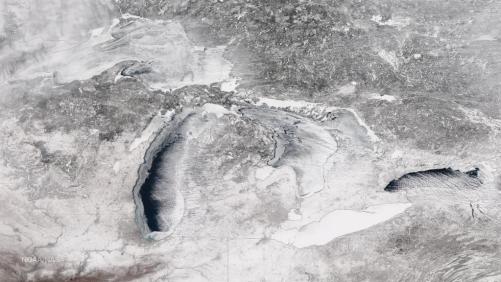
Tuesday Tweet: Great Lakes Ice at 85%

NOAA Ice Coverage

Great Lakes Ice Coverage on Feb 23, 2015, photo by NOAA Environmental Visualization Laboratory

In Great Lakes Total Ice Cover Nears 85% NOAA reports:

The NOAA Great Lakes Environmental Research Laboratory is showing total ice cover of 84.4% as of February 22, 2015, well above the long term average and closing in on last year’s mark of 92.5% coverage on March 6, 2014. In this image, Lake Erie is a vast white plain, joining Lake Huron and Lake Superior with coverages above 90% and only small areas of open water. This image was taken by the Suomi NPP satellite’s VIIRS instrument around 1803Z on February 23, 2015.

Click through to see it big as the Great Lakes and see more photos of the Great Lakes from high above if you click the “Great Lakes” keyword.

PS: Follow @NOAA@NOAA_GLERL & @NOAASatellites on Twitter for lots more great images!

A Cold Calm

A Cold Calm

A Cold Calm, photo by Mark Miller

A scan of the Michigan mercury this morning shows a lot of record and near record low temps ranging from a balmy -10 in Grand Rapids to -24 in the Soo, -26 in Ann Arbor, -28 in Alpena, -29 in Port Huron and an eye-popping -34 in the “Icebox of the North” Pellston. I hope all of you find a way to stay warm this weekend!

View Mark’s photo from last Sunday in Empire bigger and see more in his slideshow.

PS: You can check out the view from Empire Bluff (upper left corner) right here on Michigan in Pictures.

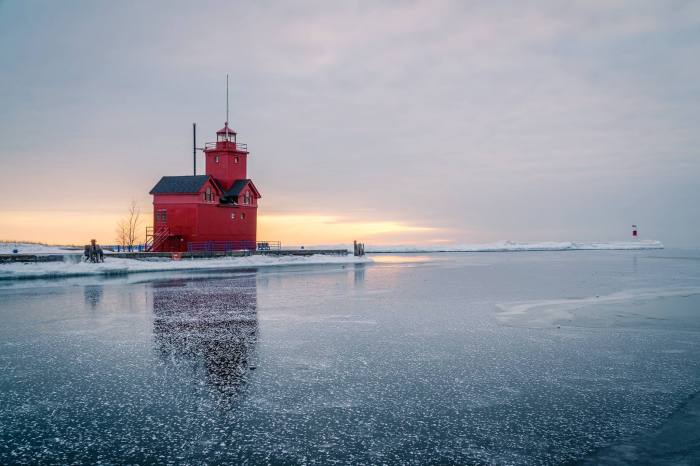
Big Red, White Snow & Blue Ice

Big Red & Blue Ice

Reflections of a cold sunset, photo by Tony Reidsma

Here’s an incredible shot of Big Red aka the Holland Harbor Lighthouse. In his extensive article on the history of the Holland Harbor Light, Terry Pepper explains how the nickname came to be:

A Coast Guard crew arrived in Holland in 1956, and gave the combined fog signal building and lighthouse a fresh coat of bright red paint in order to conform to its “Red Right Return” standard, which called for all aids to navigation located on the right side of a harbor entrance to be red in coloration. Local residents thus began referring to the fifty year old structure as “Big Red,” a name which has stuck through the years. The Fourth Order lens was subsequently removed from the fog signal lantern in the late 1960’s, and replaced with a 250 mm Tidelands Signal acrylic optic.

With the fading of the Great Lakes passenger fleet, Holland Harbor had ceased to serve any real commercial traffic. With the station now serving only as a beacon to guide pleasure boats in and out of Lake Macatawa, the Coast Guard announced plans to abandon the old fog signal building to eliminate ongoing maintenance costs in 1972. Over the years, “Big Red” had become as much of an iconic symbol of tourist-centered Holland as tulips and windmills, and fearing the loss of their beloved landmark, the citizenry of Holland gathered together and circulated petitions in an attempt to save the historic structure. To this end, the Holland Harbor Lighthouse Commission was formed in 1974 to coordinate preservation and restoration efforts, and continues to manage the structure to this day.

View Tony’s photo big as Big Red on Facebook and see and purchase some of his work at imagesforyourwalls.com.  If you’re in an icy mood, consider attending the opening of his Frozen In Time exhibition at the Holland Arts Council from March 5 – April 18, 2015. The opening reception is March 5th, starting at 6pm.

More winter wallpaper and more lighthouses on Michigan in Pictures!

Happy Frozen Valentine’s Day

Valentine on Ice by GR2 Photography

Happy FROZEN Valentine’s Day everyone. If you’re like me, with highs predicted for today and tomorrow in single digits and lows below zero across most of Michigan, you’re probably wishing that Mother Nature would let it go!

What an eye from Greg, eh? View his photo bigger and see many more photos & follow him at GR2 Photography on Facebook. Also, if you want to stock up on cool Valentines for next year, click the pic and ask him about that!

More Michigan Valentine’s Day on Michigan in Pictures.

Support Michigan in Pictures with Patreon

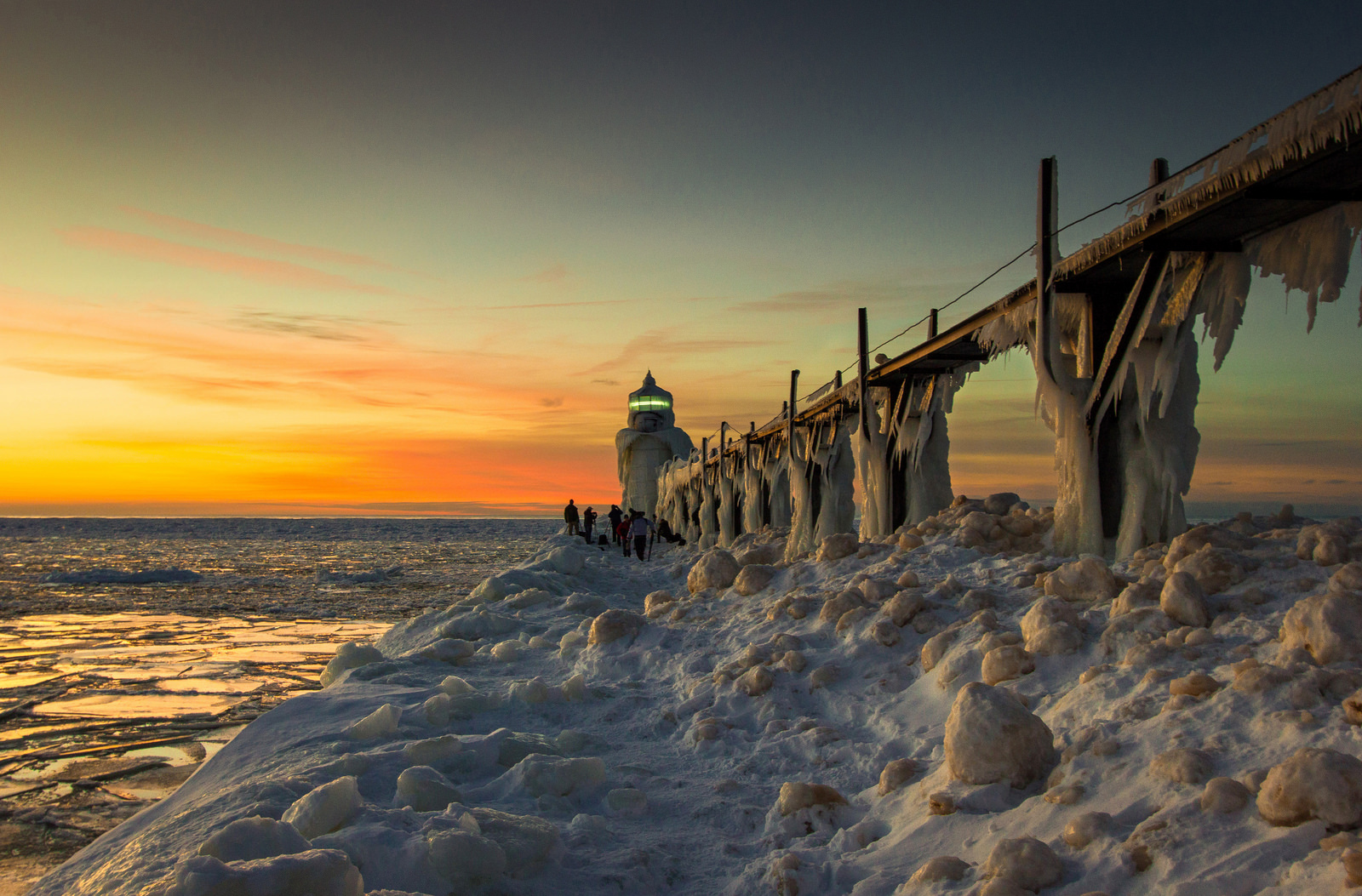
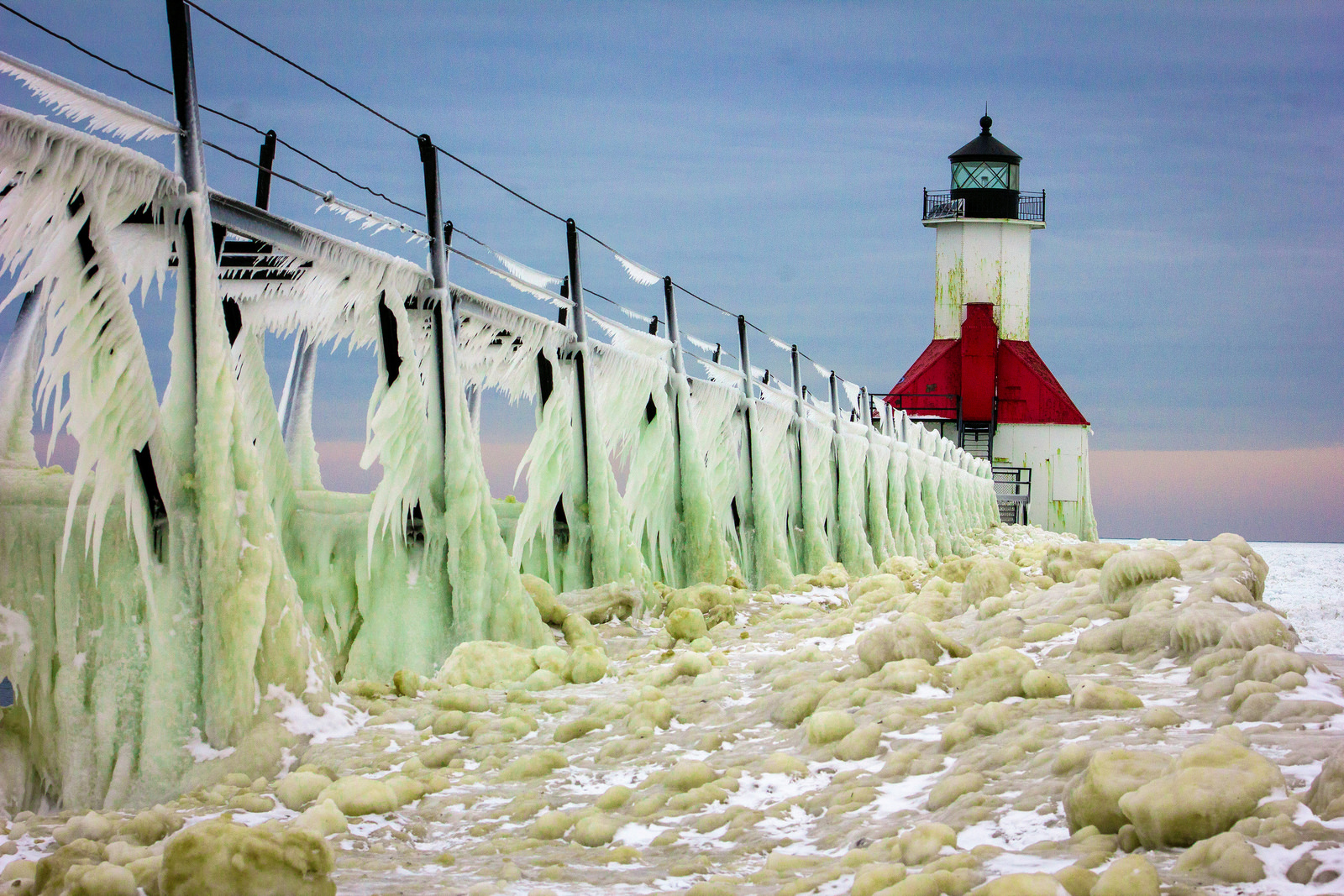
St Joseph Outer & Inner Pier Lighthouses

St Joseph Sunset

St Joseph Sunset, photo by PhotoJacko

We’ve all been seeing a bunch of photos from the frozen St. Joseph Pier, so I thought it would be good to give you a little primer about which is which. It took a little digging, but Dave Wobster at Boatnerd.com has the best info on St. Joseph North Pier Outer & Inner Lights:

The present range lights were built in 1907 when the north pier was extended 1000-feet necessitating two lights which serve as range lights. Previously, there had been lights erected as early as 1832 at this location. A round stone tower, built in 1859, was replaced by the present lights.

Outer – (Front Range) is a round, cast-iron plate 35-foot tall tower topped by a round watch room and 10-sided lantern room. The tower is painted white, and the lantern room is black. The fixed light is exhibited via a Fifth-Order Fresnel lens and two brass reflecting panels manufactured by Barbier & Benard of Paris. The light is visible for 180 degrees. (above)

Inner – (Rear Range) was built in 1898 and rebuilt 1907. A 26-foot square steel-framed fog signal building encased in 3/8″ cast iron plates with an octagonal light tower on a hip roof. The helical bar lantern room contains a Fourth-Order fixed Fresnel lens with a brass reflector manufactured by Sautter & Company of Paris. The building is white with a red roof, and the lantern room is painted black. The light is visible over a range of 270 degrees. (below)

The lights are connected by an elevated catwalk that extends from the shore to the outer light. The walkway was constructed to permit the light keepers access to the light during rough weather.

Yesterday I featured a photo by Jackie as the cover of the Absolute Michigan Facebook page. Click the photos to view them bigger on Flickr, see more in her Winter slideshow and follow her  at Jackie Novak Photography on Facebook.

St Joseph Lighthouse

St Joseph Lighthouse, photo by PhotoJacko


Zenith

Zenith

Zenith, photo by Aaron Springer

Aaron writes:

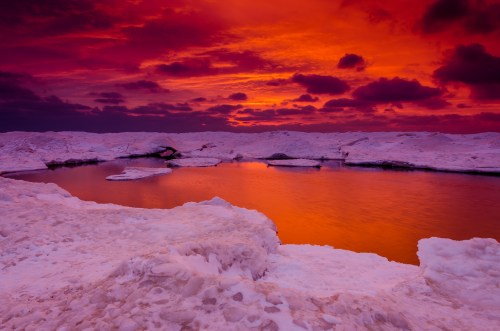
Crimson currents flow toward the deeper waters of Lake Michigan during an eruption of last light.

While at this location the night before I hastily packed up my things after sunset and left some gear behind by accident. I returned the next evening to see if I could find what had been forgotten. The light was glum and I began shooting long exposure panoramas with the intention of converting them to black and white. After a short time a very slight hue of pink began to show up in the exposures and within minutes the sky exploded with one of the most color intense sunsets that I have ever witnessed.

View his photo bigger on Flickr and check out more of his ice photos.

2015 Michigan Ice Fest this weekend!

DSCN0507

Untitled, photo by Greg Maino

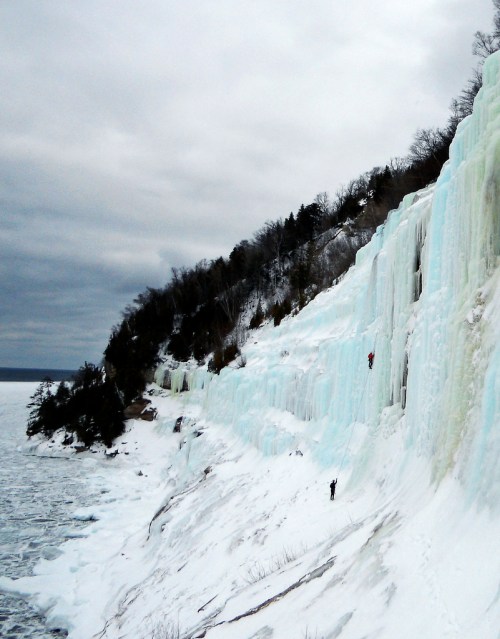
Every year at the beginning of February (Feb 5-8, 2015), ice climbing fans from all over descend on Munising for the Michigan Ice Festival. The weekend features presentations and instruction from some of the top climbers in the world, gear demos, climbing socials and the premier of the trailer for the Michigan Ice Film.

You can see some of the climbing locations (formed by frozen waterfalls and seepage) right here, and if you do head up and pack your camera, consider entering their 2015 Ice Fest photo contest.

View Greg’s photo background big. Most of the climbing is not this extreme – see more of it in his Icefest 2011 slideshow. Be sure to also check out his Icefest: Early Years slideshow and follow his adventures at juskuz.com.

Blizzard beats boat: The Blizzard of ’78

Capsized and Ice Locked

Blizzard beats boat, photo by John Russell

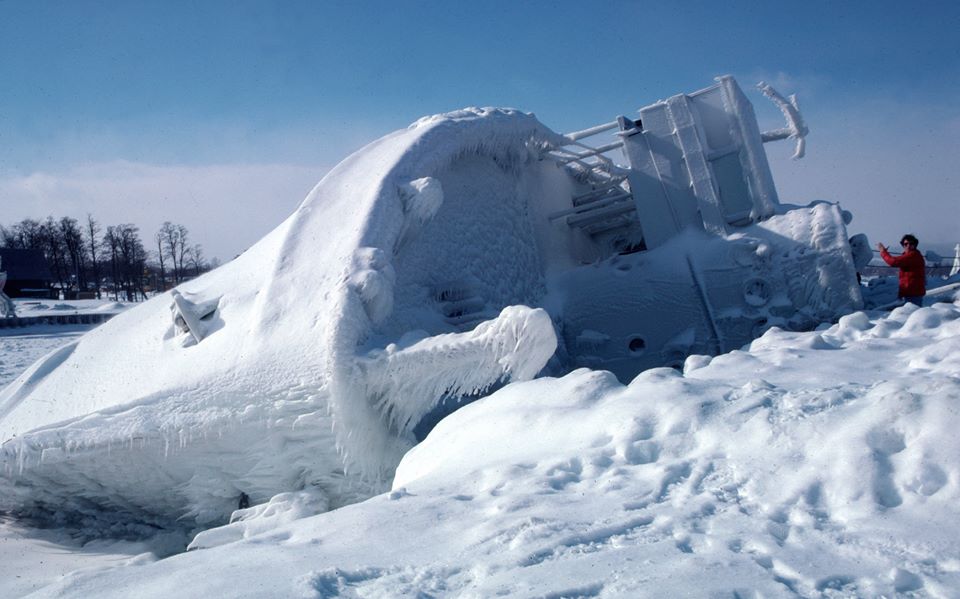
Oh ice, I can’t stay mad at you, even when you misbehave like this.

Associated Press photographer John Russell shared this photo from January 29, 1978. He writes:

My office 37 years ago: Marty Lagina stands on the frozen pier at the Great Lakes Maritime Academy on January 29, 1978, viewing the capsized training vessel Allegheny, which capsized from ice buildup during the Blizzard of ’78. This image was on assignment for TIME magazine, who had seen my b&w image on the UPI wire and wanted a color image.

Marty and I were lucky – the sky cleared and the wind stopped for about 20 minutes, then the storm began again. I wondered at the time who TIME knew to make that happen….

The photo was taken in Traverse City, ground zero for the blizzard Seeking Michigan shared info about one of Michigan’s most significant winter storms:

On January 26-27, 1978, snowstorms with fifty-to-seventy-mile per hour winds pummeled much of Michigan. Snowfall totals ranged from eighteen inches in Lansing to an incredible fifty-one inches in Traverse City. More than 100,000 cars were abandoned on roads and highways, and travel was impossible for days. Governor William G. Milliken declared a state of emergency on January 26 and activated the National Guard to assist with the cleanup. The governor also requested financial assistance from the federal government and estimated damage totals to be more than $25 million, not including lost productivity from workers who were unable to get to their jobs.

Click through to view his photo bigger and friend John on Facebook – his “My Office” series is a great look at what’s happening all over Michigan.

PS: Sorry for all the pics from Leelanau/Traverse City lately. Sometimes it just works out that way…