
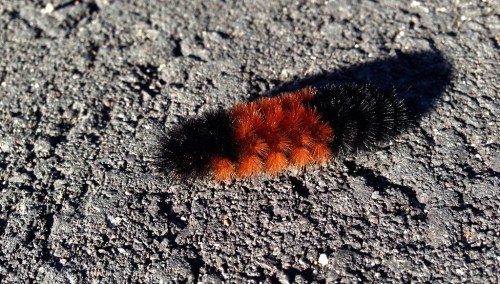
Hmmm…thick or thin? And what does it mean anyways?, photo by dan bruell
Predicting Winter Weather: Woolly Bear Caterpillars at the Farmer’s Almanac says that in 1948, Dr. C. H. Curran, curator of insects at the American Museum of Natural History in New York City sought to determine the average number of reddish-brown segments and use that to forecast the coming winter weather. For eight years, he continued to try and prove scientifically a weather rule of thumb that the wider that middle brown section is (and the more brown segments there are) the milder the coming winter will be, while a narrow brown band means a harsh winter.
Between 1948 and 1956, Dr. Curran’s average brown-segment counts ranged from 5.3 to 5.6 out of the 13-segment total, meaning that the brown band took up more than a third of the woolly bear’s body. As those relatively high numbers suggested, the corresponding winters were milder than average. But Curran was under no scientific illusion: He knew that his data samples were small. Although the experiments popularized and, to some people, legitimized folklore, they were simply an excuse for having fun. Curran, his wife, and their group of friends escaped the city to see the foliage each fall, calling themselves The Original Society of the Friends of the Woolly Bear.
…Mike Peters, an entomologist at the University of Massachusetts, doesn’t disagree, but he says there could, in fact, be a link between winter severity and the brown band of a woolly bear caterpillar. “There’s evidence,” he says, “that the number of brown hairs has to do with the age of the caterpillar—in other words, how late it got going in the spring. The [band] does say something about a heavy winter or an early spring. The only thing is . . . it’s telling you about the previous year.”
Read on for more!
View Dan’s photo background bigtacular and see more in his Fall 2014 slideshow.
More weather on Michigan in Pictures!

 Michigan in Pictures