
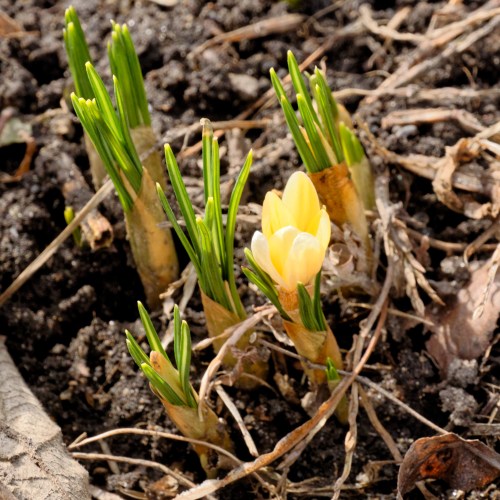
Spring!, Photo by Joel Dinda
View Joel’s photo background bigtacular and then just lay back and watch his massive Flowers slideshow until you too believe in SPRING!
There’s lots more spring wallpaper on Michigan in Pictures.
Spring!, Photo by Joel Dinda
View Joel’s photo background bigtacular and then just lay back and watch his massive Flowers slideshow until you too believe in SPRING!
There’s lots more spring wallpaper on Michigan in Pictures.
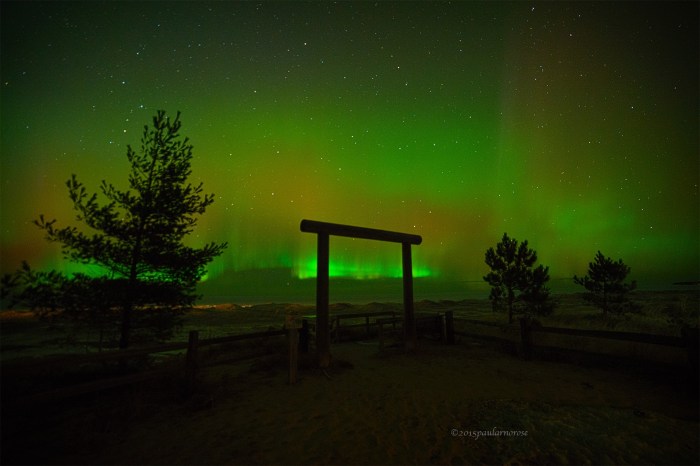
Northern Lights over Lake Lake Superior, photo by Paul Arno Rose
NOAA’s Space Weather Prediction Center is THE place to go for forecasting of likely northern lights activity. Yesterday they held a press conference regarding the G4 storm (on a scale of 1-5) that was caused by two magnetic eruptions on March 15 that combined to form a single wave producing the biggest storm so far of Cycle 24.
Their page on Geomagnetic Storms explains:
A geomagnetic storm is a major disturbance of Earth’s magnetosphere that occurs when there is a very efficient exchange of energy from the solar wind into the space environment surrounding Earth. These storms result from variations in the solar wind that produces major changes in the currents, plasmas, and fields in Earth’s magnetosphere. The solar wind conditions that are effective for creating geomagnetic storms are sustained (for several to many hours) periods of high-speed solar wind, and most importantly, a southward directed solar wind magnetic field (opposite the direction of Earth’s field) at the dayside of the magnetosphere. This condition is effective for transferring energy from the solar wind into Earth’s magnetosphere.
The largest storms that result from these conditions are associated with solar coronal mass ejections (CMEs) where a billion tons or so of plasma from the sun, with its embedded magnetic field, arrives at Earth. CMEs typically take several days to arrive at Earth, but have been observed, for some of the most intense storms, to arrive in as short as 18 hours. Another solar wind disturbance that creates conditions favorable to geomagnetic storms is a high-speed solar wind stream (HSS). HSSs plow into the slower solar wind in front and create co-rotating interaction regions, or CIRs. These regions are often related to geomagnetic storms that while less intense than CME storms, often can deposit more energy in Earth’s magnetosphere over a longer interval.
Storms also result in intense currents in the magnetosphere, changes in the radiation belts, and changes in the ionosphere, including heating the ionosphere and upper atmosphere region called the thermosphere. In space, a ring of westward current around Earth produces magnetic disturbances on the ground. A measure of this current, the disturbance storm time (Dst) index, has been used historically to characterize the size of a geomagnetic storm. In addition, there are currents produced in the magnetosphere that follow the magnetic field, called field-aligned currents, and these connect to intense currents in the auroral ionosphere. These auroral currents, called the auroral electrojets, also produce large magnetic disturbances. Together, all of these currents, and the magnetic deviations they produce on the ground, are used to generate a planetary geomagnetic disturbance index called Kp. This index is the basis for one of the three NOAA Space Weather Scales, the Geomagnetic Storm, or G-Scale, that is used to describe space weather that can disrupt systems on Earth.
During storms, the currents in the ionosphere, as well as the energetic particles that precipitate into the ionosphere add energy in the form of heat that can increase the density and distribution of density in the upper atmosphere, causing extra drag on satellites in low-earth orbit. The local heating also creates strong horizontal variations in the in the ionospheric density that can modify the path of radio signals and create errors in the positioning information provided by GPS. While the storms create beautiful aurora, they also can disrupt navigation systems such as the Global Navigation Satellite System (GNSS) and create harmful geomagnetic induced currents (GICs) in the power grid and pipelines.
Lots more including the ability to sign up for space weather alerts at www.swpc.noaa.gov. Also head over to the NOAA Auroras group on Flickr to share your photos.
View Paul’s photo background bigtacular and check out more of his photography on his Facebook page.
More northern lights photos & info on Michigan in Pictures.
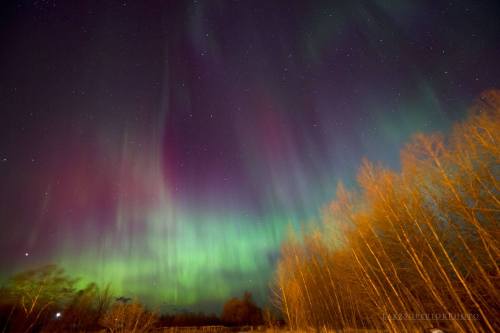
St. Patrick’s Day 2015 Northern Lights, photo by Lake Superior Photo
Shawn of Lake Superior Photo writes:
Some great auroras this morning, but it was very difficult to photograph, brutal wind- it’s still out and still dark, go look north
Click to view the photo background bigtacular after you go out and check!!
Call it the luck of the Irish for early risers! Stay safe and happy St. Patrick’s Day everyone.
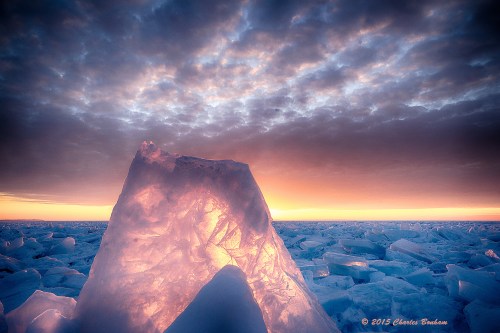
Fire & Ice, photo by Charles Bonham
I keep thinking to myself just one more winter photo … and then there’s one more.
Charles shot this at Gills Pier on the Leelanau Lake Peninsula last week. View it background bigtacular (for real – the detail on the ice in the foreground is staggering) and see lots more Lake Michigan ice and beauty in his awesome slideshow.
More winter wallpaper, more Lake Michigan and more sunsets on Michigan in Pictures.
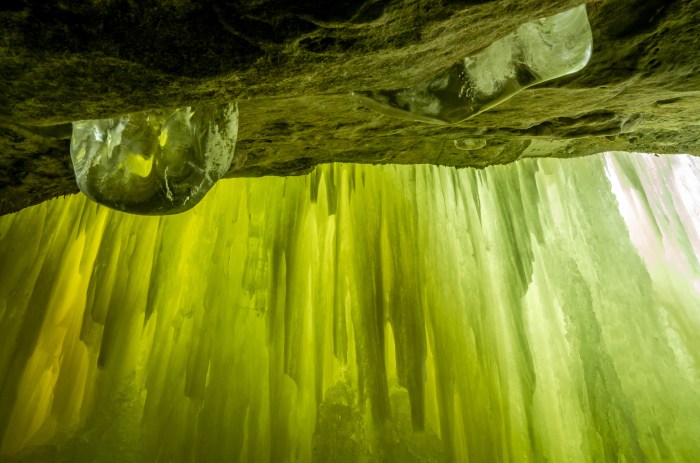
Feeling Green, photo by Joseph Snoweart
This weekend features many St. Patrick’s Day celebrations around the state. I hope that if you’re taking part you have a lot of fun, stay safe and remember to be kind to any leprechauns you happen to meet!
View Joseph’s photo from the Eben Ice Caves background bigtacular and see more in his slideshow.
More winter wallpaper and more about the Eben Ice Caves on Michigan in Pictures.
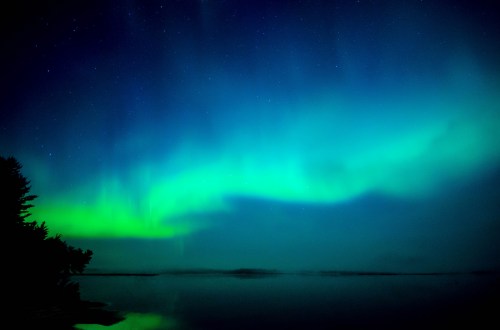
Northern Lights, photo by Stephen Tripp
Intense colors from the rare Great Aurora painted the skies around the world in vivid shapes that moved like legendary dragons. Ghostly celestial armies battled from sunset to midnight. Newspapers that reported this event considered the aurora, itself, to be the most newsworthy aspect of the storm. Seen as far south as Florida and Cuba, the vast majority of people in the Northern Hemisphere had never seen such a spectacle.
~Dr. Sten Odenwald
I like to revisit this March 13, 1989 incident documented by Dr. Odenwald in A Conflagration of Storms. In addition to being an amazing display of the aurora borealis, this solar storm took down Quebec’s power network and very nearly much more:
In many ways, the Quebec blackout was a sanitized calamity. It was wrapped in a diversion of beautiful colors, and affected a distant population mostly while they slept. There were no houses torn asunder, or streets flooded in the manner of a hurricane or tornado. There was no dramatic footage of waves crashing against the beach. There were no cyclonic whirlwinds cutting a swath of destruction through Kansas trailer parks. The calamity passed without mention in the major metropolitan newspapers, yet six million people were affected as they woke to find no electricity to see them through a cold Quebec wintry night. Engineers from the major North American power companies were not so blasé about what some would later conclude, could easily have escalated into a $6 billion catastrophe affecting most U.S. East Coast cities. All that prevented 50 million more people in the U.S. from joining their Canadian friends in the dark were a dozen or so heroic capacitors on the Allegheny Power Network.
The Media seemed to have missed one of the most human impacts of the beautiful aurora they so meticulously described in article after article. Today the March 1989 ‘Quebec Blackout’ has reached legendary stature, at least among electrical engineers and space scientists, as an example of how solar storms can adversely affect us. It has even begun to appear in science textbooks. Fortunately, storms as powerful as this really are rather rare. It takes quite a solar wallop to cause anything like the conditions leading up to a Quebec-style blackout. When might we expect the next one to happen? About once every ten years or so, but the exact time is largely a game of chance.
Call it the ultimate Friday the 13th! The whole book The 23rd Cycle:Learning to live with a stormy star is available online, and you can read a lot more from Dr. Odenwald at his website, The Astronomy Cafe or at facebook.com/AstronomyCafe.
View Stephen’s photo bigger and see more in his excellent Northern Lights slideshow.
A whole lot more northern lights on Michigan in Pictures!
PS: Keep an eye on solar storminess and get heads up notifications when the northern lights might be visible at NOAA’s Space Weather Prediction Center.
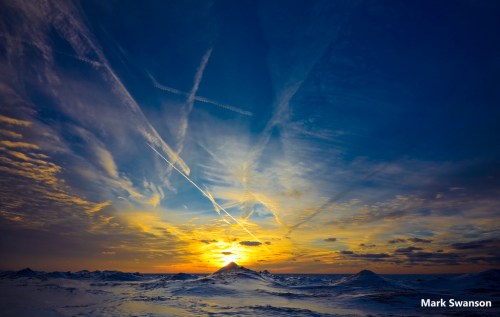
Contrails in a winter sky, photo by Mark Swanson
Whole lot going on in that sunset – definitely not like the ones I grew up with.
Mark writes:
I could not avoid contrails in the sky tonight (pretty sure much of this is Chicago), so I decided to focus on them.
I think that’s a good choice.
View his photo bigger on Flickr and see lots more Lake Michigan wintry goodness in Mark’s slideshow.
PS: Speaking of Lake Michigan goodness…
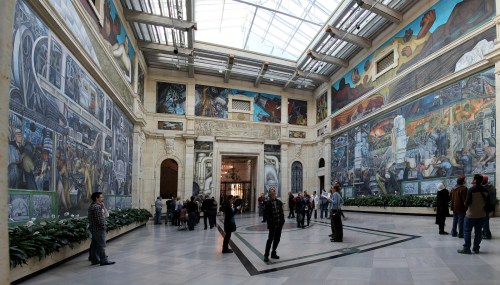
Rivera Court – Detroit Institute of Arts, photo by Trish P.
Crain’s Detroit Business has a report on this Sunday’s DIA opening ‘Diego Rivera and Frida Kahlo in Detroit’:
When Diego Rivera and his wife and fellow artist Frida Kahlo were in Detroit in 1932-33, the worst of the Great Depression was upon the country.
A labor march had just taken place in Detroit, and four workers had been killed, said Mark Rosenthal, adjunct curator of contemporary art at the Detroit Institute of Arts, speaking during a media preview of the exhibit Tuesday morning.
Rivera and Kahlo, described by the museum as “an explosive couple” in their own right, arrived on the scene — he carrying a pistol, and she carrying a flask.
He romanticized Detroit, and Kahlo, who suffered a miscarriage while in Detroit, rejected the city, the DIA said.
Yet out of that time came pivotal work for both artists.
Rivera created the “Detroit Industry” murals on the DIA’s walls, which he considered to be his greatest work, Rosenthal said. And Kahlo, encouraged by her husband, began to create the paintings that would typify her career and make her famous.
The DIA’s upcoming “Diego Rivera and Frida Kahlo in Detroit” exhibit, which opens Sunday, will give art enthusiasts a chance to see who the artists were before they came to Detroit and who they were after, Rosenthal said.
Read on for more and get information about the exhibit that runs Sunday through July 12th from the DIA (including an opening lecture Sunday at 2).
View Trish’s photo bigger on Flickr and see more in her Detroit slideshow.
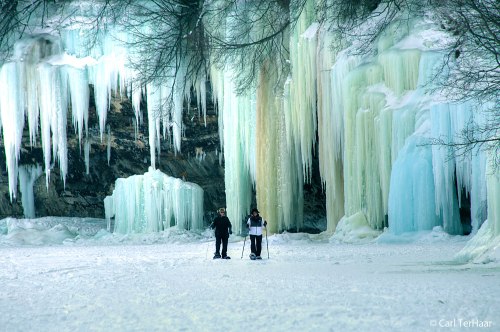
Ice Curtains on Grand Island, Munising, MI, photo by Carl TerHaar
Seems fitting to stay at Grand Island for another day. With a few exceptions, most of Michigan is above freezing even at this early hour, which means it’s time to say goodbye to winter and icy excursions. What a winter!!
View Carl’s photo background bigilicious and see more in his slideshow.
Haven’t had enough? There’s more winter wallpaper on Michigan in Pictures!
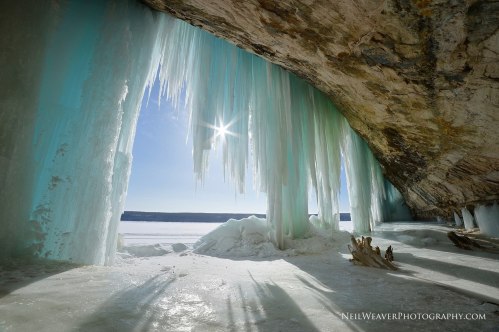
Grand Island Ice Curtains, photo by Neil Weaver Photography
Neil says that seeing these in person was such an awesome experience. View the photo background bigtacular on his Facebook page, purchase a print right here, and check out lots more icy goodness at neilweaverphotography.com.
Except for a tiny sliver, the entirety of this Lake Superior island just off Munising is open for public access as the Grand Island National Recreation Area. You will definitely want to check with locals regarding ice conditions. With a warming week of weather ahead, this is probably something to put on your 2016 agenda.
More winter wallpaper on Michigan in Pictures!
 Michigan in Pictures