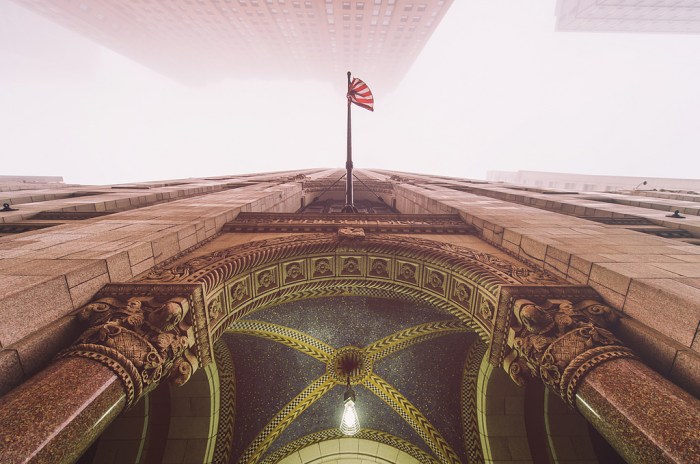
Detroit’s Buhl Building

Buhl Building Detroit Michigan

buhl building | detroit, michigan, photo by Ryan Southen

Detroit1701.org is an excellent resource for the history of Detroit. Their page on the Buhl Building says (in part):

The Buhl brothers, Frederick and Christian, came to Detroit early in the Nineteenth Century. They made their money in the fur trade and then in the hat business. As Detroit became a leading industrial metropolis, they turned to manufacturing as well as retailing and property development. They founded the Detroit Locomotive Works and then the Buhl Iron Works that later became the Detroit Copper and Brass firm. They added to their wealth by entering the hardware business and then erected an office building at the corner of Griswold and Congress that became an attractive location for prosperous law firms. Frederick Buhl served as mayor of Detroit in 1848, while his brother, Christian, served as mayor twelve years later after holding a variety of other political offices.

The skyscraper building boom in Detroit reached its zenith in the late 1920s, reflecting the demand for office space generated by the vehicle industry. A third generation of Buhls decided to make more profitable use of their prime downtown land by replacing their small office building at Griswold and West Congress with the 26 story building that you see. They selected the Smith, Hinchman and Grylls firm and, fortunately for them, the skilled and imaginative Wirt Rowland was selected as the architect. His most magnificent accomplishment is the nearby Guardian Building but he created a beautiful structure in the Buhl Building, one that has great appeal some eight decades after he first sketched it.

Read on for more and also check out Historic Detroit for more about the Buhl & architect Wirt C. Rowland, avid modernist, supporter of the Arts and Crafts movement, and key contributor to the Art Deco-style skyscrapers along Detroit’s skyline.

View Ryan’s photo bigger, see more in his Detroit slideshow, and be sure to follow him on Instagram. If you’re interested in a great wedding photographer, head over to his photography website!

More architecture and lots more Detroit on Michigan in Pictures!
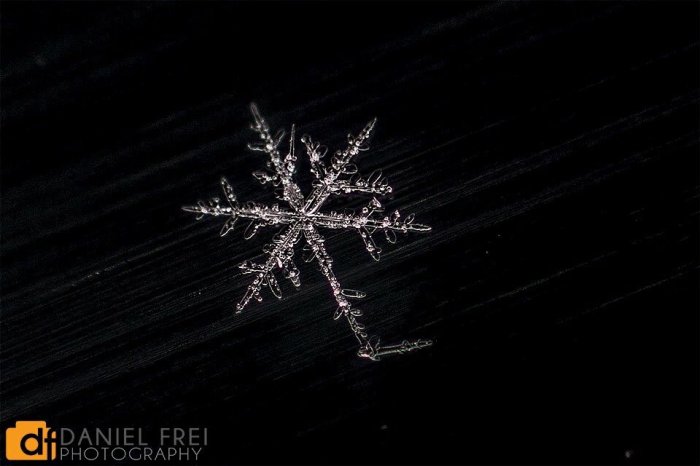
Where’s Winter? (Hint: ask El Niño)

Where's Winter

Where’s Winter?, photo by Daniel Frei Photography

Dan writes:

WANTED: millions and billions and zillions of these pretty things!

Retweet if you want snow too!

But how likely is snow? Here’s an in-depth report by Jessica Eggert on the likliehood (or lack thereof) of snow by Christmas Day that draws from a number of sources and pegs Detroit’s chances at just 46%. For the why behind this, check out Jeff Masters’ report on the warmest meteorological autumn on record:

Meteorological autumn (September – November) was the warmest in 121 years of recordkeeping for the 48 contiguous U.S. states, according to NOAA’s national wrapup of November and fall conditions released Wednesday morning. The national average of 56.8°F was a full 3.3°F above the 20th-century average and 0.2°F above the previous record of 56.6°F (Sep-Nov 1963). Only one state (Florida) had its warmest autumn on record, but the nation as a whole still came out on top because of the rare coast-to-coast nature of the warmth. (FYI Michigan was 120 out of 121 years in 2015)

The dynamics associated with El Niño are likely to keep unusually mild weather predominating over the northern U.S. for most of the winter, according to seasonal outlooks from the National Weather Service.

View & share Dan’s photo from his Twitter and see more and purchase prints at his photography website.

More snow on Michigan in Pictures!

PS: Here’s a great article about snow by Jerry Dennis with illustrations by Glenn Wolff titled Nature Baroque Snowflakes & Crystals that I shared in my online magazine the Northern Michigan Journal a decade ago.

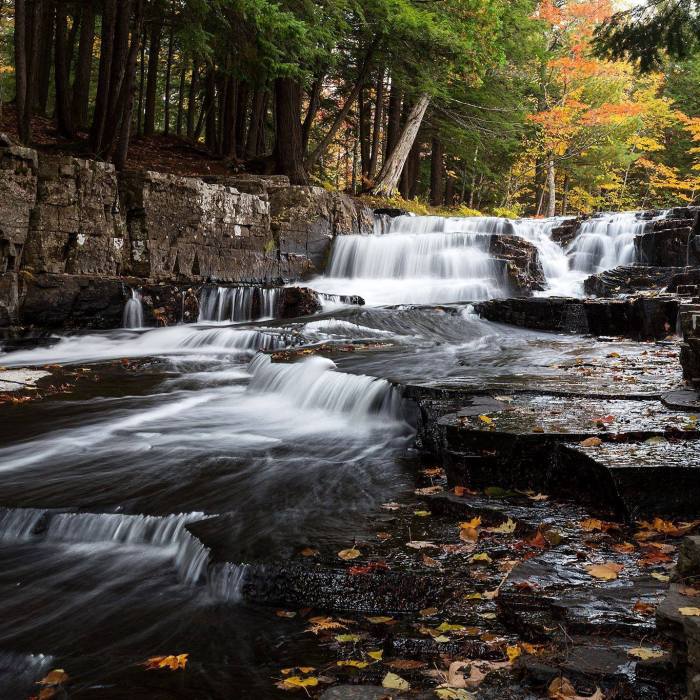
Waterfall Wednesday: Quartzite Falls on the Slate River

Quartzite Falls on the Slate River

Quartzite Falls on the Slate River, photo by Amie Lucas

Waterfalls of the Keewenaw’s page on Quartzite Falls says:

Quartzite Falls is a perfect little waterfall high above the rugged gorge on Slate River. The river drops in a sudden crescent onto a large, flat slide of slate before flowing into a deep pool surrounded by cedars. Quartzite Falls may be small, but it’s shape and scenic area makes for an amazing waterfall experience.

This waterfall is a short distance downstream of Black Slate Falls, easy walking distance from the road and about a mile from the slate quarries of Arvon. These three areas make for an excellent little adventure that is fairly accessible for all ages.

You can click through for directions and some pics. Amie took this back in October and writes:

The Slate River is magnificent. I spent an entire day traversing over rough, steep terrain & wading through cold water on slippery rocks to visit places that felt like no one had ever been before. Quartzite Falls, one of the many beauties on this river, is one of the easier waterfalls to access.

View her photo background bigilicious, follow her on Facebook and definitely check out her waterfall gallery and others at her photography website!

Many more Michigan waterfalls and (if you can’t let go of autumn) more fall wallpaper on Michigan in Pictures!

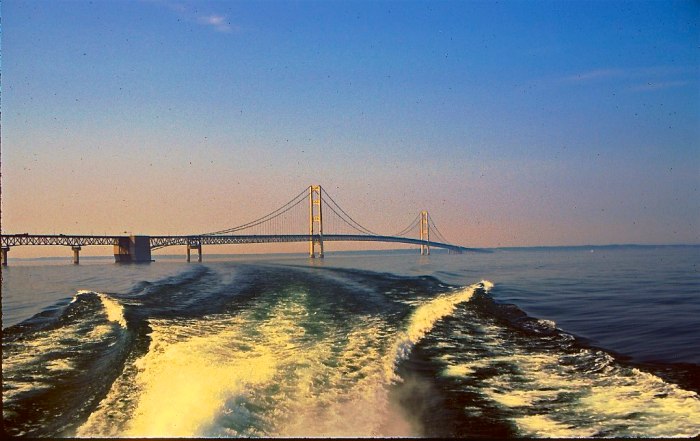
Mackinac Wake

Mackinac Bridge from ferry

Mackinac Wake, photo by Bill Johnson

Bill took this photo in May of 1987 and writes:

We had been out to the island and were returning via ferry when the captain announced a slight detour in our route. There was some kind of a special group aboard and as a treat, our boat went under the Mighty Mac, something they hardly ever do. It was pretty neat. The five mile long bridge is no longer the longest suspension bridge in the world, but to me it’s still the prettiest. I’ve personally seen several other suspension bridges, including the Golden Gate, and I’ll pick the Mac every time.

View his photo background big and see more in his Michigan slideshow.

Lots more of the Mighty Mackinac Bridge on Michigan in Pictures!

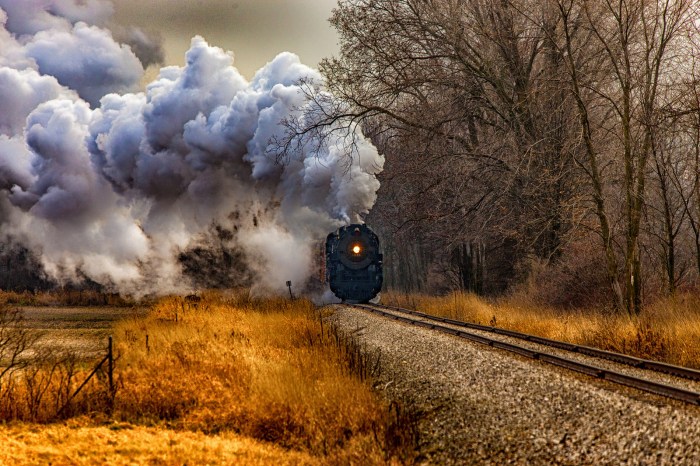
How Pere Marquette 1225 inspired the Polar Express

Pere Marquette 1255

Pere Marquette 1225, photo by Bob Gudas

The Steam Railroading Institute in Owosso is home station for the Pere Marquette 1225 locomotive aka the Polar Express:

Retired from service in 1951, 1225 was sent to scrap, in New Buffalo, Michigan. In 1955, Michigan State University Trustee, Forest Akers was asked by C&O Chairman Cyrus Eaton if the University would be interested in having a steam locomotive (Eaton did not want to scrap the engines but was having a hard time finding places that would accept them) so that engineering students would have a piece of real equipment to study. Forest Akers thought it a good idea and proposed the idea to University President John Hannah. John Hannah accepted the gift of the locomotive. When he told the Dean of the College of Engineering about the gift, the Dean said that Engineering was not interested in an obsolete locomotive. John Hannah then called up Dr. Rollin Baker, director of the MSU Museum and told him that he was getting a locomotive. The C&O then instructed the yardmaster at New Buffalo to send an engine to the Wyoming Shops for a cosmetic restoration and repainting with the name Chesapeake and Ohio on the side. The 1225 was the last engine in the line, i.e. easiest to get out. It had nothing to do with the number representing Christmas Day.

Baker received the gift of the locomotive in 1957 when it was brought to campus. The locomotive remained on static display near Spartan Stadium on the Michigan State campus in East Lansing, Michigan for a decade. While on display, a child by the name of Chris Van Allsburg used to stop by the locomotive on football weekends, on his way to the game with his father. He later stated that the engine was the inspiration for the story, Polar Express.

Lots more about the Michigan’s largest operating steam locomotive at Wikipedia and information about riding the train and the rest of their collection at the Steam Railroading Institute.

View Bob’s photo bigger and see more in his slideshow.

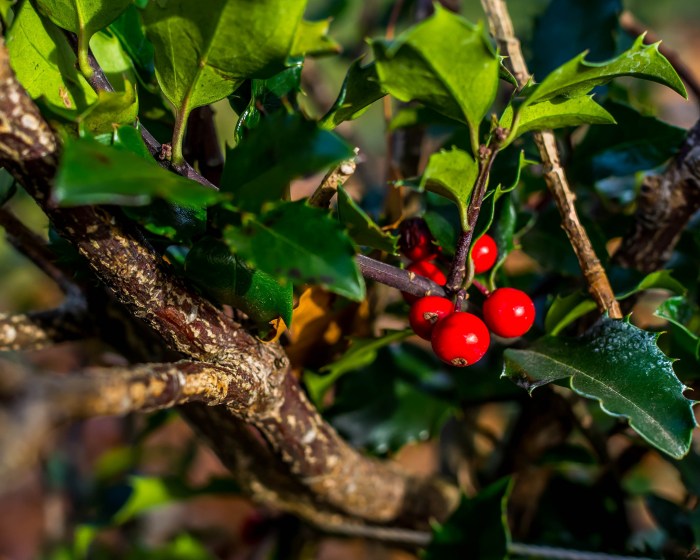
Michigan Holly or Winterberry

Holly

Holly, photo by Third Son

How like the holly in deep winter time
How like the star in the dark night shine
How like a path on the snow driven plain
How like the candle — how like the flame
How like the winter that promises spring
How like the carol we sing.
~Joel Mabus (How Like the Holly)

The Hope College Biology Nature Preserve has this to say about Michigan Holly (Ilex verticillata: Aquifoliaceae):

Michigan Holly is a medium sized shrub not normally growing taller than 12 feet and usually about 6 to 8 feet tall and 3 to 5 feet wide. It has densely branched stems that grow into a round crown and flower in May and June with small yellow-white flowers. The fruits are highly distinguishable and grows in bright red clusters of small berries, forming in September and October and persisting into mid-winter. Michigan Holly (also known as Winterberry) is dioecious, so both male and female plants are needed for fruit production and only females bear fruits.

Michigan Holly is found throughout Eastern and Central North America, but does not grow well in the West, Southwest, or Lower Midwest because of dry winds and heat. It is found naturally in wetlands and will tolerate standing water or swamps, however, it prefers to grow in well-drained, acidic, damp, loamy or sandy soils and full or partial sun.

Click through for photos and a little more information.

View Third Son’s photo background bigtacular and see more in his Early Winter 2015 slideshow.

More winter wallpaper on Michigan in Pictures. Also, definitely check out Michigan sonwriter Joel Mabus’s CD How Like the Holly – one of my favorite holiday albums ever!

When did summer end?

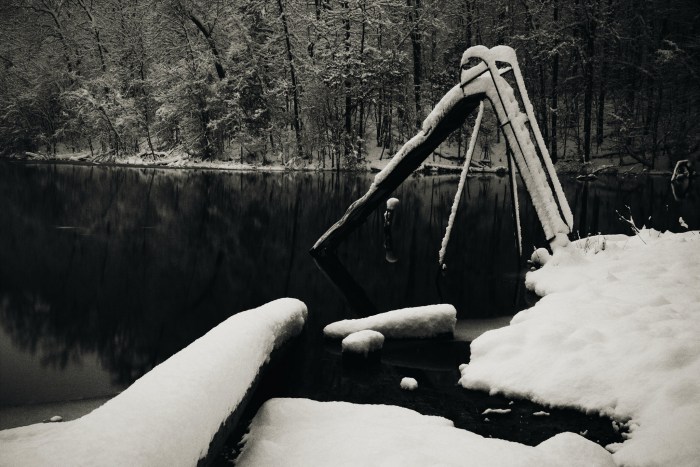
When Did Summer End

When did summer end?, photo by Cameron

Cameron took this 30 second exposure in heavy snowfall last week at Upland Hills Farm, which looks like a pretty cool place.

View the photo background bigtacular and see more in his Upland Hills Farm slideshow.

More winter wallpaper on Michigan in Pictures.

Forecasting sunsets through Sunset WX

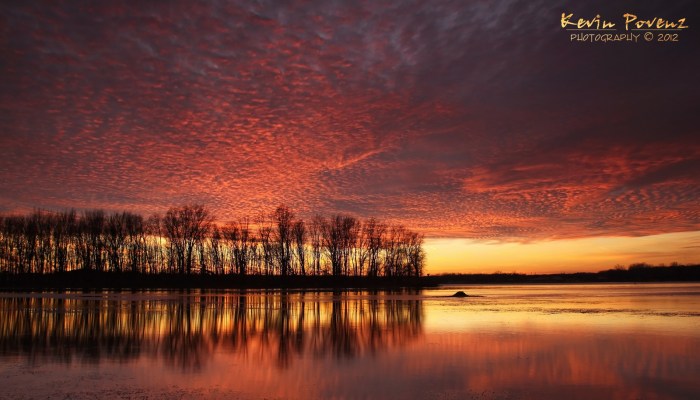
Sunset at the Bend Area

Sunset, photo by Kevin Povenz

If you’re looking to get the perfect sunset, you might want to check out the sunset forecast from Sunset WX. They explain (in part) their model for sunset forecasts:

…we understand there are numerous definitions for the criteria: Vivid, average, and poor. However, as a landscape photographer, there are certain variables I look for each evening before making the decision to take time out of my day and photograph the sunset. The most important factor I look for is sky cover, and more specifically, the existence of high clouds over the area. High clouds not only provide moisture to refract the sunlight, their ‘wispy’ formation also provides “texture” to the sky and are high enough in the atmosphere for the sun to scatter light below. Think of these as a movie theatre screen, in which light can be projected upon.

Because of this, we weighted high clouds the most as stated before, and consider this necessary for a “Vivid” sunset. In general, regions that are displayed “Poor” in the model, are areas of near 100% of total cloud cover, and also areas that are projected to experience precipitation around sunset time. The ‘hard to define’ area comes in between the two. To some, a clear sky at the time of sunset may be the definition of a great one. In this model, it is our intent to weight a clear sky sunset as average, and therefore it would show up as green or light yellow. The oranges and reds are really the areas where we are trying to show that the sunset will be one of those that makes you go ‘Wow’.

Click through to check out the live sunset forecast map – it’s pretty cool!

Kevin took this photo back in December of 2012 at “The Bend Area” in Ottawa County on the Grand River near Jenison. View it bigger and see lots more in his Sunrise/Sunset slideshow.

Lots more great Michigan sunsets on Michigan in Pictures!

Old School Efficiency at Copper Harbor Lighthouse

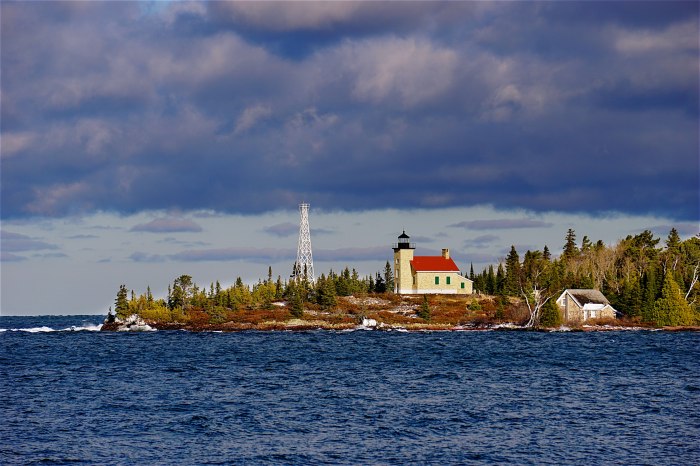
Copper Harbor Lighthouse

Copper Harbor Lighthouse, photo by Frank Wulfers

Terry Pepper’s Seeing the Light has an extensive article on Copper Harbor Lighthouse that shines a light on some solid planning from back in the day … and some that was less so:

As was the case with virtually all of the lighthouses built on the Great Lakes during the Pleasonton administration, the true costs of inferior materials and shoddy workmanship began to show. After his 1864 visit to the station, the Eleventh District Inspector remarked that the Copper Harbor lighthouse required “extensive repairs.” On subsequent investigation, the condition of the tower was determined to be beyond repair, and the following year the decision was made to raze the old tower and erect a completely new structure. With old Pleasonton-era stations needing replacement at both Marquette and Ontonagon, and new stations planned for Gull Rock, Huron and Granite Islands, the decision was made to build all six lights to the same plan. Specifying a simple brick two-story dwelling with a tower integrated into the center of one of the gable end walls, this design would eventually become known as the “schoolhouse” style, as a result of its similarity to the design of rural nineteenth century one room schoolhouses.

The lighthouse tender HAZE returned to Copper Harbor in early 1866 and deposited a working crew and materials on lighthouse point to begin construction of the new main lighthouse. Work began with the demolishing of the old rubble stone tower, and excavating the foundation for the new structure. Under normal circumstances one would assume that the old tower would have been left standing until the new station was complete. However, an archeological survey conducted by the Michigan Technological University in 1994 showed that a large portion of the stone from the old tower was reused in building the foundation of the new building. Thus it is evident that the old tower must have been demolished first. What steps were put in place to allow the continued display of a light at the station for the time period between the demolishing of the old tower and the completion of the new structure are unrecorded. However, it is almost certain that some arrangement for the display of a temporary light would have been made.

Atop the rubble stone foundation, a team of masons erected a Cream City brick building, and its 42-foot tall tower capped with a square gallery with iron safety railing. A spiral cast iron stairway within the tower provided the only means of passing between the first and second floors in addition to providing access to the lantern. Centered atop the gallery, a decagonal prefabricated cast iron lantern was installed, and the Fourth Order lens from the old tower reassembled atop a cast iron pedestal at the center of the new lantern.

Seeing the Light has much more including old photos and an account of the Pleasanton Administration’s first draft of the Copper Harbor lighthouse. Before you judge Stephen Pleasanton too harshly, however, click over to his Wikipedia entry where you will learn how this James Monroe appointee helped to save the Declaration of Independence during the War of 1812!

View Frank’s photo background big and see more in his Michigan Upper Peninsula slideshow.

More Michigan lighthouses and more Copper Harbor on Michigan in Pictures.

December 1st … Back into the Woods Day

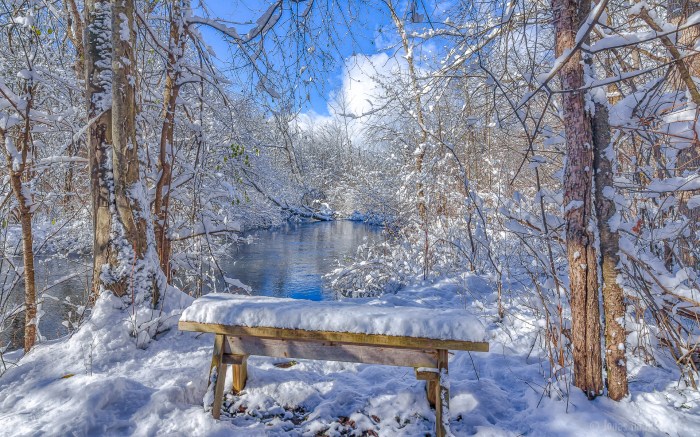
Sit for a Spell

sit for a spell, photo by Doug Jonas

Longtime readers may know that I celebrate December 1st as “Back into the Woods Day” because for my money, the hardest 15 days for the year for the non-hunting lover of the outdoors in Michigan are November 15-30th. Enjoy as you will – orange clothing not required!

The photo was taken in Michigan State University’s W.K. Kellogg Experimental Forest in Augusta, midway between Kalamazoo & Battle Creek:

Established on abandoned agricultural land, the 716-acre Kellogg Experimental Forest is known worldwide for research on tree breeding and genetics, planting techniques, and plantation establishment and management. Much of the research that developed the Spartan spruce, a hybrid that combines the color and drought resistance of a blue spruce and the softer needles and rapid growth rate of the white spruce, was done at the Kellogg Forest. The forest is open to the public for biking, hiking, horseback riding and cross-country skiing, and has several interpretive trails.

Click for visitor information and there’s also some videos of what researchers are up to that show some of this beautiful spot.

Doug says this was an enchanted afternoon in the woods, with sun, shadow, snow and reflected sky. View his photo background bigilicious and click for more of his great Michigan photos.

More winter wallpaper and lots more parks & trails on Michigan in Pictures!