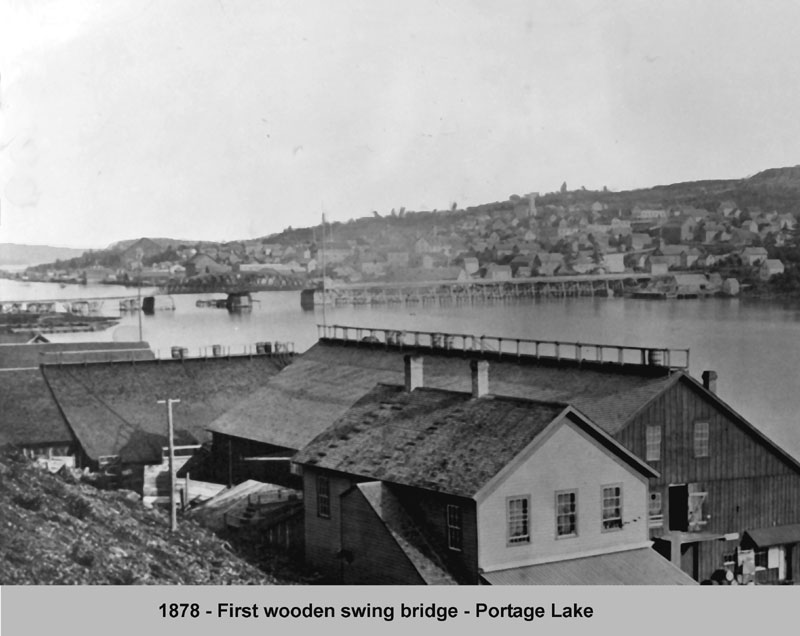
In 1897, the Mineral Range Railroad Company built a new iron swing type bridge, replacing the old wooden bridge. This bridge also featured a two lane roadway, with a railroad crossing underneath. New reconstructed support cribs were also sunk. But on August 15, 1905, disaster struck, when the steamer Northern Wave (Mutual Transit Lines), en route to the Quincy Smelter to pick up copper ingots, smashed into the center section, destroying much of it. The mishap was apparently caused by a mixup in signals.
Original Portage Wooden Swing Bridge Taken from the north side of Ruppe Dock and Warehouse in Hancock, 1878
The bridge would be replaced one year later, again with an iron bridge, and center swing section, and a control house above the roadway, over the center turnstile. This new bridge would have 118 ft. of clearance on the north maritime passage, and 108 ft. on the south side passage. (Newspaper accounts of the period, gave maritime traffic at 6,000 bridge openings per year, and up to 40 daily train crossings per day, both of which began to taper off by 1920). Although almost struck again in 1940 by the Steamer Maritana (Hutchenson Lines), it narrowly avoided the collision by dropping its anchors which caught the submarine telephone cables, stopping it just short of the bridge. (This would happen again 20 years later). Light signaling was added during WWII, to augment the steam whistles already in use. The bridge served the communities until 1960.
In the late 1950s, the Michigan Department of Transportation began studies on how best to replace the aging bridge, with a more modern one, that would accommodate the now much larger ships plying the waterway. It was decided to build what would be become the worlds heaviest aerial lift bridge, which was under construction by 1959, just to the West of the then current bridge. This new bridge, with 4 traffic lanes above, and a railroad crossing below, had its ribbon cutting on Saturday, June 25, 1960. But it almost didn’t happen. During the night before, the Steamer J.F. Schoelkoff (American Steamship Company), traveling westward, signaled for the bridge to open, but the signals were not acted on. Dropping all their anchors, they snagged the submarine telephone cables in an eerie repeat of 20 years previously. Onlookers for the ribbon cutting ceremonies were treated to the spectacle of a large freighter jammed crossways in the waterway, just a quarter mile from the Bridge. Area phone service was disrupted for nearly three days. Telephone service to the bridge, and marine radios were installed shortly. That incident not withstanding, the new Portage Lake Lift Bridge continues to well serve the area, as the possibility of adding yet another new bridge may be explored.
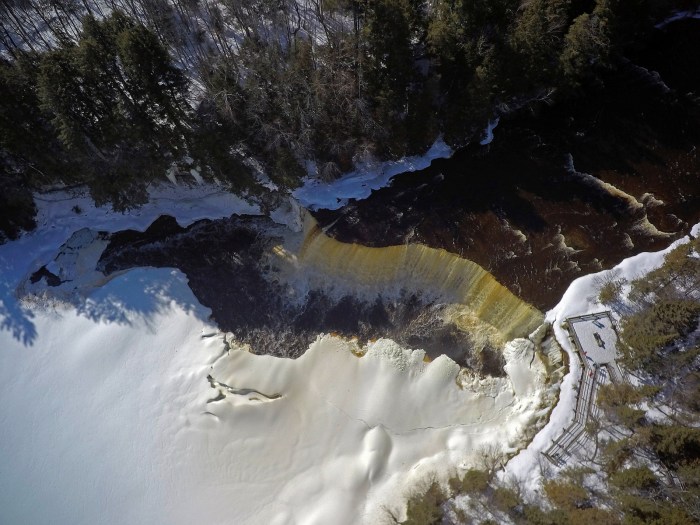
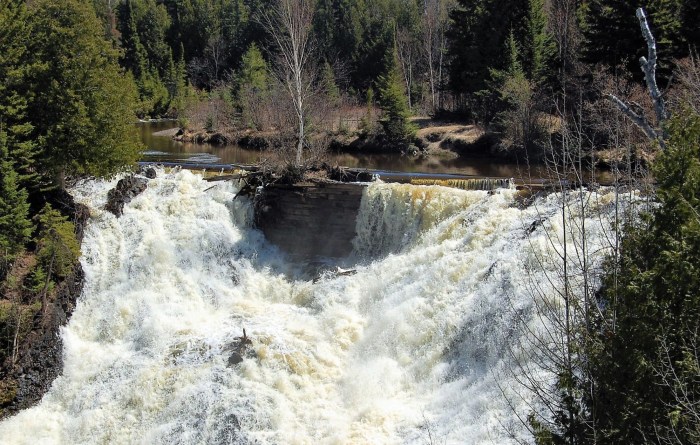
Julie got this cool shot of the Tahquamenon Falls throwing off winter’s grip at the beginning of the month. Now it looks like winter is going to strike back. Via the Detroit news and Sara Schultz, meteorologist with the National Weather Service in White Lake, a winter storm is arriving today:
“We’re looking at the heaviest snowfall north of Saginaw, in the Thumb area and then to the north and west of that, and then of course the lower northern Michigan areas, where they could see six-plus inches of snow.”
A winter storm watch will be in effect Wednesday morning through early Thursday evening for areas north of Interstate 69, Schultz said.
“We’re looking at areas south of I-69 as mostly rain,” she said. “Between Flint and Saginaw, we’re looking at accumulation of snow and ice; just some light accumulation.”
Schultz cautioned that the forecast remains flexible as the storm enters the state. “That rain/snow line along I-69, if it shifts just a little it could throw off everything,” she said.
“A glooming peace this morning with it brings; The sun, for sorrow, will not show his head: Go hence, to have more talk of these sad things; Some shall be pardon’d, and some punished: For never was a story of more woe Than this of Juliet and her Romeo.” ~William Shakespeare
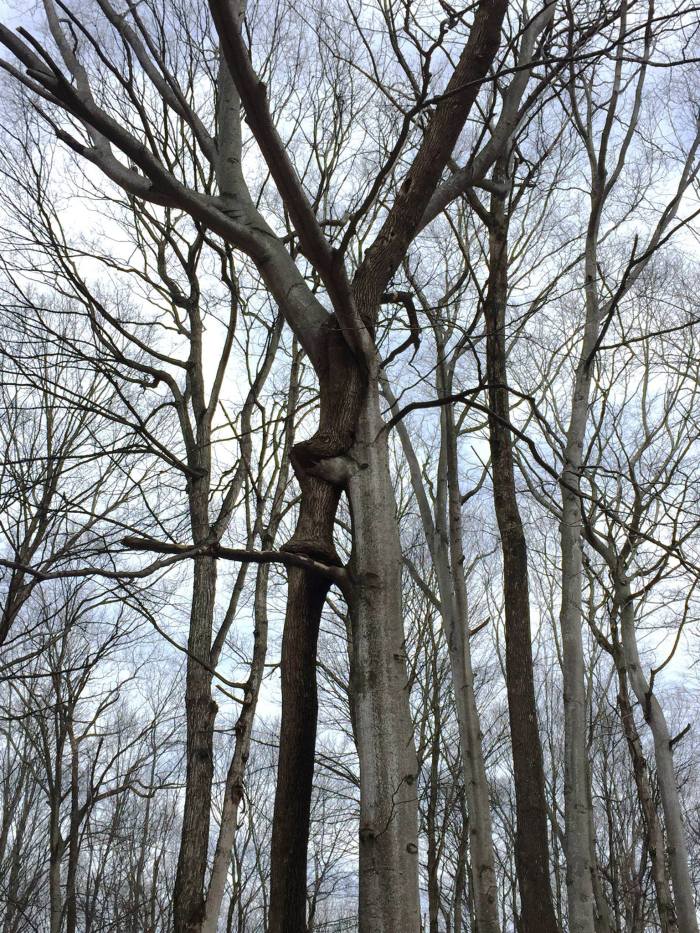
The two hugging trees on the trail to Treat Farm share a similar fate to the star crossed lovers, Romeo and Juliet. The beech scale brings a fungus that is deadly like a poison, and kills off the American beech trees. The Emerald Ash Borers pierce the hearts of the ash trees to take the nutrients.
Invasive species have made their way to the fair Lakeshore of Sleeping Bear Dunes. You can help prevent the spread by purchasing local firewood, and burning it within the local area.
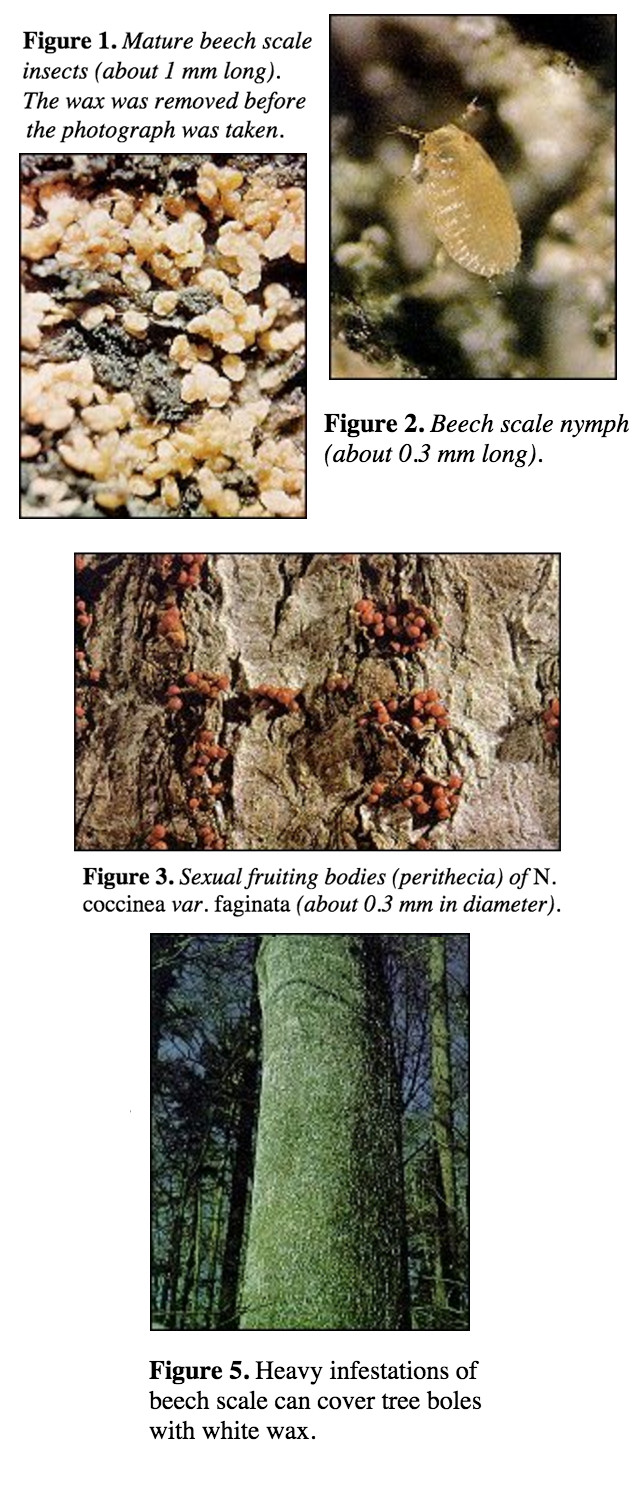
Beech bark disease is one of the latest exotic pest problems to plague Michigan forests. Beech bark disease refers to a complex that consists of a sap-feeding scale insect and at least two species of Nectria fungi. Beech bark disease begins when American beech (Fagus grandifolia) becomes infested with beech scale (Cryptococcus fagisuga Lind) (=Cryptococcus fagi Baer.). The tiny scale insects, found on the tree trunk and branches, feed on sap in the inner bark. White wax covers the bodies of the scales.
When trees are heavily infested, they appear to be covered by white wool. Minute wounds and injuries caused by the scale insects eventually enable the Nectria fungus to enter the tree. Nectria kills areas of woody tissue, sometimes creating cankers on the tree stem and large branches. If enough tissue is killed, the tree will be girdled and die. Other trees may linger for several years, eventually succumbing to Nectria or other pathogens. Some infected trees will break off in heavy winds — a condition called “beech snap.” Dense thickets of root sprouts are common after trees die or break.
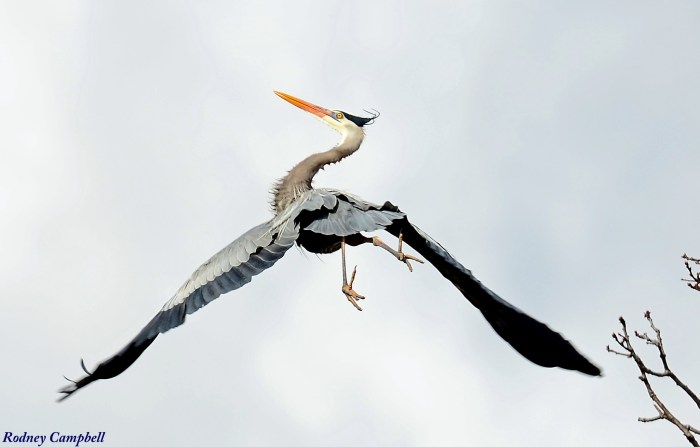
The great blue herons in Michigan are largely migratory, with almost all leaving the state during the winter months. Most leave by end of October and return in early to mid-March.
The great blue heron is mostly a colonial nester, occasionally they nest in single pairs. Colonies are typically found in lowland swamps, islands, upland hardwoods and forests adjacent to lakes, ponds and rivers. Nests are usually in trees and may be as high as 98 ft. (30 m) or more from the ground. The platform like nests are constructed out of medium-sized sticks and materials may be added throughout the nesting cycle. Nests are usually lined with finer twigs, leaves, grass, pine needles, moss, reeds, or dry gras. The same nests are refurbished and used year after year.
Most great blue herons return to southern Michigan heronries in mid-March although a few may remain through the winter if there are areas of open water. Courtship and nest building commences from early April in southern Michigan to early May in the extreme northern portions of the state. Both sexes are involved in the nest building process with males primarily gathering sticks from the ground, nearby trees, or ungarded nearby nests.
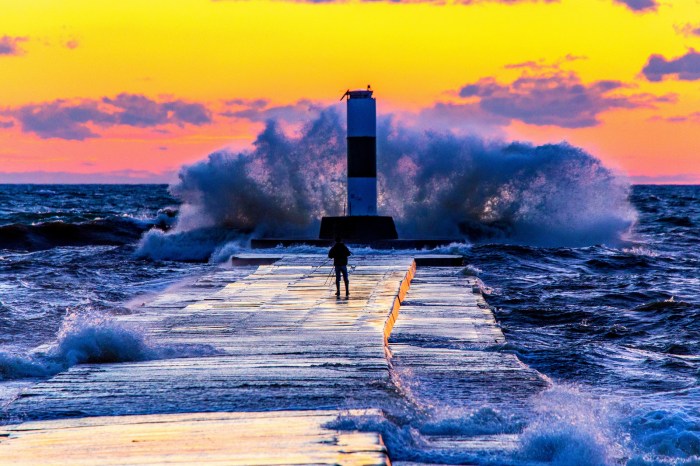
Bob took this shot of a photographer on Grand Haven’s North Pier with more guts or maybe less sense than most. I bet his photo was pretty sweet though!
One of the coolest events in the City of Detroit is the Marche Du Nain Rouge. Every year, on the Sunday after the Vernal Equinox, Detroiters gather in Cass Park to say “Eff you!” to the Red Devil. The Marche is a huge Mardi Gras style party and parade with a fire breathing dragon, music and outlandish costumes. People from all over the city come together to “banish” the Nain and celebrate all the good things happening in the City of Detroit.
The Marche du Nain Rouge is an annual, symbolic celebration of the liberation of Detroit from the Nain Rouge (Red Dwarf), a supernatural imp who has purportedly plagued the city since at least its founding. The celebration takes place this Sunday (March 20, 1-3 PM) and you can get all the details and lots of great photos at from the Marche du Nain Rouge website. Also be sure to check out the story of the Nain Rouge on Absolute Michigan.
Luck is believing you’re lucky. ~Tennessee Williams
My St. Patrick’s Day wishes are that my Michigan State Spartans prove they should have been a #1 seed all along (Go Green!), that the Michigan Wolverines show they’re not the only ballers in the Great Lakes State by defeating Notre Dame (Go Blue!), and that luck makes itself a believable part of your life (Go Luck!!).
Danielle writes “This little guy was having a hard time keeping his hat on – my best shot was a little blurry so had to resort to this one.” View photo bigger than a leprechaun and see more in her Motor City slideshow.
When I come across a waterfall photo that I can’t place, I have three places I turn:
GoWaterfalling.com – hands down the best resource for waterfalls of Michigan and the Great Lakes region (with a few others scattered in for good effect). The author delivers concise descriptions, photos of the falls and accurate directions with maps and tips for hundreds of waterfalls.
Waterfalls of the Keweenaw – this site was created by Jacob Emerick and has information, directions and beautiful photos for 200 Michigan waterfalls, in the Keweenaw and beyond. Sorry for getting Jacob’s name wrong!!
I have my ideas as to which waterfall this is – any guesses? Post them in the comments!
Paula took this last April on the Keweenaw when spring snowmelt in the U.P. pumps the waterfalls up to incredible levels. View her photo background big and see more including some crazy ice-climbing shots in her slideshow.
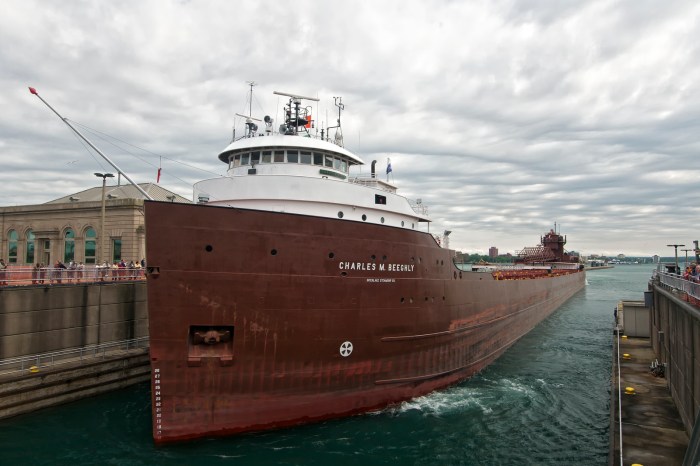
A U.S. Department of Homeland Security report indicates a 6-month shutdown of the Poe Lock in Sault Ste. Marie, if one occurred, would plunge the nation into recession, closing factories and mines, halting auto and appliance production in the U.S. for most of a year and result in the loss of some 11 million jobs across the nation.
The report, obtained by the Free Press through the Freedom of Information Act, paints a grim picture of the outcome of any long-term shutdown of the Poe, the only one of the so-called Soo Locks able to handle the 1,000-foot-long vessels that each year move millions of tons of iron ore from mines in Minnesota and northern Michigan to steel mills dotting the lower Great Lakes and beyond.
….But what is also clear from the Homeland Security report is that while a longer-term shutdown would be catastrophic, even a shorter one could have a much wider impact than previously thought: If such a closure occurred at the Poe during the March 25-Jan. 15 shipping season, for instance, as much as 75% of the nation’s steel output could be halted within two to six weeks.
Read on for more, including a video of a ship going into the locks.
The State of Michigan has 83 counties, and since I got a number of comments asking for more about our communities, I’ll try and profile them all … sooner or later. Here’s some information via Wikipedia about Kalkaska County, Michigan:
The first settler in Kalkaska County was an Englishman named William Copeland, who purchased land in the northwest corner of the county in 1855. The county was set off in 1840 and called Wabasee until 1843. The name Kalkaska is thought to be a Chippewa word meaning flat or burned-over country. An alternative theory is that this is a neologism or neonym created by Henry Schoolcraft, originally spelled Calcasca. Some theorists suggest this is word play. Schoolcraft’s family name had been Calcraft, and the Ks may have been added to make the name appear more like a Native American word.
Logging was the first important industry. The discovery of substantial deposits of oil and natural gas resulted in the construction of a processing plant by Shell Oil Company in 1973 and a major economic boom in the community.
Kalkaska Sand, the state soil of Michigan, was named after the county because of the large amounts deposited in the area from the glaciers in the Ice Age. Kalkaska County has over 80 lakes and 275 miles of streams and rivers. Much of the county is marshland. County elevation ranges from 595 feet (181 m) to about 1,246 feet. This makes it one of the more uneven counties in the Lower Peninsula.
The Pere Marquette State Forest covers much of the county. Glaciers shaped the area, creating a unique regional ecosystem. A large portion of the area is the so-called Grayling outwash plain, which consists of broad outwash plain including sandy ice-disintegration ridges; jack pine barrens, some white pine-red pine forest, and northern hardwood forest. Large lakes were created by glacial action.
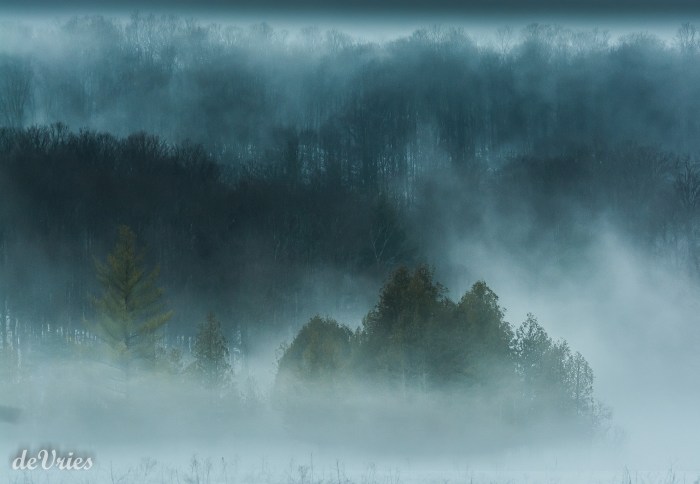
“With abundant snow cover yet and temperatures around 65 F, fog forms in almost white out conditions near large snow fields! This can lead to near zero visibility in a matter of seconds and makes for some amazing photographs!”




 Michigan in Pictures