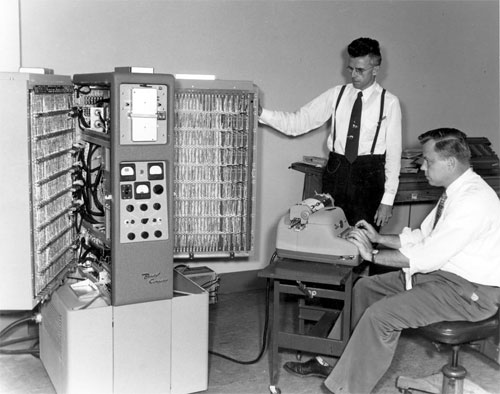
Bendix G-15: $45,000 worth of computer

1950s Computer, photo courtesy Archives of Michigan

In their June 2008 Image of the Month, the Archives of Michigan explains:

This image shows how far computer technology has advanced! Although undated, it was probably taken during the last half of the 1950s. The Michigan State Highway Department offices would seem the likely setting. (The words “Department of Transportation” are stamped on the reverse side. The Michigan State Highway Department is a predecessor agency of the Michigan DOT.)

A logo reading “Bendix Computer” appears on the machine. Having conducted some research, this author believes the computer to be a Bendix model G-15. Paul E. Cerruzi, in his book A History of Modern Computing (Cambridge, Mass.: MIT Press, 1998 ) notes that Harry Huskey developed the Bendix G-15 at Detroit’s Wayne State University in 1953. Cerruzi notes that the G-15 “was regarded as difficult to program, but for those who could program it, it was very fast.” He adds that the first models were delivered in 1956, at a “basic price of $45,000.” (Click History of Modern Computing to access an electronic copy of this book through ANSWER, the Library of Michigan’s online catalog.)

Click through to read the rest and be sure to view it bigger to appreciate the awesome computing power (and that amazing hair style). You can also check out Wikipedia’s info on the Bendix Corporation.

50th anniversary of the launch of the S. S. Edmund Fitzgerald

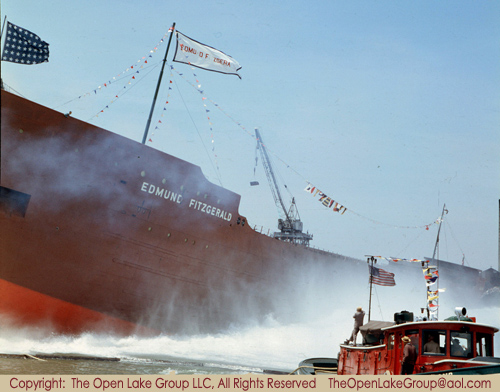
Hull 301 Launch 3

Hull 301 Launch 3, photo courtesy The Open Lake Group, LLC

I was initially going to use another photo of the Edmund Fitzgerald for this post, but when I asked about that one, Wade showed me this one from the launch of “Hull 301”. How cool is it that I would happen to contact someone who had an unpublished photo of the launch? You can see a couple more photos from the launch (including one that shows the huge crowd) in his Edmund Fitzgerald set.

Saturday June 7th marks the 50th anniversary of the launch of what’s probably the most well known Great Lakes ship. Over on Absolute Michigan, SSEdmundFitzgerald.com posted “Celebrating the launch of the S. S. Edmund Fitzgerald”. Reading it made me realize that our remembrance of what was once the largest ship ever to ply the Great Lakes ignores almost two decades of service and countless hours of hard work and craftsmanship.

It was a beautiful Saturday afternoon on June 7th, 1958, as more than 10,000 people lined the banks of the Detroit River. They had come to witness the launching of Hull 301 at the Great Lakes Engineering Works of River Rouge, Michigan. Mrs. Edmund Fitzgerald, wife of the president of the Northwestern Mutual Life Insurance Company for which the ship was named, christened the brand new ship and at 12:34 p.m. the 729 ft. “Edmund Fitzgerald” slid gracefully into the basin amid cheers, salutes, and well wishers.

For many of those in attendance, it was a spectacle that they would never forget.

The shipyard workers who constructed “Big Fitz” felt a deep sense of satisfaction as they anxiously watched the launch of this marvelous vessel. Being a prideful lot, they often endured long hours and harsh conditions. This was their “crowning achievement” and the beauty of their craftsmanship was truly evident to all those present.

This year marks the 50th anniversary of that memorable event. It is an opportunity to reflect on and celebrate a joyous time in our lives. It is also a chance to recall the great pride and cherished memories experienced by the ship workers, the community, and all who had the opportunity to witness the launching of the Edmund Fitzgerald.

On this historic occasion, let us joyously share our personal stories, renew old friendships, and fondly remember the day when the “Queen Of The Lakes” was born.
June 7, 2008 Detroit MI

Great Lakes Ship Builders (Detroit Area) host the 50th Anniversary of the Edmund Fitzgerald Launch and Down River Celebration from 11 AM – 4 PM on Saturday, June 7 2008. The celebration will include a chance to meet the designers and others who worked on the Fitz, workshops on shipbuilders, and ships built in the downriver during the last 200 years. There will also be a Salute to Excellence Award, launch commemoration, and lots of art and artists. For more information, call Roscoe at 810 955-4305 (and poke around SSEdmundFitzgerald.com).

As often, there’s a Wikipedia entry for the SS Edmund Fitzgerald and you can see a gallery of photos from the building of the Fitz and this Zapruder-class video of the launch of the Edmund Fitzgerald.

tough

tough

tough, photo by daveraoul.

This is the part where I’m supposed to say something so … I agree that this Ford looks totally tough.

The Capture Main Street Michigan Project from the Michigan Production Alliance

Downtown Houghton by aragirn

Downtown Houghton, photo by aragirn

Kyle has tons more photos of Houghton and the Keweenaw and some of his best are on his photo gallery at kyleschneider.net.

The Michigan Production Alliance is a trade organization that seeks to encourage a more stable financial environment for Michigan film and video production companies, freelancers and support services. The best way to do that is of course to get more movies filmed in Michigan. To that end, they have launched the Capture Main Street Michigan Project:

The idea is to capture ALL Michigan’s cities and towns main streets so they can be shown to producers of commercials and feature films – and entice them to SHOOT MICHIGAN!

We can’t do this alone. So we’d like to shout out to all MI Photogs and location scouts. We will give all photogs name credit as well as a hyperlink to a website. The photos can and should be low rez, named for location, city, county. and of course photog name, email, etc.

What we are looking for are shots of Main Street Blocks that show the architecture of city buildings, the flavor of the city. Day or Night – Any Season…

You can go to their web site above to email it to them and if you’re on Flickr, they have created a Capture Main Street Project group where you can share your photos. More about Michigan film& movies at the Michigan Film Office.

William Leabs, Jr. and Michigan’s Black History

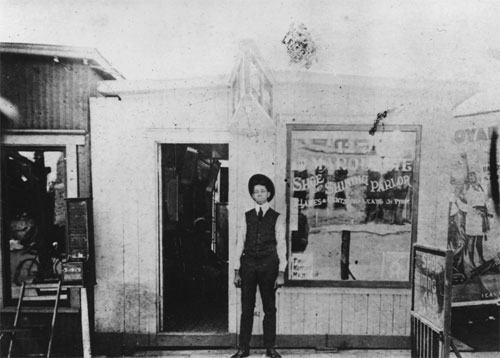
William Leabs, Jr. at his Marquette Shoe Shining Parlor

William Leabs, Jr., photo courtesy the Archives of Michigan

The description from the Archives of Michigan begins:

Here, we see William Leabs, Jr., an African American businessman. He’s standing in front of his store, the Marquette Shoe Shining Parlor (view larger). This business is listed in the Lansing City Directories of 1902 and 1904, and the photo presumably dates from about that same time frame.

Lansing’s African American heritage is as old as the city itself. Lansing’s first black resident of record is James Little, a freed slave from New York state. Little came to Lansing in 1847 (the year of the city’s founding) and started a farm.

Lansing’s black population increased slowly during the remainder of the 19th Century. Many black settlers came from other Northern states and from the upper South. Some were Canadians descended from escaped slaves. Others came from elsewhere in Michigan, with the majority of those hailing from Cass County (Freed slave communities had been established there before the Civil War.).

You can read more at the Image of the Month for February 2008 and also in Robert Garrett’s article The Birth and Death of Lansing’s Black Neighborhoods in the Lansing City Pulse.

February is Black History Month in Michigan and you can get a ton more articles from Absolute Michigan’s Black History in Michigan.

Old Steel, New Library of Congress

Hanna furnaces of the Great Lakes Steel Corporation, Detroit, Mich. Coal tower atop coke ovens (LOC)

Hanna furnaces of the Great Lakes Steel Corporation, Detroit, Mich. Coal tower atop coke ovens (LOC), photo by The Library of Congress.

Yesterday I learned through a couple of emails, an IM, Lifehacker and even this post in the Absolute Michigan pool (yay!) that the Library of Congress has embarked on a new project to increase access to their photographic collection and also to more completely “tag” their photos. From My Friend Flickr: A Match Made in Photo Heaven on the Library of Congress blog:

The project is beginning somewhat modestly, but we hope to learn a lot from it. Out of some 14 million prints, photographs and other visual materials at the Library of Congress, 3,000 photos from two of our most popular collections are being made available on our new Flickr page, to include only images for which no copyright restrictions are known to exist.

The real magic comes when the power of the Flickr community takes over. We want people to tag, comment and make notes on the images, just like any other Flickr photo, which will benefit not only the community but also the collections themselves. For instance, many photos are missing key caption information such as where the photo was taken and who is pictured. If such information is collected via Flickr members, it can potentially enhance the quality of the bibliographic records for the images.

This photo was taken in November of 1942 by Arthur Siegel of the Hanna furnaces of the Great Lakes Steel Corporation in Detroit (now U.S. Steel’s Great Lakes Works). You can see (and perhaps help to classify) more photos tagged as Michigan right here.

Much as I love Detroit’s rich industrial history, I really hope that the good people at the Library of Congress can toss up a few photos from elsewhere in the state, including some that highlight Michigan’s natural beauty!

LOC Call Number: LC-USW36-811 (link)

Inside the Michigan License Plate Factory

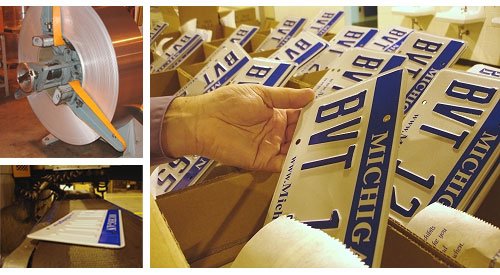
Inside the Michigan License Plate Factory
Inside the Michigan License Plate Factory, photos by Bob Nelson

I’d always heard about convicts making license plates, but until I happened upon this site, I really had no concept of how that process took place. Bob writes that All motor vehicle license plates in Michigan are made by inmates at the Parr Highway Correctional Facility at Adrian, one of many secure facilities operated by the Michigan Department of Corrections.

To see a ton of photos from start to finish, click through to the tour of the Michigan License Plate Factory.

I can’t tell you much about Bob, but I can guess that he’s wearing green & white on Saturdays!

The Copper Miner’s Strike of 1913 and the tragedy at Calumet’s Italian Hall

Copper Miners outside Dunn's Bar

dunns 6th calumet, photo by Ztef

I usually try to make Michigan in Pictures a happy place to be because there’s enough unhappy things out there. Every so often, however, I think there are stories that warrant a look and rememberance if only to say: “Let’s make darn sure this never, ever happens again.”

Ztef captioned the above photo rather sparsely with Copper miners strike outside of Dunn’s bar on 6th Street in Calumet, Michigan – 1913, but he has provided a link to Calumet: The Copper Miner Strike of 1913. This page offers a very detailed and readable account (complete with some great old photos) of the labor troubles in Keweenaw during the early part of 20th Century from the perspective of the Zawada family, Poles who worked in the copper mines for the mining giant Calumet & Hecla. Of this photo it says:

Strikers outside of Dunn’s Bar, a favourite among miners. Just next door to Dunn’s was the No. 203 local WFM office (Western Federation of Miners). The sign on the left reads: “Something just as good Miners ask for bread, Jim [MacNaughton, C&H General Manager] offers lead”. The sign in the middle reads: “One man machine Our Agitator”. The sign on the right reads: “We demand higher wages and better working conditions”. The men in front are holding copies of the Miner’s Bulletin, but the headlines are not clear.

As you can read at the link above, the strike was characterized by escalating violence, calling in of the National Guard and even murder. The chaos culminated with what has been called a Disaster, Tragedy and even Massacre at Calumet’s Italian Hall. Copper Country Reflections’ Italian Hall Tragedy page at Pasty.com explains:

By the end of December, the miner’s strike had been waged for 5 long months, with no end in sight. The mining companies and their supporters were holding firm in their resistance to the WFM, while the union was still somewhat solid in its position.

To temporarily set aside their cares, a group of union members planned a Christmas eve celebration for their children at the Italian Hall on Seventh Street in Calumet. I can only assume that the activities that evening must have been the most fun these children had since the start of the strike. Unfortunately, the excitement turned to tragedy as someone, his identity never learned, cried FIRE. As the children and adults panicked, many worked their way towards the stairwell. The first unlucky souls quickly realized the doors at the bottom would not open. Were they locked? Was somebody holding them closed?

It is hard to comprehend, but 73 men, women and children died in that staircase. Some were crushed, others died from suffocation. Can you imagine the shock of the rescuers when they finally pried open the doors? As they pulled bodies up and out of the staircase?

The page above also includes photos that are definitely not for the faint of heart. If you’d like to explore further, there’s more information and photos at the Italian Hall 1913 Massacre site and you can see a photo of the Michigan historical marker & memorial at the site of Italian Hall in Calumet.

One thing you definitely should do is watch the moving accounts of survivors of the tragedy at the December 2007 update from the 1913 Massacre Film Project. The movie project has been going for several years and it looks like it will be very good.

The Absolute Michigan map of Michigan has the location of Italian Hall in Calumet.

Manabezho Falls in the Porcupine Mountains State Park

Manabezho Falls, long exposure

Manabezho Falls, long exposure, photo by DA2Brian.

GoWaterfalling’s page on Manebezho Falls says:

The Manabezho Falls are part of the Presque Isle River’s spectacular final dash to Lake Superior. The entire 1 mile stretch is very beautiful, with lots of bare rock and rapids. It is easily accessible from the Presque Isle entrance off of CR-519 on the western end of the park…

Manido Falls are just short distance upstream. Nawadaha Falls is a bit farther upstream. Downstream of Manabezho the river plunges into a narrow gorge. The “falls” there have no name, but they are quite interesting.

The falls are located in the Porcupine Mountains State Park and you can see more photos of Manabehzho Falls on Flickr (slideshow) and also check out the Porcupine Mountains group!

I’m pretty sure that “Manabehzo” is Manabozho, the Ojibwa/Algonquin trickster and messenger of the Great Spirit. For more about this colorful figure, check out Manabozho, the Mischief-maker by Rick Walton.

Labor Day in Michigan

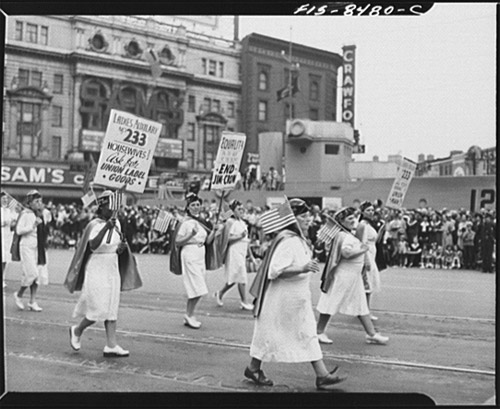
1942 Detroit Labor Day Parade

Women Workers in the 1942 Detroit Labor Day Parade by Arthur S. Siegel.

Wikipedia says that Labor Day:

…has been celebrated on the first Monday in September in the United States since the 1880s. The form that the observance and celebration of Labor Day should take were outlined in the first proposal of the holiday — a street parade to exhibit to the public “the strength and esprit de corps of the trade and labor organizations” of the community, followed by a festival for the recreation and amusement of the workers and their families.

The entry goes on to say how that has mellowed to more of a day of family rest and recreation (and for political appearances of course).

The Detroit News Rearview Mirror series How Labor won its day by Patricia K. Zacharias does an excellent job of weaving Michigan’s role in the holiday into the broader historical picture and has some great old pictures (be sure to click the button at the top left!).

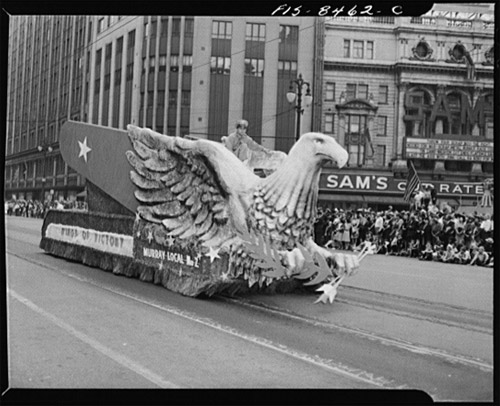
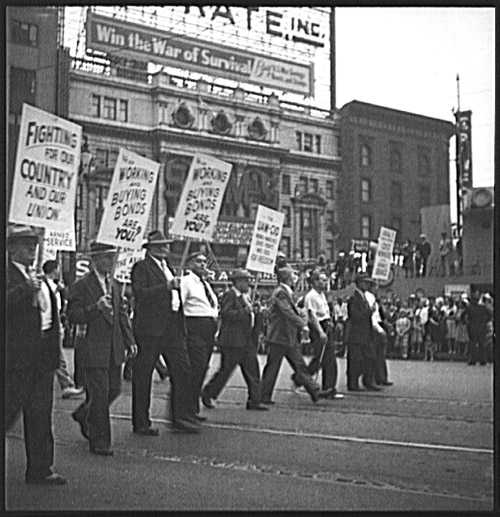
These pictures were taken at the 1942 Labor Day Parade in Detroit by Arthur S. Siegel. You can click the photos at the right for a larger view too!

1942 Detroit Labor Day Parade, Wings of Victory

1942 Detroit Labor Day Parade, War of Survival