A War Worth Waging and A Vote Worth Casting

A War Worth Waging – HFM, photo by MikeRyu

View it bigger on black and see more photos in Mike’s Henry Ford Museum set (slideshow).

Seeing this photo and realizing it’s been less than 100 years that women have enjoyed the right to vote made me think about how tirelessly they worked to secure the right to vote. Here’s a snapshot of women’s suffrage in Michigan courtesy the H-Net Chronology of Michigan Women’s History:

1849 A Senate committee, led by Senator Rix Robinson of Ada, proposes a universal suffrage amendment but it is not acted upon because of the “unusualness” and “needlessness” of the franchise for women.

1866 The state’s first bill on woman suffrage is defeated by one vote.

1867 The Michigan Legislature grants women taxpayers the right to vote for school trustees but rejects total woman suffrage.

1912 Governor Charles S. Osborn successfully urges the Michigan State Legislature to put the suffrage question before the all-male electorate in November. Clara B. Arthur of Detroit leads the campaign and the proposal appears to win. However, the opposition steals the election under suspicious circumstances.

1917 Governor Albert E. Sleeper signs a bill on May 8, granting Michigan women the right to vote in presidential elections.

1918 Michigan male voters approve a state constitutional amendment granting suffrage to Michigan women.

1919 Michigan women vote for statewide offices for the first time.

1920 The 19th Amendment to the Constitution, granting the vote to women, becomes law on August 26. Women vote for the first time in the presidential election on November 2.

It also made me wonder how something (each of our rights to vote) that has been bought and paid for time and again with far, far too much blood, sweat and tears can be treated with such disdain by many.

Your vote is your voice, please speak up today.

More about voting in Michigan from Absolute Michigan.
The Power of Green

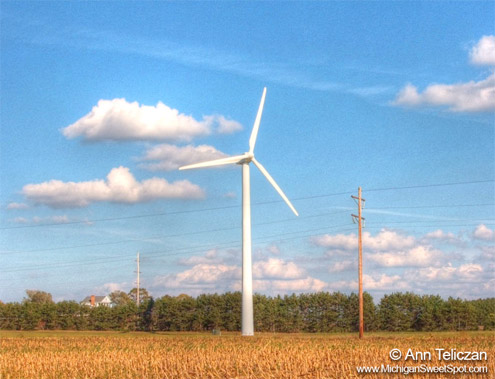
We’ve Got the Power, photo by Ann Teliczan

I was just working on a simple post about Green Jobs Now, who have designated this Saturday (Sep 27) as a national day of action in support of jobs in renewable energy and other green industries so I could link to their list of Green Jobs Now Events in Michigan.

It got kind of out hand though, and ended up being a Renewable Energy linkfest of epic proportions that is now on Absolute Michigan.

As a side note, this lonely windmill just outside of Traverse City was the first utility windmill in Michigan and the largest machine in North America. As another side note, Ann has more great photos from the Leelanau/Traverse area right here!

The Atlas Experiment and the Large Hadron Collider

Large Hadron Collider

ATLAS instrument (Large Hadron Collider), courtesy University of Michigan

The Large Hadron Collider (LHC) is the world’s largest and highest-energy particle accelerator, involving over eight thousand physicists from over eighty-five countries as well as hundreds of universities and laboratories. University of Michigan physicists and students were heavily involved in designing and building major components of ATLAS instrument which is one of two main particle detectors in the LHC. In Michigan integral to world’s largest physics experiment, the UM relates that tomorrow:

After 20 years of construction, a machine that could either verify or nullify the prevailing theory of particle physics is about to begin its mission.

CERN’s epic Large Hadron Collider (LHC) project currently involves 25 University of Michigan physicists and students. More than 100 U-M researchers have been involved in the project over the years. CERN is the European Organization for Nuclear Research, located in Geneva, Switzerland.

…The collider will, in essence, recreate the conditions of the earliest universe. It will tear apart particles so physicists can study their components and observe as the particles put themselves back together.

You can see the Atlas being built in this video and also take a video tour of the LHC on YouTube. There’s some cool large photos at the Boston Globe. For more photos of Atlas and other components of the LHC, visit the official LHC web site and (highly recommended) The Atlas Experiment, where you can see movies, watch webcams, read about the experiment and even check out a virtual tour of the Atlas instrument.

When writing about the LHC, it’s pretty much required that you note concerns about the safety of the experiment, and then say that the chances are infinitesimal (1 in 50,000,000 or less) that Earth-devouring black holes, strangelets or quantum gates will be created.

You’ll be able to tune into a live webcast of the Large Hadron Collider almost certainly not destroying the world at 4 a.m. Eastern Time on Wednesday, September 10, 2008.

Barack Obama in Detroit – Labor Day 2008

Detroit Loves Obama

Detroit Loves Obama, photo by Maia C.

Maia writes that this is just part of the crowd gathered in Detroit’s Hart Plaza to show their support for Barack Obama on Labor Day, 2008.

The Detroit News has a great panorama by photographer Anne Savage and there’s a nice photo gallery on the Freep as well. There’s some video at the Freep and (when that gets removed) on YouTube from tdndavid. Nice to see Michigan get as little national face time looking sunny & fun!

You can see a lot more photos from Obama’s Labor Day visit to the Motor City on Flickr (slideshow).

Note: Not trying to be partisan here, just documenting a major Michigan story. As an aside, I’ve been looking all summer for pics from John McCain in Michigan – nothing has been shared with Absolute Michigan yet. So get out there, you McCainiacs and get clicking!

Michigan Logging Train Excursion

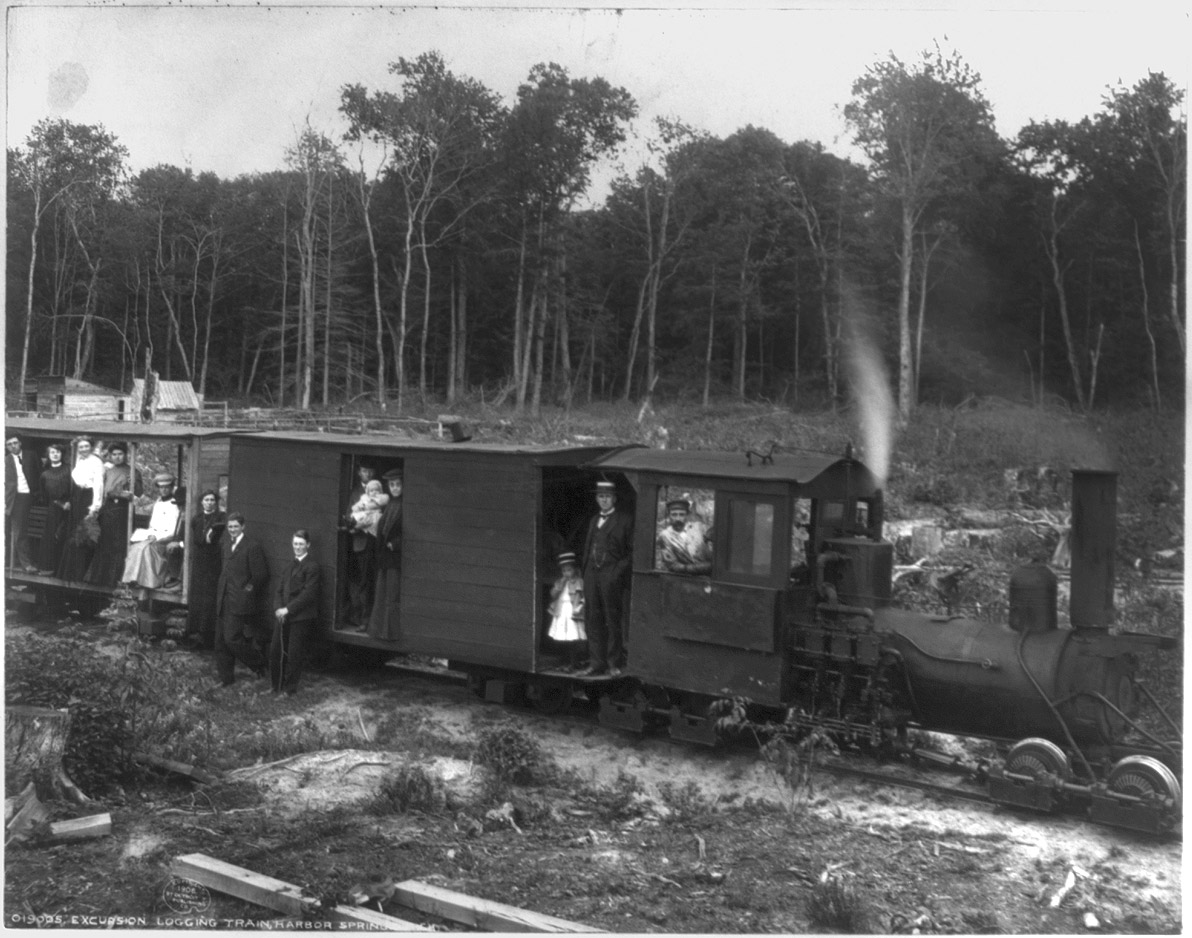
Excursion Logging Train, Harbor Springs, photo from Detroit Publishing Co., c1906 (at the Library of Congress)

I noticed that the Newaygo Logging Festival (Eventful link w/ map) happens this weekend. Several recent conversations and excursions of my own have driven home how profoundly the logging industry has shaped Michigan. Like miners, the timber trade roamed from river mouth to natural harbor up and down our Great Lake shoreline, into connected lakes and with the coming of the railroad, across the entire Lower & Upper Peninsulas.

At every stop, when the trees were gone, the land was left cleared and ready for villages and farms. Many of those working in the timber trade turned to farming and town building, and the names of the founders of these towns (and the owners of the dry goods stores) were often the names of the principals of the lumber companies.

Over Labor Day Weekend, I think it would be neat if Michigan were to somehow remember and honor the role of logging and loggers played in creating our state.

…and when it’s not such a lovely, last weekend of summer out there, be sure to check out some Michigan lumbering history and this really cool collection of Michigan logging photos from MichiganEpic.org.

Seriously, these logging photos are great!

Fuel or Food?

Grain (1).jpg

Grain (1).jpg, photo by smartee_martee.

21 July 2008 … fields of grain in Solon, Michigan.

This is a part of Overnight Photo Trip July 2008 (slideshow). If it’s anything like his other sets, it’s sure to grow.

Garage Sale Culture: Resourceful

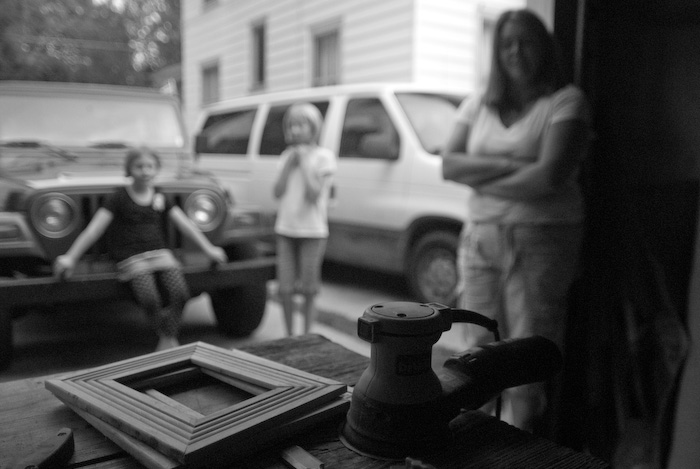
Resourceful by David McGowan

Resourceful, photo by David McGowan

David writes:

Michelle is a single mom with her daughter, Brynn. She hard-working, a resourceful builder and recycler, and unemployed in Michigan. While waiting for HR departments that are slow to respond, she spends much of her time working in her shop. Michelle builds frames, tables, signs with clever quotes, repurposes barn wood, builds frames for mirrors, refinishes end tables, cabinets, bed frames—you name it. She gives them all a “shabby chic” flavor before sending them off to consignment. At the moment this is her main source of income.

To maintain life as they know it, everything in their home has a figurative price tag on it until Michelle finds steady income. She’s reluctantly willing to part with her childhood brass bed frame, particularly sentimental since her mom passed away.

This photo is just the first of the series titled “Resourceful“, and that’s just one of the series to be found in David McGowan’s Garage Sale Culture at humanfiles.com (check out his Garage Sale Culture Part 1 slideshow!). He explains:

I have a simple but timely idea to examine Michigan’s economy through “Garage Sale Culture.” Currently there’s a boom in garage sales in Michigan, a percent of which can be attributed to people unloading goods to make ends meet. Sellers are also seeing the opportunity to move items in an economy that is reluctant to pay retail prices. There are moving sales as the result of job loss or mortgage foreclosures. Folks are selling luxury items (boats, trucks, etc.) because of soaring gas prices. These are the people I want to meet.

I’m envisioning the heart of the work to be portraiture—images that are in the moment but deliberate, that incorporate the goods being sold, or show the yard sale in progress. I’m not necessarily looking for impoverished, tug-at-your-heartstrings images, but more of common people facing unusual choices. The idea is to create a series of faces that represent the stories we hear on the local news every night, and perhaps marks the state of our State during the summer of this election year.

So click through and check these out, and do yourself a favor and bookmark humanfiles.com.

The Reo Ramblers at the 1937 sit-down strike

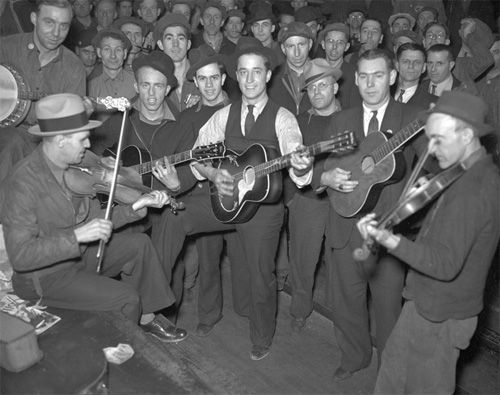
The Reo Ramblers at the 1937 sit-down strike, March 10-mid April 1937, photo courtesy Archives of Michigan

The Archives of Michigan’s July 2008 Image of the Month comes from the R.C. Leavenworth photographic collection. They write:

Lansing Auto Worker declared during the event, “Reo Strike Is Nation’s Model Demonstration.” Under the stress of wage reductions and layoffs resulting from the nation’s Depression, Reo workers shut down the factory and occupied it for a month. Workers remained peaceful, engaging in activities such as checkers, volleyball, and singing with the Reo Ramblers. The strike was successful and reenergized the local UAW chapter.

Michigan in Pictures has a post titled Remembering the Flint Sit-Down Strike on a Labor Day that has some great info about this landmark strike and – as is often the case – Wikipedia has a nice Flint Sit Down Strike article (with some more photos).

You can click the photo to read about a special Leavenworth exhibit at the Michigan Historical Center and also see another shot by Leavenworth of Jazz Music in Lansing in the 1920s.

Tiger Stadium demolition: When the walls come tumblin’ down

Tiger Stadium Demolition

tiger stadium, photo by Rhonda_Marie

View bigger in Rhonda’s Tiger Stadium slideshow (view set). Demolition has begun on Tiger Stadium. You can follow the bouncing wrecking ball using any or all of the ways below:

Dredging Michigan’s Harbors

great lake - dredging

great lake – dredging, photo by j image.

Jim captured folks working at one of the many under-appreciated tasks in the world: dredging our harbors. As a lifelong resident of a coastal village, I anticipated the arrival of the dredging crew as a sign that summer was on the way. The US Army Corps of Engineers Detroit District explains why dredging is necessary on the Great Lakes:

Nearly all Federal harbors on the Great Lakes are located at the mouth of a river or along a coastline, utilizing natural or dredged navigation channels. Lake and river currents transport sand and silt eroded from the coastline and watershed. Some of this material may become deposited in navigation channels. Dredging is necessary to allow for safe commercial navigation and recreational boating. These natural processes would eventually lead to the filling of our harbors and waterways with rock, sand, mud, or clay. Harbors and major rivers, so vital to commercial, recreational and defense activities, would eventually fill in, leading to vessel delays and grounding. Today’s ore carriers, container ships, oil tankers and Coast Guard vessels need deep channels and docking facilities to move freely. Dredging is necessary to maintain Americas waterborne commerce and defense capability.

In addition, many recreational harbors need to be dredged regularly to remain open for small craft.

The page also explains something called “Beach Nourishment”, which I thought was a pretty unique term. Here’s a few dredging photos from the Absolute Michigan pool (slideshow)