Old Reliable: Quincy Mine on the Keweenaw Peninsula

24/365 - Quincy Boiler and Shaft

24/365 – Quincy Boiler and Shaft, photo by dcclark.

You can buy mine related stuff and get tour information from the Quincy Mine Hoist Association. You can’t, however, get historical information.

Thankfully, David has posted a bunch. He has some information on his Copper Country Explorer web site (update: actually run by his friend Mike!). On his Cliffs & Ruins blog he writes:

In the foreground are the ruins an old boiler house — once filled with huge steam boilers, providing steam power to the mine. Behind it is the #2 shafthouse, a modern steel structure from a different era of the mine’s development.

The Quincy Mine is a very different mine from the Central Mine, featured yesterday. Although both started in the 1850s, the Central was a “fissure” mine — mining primarily huge, pure chunks of copper. The Quincy, on the other hand, was an “amygdaloid” mine — mining rock with tiny bits of copper infused through it. As it turns out, Quincy’s model was better, and all of the truly successful mines in the Copper Country were amygdaloid mines. Quincy paid dividends for nearly 50 years straight, earning it the name “Old Reliable”. But, just like the Central and all other Copper Country mines, the Quincy is now nothing more than a collection of shafts and ruins.

It’s one of the Keweenaw National Heritage Sites and there’s detailed information on Wikipedia’s Quincy Mine entry.

Be sure to check this out bigger, in David’s store and on his Quincy, Michigan map.
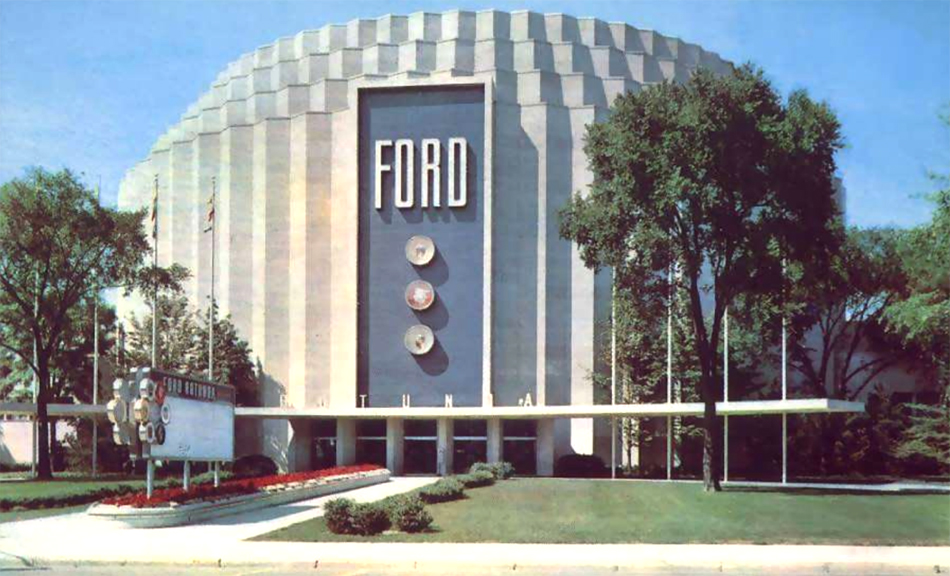
The Ford Rotunda

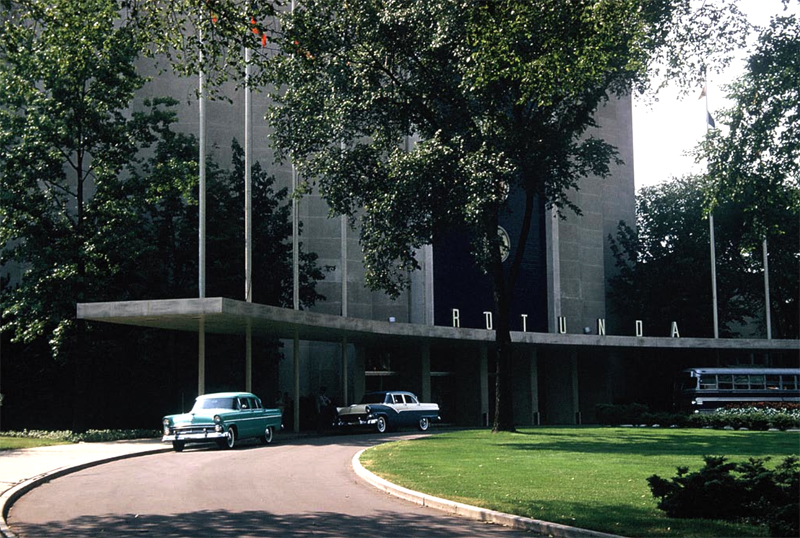
The Ford Rotunda – Dearborn, Michigan, photographer unknown

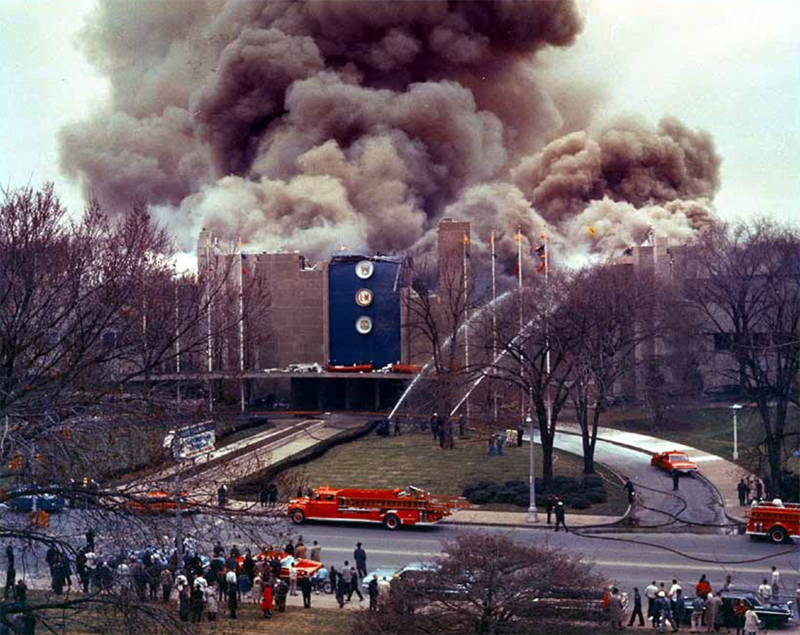
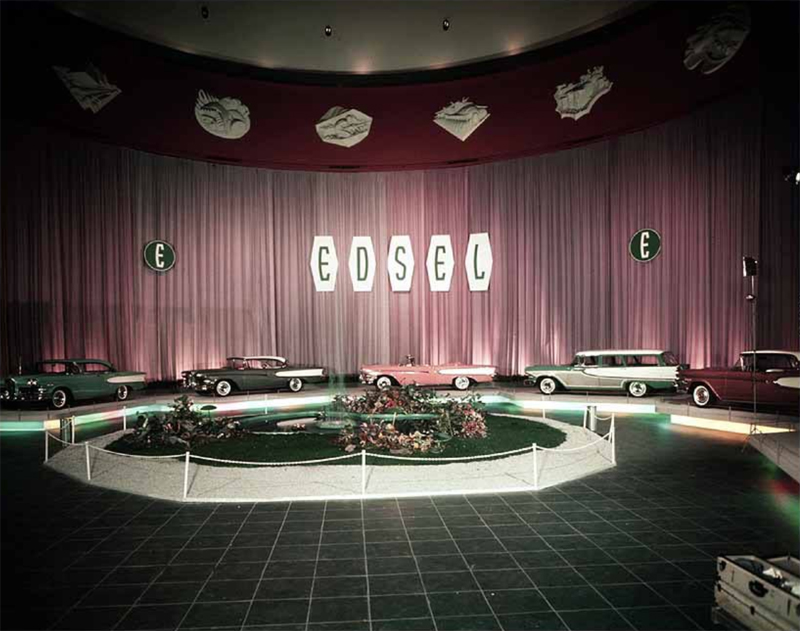
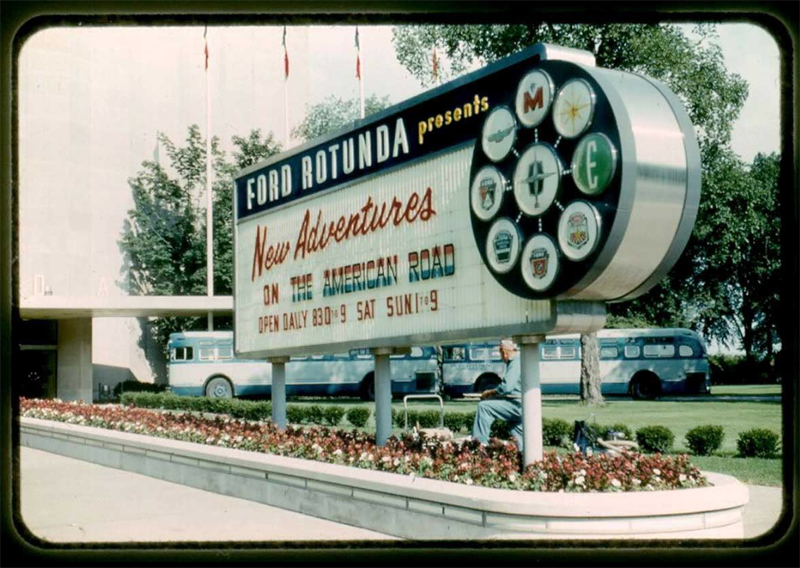
Michigan in Pictures regular Matt passed an email about the Ford Rotunda along that had some cool pictures I thought folks would like to see. When flames consumed a Christmas fantasy from the Detroit News Rearview Mirror begins:

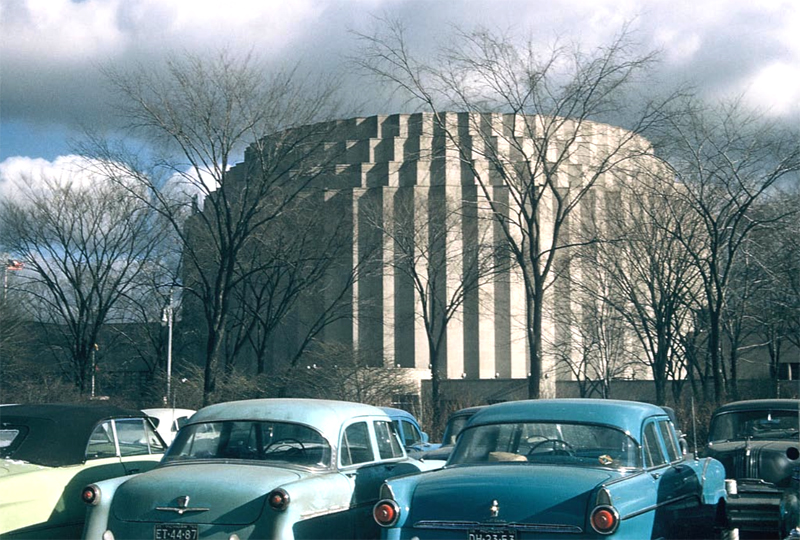
From 1936 to 1962, the gear-shaped Ford Rotunda attracted visitors from around the world. It was the fifth most popular tourist destination in the United States in the 1950s.

The building had its roots in the 1933 Chicago World’s Fair, known as the Century of Progress Exposition, which opened in May of 1933 and attracted more than 40 million visitors over its two-year run. One of the major attractions at the fair was Ford Motor Company’s Rotunda, which was disassembled after the fair and brought back to Dearborn, where it was reconstructed using more permanent materials. Designed to be the showcase of the auto industry, the Ford Rotunda was opened to the public on May 14, 1936.

…In 1960, the Rotunda ranked behind only Niagara Falls, the Great Smoky Mountains National Park, The Smithsonian Institution and the Lincoln Memorial as a national tourist destination. It was more popular than Yellowstone, Mount Vernon, the Washington Monument and the Statue of Liberty.

Read on for the sad tale of how it burned to the ground on November 9, 1962.

Television History – The First 75 Years might be the photographer – there’s some of the same shots there and they write about their parents taking them to see Santa during the Christmas Season at the Rotunda. They also have a nice aerial of how the Ford Rotunda was located in relation to the Rouge Plant.

2000 is a big number

Dock o' boats

Dock o’ boats, photo by &Sam.

Over on Absolute Michigan I noted that the 2000th photographer joined our Absolute Michigan pool on Flickr. It’s where almost all of the photos on Michigan in Pictures come from and really an amazing resource that we are so fortunate to have at our disposal.

Be sure to check this photo out bigger and in Sam’s Outside set (slideshow).

Michigan Downtowns

Postcard View

Postcard View, photo by Eridony.

Today I’m at the Michigan Downtown Conference in Lansing. Assuming the wifi at the Lansing Center is up to the task, I’ll be posting over on updates from the conference on Absolute Michigan.

Be sure to check this out bigger and in his massive Downtown Lansing set (slideshow).

Electric Blues: Remembering Les Paul

courtesy Absolute Michigan

Electric Blues

Electric Blues, photo by Rudy Malmquist.

“Les Paul brought six strings to electricity and electricity to six strings. Les Paul was an innovator, a groundbreaker, a risk taker, a mentor and a friend. Try to imagine what we’d be doing if he hadn’t come along and changed the world. There will always be more Les to come. That’s certified.”
~ Billy Gibbons, one of many to praise Paul

Les Paul, designer of the Gibson Les Paul and an incredibly influential musician, passed away yesterday at the age of 94.

Wikipedia says that in addition to collaborting on the the guitar that bore his name, Paul is credited with recording innovations including overdubbing, tape delay, phasing effects, and multitrack recording. The “Wizard of Waukesha” was also one of the most influential guitarists ever, developing licks, trills, chording sequences, fretting techniques and timing that set him apart from his contemporaries and have carried through to the modern day.

There’s so much more to be said. Start with:

Les Paul Online is the artists official web site. Definitely go here to get a feel for the man. Paul’s good humor and amazing skills shine through.

The World Has Lost a Remarkable Innovator and Musician: Les Paul Passes Away at 94 from Gibson Guitar

What makes the Gibson Les Paul unique and The Man Behind the Guitar from the Les Paul Guide

You can (and should) watch Les Paul – Chasing Sound! on YouTube. Also see Les Paul Chasing Sound (IN MEMORIAM 1915-2009) at PBS to read some great history and a timeline of Paul’s career.

Legendary guitar-maker Les Paul left mark in Kalamazoo from mLive is just one of the articles they have about Paul.

Gibson Guitar in Kalamazoo, Michigan from Michigan in Pictures seems to be where people go to ask questions about Gibson guitars the have … and has some good information about the company.

Be sure to check out Rudy’s photo bigger.

Riverfront Redevelopment: Lansing’s Ottawa Street Power Station

Riverfront Redevelopment

Riverfront Redevelopment, photo by Mario.Q.

Mario has a great Ottawa Street Power Station set (slideshow) in which he’s documenting this redevelopment project.

Wikipedia’s entry for the Ottawa Street Power Station says:

The Ottawa Street station provided electricity and steam to the downtown Lansing area from 1939 through the late 1980’s. By 1971, improvements at the Board of Water and Light’s Eckert Station permitted the Ottawa Street Station to operate as a backup station for electric generation. It continued to provide steam service into the 1980s. In 1984, this Board of Water and Light’s Eckert Station began providing steam service, initially as a backup to the Ottawa Street Station, but eventually as the primary steam service source. As equipment became obsolete, it was removed from the Ottawa Street Station, and ultimately it was decommissioned in 1992 for electric and steam.

…In 2007 it was sold to be redeveloped as corporate headquarters for the Accident Fund Insurance Company of America. Massive renovations to convert the plant to an office building are currently underway by The Christman Company, with completion of the entire 7-acre office campus scheduled for the first quarter of 2011.

Lansing City Pulse article about the Ottawa Power Station redevelopment and this great thread on the project from SkyscraperPage (complete with 3D renderings).

Get out your pen, it’s Tax Day

Pen Macro, Get the point?

Pen Macro, Get the point?, photo by cfoxtrot.

Be sure to check this out bigger.

Coffee Tasting at Paramount Coffee of Lansing

Coffee Tasting, photo by WAXY.

John writes that this is from a coffee tasting session at Paramount Coffee in Lansing. The man on the right is his grandfather, Lawrence B. Weingarten, one of the founders of Paramount. He got this history from a previous version of the Paramount Coffee web site:

In 1935, during the height of the great depression, two established coffee salesmen decided to take a chance. They left their jobs in Chicago and ventured up I-94 to Lansing, Mich., to start their own company. They chose Lansing as they felt it was the ideal location for their new challenge. So on Aug. 14, 1935 the two friends scraped together every penny they had and went after their lifelong dream. What they lacked in money, they more than made up for in enthusiasm and energy. Paramount Coffee Company was born.
You can see this photo bigger in John’s slideshow and more of his work can be found at Waxy Photography.

Michigan road salt & the Detroit Salt Mine

Salt Mountain, photo by otisourcat

In the battle against snow and ice that is waged every winter day on Michigan’s roads, salt remains and essential ingredient. MDOT records for 1991 show that 442,223 tons of road salt were applied to 10,000 linear miles of trunk line maintained under MDOT’s jurisdiction. The Wayne County Road Commission notes that a single salt run for a truck can use up to 12 tons of salt, depending upon the truck size. That page has several more bits of trivia including the fact that at temperatures below 20 degrees, salt begins to lose its effectiveness. It becomes almost completely ineffective at 0 degrees or colder.

The Salt Institute’s page on Michigan salt says that estimated salt deposits in Michigan are astronomical. In the Detroit area alone, it is believed that there are over 71 trillion tons of unmined salt. Geological studies estimate that 55 counties of the Lower Peninsula cover 30,000 trillion tons of salt.

Our largest salt mine is actually the Detroit Salt Mine, operated by the Detroit Salt Company (closed for a time but now re-opened, comes with an annoying & loud Flash warning) and I suppose is makes sense that in 1940 Detroit became the first major city to use rock salt for snow and ice control. The Great Lakes Radio Consortium’s Ann Murray has a great report titled Exploring a Great Lakes Salt Mine that takes you inside the Cleveland salt mine that extends under Lake Erie. The best exploration of the mine is via The ghostly salt city beneath Detroit in the Detroit News:

In a 1925 Detroit News article, miner Joel Payton told about his salt mine job. “The only dirty part of this job is going down to work,” Mr. Payton explained.

“I have to wear this old outfit because the big buckets that take us down get smudgy from the action of the sulphur water on the iron of the buckets.

“The mine itself is dry and clean as pure rock salt in a solid vein 35 feet thick is bound to be. The high vaulted rooms that we have hollowed out have sparkling white floors, walls and ceilings.”

Payton continued, “One reason we don’t have any rats in our Detroit mine is because the rats would have nothing to eat except the leavings of our lunch pails. And by the way, not only are there no rats or cockroaches or other living creature in our mine, but also no remains of living things from past ages. The salt vein is, of course, a dried up sea that once covered this section for hundreds of miles. You’d naturally suppose that some fish or vegetation would have been pickled or fossilized in the brine as it hardened. But I’ve never seen a single fossil or sea shell or any remains of that kind”

The photo above was taken at the Verplank salt dock, Muskegon and you can see more photos of otisourcat has taken of Michigan road salt.

There used to be blue skies at General Motors…

There used to be blue skies at General Motors...

There used to be blue skies at General Motors…, photo by Derek Farr ( DetroitDerek ).

This photo is part of Derek’s great Detroit set of photos (slideshow). Derek writes:

A view out of General Motors World Headquarters, located in the Rencen Building in Downtown Detroit. There was a time that even thinking of General Motors running out of cash would be laughable … not anymore.

Indeed. This morning I’ve read editorials in the leading papers on both sides of the aisle that show a rising sentiment against the Detroit car companies. In Bailout to Nowhere in the New York Times, David Brooks suggests that it’s a bad idea to try and manage the economic jungle that claimed PanAm, ITT and Montgomery Ward and replaced them with Microsoft, Southwest Airlines and Target.

In the Wall Street Journal Robert Hahn and Peter Passell suggest that we should Stimulate Car Buyers, Not Car Makers:

Since a big fiscal-stimulus package for fighting the recession — some combination of tax cuts, extended unemployment compensation, infrastructure grants and assistance to states — is coming soon, why not stimulate consumers to buy cars? Why not offer eye-popping rebates — say, $3,000 — for a limited time to buyers of cars and light trucks? It would probably make sense to phase out rebates for the most expensive cars, and as a treaty obligation, it wouldn’t do to discriminate against foreign makes.

How much downstream benefit this would generate and for whom is hard to predict. Still, it is a fair bet that most of the money would be quickly recycled in the form of demand for everything from auto parts to car mechanics’ salaries — just what you want to happen in a recession.

What do you think? Are we watching the sunset of the Big Three … and will the sun rise for them and for the Michigan auto industry?

Ercy posted a link to GM Facts & Fiction. It’s by GM, but I think that GM has a part of the story to tell too. Found an interesting column in the Freep through their links by Susan Tompor titled Where’s the love? I never knew Detroit was a dirty word (please go read it). She makes a lot of great points including:

We’re watching one huge disconnect here.

We have the worst financial crisis that most of us have ever seen. Automakers sell big-ticket items that generally require financing. Michigan has been in a recession for years — not just a few months. We are on the edge. And somehow, still, no one here deserves any help.

General Wesley Clark suggests that aiding the American automobile industry is not only an economic imperative, but also a national security imperative in What’s Good for GM is Good for the Army.