Lions in the Sky: The 2016 Leonid Meteor Shower

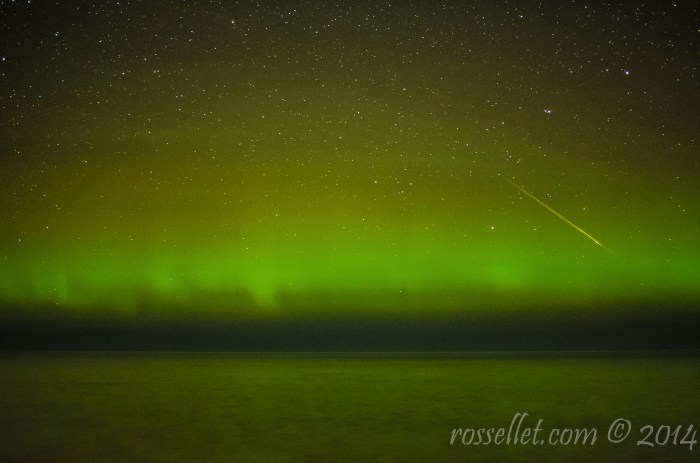
aurora-fireball-by-ross-ellet

Aurora Fireball, photo by Ross Ellet

Space.com’s page on How to Watch the Leonids says in part:

The Leonid meteor shower happens every year in November, when Earth’s orbit crosses the orbit of Comet Tempel-Tuttle. The comet makes its way around the sun every 33.3 years, leaving a trail of dust rubble in its wake. When Earth’s orbit crosses this trail of debris, pieces of the comet fall toward the planet’s surface. Drag, or air resistance, in Earth’s atmosphere cause the comet’s crumbs to heat up and ignite into burning balls of fire called meteors.

…The Leonid meteor shower peaks on the night of Thursday, Nov. 17, and early the following morning. Skywatchers might be able to see some meteors as early as Sunday, Nov. 13. However, with a full supermoon slated to rise Monday, Nov. 14, moonlight will likely outshine most meteors, rendering them difficult to see.

But don’t feel bummed if you don’t spot any of the early meteors. The Leonids will continue to graze the night sky until Nov. 21. At this point, the waning moon will be at its third quarter, meaning only half of the moon’s face will illuminate the sky. With less of the moon’s natural light obstructing the view, skywatchers who were unable to see the meteor shower at first will still have a chance to catch the last Leonid meteors.

Ross took this photo in late September of 2014 and writes:

The sky was cloudy most of the night, but at 3:30am there wasn’t a cloud in the sky. We made our way to the lakeshore and sure enough the northern lights were dim on the northern horizon. At one point you could hear the howl of a distant wolf pack while the northern lights were out. Then moments later a slow move fireball flashed across the sky. It lasted a couple seconds and the brightness pulsed as it moved through the atmosphere. After that the aurora faded, but several more meteors (some very bright) streaked above us.

View it background bigtacular and see more in his Porcupine Mtns slideshow, and definitely check out his website, Ross Ellet’s Weather & Photography for more!!

PS: Some of the best northern lights on the year happen in November so be sure to keep an eye on the skies!
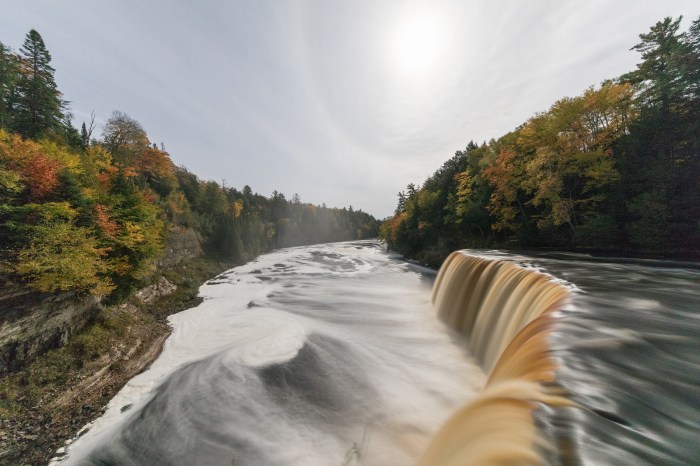
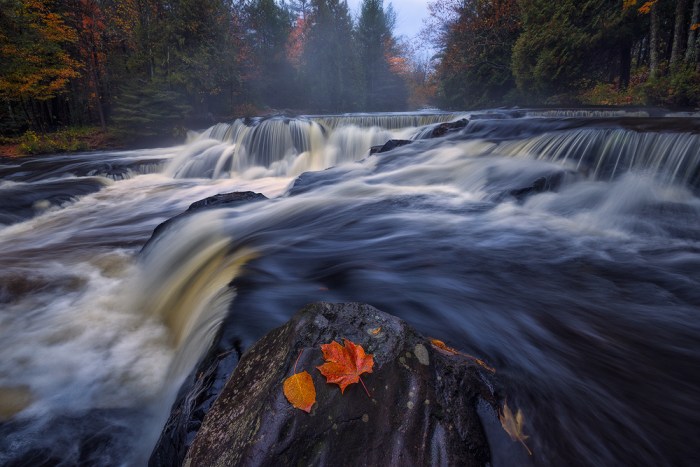
Moonglow at Tahquamenon Falls

moonglow-y-rudy-malmquist

Moonglow, photo by Rudy Malmquist

Gorgeous photo from after dark at Tahquamenon Falls State Park.

View Rudy’s photo background bigtacular and see more in his slideshow.

Lots more about Tahquamenon Falls on Michigan in Pictures.

Misty Bond Falls

misty-bond-falls-by-yanbing-shi

Misty Bond Falls, photo by Yanbing Shi

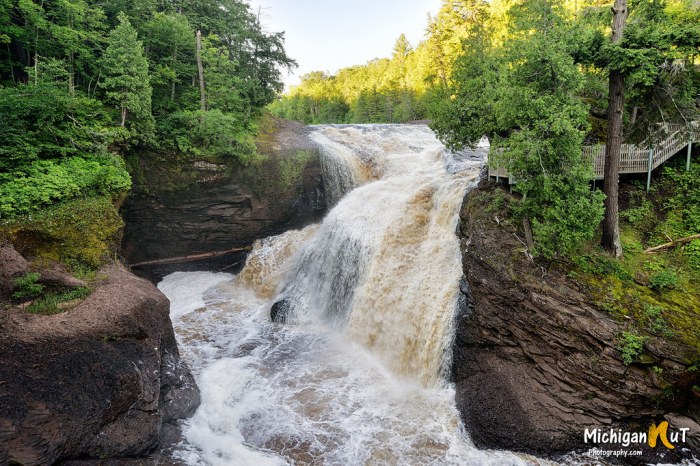
Gorgeous photo from Bond Falls in the western Upper Peninsula taken back in October of 2014. GoWaterfalling’s page on Bond Falls says (in part):

This is the best single waterfall in the Western U.P, and the second best waterfall in Michigan. If you are in the Western U.P., possibly on your way to or from the Porcupines or Copper Harbor, this is a definitely worth a stop.

…The main drop is 40 feet high and 100+ feet wide. Above the main falls are a series of cascades and rapids that must drop a total of 20 feet. The water level is controlled by a dam, and a steady flow over the falls is maintained for scenic reasons. Of course during the spring melt the flow is much higher.

View Yanbing Shi’s photo bigger and see more from Michigan and elsewhere in his Landscape slideshow.

More Michigan waterfalls and more fog & mist on Michigan in Pictures.

Manganese Falls on the Keweenaw Peninsula

manganese-falls

Manganese Falls, photo by John Gagnon

GoWaterfalling’s page for Manganese Falls says in part:

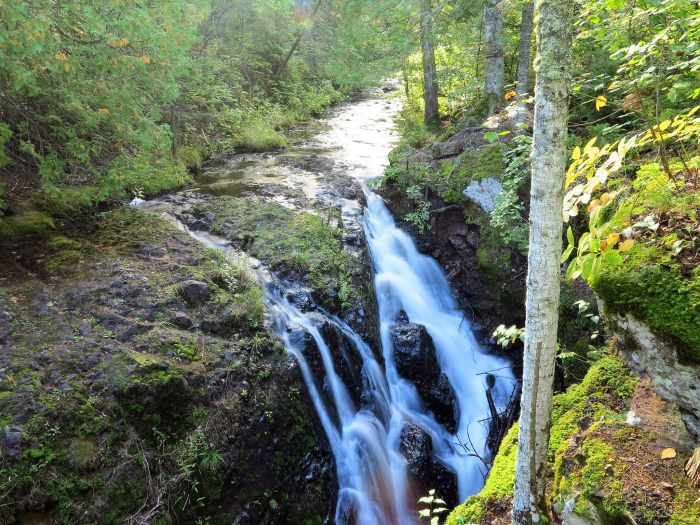
Manganese Falls is a steep cascade falling into a narrow gorge. The gorge is so narrow that it is actually hard to see the falls. There is a well marked overlook for the falls, but trees mostly obscure the falls. The overlook is perched on top of a sheer cliff, so do not even think about climbing over the fences for a better view.

It is easy to get to the top of the falls and you can look down the gorge. Even better views of parts of the falls can be had from the far side of the gorge. A large stretch of the main drop is visible. Getting a shot of the base of the falls would be very difficult. First there is a large pool at the base of the falls surrounded by steep walls, with apparently no dry places to stand. Second getting down there would be very difficult and dangerous.

Manganese Falls is located along Manganese Road just south of Copper Harbor. The road is paved, but steep in places. The falls are less than a mile from town.

Read on for more including some visiting tips and alternative viewing ideas.

View John’s photo background bigtacular and see more in his Rivers/streams slideshow.

More waterfalls on Michigan in Pictures

Rainbow Falls and the Waterfalls of the Black River

Rainbow Falls Ottawa National Forest

Rainbow Falls, Ottawa National Forest, photo by John McCormick

GoWaterfalling’s page on the Waterfalls of the Black River Scenic Byway explains that this section of the river is Michigan’s waterfall alley:

The Black River Scenic Byway is located in the western corner of Michigan’s Upper Peninsula. Dedicated in 1992 as a National Forest Scenic Byway, it starts just north of Bessemer Michigan and ends at the Black River Harbor in the Ottawa National Forest, following the Black River on its way towards Lake Superior.

Along the way it passes five main waterfalls, as well as some minor ones. The five main waterfalls are all located on the last three miles of the river before it reaches Lake Superior.

The waterfalls are Great Conglomerate Falls (profiled last week), Potawatomi, Gorge, Sandstone, and Rainbow Falls which is:

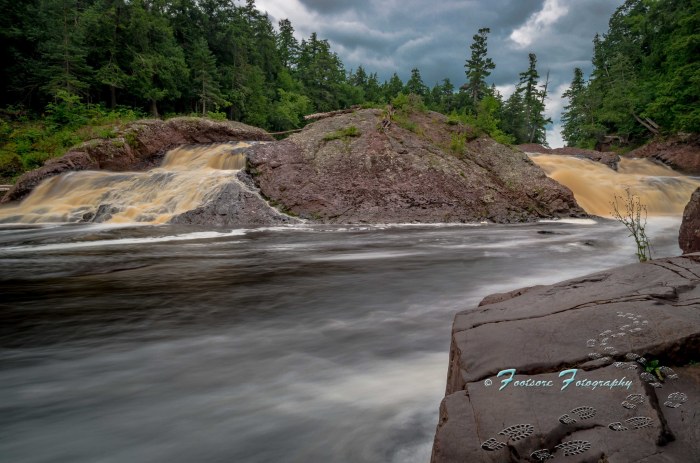
the last of the main falls on the Black River before it enters Lake Superior…The waterfall has carved out a large pothole. Most of the river falls into the pothole, but some of the water, depending on how high the river is, goes around or jumps clear over this hole.

Head over to GoWaterfalling for more pics, directions, and info about the falls in the area.

Check out John’s photo bigger, see more in his Michigan Waterfalls slideshow, and definitely follow John’s Michigan Nut Photography on Facebook for lots more like this shot of nearby Gabbro Falls, also on the Black River!

Many more Michigan waterfalls on Michigan in Pictures!

Waterfall Wednesday: Great Conglomerate Falls on the Black River

Great Conglomerate Falls

Great Conglomerate Falls, photo by Gray McCormick

GoWaterfalling’s entry on Great Conglomerate Falls says (in part):

The first of the five main waterfalls on the Black River. This waterfall is named for the large piece of conglomerate rock that divides the two segments. It is hard to see all of this waterfall at once, but that is no reason not to visit.

Great Conglomerate Falls is the first of the five main waterfalls on the Black River Scenic Byway. Here the river slides down 20 feet around a large chunk of conglomerate rock, hence the name of the falls. It is hard to get a picture of the full waterfall from the observation area. The two segments of the waterfall are pictured separately below plus a composited image of the entire falls.

Read on for directions and info about other nearby falls!

View Gary’s photo background big and see more in his Black River slideshow.

More Michigan waterfalls on Michigan in Pictures!

Get away from it all at Alder Falls

Alder Falls Marquette Michigan

Alder Falls, photo by David Marvin

GoWaterfalling’s page on Alder Falls says this waterfall:

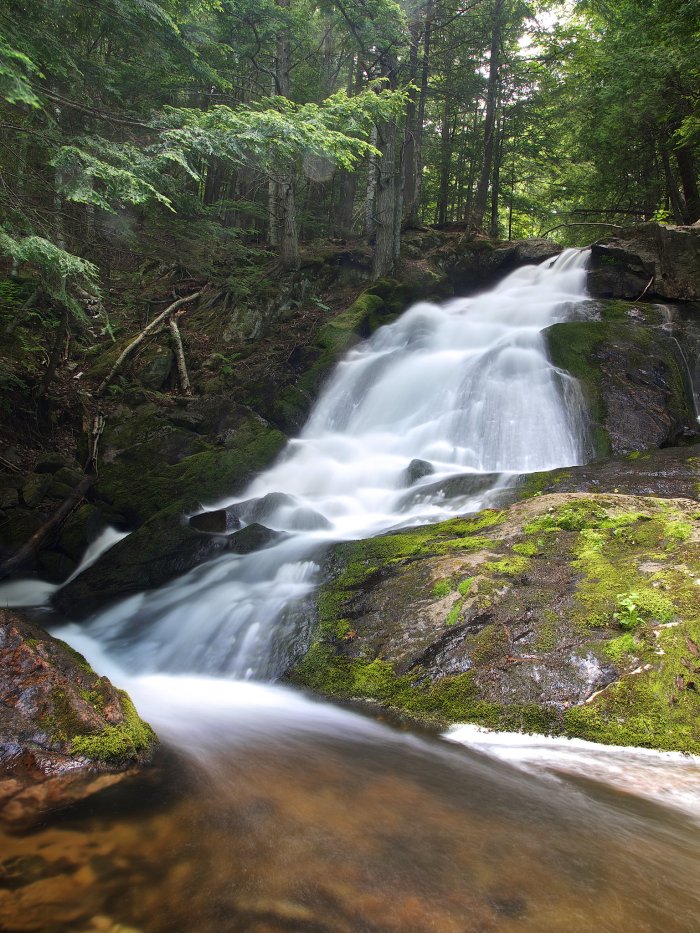
…is located about 20 miles north of Marquette on County Road 550. This is Canadian Shield country and the falls is typical of the falls found there. The falls is a slide about 30 feet high cascading down at a 45 degree angle. It falls into a deep, secluded and well shaded gorge. The gorge adds to the sense of wildness and isolation of the falls, even though it is only a mile from the main road.

Finding this waterfall is not trivial because Marquette does not seem big on marking their waterfalls or their rivers and creeks…

Upstream of the main falls are three more drops each around 5 feet high. The first of these is a short distance above the main falls and easy to reach from the north side of the creek. Upstream of that the creek has carved its way through an enormous rock, creating a narrow gorge. A second, not easily seen, drop is in the gorge. A third drop is beyond that.

Read more including detailed directions to what appears to be one of the more difficult waterfalls to get to at Go Waterfalling.

View David’s photo background bigtacular and see a bunch more shots from Alder Falls in his slideshow.

More Michigan waterfalls on Michigan in Pictures!

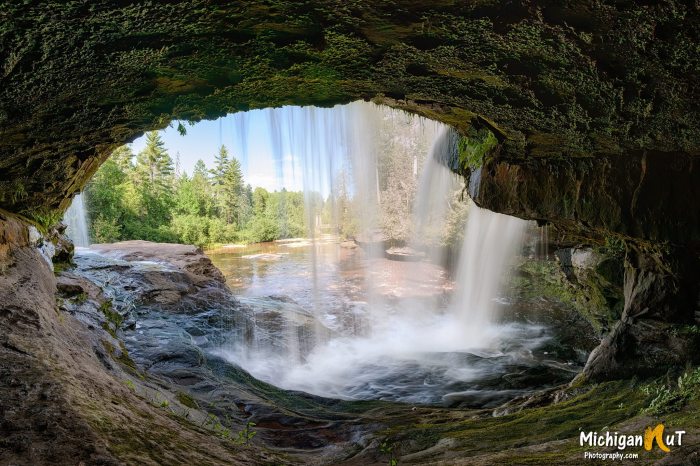
Behind O-Kun-de-Kun Falls

Behind O-Kun-de-Kun Falls

Behind O-Kun-de-Kun Falls, photo by Michigan Nut Photography

See a view from the front and get directions in Don’t Lose Your Bowl at O-Kun-de-Kun FallsThe waterfall is in Ontonagon which came to be named in a pretty hilarious story:

The name “Ontonagon” is derived from the Ojibway word “nontounagon,” which means “I lost my bowl.” Local legend surrounding the name stems from the story that a member of Chief O-Kun-De-Kun’s band was washing bowls near the mouth of the river when she was startled by an unkempt stranger in a canoe. The woman inadvertently dropped one of the bowls into the river and exclaimed “nontounagon”. The white man took her declaration to be a reply to his question about the name of the area.

John writes that a few years ago, he didn’t see a way to get behind the wild and scenic O-Kun-de-Kun Falls, but he found a way this time … and got a nice shower in the process!

See his photo bigger and view & purchase photos at Michigan Nut Photography.

More Michigan waterfalls on Michigan in Pictures.

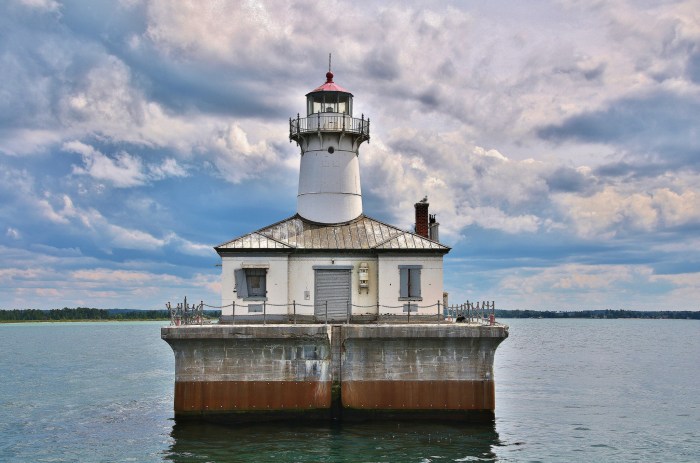
Fourteen Foot Shoal Lighthouse in Lake Huron

14 foot shoal lighthouse by David Juckett

14 foot shoal lighthouse, photo by David Juckett

Terry Pepper’s Seeing the Light remains the gold standard for information about the lighthouses of the Great Lakes. Terry writes (in part) of the process of constructing Fourteen Foot Shoal Light near the entry into Cheboygan Harbor:

With completion of the work at Poe Reef in 1929, the work crew turned their attention to work at Fourteen Foot Shoal. While the new light was of a totally different design, and considerably smaller than the twin lights built at Martin and Poe Reefs, the construction of the crib proceeded in much the same manner, with the construction of a wooden crib at the shore station on the Cheboygan Pier. After an area on the shoal was leveled, the crib was eased down wooden ways into the water, and towed to the shoal by the Lighthouse Tender Aspen. Once over the leveled area, the crib was sunk to the bottom by filling its empty pockets with rocks and gravel.

This timber foundation then served as a core, upon and around which wooden forms were constructed and filled with concrete loaded from the Lighthouse Service scow. As was the case with both the Martin and Poe stations, the upper edge of the crib was formed into a graceful flare, designed to deflect waves away from the pier, in order to help protect the structures which would be erected on the deck. With the completion of the concrete work, the pier stood fifty feet square, and its deck level fifteen feet above the water.

The steel framework for the single story equipment building was erected at the center of the deck. Standing thirty-four feet by twenty-eight feet in plan, on completion, the entire exterior of the building was sheathed with 1/4-quarter inch steel plates, each riveted to the steel framework beneath. Centered on the roof ridge, a cylindrical steel tower was integrated into the roof, standing six feet in diameter and twenty-four feet above the ridge line. The tower was capped with an octagonal cast iron lantern and outfitted with a flashing white Fourth Order Fresnel lens.

Read on for lots more and photos!

View David’s photo background bigtacular and see more in his slideshow.

Many more Michigan lighthouses on Michigan in Pictures!

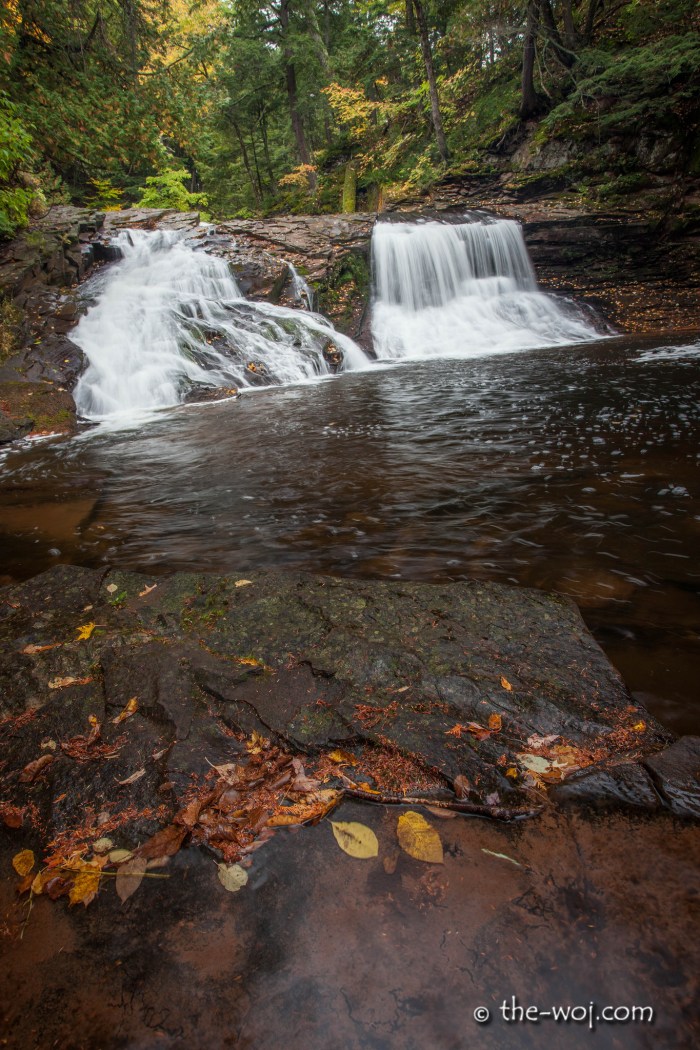
Taking the plunge at Shining Cloud Falls

Shining Cloud Falls

Shining Cloud Falls, photo by Paul Wojtkowski

GoWaterfalling shares that Shining Cloud Falls is the largest and one of the wildest backcountry waterfalls in the Porcupine Mountains State Park:

You will have to hike at least 5 miles in to see the falls, and another 5 miles to get back. If you are looking for a good long day hike this is a winner. In addition to the main falls there are also a number of smaller cascades, and whatever route you take there is lots of wilderness scenery.

The total drop of the falls is about 20′. The falls consists of two parts, a slide on the left, and a plunge on the right. In higher water the two parts merge, but in lower water the two parts are distinct, as can be seen in the photos on this page. Plunge falls are rare around Lake Superior.

…Downstream of Shining Cloud Falls are a number of unnamed falls and rapids. Several of these are larger than some of the named falls on the Little Carp River. The last drop near the Lake is known as Bathtub Falls. If you are hiking upstream to the falls, do not be fooled by the smaller drops. The trail follows the river closely, but it climbs away from the river before reaching Shining Cloud Falls. There is no sign marking Shining Cloud Falls, but it is very distinctive.

You can read on for more including directions. FYI, “plunge falls” are those where the water descends vertically without contact with the surface.

View Paul’s photo background bigtacular, see more in his slideshow, and view & purchase his photos in his Especially in Michigan gallery at the-woj.com.

Lots more waterfalls on Michigan in Pictures!