Ross’s Goose

Ross's Goose

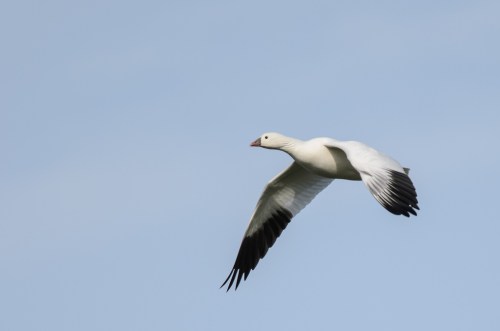
Ross’s Goose, photo by jsommer2

A few weeks ago there was a bit of a question as to the duckishness of a sleeping duck I posted, so I spent a lot of time looking at ducks & duck-like birds. One of them showed up in the photo group so without further delay…

The All About Birds entry for Ross’s Goose (Chen rossii) says:

A tiny white goose with black wingtips, the Ross’s Goose is like a miniature version of the more abundant Snow Goose. It breeds in the central Arctic and winters primarily in central California, but it is becoming more frequent farther east.

Prior to the 1950s the Ross’s Goose was confined to well-defined breeding and wintering areas, with few seen as strays. Since that time the species has been expanding eastward, both on the breeding and wintering grounds. The change in breeding distribution has resulted in more contact and subsequent hybridization with the Snow Goose.

The female Ross’s Goose does all of the incubation of the eggs. The male stays nearby and guards her the whole time. The female covers the eggs with down when she leaves the nest. The down keeps the eggs warm while she is away and may help hide them from predators.

More including photos and identification tips at All About Birds.

Check jsommer’s photo out background big and view the slideshow for more photos including a shot of this goose with some much bigger Canadian geese!

Many more Michigan birds on Michigan in Pictures!

Golden Hour on the Rouge River

The Golden Hour on the Rouge

The Golden Hour on the Rouge, photo by pkHyperFocal

The Rouge River Gateway Project relates that the Potawatami referred to the river as Minosa Goink which means “Singeing Skin River” – the place where game animals were dressed. The history continues (with my links to other fun stuff):

The French first settled on the banks of the Rouge River in the 1780s. They named the river “Rouge”, or red. Settlers would claim a few hundred feet of river frontage and extend their farms deep into the forest. Remnants of these “ribbon farms” still exist today in land ownership patterns along the river. Europeans continued to immigrate into the region to take advantage of its resources. They used the reddish clay for brick, mined the area’s salt deposits, and built farming communities along the riverbanks. The native prairie oak savannah and hardwood forests were cleared to make room for agriculture and industry.

Rapid growth and industrial development characterized the late nineteenth century. Henry Ford purchased extensive land holdings along the river. He built a factory in Dearborn to manufacture farm tractors, but kept a good portion of his land in agricultural production, partially for testing equipment. In 1914, he started construction of a permanent residence on the banks of the Rouge River.

A defining moment in the history of the river transpired with the construction of the Ford Rouge Plant during World War I. The development of the plant was motivated by Henry Ford’s desire to supply submarine chasers to the US military. The Ford Rouge Manufacturing Complex grew into a massive self –contained industrial complex that daily employed over ninety thousand men in the early 20th century. Raw materials including coke, iron ore, and rubber were brought in and transformed into cars in less than thirty hours, a process that set a new global standard for industry. The Rouge Manufacturing Complex became the largest manufacturing site in the world.

In his book Burning Rivers, Allen Park native John Hartig relates how heavy manufacturing and population growth seriously impacted the river to the point where the river became one of the most polluted waterways in the nation, catching fire in 1969 shortly after the famous Lake Erie/Cuyahoga River fire.

In 1986, in a Sunday feature on a new organization seeking to restore the Rouge, the Detroit Free Press called it the “sewer for a metropolis, discharge drain for industry, dumping ground for junk and garbage”. They went on to say that “the Rouge River has become so polluted that a cleanup seems unthinkable.”

While the Rouge is certainly far from restored, the organization the Freep was talking about, Friends of the Rouge, has been dedicated along with other public and private efforts to the preservation & restoration of the river. I encourage you to check them out for more information and to learn about their good work on the behalf of the river. Lots more at the Rouge River Project and Wayne County’s Rouge Project.

View pkHyperFocal’s photo big as a boat and see more in their Man Made slideshow.

More industry on Michigan in Pictures.

#TBT Ice Wine Season

Ice Wine Season

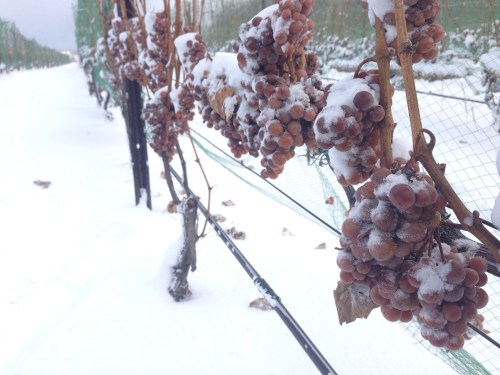
Ice Wine Season, photo by Andrew McFarlane

This morning as I was working on a Facebook post announcing the release of Black Star Farms’ 2013 A Capella Ice Wine, I stumbled upon a cool synchronicity that brought together several of my personal and professional pursuits into such a neat package that I had to share it!

It turns out that exactly one year ago today, I spent a very cold day on the Old Mission Peninsula shooting a photo feature for eatdrinkTC of the ice wine harvest & pressing at Black Star Farms. Ice wine, eiswein in the original German, is a rare dessert wine that requires care and skill to produce and…

While December 11, 2013 was by no means the coldest December 11th on record (that would be 1977 at -11), it was a bone-chilling day with temps hovering around 11 degrees with a wind chill that never got above zero after 9:30 AM.

In short, as Black Star Farms winemaker Vladimir Banov explained, the perfect day for the ice wine harvest.

Ice wine is not made every year, and not by every winery. U.S. law for ice wines specifies that the grapes must be naturally frozen to be sold as ice wine.

To begin, a winery will leave a portion of the harvest to hang. Even under the bird netting, it’s a gamble against mercurial weather and clever creatures. Many years, it will leave the winery with nothing.

In some years however, such as this one, patience is rewarded.

Click through for a photographic look at the ice wine process along with some videos. If you’re interested, here’s information about A Capella Ice Wine.

You can view my photo background big and see more in my Ice Wine at Black Star Farms slideshow.

More wine and more winter wallpaper on Michigan in Pictures!

The Anvil and the Pine

Cliffs from below

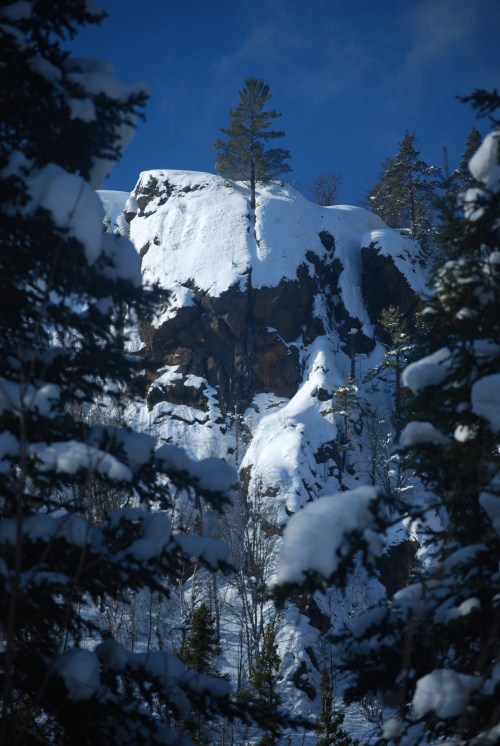
Cliffs from below, photo by David Clark

David writes that “The Anvil” is a high point where a white pine somehow makes a living growing out of a crack in the rock. On his blog, Cliffs and Ruins he writes:

This is one of my favorite places along the Cliff range: The Lookout. Apparently different people have different lookouts, but this is what I think of as the Cliff Lookout.

It’s a bit of a hike (no, you don’t have to go straight up the side of the cliffs… but you can if you want), but the view is 100% worth it. You can even see the silhouettes of the Huron Mountains in the distance. The most amazing thing, to me, is that tree — you can see it here. It’s a big old pine growing straight up out of the rock, over the edge of the cliffs.

There’s nothing quite like the solitude at the top of the lookout. When I snowshoed out to the lookout, there weren’t any tracks at all on the trail to the lookout — nor on the trail to the trail! It was one of those feelings which I love when I’m hiking up here — that I’m the first person in years to set foot here and see these sights. It might not be true, but this is still one of my favorite places to go whenever I really need some time alone.

View his photo background bigtacular and see more in his Winter slideshow. You can purchase David’s pics right here.

More winter wallpaper on Michigan in Pictures.

It’s a long night for December’s full moon

aDSC_0287

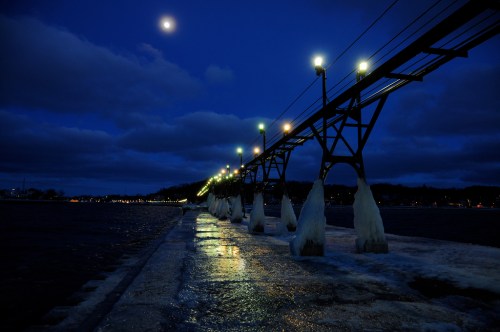
aDSC_0287, photo by Craig

The moon will be full at 7:27 am tomorrow, which basically means tonight. The Old Farmer’s Almanac has this to say about the December Full Moon, known also as the Cold Moon:

During this month the winter cold fastens its grip, and nights are at their longest and darkest. It is also sometimes called the Moon before Yule. The term Long Nights Moon is a doubly appropriate name because the midwinter night is indeed long, and because the Moon is above the horizon for a long time.

The midwinter full Moon has a high trajectory across the sky because it is opposite a low Sun.

Also, I found a moon phase calendar for December 2014 (and beyond) that’s a really cool way to visualize the month’s moon!!

View Craig’s photo from back in 2009 on the Grand Haven south pier background big and see more in his Pier slideshow.

There’s many moons in the Michigan in Pictures archives!

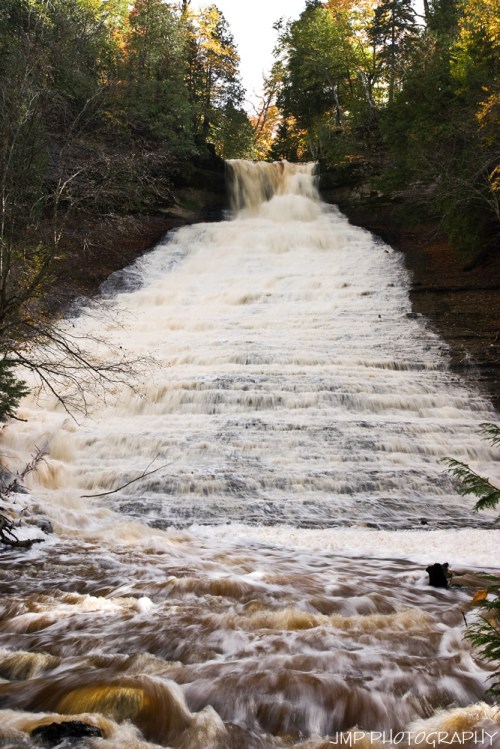
Tale of the tape at Laughing Whitefish Falls

Laughing Whitefish Falls

Laughing Whitefish Falls, photo by James Marvin Phelps

GoWaterfalling’s page on the Laughing Whitefish Falls says (in part):

Laughing Whitefish Falls is in the Laughing Whitefish State Park. This is one of the most impressive of Michigan’s waterfalls. I believe it is the highest waterfall in Michigan that is readily visitable.

The falls can be found off of M-94, about 30 miles from Munising or Marquette, and just outside of Chatham…

The waterfall is named for the river. The river is so named because the mouth of the river resembled a laughing fish when viewed by the Ojibwe from Lake Superior.

Get detailed directions at GoWaterfalling.com. They add that later in the year the water flow can get thin enough to be hardly visible!

To answer the question of the height, I found a very cool list of Michigan waterfalls by height at the World Waterfall Database. At 100 feet tall, Laughing Whitefish Falls check in fourth behind:

  • Spray Falls – 140′ (towering and incredible – view by Pictured Rocks boat tour or long hike)
  • Jasper Falls (125′, midway between Miners Beach & Sand Point along the Pictured Rocks National Lakeshore shoreline – they say it’s basically a trickle most of the time)
  • Houghton Falls (110′, private property/no trespassing! You can click that link for a Michigan in Pictures photo from someone who got permission from the landowner to visit)

View James’ photo on Flickr and see more in his massive Michigan Waterfalls slideshow including a few nice shots of Spray Falls and some waterfall videos!

PS: Just realized that this photo was from way back in 2005! Amazing that I’ve been doing Michigan in Pictures for so long, and that people like James have been supporting me with their photography for so long!

More Michigan waterfalls on Michigan in Pictures.

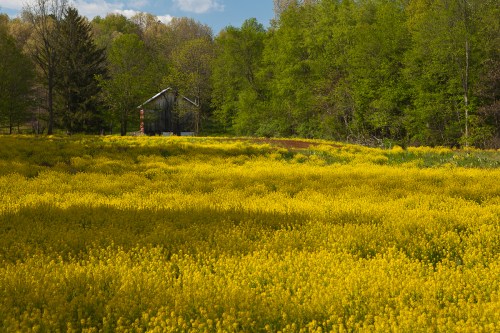
Field of Dreams: Winter Fantasy Edition

TWaggoner_Field of Dreams

Field of Dreams, photo by Terry Waggoner

As winter closes in I can’t help but remember warmer times…

View Terry’s photo background big and jump into his slideshow for more!

More barns on Michigan in Pictures.

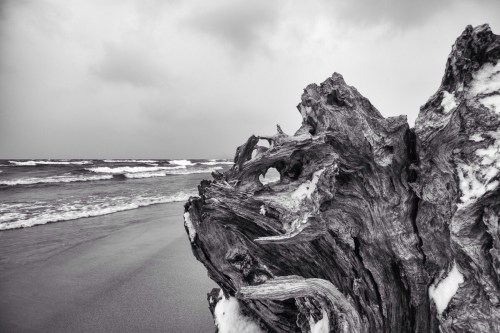
Driftwood detail

Driftwood with great detail on the Lake Michigan shore in Grand Haven.

Driftwood with great detail…, photo by Brad Terry

View Brad’s photo from the Lake Michigan shore in Grand Haven background big and see more in his Pier Series slideshow.

More black & white photography and more winter wallpaper on Michigan in Pictures!

Bears, it’s what’s for (Thanksgiving) dinner!

Thinking About the Zoo Visitors?

Thinking About the Zoo Visitors?, photo by Maia C

A very happy Thanksgiving to all of you. I remain very thankful that I have such a great group of photographers and readers for Michigan in Pictures. I love doing this blog, and your support makes it possible!

Maia suggests that this lion is perhaps thinking about zoo visitors, but my personal theory is that he’s thinking about bears, Chicago Bears to be exact! Thankfully, the NFL has given us the opponent who started it all, as the Detroit Lions share the history of the Thanksgiving Day game:

The game was the brainchild of G.A. Richards, the first owner of the Detroit Lions. Richards had purchased the team in 1934 and moved the club from Portsmouth, Ohio to the Motor City. The Lions were the new kids in town and had taken a backseat to the baseball Tigers. Despite the fact the Lions had lost only one game prior to Thanksgiving in 1934, the season’s largest crowd had been just 15,000.

The opponent that day in 1934 was the undefeated, defending World Champion Chicago Bears of George Halas. The game would determine the champion of the Western Division. Richards had convinced the NBC Radio Network to carry the game coast-to-coast (94 stations) and, additionally, an estimated 26,000 fans jammed into the University of Detroit Stadium while thousands more disappointed fans were turned away.

Despite two Ace Gutowsky touchdowns, the Bears won the inaugural game, 19-16, but a classic was born. Since 1934, 69 games have been played with the Lions holding a series record of 33-34-2 (.493). And each game, in its own way, continues to bring back memories of Thanksgiving, not only to Lions’ fans, but to football fans across the nation.

View Maia’s photo big as a lion and see more in her Detroit Zoo Spring/Summer 2008 slideshow.

More Thanksgiving features & photos and more Detroit Lions on Michigan in Pictures.

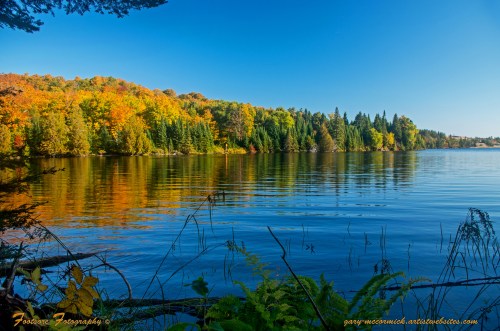
Fall color on Grand Sable Lake

Fall Colors On Grand Sable Lake

Fall Colors On Grand Sable Lake, photo by Gary McCormick

Gary took this back in September at Grand Sable Lake in the Pictured Rocks National Lakeshore.

Get it background bigtacular and see more in his Grand Marais, MI slideshow.

More Fall wallpaper & more Pictured Rocks on Michigan in Pictures.