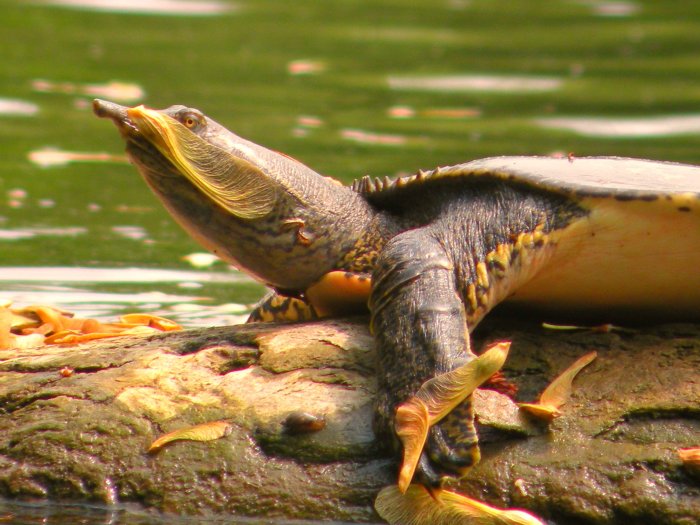
Know your Michigan Turtles: Spiny Soft-shell Turtle

Soft Shell Attracts Seed Pods

Soft Shell Attracts Seed Pods, photo by David Mayer

One of the most popular posts on Michigan in Pictures is Know Your Michigan Turtles where we now have 8 of Michigan’s 10 turtle species profiled. You can click that link for the list of all of them and read on to learn about the soft shell turtle.

The Spiny Soft-shell Turtle (Apalone spinifera spinifera) entry at the University of Michigan Animal Diversity Web says that:

Apalone spinifera inhabits various freshwater systems such as rivers, lakes, marshes, farm ponds as well as bays of the Great Lakes . Apalone spinifera prefers open habitats with a small amount of vegetation and a sandy or muddy bottom and require sandy raised nesting areas close to water.

…Spiny softshell turtles are diurnal animals, spending most of the day basking in the sun and foraging for food. They can be spotted sunning on logs and river banks. If disturbed, they will quickly retreat into the water and bury themselves in sand, leaving only their heads visible. These turtles are also able to breathe underwater for extended periods through their pharyngeal lining, cloacal lining, and skin. Spiny softshell turtles spend October to April in the water buried underneath substrate in a state of dormancy.

Apalone spinifera preys on on various macroinvertebrates such as aquatic insects, crayfish, and occasionally a fish. They find their food underneath objects, along the floor of the lake, and in vegetation. They also hide in the floor substrate and grab prey as they swim by.

Spiny softshell turtle nests are often destroyed by raccoons, skunks, and foxes. Young softshell turtles are eaten by raccoons, herons, and fish. Adults are killed and eaten only by humans, they have few natural predators. When bothered, spiny softshell turtles will extend their long necks and snap viciously at their attacker, inflicting a painful bite. They are wary and can hide themselves quickly.

Read on for a whole lot more including photos.

David says to be sure to check out the seed pod copter on this turtle’s face! View it background big and see more in his Wildlife slideshow.
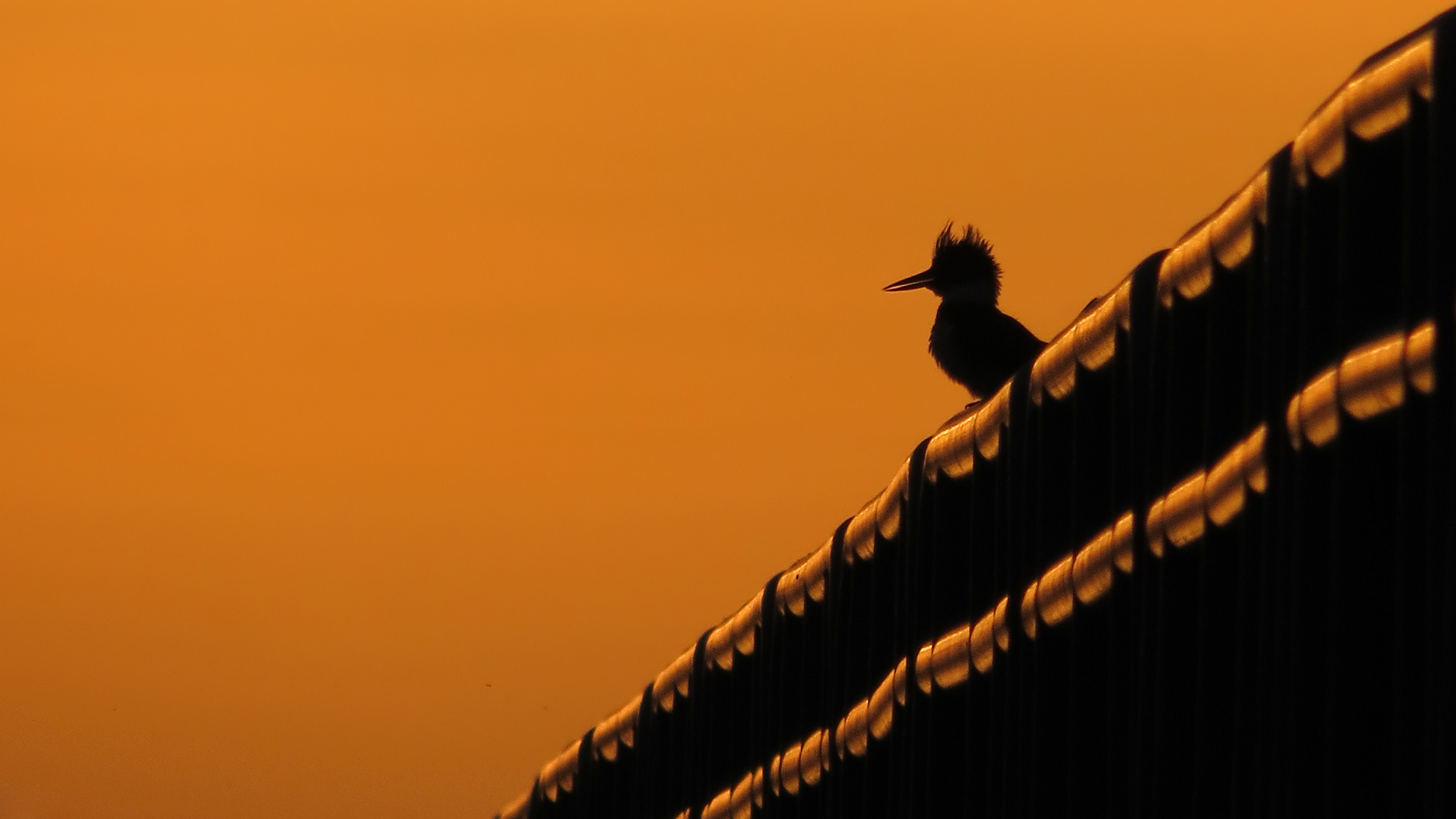
Kingfisher Friday: The Belted Kingfisher

Kingfisher HD Friday

Kingfisher Silhouette HD Wallpaper, photo by John Britt

All about Birds says that the Belted Kingfisher is:

A common waterside resident throughout North America, the Belted Kingfisher is often seen hovering before it plunges headfirst into water to catch a fish. It frequently announces its presence by its loud rattling cry.

It breeds along streams, rivers, lakes, and estuaries with banks for nest holes. The breeding distribution of the Belted Kingfisher is limited in some areas by the availability of suitable nesting sites. Human activity, such as road building and digging gravel pits, has created banks where kingfishers can nest and allowed the expansion of the breeding range.

View John’s photo background big and see more in his Northern Michigan – Seasons, Sunrises, Beaches, Waterfalls, Mountains slideshow.

More Michigan Birds from Michigan in Pictures.

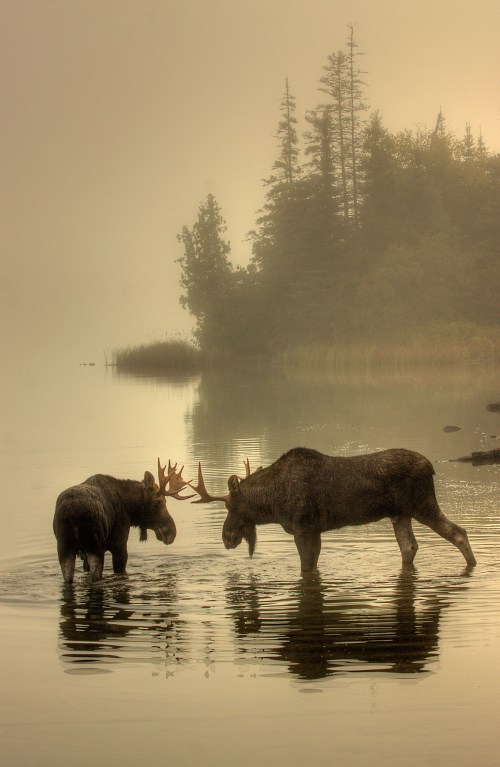
Michigan Moose Numbers Declining

Moose Point Face-off

Moose Point Face-off, photo by Carl TerHaar

The Detroit Free Press reported that Michigan moose numbers are down:

The moose population in Michigan’s western Upper Peninsula appears to have dropped over the past two years and experts warn that a warming climate could be cause for concern for the species’ future in the state.

The latest biennial survey by the Department of Natural Resources produced an estimate of 323 moose in their primary Michigan range, which includes Baraga, Iron and Marquette counties. If correct, that would be a decline there of about 28 percent from 2013, when the estimate was 451.

…Even so, surveys since 1997 turned up regular population increases of about 10 percent. Beginning in 2009, the growth rate slowed to about 2 percent.

Now it appears to be dropping.

“It might not happen in our lifetime, or our children’s, but we have to face the possibility that there might not be a wild moose population in Michigan,” Chad Stewart (deer, elk and moose management specialist with the DNR) said.

Scientists are not certain what caused the apparent decline over the past two years, he said. Bitter cold and heavy snow the past two winters is one possible culprit. Also, wolves increasingly may be targeting moose because of falling deer numbers, although Stewart said there’s no hard evidence of that.

But in the long term, a warming climate may be the moose’s biggest enemy. Blood-sucking ticks thrive under such conditions. Thousands can attach themselves to a single moose and weaken the hulking beast.

More at the Freep.

View Carl’s photo big as a moose and see more in his massive Isle Royale National Park slideshow.

More Michigan moose information & photos on Michigan in Pictures

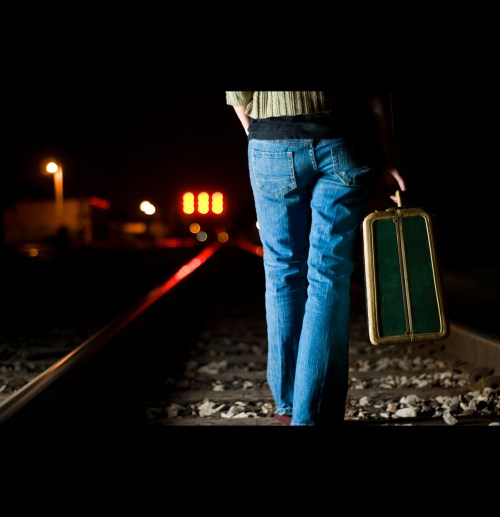
Leaving … for a little while

Leaving

Leaving, photo by Christian Spencer

(but just to be clear, I’ll be back)

I wanted to let you all know that I’m about to embark on a little adventure to Central America for the next couple of weeks. To keep you company while I’m gone, I’ve selected a bunch of photos so you probably won’t notice much in the way of difference. I do apologize if something happens that makes a photo I scheduled seem tone deaf.

Anyway, enjoy my vacation!

View Christian’s photo background big and see more in his Strobist & Concert slideshow.

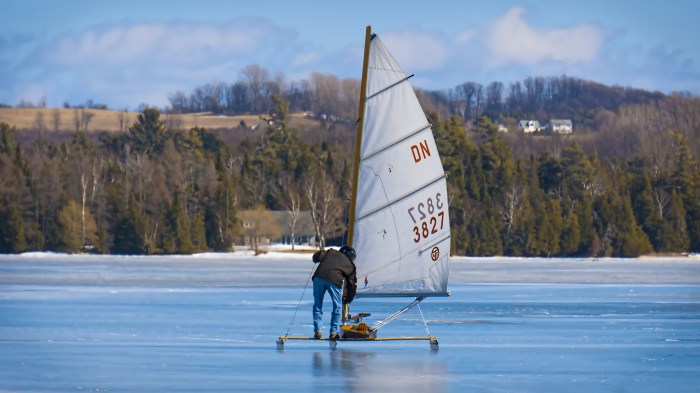
Standing Iceboater

Ice Boating in Leelanau County Michigan

Standing Iceboater, photo by Mark Smith

It’s 8 degrees right now in Traverse City, and while the weeklong run of wintry weather hasn’t been good for such popular pursuits as getting the garden ready, boxing up winter clothes and keeping your house from being declared a Cabin Fever Disaster Area, it has left the ice in many parts of the state just perfect for the sport of ice boating.

Northern Michigan AP News photographer John Russell is a Michigan in Pictures contributor and wrote Ice Boating: An Ancient Sport in a Modern World a few years ago. It begins:

Sailing on frozen surfaces is believed to have its roots in Northern Europe, where goods and people moved around the region on frozen rivers and canals, using simple sails and handmade boats.

The Dutch and others brought iceboating to the Hudson River valley and other places along the East Coast, where miles of frozen rivers made for great sailing during the winter months. Freight and people were commonly moved up and down the Hudson River in huge, slooped-rigged boats.

Ranging in length from 30 – 50 feet, the stern-steering boats are still raced today by the Northwest Ice Yacht Association, having recently celebrated its 100th anniversary.

The ancient sport of sailing on frozen lakes and rivers is alive and well in our state, which has a long and involved history in the sport. Innovations developed in Michigan have enhanced and improved iceboating.

During the winter of 1936-1937, in the hobby shop at the Detroit News, boat builder Archie Arroll, along with Norm Jarrait and Joe Lodge, designed an ice boat they called the Blue Streak 60. Designed to be small enough to build in a garage, and easy enough to be built by anyone, the 12-foot hull design became known as the DN 60, for Detroit News and the 60-square-foot sail.

It is now the largest one-design boat class in the world, with over 8,000 registered boats around the world.

Read on for more including our state’s role in international ice boat racing, some state clubs, safety tips and a couple of photos from John.

Mark took this shot earlier in the week on Lake Leelanau. View it background bigtacular and see more photos (and a couple videos) in his Ice Boats slideshow.

More Michigan iceboating on Michigan in Pictures!

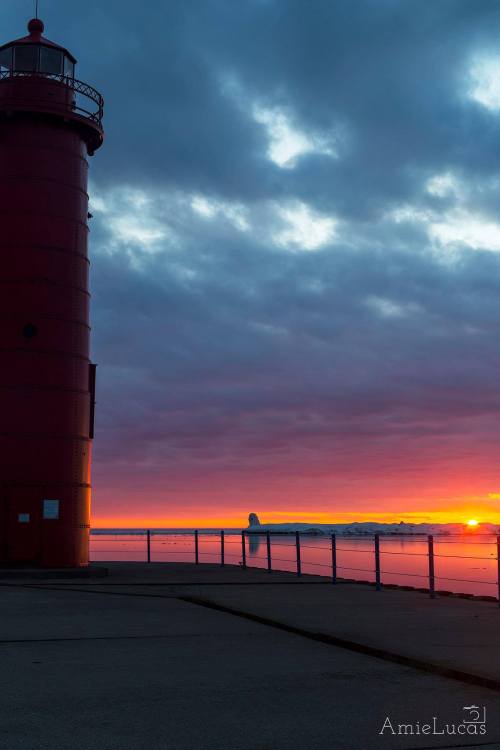
Sunset at Muskegon Lighthouse

Sunset at Muskegon Lighthouse

Sunset at Muskegon Lighthouse, photo by Amie Lucas

Lighthouse Friends’ page on the Muskegon South Pier Light begins:

The name ‘Muskegon’ comes from the Ottawa Indian term ‘Masquigon,’ meaning “marshy river or swamp,” and refers to the Muskegon River that expands into Muskegon Lake before emptying into Lake Michigan. Settlement on the shores of Lake Muskegon began in 1837 with the establishment of Muskegon Township. Nicknamed the ‘Lumber Queen of the World,’ Muskegon was home to more millionaires than any other town in America during the late 1800s, when its lumber helped rebuild Chicago after the great fire of 1871.

In August 1838, Lieutenant James T. Homans visited the river and included the following in a report to the Secretary of the Treasury:

Muskegon river, on lake Michigan, came next under my observation, it is a large stream, opening, within half a mile of its outlet, into a considerable lake, eight miles long by four wide. The channel in, is wide and easy of access, and not less than twelve feet of water in it; making this harbor, in my estimation, the best on lake Michigan, all things considered. Its value as a safe haven, and the rich lumber trade in which it will soon be engaged, (three extensive steam saw-mills having been erected there,) entitle it to a light-house near the entrance. I selected a point, on the south side of the river’s mouth, as the best location, in the event of an appropriation being made for a light there.

On March 3, 1849, Congress set aside $3,500 for a lighthouse at the site selected by Homans, and in 1851 a one-and-a-half-story, rubblestone dwelling, surmounted by a wooden tower, was built. The dwelling measured thirty-six by eighteen feet, and the top of the tower stood twenty-six feet above the ground. Six lamps with fourteen-inch reflectors were originally used in the lantern room, but a sixth-order Fresnel lens replaced these in 1856. Alexander Wilson was hired as the light’s first keeper at an annual salary of $450.

Read on for lots more including photos.

View Aime’s photo background big on Facebook and see more Lake Michigan sunset goodness in A Muskegon Sunset at amielucasphotography.com.

There’s more lighthouses, more sunsets, more Lake Michigan and more Muskegon on Michigan in Pictures.

Signs of Spring #56: Chevrons

Chevrons

Chevrons, photo by MichaelinA2.PortrayingLife.com

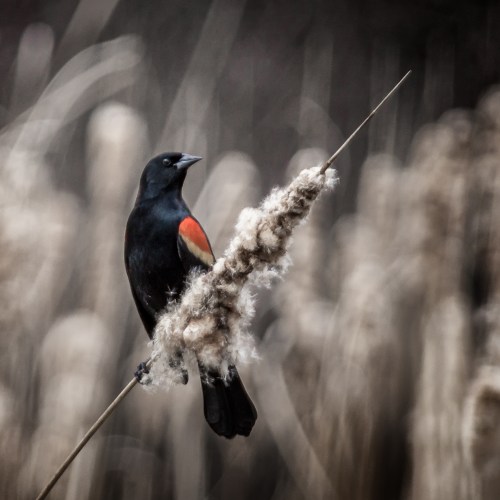
Spring officially arrives today at 6:45 PM, and we are starting to see signs that winter is running out of steam. One of them is the return of Red-winged blackbirds Agelaius phoeniceus about which University of Michigan BioKids says (in part):

These birds are some of the first springtime birds to return from their wintering sites. Once males arrive, they devote their time to defending their territory. The most successful defenders are not necessarily the most aggressive birds. Males that spend more time in, as well as foraging on, their territory are more likely to retain ownership of that territory.

Males with darker colored shoulders do not tend to keep their territories. Typically in the spring, male red-winged blackbirds display in a “song spread.” They fluff their plumage, raise their shoulders, and spread their tail as they sing. As the display becomes more intense, the wings are more arched with the shoulders showing more prominently. Males use this same body display as a threat to other male birds that enter into the male’s territory.

Females will also engage in a “song spread” display directed at each other early in the breeding season. One possibility is that a female will defend a sub-territory within the male’s territory. The female will engage in a “wing flip” display when a disturbance prevents her from returning to her nest full of young.

Red-winged blackbirds are active during the day and migrate between their summer breeding grounds and winter feeding areas. During the winter, red-winged blackbirds aggregate in huge flocks and tend to stay in or near areas where grains and seeds are available to eat.

Read on for more including their ability to help control insect pests.

View Michael’s photo background big and see more in his soon to grow Birds 2015 slideshow.

Many more Michigan birds on Michigan in Pictures.

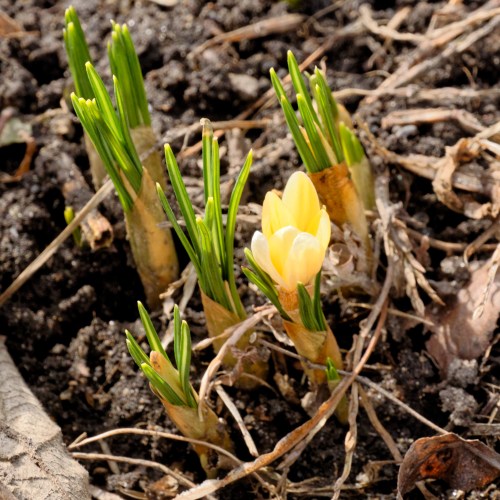
Spring!

Spring

Spring!, Photo by Joel Dinda

View Joel’s photo background bigtacular and then just lay back and watch his massive Flowers slideshow until you too believe in SPRING!

There’s lots more spring wallpaper on Michigan in Pictures.

Northern Lights: Ancient Aliens Edition

Northern Lights Ancient Aliens Edition

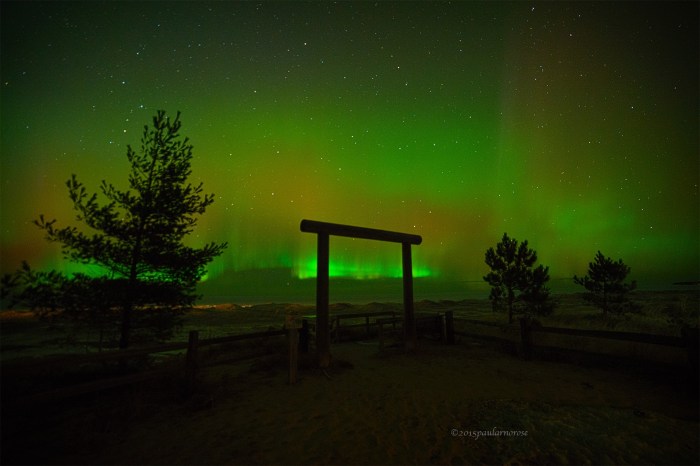
Northern Lights over Lake Lake Superior, photo by Paul Arno Rose

NOAA’s Space Weather Prediction Center is THE place to go for forecasting of likely northern lights activity. Yesterday they held a press conference regarding the G4 storm (on a scale of 1-5) that was caused by two magnetic eruptions on March 15 that combined to form a single wave producing the biggest storm so far of Cycle 24.

Their page on Geomagnetic Storms explains:

A geomagnetic storm is a major disturbance of Earth’s magnetosphere that occurs when there is a very efficient exchange of energy from the solar wind into the space environment surrounding Earth. These storms result from variations in the solar wind that produces major changes in the currents, plasmas, and fields in Earth’s magnetosphere. The solar wind conditions that are effective for creating geomagnetic storms are sustained (for several to many hours) periods of high-speed solar wind, and most importantly, a southward directed solar wind magnetic field (opposite the direction of Earth’s field) at the dayside of the magnetosphere. This condition is effective for transferring energy from the solar wind into Earth’s magnetosphere.

The largest storms that result from these conditions are associated with solar coronal mass ejections (CMEs) where a billion tons or so of plasma from the sun, with its embedded magnetic field, arrives at Earth. CMEs typically take several days to arrive at Earth, but have been observed, for some of the most intense storms, to arrive in as short as 18 hours. Another solar wind disturbance that creates conditions favorable to geomagnetic storms is a high-speed solar wind stream (HSS). HSSs plow into the slower solar wind in front and create co-rotating interaction regions, or CIRs. These regions are often related to geomagnetic storms that while less intense than CME storms, often can deposit more energy in Earth’s magnetosphere over a longer interval.

Storms also result in intense currents in the magnetosphere, changes in the radiation belts, and changes in the ionosphere, including heating the ionosphere and upper atmosphere region called the thermosphere. In space, a ring of westward current around Earth produces magnetic disturbances on the ground. A measure of this current, the disturbance storm time (Dst) index, has been used historically to characterize the size of a geomagnetic storm. In addition, there are currents produced in the magnetosphere that follow the magnetic field, called field-aligned currents, and these connect to intense currents in the auroral ionosphere. These auroral currents, called the auroral electrojets, also produce large magnetic disturbances. Together, all of these currents, and the magnetic deviations they produce on the ground, are used to generate a planetary geomagnetic disturbance index called Kp. This index is the basis for one of the three NOAA Space Weather Scales, the Geomagnetic Storm, or G-Scale, that is used to describe space weather that can disrupt systems on Earth.

During storms, the currents in the ionosphere, as well as the energetic particles that precipitate into the ionosphere add energy in the form of heat that can increase the density and distribution of density in the upper atmosphere, causing extra drag on satellites in low-earth orbit. The local heating also creates strong horizontal variations in the in the ionospheric density that can modify the path of radio signals and create errors in the positioning information provided by GPS. While the storms create beautiful aurora, they also can disrupt navigation systems such as the Global Navigation Satellite System (GNSS) and create harmful geomagnetic induced currents (GICs) in the power grid and pipelines.

Lots more including the ability to sign up for space weather alerts at www.swpc.noaa.gov. Also head over to the NOAA Auroras group on Flickr to share your photos.

View Paul’s photo background bigtacular and check out more of his photography on his Facebook page.

More northern lights photos & info on Michigan in Pictures.

Wearing o’ the Green (Aurora)

Wearing o the Green Aurora

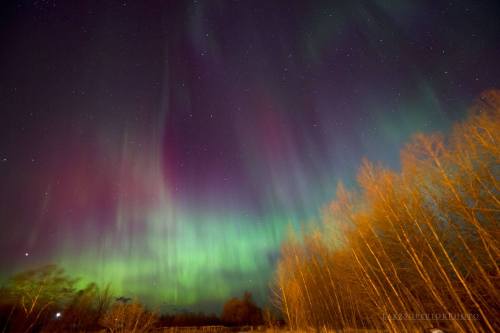
St. Patrick’s Day 2015 Northern Lights, photo by Lake Superior Photo

Shawn of Lake Superior Photo writes:

Some great auroras this morning, but it was very difficult to photograph, brutal wind- it’s still out and still dark, go look north

Click to view the photo background bigtacular after you go out and check!!

Call it the luck of the Irish for early risers! Stay safe and happy St. Patrick’s Day everyone.