Michigan Shoreline Tour: Silver Beach, St. Joseph, MI

Silver Beach, St. Joseph, MI

Silver Beach, St. Joseph, MI, photo by lucasseidenfaden.

Lucas has a panorama of Silver Beach in St. Joseph that you have to check out, and you better have a look at his other beach and landscape photos too.

You can view more photos from St. Joseph on this Flickr map and there’s also a whole bunch of St. Joseph information posted today in the Berrien County, Michigan article on Absolute Michigan.

The Shiawassee River

Shiawassee River

Shiawassee River, photo by naokomc.

Poked around the map of Michigan this morning, looking for a place I hadn’t been. That turned out to be the Shiawassee River. (Shiawassee River slideshow)

The very good (if staggeringly bright yellow) page on the Shiawassee River basin from Shiawassee History says:

The Shiawassee River Basin plays a major role in the mid-Michigan area. Its drainage area is approximately 1,200 square miles and portions of the river touch at least 7 counties.

The river is about 110 miles long and generally flows in a northerly direction, which is one of only two or three in the world. The Flint River, Cass River and Titabawassee River join the Shiawassee just southwest of the City of Saginaw and together form the Saginaw River which drains into the Saginaw Bay.

Shiawassee History also explains that Shiawassee may come from the Chippewa term for straight running river; Shiawassee (straight, or straight ahead) wassee. Then again, you can find other sources saying that the name means “river that twists about”.

The Nature Conservancy has a nice page on the Shiawassee River Watershed and the threats it faces from development pressures.

I’ll link to Wikipedia’s brief entry on the Shiawassee River because it had a link to Headwater Trails proposed Shiawassee River Water Heritage Trail (and in hopes that someone can go there and make the entry better).

Update (6/12/07): I just found the Saginaw Basin Land Conservancy who relate that the Saginaw Bay Watershed is the largest contiguous freshwater coastal wetlands system in the United States, featuring more than 175 inland lakes and about 7,000 miles of rivers and streams that are home to large populations of waterfowl, birds, snakes, turtles, amphibians, and more than 138 endangered or threatened species. They’re having a photo contest too – see the comments for details!

Twilight Wishes and Dandelion Clocks

Twilight Wishes

Twilight Wishes, photo by suesue2.

I saw this photo and my first thought was to wish for “more time”.

That led me to remember “dandelion clocks” which in turn led me (as many idle wonderings do) over to Wikipedia, specifically the page on dandelions. The entry says that the globe of seed-containing achenes are called the “dandelion clock,” and blowing it apart is a popular activity for children worldwide (cool macro of the dandelion clock).

I also found this gorgeous dandelion illustration from Elizabeth Blackwell’s flora Herbarium Blackwellianum… published in 1757.

An astute observer might well point out that were I not so prone to wondering and then wandering and then writing it all down, I might have more of that time I’m wishing for.

In my defense, I also found a link to dandelion folklore which quotes Alexander Chamberlain as saying “the dandelion is called the rustic oracle; its flowers always open about 5 A.M. and shut at 8 P.M., serving the shepherd for a clock.” I also learned:

“The dandelion is an excellent barometer, one of the commonest and most reliable. It is when the blooms have seeded and are in the fluffy, feathery condition that its weather prophet facilities come to the fore. In fine weather the ball extends to the full, but when rain approaches, it shuts like an umbrella. If the weather is inclined to be showery it keeps shut all the time, only opening when the danger from the wet is past.”
-Source: “Camping For Boys,” by H.W. Gibson

So there you go.

Michigan Capitol, Michigan Governor, Michigan Week

Blair and the Capitol

Blair and the Capitol, photo by Apocaplops.

On the statue of Austin Blair “War Governor of Michigan” at the Michigan Capitol in Lansing it says “He gave the best years of his life to Michigan and his fame is inseparably linked with the glorious achievements of her citizen soldiers.” (check it out in the super-biggie-sized view and Michigan Governor Austin Blair on Wikipedia)

It’s hard to ask that anyone give the best years of their life to anything as large as a state, but it might be good to take a few moments sometime during Michigan Week (May 19 – 25, 2007) to consider the massive challenges that people of our state have fought through in the past. From hundreds of thousands of lives given to preserve the Union to hundreds of thousands of hours labored to carve farms from forest, Michiganians have a history of standing tall and staring down and battling through adversity.

While saving our state from today’s troubles is beyond any one of us, there’s little doubt that each one of us has some measure of the solution with our grasp.

Deer, Presque Isle and sunset on Mother’s Day

deerlighthoue

deerlighthoue, photo by Zen Me.

I kind of ignored Mother’s Day here on Michigan in Pictures.

I think that’s OK because I didn’t ignore it offline … and maybe because I found you all this great collection of photos taken on Presque Isle on Mother’s Day.

Thanks, moms, for all you do.

slumpy … the William Livingstone Mansion in Detroit’s Brush Park

Slumpy

slumpy, photo by SOUTHEN

Ryan writes: This is a house in the Brush Park neighborhood in Detroit. A few years ago the home was relocated to the spot it currently sits, but was done so poorly and now sags in the middle. Because of its sag this unique home as been dubbed “Slumpy” by people in Detroit. Its sad and only a matter of time before the home collapses.

Through the magic of FlickrVision, I have been watching Slumpy slump its way toward becoming a pile of rubble for a couple of years. Mac from Detroit BikeBlog (and also Bobby Alcott) pointed out this YouTube video of the front face of the mansion falling off (PG for language). UPDATE! Here’s an even better video (2nd one down). With Slumpy now one step closer to the ultimate end, I thought it would be a good time to dig for a little of the history.

The best I found is at Detroit 1701’s page on the William Livingstone Residence which says:

A prosperous family in Detroit in the 1890s likely wanted to build a home in one of the city’s most elegant neighborhoods. The two most prestigious, arguably, were Brush Park with its numerous mansions or Woodward Avenue where David Whitney and Colonel Hecker had built their castle-like mansion. William Livingstone selected Eliot Street in Brush Park and then employed a very young Albert Kahn who was working for the George Mason-Zachariah Rice firm. When he obtained this commission – presumably with Mason’s help; Kahn was only 22 or 23 years old and had just returned from spending 1891 in Europe studying the classical architecture of the Old World.

Albert Kahn designed in a French Renaissance mode for the home you see, perhaps, reflecting the time he spent sketching the best Gallic architecture. Currently, it takes a great deal of imagination to understand what this once-impressive home looked like in 1893 when Kahn completed it. You can see an interesting array of windows, an appealing tower with its conical roof along with an impressive entryway. This residence was originally built about one block to the west of its present location to the west of John R. The Red Cross intended to demolish this home for their new building. Preservationists succeeded in successfully moving the Livingstone Home about one block to the east.

Wikipedia has a list of buildings designed by Albert Kahn and more information about the architect. They note that as of 2006, Kahn had around 60 buildings listed on the National Register of Historic Places.

Slumptacular Links

Connecting the dots on the Grand Rapids skyline

Grand Rapids skyline

Grand Rapids skyline, photo by sparky05.

Web technology like tagging and social networks are increasing our ability to relate our photos to real world data and to relate to each other through our photos.

A great example of this can be found in the ways in which photos of Grand Rapids are woven together. Using Flickr, you can assign locations to your photos. Here’s a photo map of downtown Grand Rapids featurign pictures taken by Sparky and others.

Maps aren’t the only way to connect with photographers (and photographs) of Grand Rapids. Check out the Grand Rapids, Michigan Group on Flickr. Two other good spots are the Grand Rapids Photo Blog and the Grand Rapids forum on UrbanPlanet.org.

Building buffs will also want to head over to the Skyscraper Page for buildings of Grand Rapids. It gives details of all the buildings (including those under construction), drawings of the individual buildings and a lineup of Grand Rapids buildings by height.

All of this may seem like overkill, but consider how incredibly useful this might be to a company that was scouting Grand Rapids (or your city) as a potential location.

From the top of Sleeping Bear Dunes

Muted by Jessie Turner

Muted, photo by Jessie Turner

This is the view of Little Glen Lake (foreground) and Big Glen Lake from atop the Sleeping Bear Dunes. It’s part of a great set of photos of the Sleeping Bear Dunes National Lakeshore.

I don’t have time to do a full history on the Sleeping Bear Dunes, but I can say that if you visit, you will not be disappointed. More information at the Sleeping Bear Dunes National Lakeshore web site and also the Unofficial Sleeping Bear Dunes Homepage. There is a shot from here in this YouTubed 1949 travelogue of Northern Michigan.

Waterfall Hunting in the Upper Peninsula

Ripley Falls

Ripley Falls, photo by We Are CS.

It’s probably fitting that I came to today’s post in a roundabout fashion. I was checking out UPLiving.com, a new addition to Absolute Michigan. On their photo page I saw this gorgeous photo of Ripley Falls. A quick check of The Google found a page on the Hiawatha National Forest site that itself seemed lost from their waterfalls page titled
115 Waterfalls of Michigan’s U.P.:

It’s been said there are two things man never tires of watching – fire and falling water. Hence the fascination of fireplaces and waterfalls. Fireplaces, fortunately, are found everywhere in the land. But waterfalls are found only in very special parts of the land. One of these is Michigan’s Upper Peninsula. There are more than 150 waterfalls across the length and breadth of this rugged peninsula – enough to satisfy any collector of cascades. Some are tall and stately like the Laughing Whitefish. Some are broad and massive like the mighty Tahquamenon. All are spectacles of white splendor … A few of the Upper Peninsula’s falls are located conveniently along well-traveled highways. More often the falls are the dramatic climax to a rewarding hike through the woods and in every case they are well worth the effort involved in getting there. Some waterfalls are located on private property permission should be secured from the owner to cross the property. When large land holders such as paper, utility, mining, and forest companies are involved, the public is usually welcome to use the forest lands, unless posted against entry.

Ripley Falls was listed as #42 with just the terse note Ripley Falls, on Ripley Creek behind school of Ripley. Springtime flow only.. The Keweenaw Local Resource Guide has better directions, but still not much to say.

Then I stumbled onto Wayne Premo’s Waterfalls from Hunt’s Guide to Michigan’s Upper Peninsula. Wayne tells the tale of how he lost the Michigamme Falls and then says:

As an adult I started to explore the Upper Peninsula further. The state’s Department of Natural Resources county maps became my guide. All the squiggles marking falls became increasingly intriguing. Would any of these be as impressive as Michigamme Falls, the one I had lost? I charted my plan of attack.

My goal was to search out every squiggle and photograph it, so that then I would have seen every waterfall of consequence in the Upper Peninsula. At the time, I was in no hurry and the task did not appear formidable.

Michigan WaterfallsSo go to Hunt’s Guide and read Wayne’s tale and check out some of the waterfalls he has photographed. Then think about bagging a few waterfalls this year. You can click the photo to the right to go on a Flickr tour of Michigan waterfalls.

And after all this, what does Wayne say about Ripley Falls? Only that it’s one of the few falls not on the DNR maps.

Fitting.

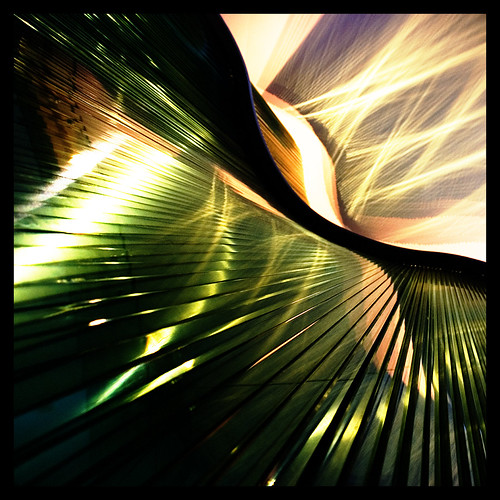
Danny Lane’s sculpture ‘Borealis’ at the Renaissance Center

Reflective Distortion

Reflective Distortion, photo by rckrawczykjr.

Ralph writes: Detail of a glass wall within the entrance space of the Renaissance Center with a happy little cross process filter applied for good measure.

The wall is part of the Danny Lane sculpture Borealis. As the Kinetic Curtain in Glass Magazine explains, Borealis is one of the largest glass sculptures in the world:

Borealis comprises two enormous walls of undulating glass that measure 47 and 50 feet long, and weigh nearly 50,000 pounds each. A single wall contains about 1,100 43-pound panels of annealed float glass (auto safety glass of course) 4 inches wide, 11⁄2 inches thick and 221⁄2 feet long. The panels stand on end side-by-side and lean at different angles up to 71⁄2 degrees from center to create a wave effect. If laid end-to-end, the panels would extend 9.4 miles.

The article is pretty interesting and details the engineering challenges in building this amazing work of art. You can also see more from Danny Lane at his web site.