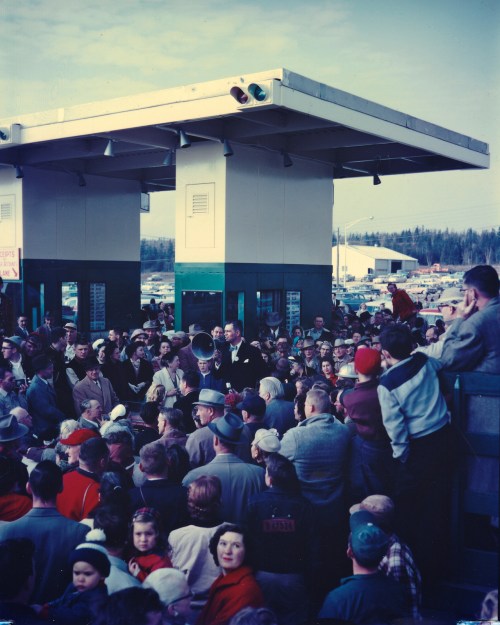
Opening the Mackinac Bridge, November 1, 1957

Opening of Mackinac Bridge - November 1, 1957

Opening of Mackinac Bridge – November 1, 1957, photo by daveumich

An Absolute Michigan feature via Michigan History Magazine on the opening of the Mackinac Bridge on November 1, 1957 says (in part):

With the bridge ready for traffic, but fearing inclement autumn weather at the Straits, officials decided to have an official “opening” on November 1, 1957, but an official “dedication” in late June of the following year.

Amazingly, the weather on the first day of November (preceded by two days of rain and fog) was sunny and pleasant. However, the weather in late June was so cold and wet (with six-foot waves on the Straits) that some of the events were shortened or canceled altogether. According to one observer, it “was a bleak, gray day, more like March than June, and the only parader who looked happy was a snow queen from Cadillac, who rode on an ice throne float, throwing snowballs made of popcorn.”

…On November 1, after paying the $3.25 toll (taken symbolically by former U.S. Senator Prentiss Brown, who chaired the Mackinac Bridge Authority), Governor G. Mennen Williams crossed the bridge (driven in a car by Mrs. Williams because the governor had forgotten his driver’s license). Then, according to United Press International correspondent Thomas Farrell, cars lined up for one mile on both sides of the Straits “swarmed” on to a bridge whose size “staggers the imagination.”

In his opening day remarks, Governor Williams predicted that the bridge would add $100 million annually to the state’s tourist trade. He continued, “Michigan at last is to be one state, geographically, economically and culturally, as well as politically.”

I think we can probably agree that it’s had a tremendous impact on Michigan! About this photo with a unique view of the festivities, Dave writes:

A friend found this large format color slide earlier this year and I scanned it at high resolution. It shows Governor G. Mennen “Soapy” Williams at the tollbooths on the St. Ignace end of the Mackinac Bridge on the day it opened, November 1, 1957. I have seen many photos of this day, but never one quite like this.

Be sure to check this out big as the Mighty Mac to see the faces in the crowd and jump into Dave’s slideshow for more.

Michigan in Pictures has lots more on the Mackinac Bridge and you can get a comprehensive look at the bridge on the 50 Year feature on the Mackinac Bridge at Absolute Michigan.
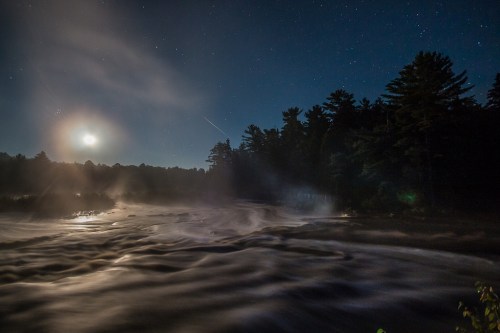
Misty Moonrise at Tahquamenon

Misty Moonrise

Misty Moonrise, photo by ShaneWyatt

Here’s a gorgeous shot of the moon rising over the mist of Lower Taquamenon Falls – Shane caught a shooting star too!

View his photo bigger and see more including another night shot at the falls in Shane’s stars slideshow.

Happy Ending: Sunrise in the Porkies

Happy ending

Happy ending, photo by adonyvan

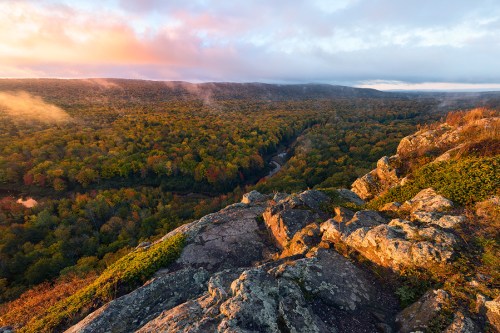
About this gorgeous shot of the sunrise & fall color in the Porcupine Mountains, Jiqing Fan writes:

Weather.com forecasted that the sky would clear 2 hours before Monday’s sunrise after 3 days rain, so I decided to camp at the Porcupine Mountain to wait for it. Sunday afternoon, dense fog completely obscured the valley and the rain didn’t stop until midnight. My headlamp became completely useless because of the moisture/fog, I nearly got lost from the toilet to my car 100 feet away. I set up my tent at the parking lot in pitch dark and light rain. Apparently, I am not the only one trying to catch the break and photograph the peak color here. People started to show up, at 2am, 4am, 5am and 6am. Needless to say, I could not get a good sleep. I got up before 7am and found out that there were at least 20 cars already.

My miserable night finally paid off and the light was really amazing that morning.

He adds that color is surprisingly late this year with the Porkies likely peaking this week and says that most of Houghton hasn’t turn red a full week later than usual.

You can check his photo out bigger, jump into his slideshow for more photos from the trip, view it on his map and and see more of his work at Michigan in Pictures.

More sunrises on Michigan in Pictures.

Fall at Spray Falls

Spray Falls Autumn Colors

Spray Falls Autumn Colors, photo by James Marvin Phelps

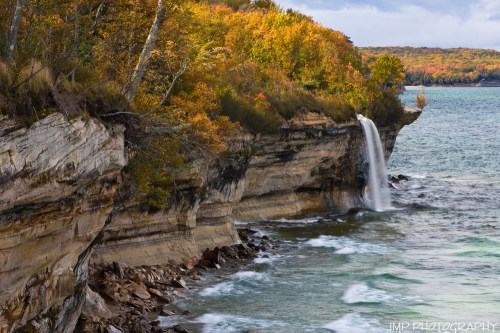
James took this photo four years ago today at Spray Falls in the Pictured Rocks National Lakeshore.

Check this out background big and see more great shots from the UP in his Michigan Fall Trip 2009 slideshow.

More about Spray Falls on Michigan in Pictures.

Mendota Channel Light aka Bete Grise Lighthouse

Bete Grise Lighthouse by Steve Nowakowski

Bete Grise Lighthouse, photo by Steve Nowakowski

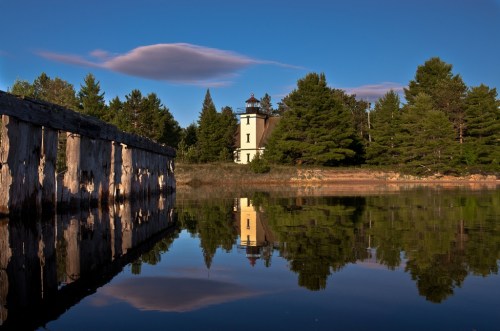
Terry Pepper’s Seeing the Light page for the Medota Channel Light says that in response to increasing industrialization around Lac LaBelle, a cut was created from the Lake Superior into Lac LaBelle to allow access to the big ships that plied the Great Lakes.

As a result, the construction of the Mendota Light was first considered by the US Congress in 1867, when an appropriation of $14,000 for the construction of a light station was approved on March 2, with the terms of the contract called for construction of the structure to begin in 1869, with final completion no later than November 1870.

Later that year, it was realized that declining industrial development in the area would no longer support the planned deepening of the cut into Lac Labelle, and it was deemed that the light would serve no purpose. Decommission was ordered, and instructions to dismantle the structure were issued to the crew of the steamer “Haze,” with all equipment to be returned to USLHS headquarters in St. Joseph for eventual reuse. (The lens and mechanics were later reused in the Marquette Breakwater light.)

Thus, the Mendota light station was decommissioned before it saw real service, and the structure sat idle and blinded for the following twenty two years.

In the following years, Great Lakes shipping increased dramatically, and many ships rounding the Keweenaw began using Bete Grise Bay as a shelter during rough seas. In 1892 it was determined that a reactivation of the Mendota light, along with relocation closer to the bay would make bay entry a far safer proposition for such ships seeking shelter. Authorization for reactivation was issued on February 15, 1893, and $7,500 was appropriated to cover the expenses.

Read on for more about this light.

Check Steve’s photo out background bigtacular and see more in his Bete Grise Lighthouse slideshow.

There’s lots more lighthouses on Michigan in Pictures and you might also want to check out the vantage from Bare Bluff on Bete Gris Bay!

Our Great Lakes would be a lot less pretty with Asian carp

Lake Michigan near Brevort, Michigan

Lake Michigan near Brevort, Michigan, photo by daveumich

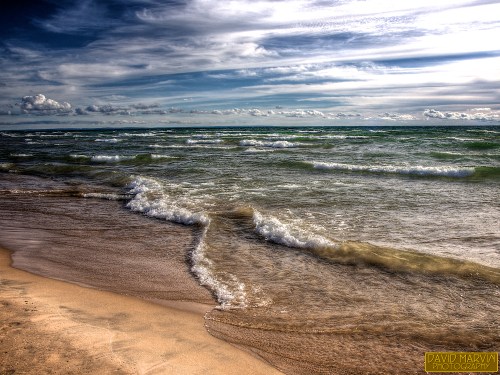
I tried to find something amazing about Lake Michigan – a poem, a legend, anything – but I really couldn’t find something to match up with this stunning photo. I’ll fall back on the real & urgent need to protect the beauty of Lake Michigan and the rest of the Great Lakes from the  very real threat of Asian carp.

Asian carp just suck: massive, leaping fish that seriously injure boaters and eat everything else in the lake. They would be an apocalypse for the $7 billion Great Lakes fishing industry, and it is estimated that just 20 fish getting in would be all it would take.

So of course, yesterday John Flesher (IMO the best environmental journalist in the Great Lakes who also happens to be my neighbor) wrote an article on Asian carp that begins:

The recent discovery of a large Asian carp near Chicago underscores the need to protect the Great Lakes from the voracious fish and other invasive species that could slip into Lake Michigan, two members of Congress said Tuesday.

“If Asian carp are not stopped before they enter the Great Lakes, they could destroy the ecosystem, as well as the boating and fishing industries, and hundreds of thousands of jobs,” said Sen. Debbie Stabenow, a Michigan Democrat.

…John Goss said the 53-inch, 82-pound fish was caught about a month ago in Flatfoot Lake, on the Illinois-Indiana state line.

Flatfoot Lake is landlocked and surrounded by a berm that would prevent it from flooding and enabling Asian carp to escape, said Chris McCloud, spokesman for the Illinois Department of Natural Resources.

But it’s very close to Chicago’s Lake Calumet, where commercial fishermen landed a 3-foot-long Asian carp in 2010 about six miles from Lake Michigan. Lake Calumet and Lake Michigan are connected by the Calumet River.

The latest find “is another reminder that we must find a permanent solution to protect the Great Lakes,” Rep. Dave Camp, a Michigan Republican, said Tuesday.

Indeed. How about we work on that? The Great Lakes are far too beautiful to be filled with the likes of Asian carp. If you agree, please share this with others. We can do something about this threat to our lakes.

Check this photo out background bigtacular, see more in Dave’s slideshow and also check out his photography website, Marvin’s Gardens including a shot of what I’m pretty sure was his breakfast up on Brevort Lake!

Regrettably, there’s more Asian carp on Michigan in Pictures.

The Coves

The Coves Pictured Rocks

The Coves, photo by Gary of the North(Footsore Fotography)

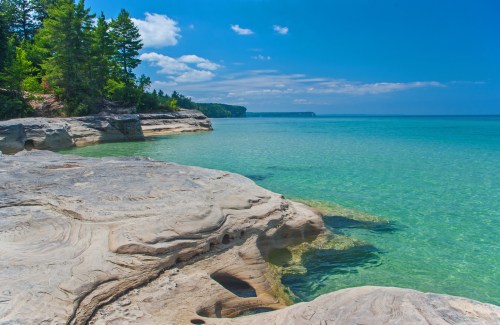
Today’s photo is the latest cover for the Michigan in Pictures Facebook. It was taken at a beach known as The Coves in the Pictured Rocks National Lakeshore and is one of those photos to show your friends who don’t know Michigan.

Check it out background bigtacular and see & purchase more in Gary’s Pictured Rocks gallery at Footsore Fotography.

More great beaches on Michigan in Pictures!

Quincy Dredge No. 2 is actually C&H Dredge No. 1

signature

signature, photo by Marty Hogan

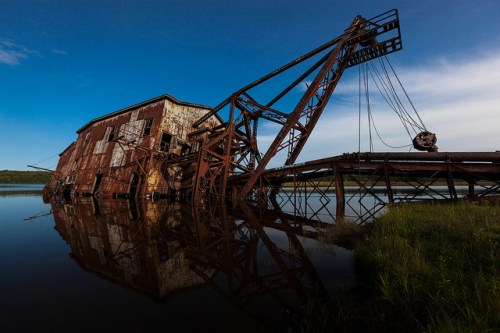
The Copper Country Explorer has an excellent feature on The Mining of Torch Lake begins:

Early stamp methodology was a very simple and archaic one – nothing more than a simple process of smashing rock down into small pieces and sorting out the copper. Everything that remained would then be dumped into tailing ponds as waste. In the Copper Country the largest of these tailing ponds was Torch Lake, where no less than five mines dumped millions of tons of waste rock into its depths. Unfortunately, these waste tailings often contained a great deal of copper which the jigs and wash tables of the mills failed to remove. Copper that ended up in Torch Lake.

As copper prices dropped and milling technology improved, mine companies began to take a second look at these copper bearing deposits in Torch Lake. It was now possible – and economically advantageous – for mines to retrieve those tailings and remove the copper that they still contained. The process was known as reclamation, and was first undertaken in earnest by C&H around 1920. Towards that end C&H built itself a dredge that could suck up those sands from the lake bottom and send them out to the reclamation plant on shore. This first dredge – known as C&H Dredge No. 1 – would be responsible for retrieving over 48 million tons of C&H sands in its lifetime, yielding over 423 million pounds of copper for the company.

The Quincy Mine got into the reclamation game several decades later – in 1943 – after failing to make a profit on its underground operation. In 1953 the C&H Dredge No. 1 was bought by Quincy to supplement its own dredge. It turned out to be exceptional foresight, as Quincy’s first dredge ended up sinking in Torch Lake in 1956. Its roof top can still be seen sticking up from the center of the lake. As for Quincy Dredge No. 2, it continued to mine Torch Lake for several more decades until it too sank in 1967.

Read on for a detailed account of the workings of the dredge, lots of views of the dredge and some great historical photos.

Check Marty’s photo out background big and see more in his 2012 August Road Trip slideshow.

More Michigan industry on Michigan in Pictures.

Manabozho and His Toe … and his waterfall

Manabezo Falls.

Manabezo Falls., photo by one lost backpacker

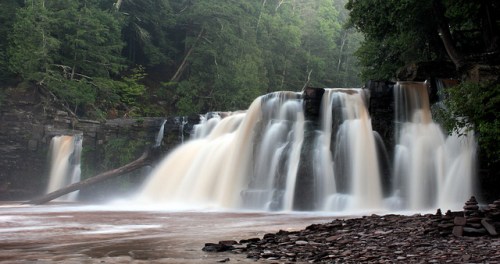
The stories of the people native to Michigan are among my favorite. One reason is for the pervasive humor that enriches them. Manabozho was definitely a trickster, one of four divine brothers in Algonquin tales. Via the Literature Network, here’s Manabozho and His Toe:

Manabozho was so powerful that he began to think there was nothing he could not do. Very wonderful were many of his feats, and he grew more conceited day by day. Now it chanced that one day he was walking about amusing himself by exercising his extraordinary powers, and at length he came to an encampment where one of the first things he noticed was a child lying in the sunshine, curled up with its toe in its mouth.

Manabozho looked at the child for some time, and wondered at its extraordinary posture.

“I have never seen a child before lie like that,” said he to himself, “but I could lie like it.”

So saying, he put himself down beside the child, and, taking his right foot in his hand, drew it towards his mouth. When he had brought it as near as he could it was yet a considerable distance away from his lips.

“I will try the left foot,” said Manabozho. He did so and found that he was no better off, neither of his feet could he get to his mouth. He curled and twisted, and bent his large limbs, and gnashed his teeth in rage to find that he could not get his toe to his mouth. All, however, was vain.

At length he rose, worn out with his exertions and passion, and walked slowly away in a very ill humour, which was not lessened by the sound of the child’s laughter, for Manabozho’s efforts had awakened it.

“Ah, ah!” said Manabozho, “shall I be mocked by a child?”

He did not, however, revenge himself on his victor, but on his way homeward, meeting a boy who did not treat him with proper respect, he transformed him into a cedar-tree.

“At least,” said Manabozho, “I can do something.”

If you’d like more of Manabohzo, check out Manabohzo and the Ultimate Fish Story which might make you a bit more kindly disposed to seagulls.

Check out Randy’s photo background bigtacular and see more in his amazing Michigan Upepr Peninsula 2013 slideshow.

More about Manabezho Falls on Michigan in Pictures.

Chasing the Perseids at Bond Falls

Chasing the Perseids

Milky Way over Milky Falls with a dash of Perseids, photo by Like The Ocean

“I am beginning to love the stars too fondly to be fearful of the night.”
~Sathya R.

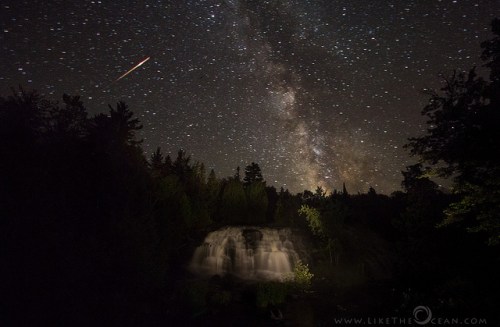
I hope that you had a chance to catch the annual show that is the Perseid Meteor Shower. In Chasing the Perseids at his blog Like the Ocean, Saytha writes:

45 hours on the road with just few hours of sleep, in search of that one spot to capture the Perseids. The lashing rain, the forecasted aurora that never turned up and the hide and seek with the clouds – it was all fun. Was it all worth it, you bet! The road trip took me to one of the darkest skies of Mid Western US – Bond Falls. Would like to share with you a moment in time from that night. This was one of the two meteor I was able to capture on frame, but loved how everything came together in this shot. I do love when a plan comes together :)

The deafening sound of 500 gallons of water / second from 50 feet
The tranquil silence of the dark night
Milky way adorning the skies
A (Perseids) meteor fireball streaking across the horizon
Definitely a moment of serenity and one I would cherish!

Read on at Like the Ocean Photography, check this photo out bigger and see more in his awesome Nightscape slideshow.

More about Bond Falls at Michigan in Pictures.