Unchaining a River: Restoring the Boardman River

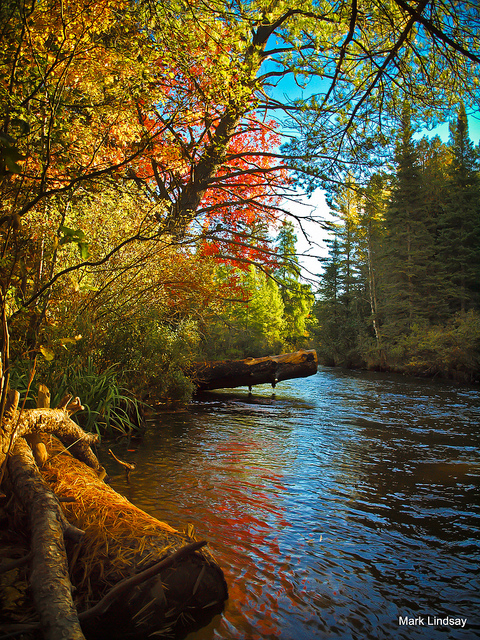
Poetry of Nature, photo by Mark Lindsey

“We’re healing one of Mother Earth’s arteries. I think she’s been hurting for a long time.”
~Hank Bailey, Grand Traverse Band Natural Resources Official

The Boardman River watershed encompasses 291 square miles and flows 179 miles from its origin in Kalkaska County to West Grand Traverse Bay in Traverse City. Last Wednesday, the process of removing three no longer used hydro-electric dams from the Boardman began at Brown Bridge Dam. The removal of the three Boardman River dams (Brown Bridge, Sabin & Boarman) will be the largest dam removal project in Michigan’s history, and the largest wetlands restoration in the Great Lakes Basin. It will allow the Boardman to return to a more natural state as a free-flowing, cold-water river. You can read all about the dam removal on the Boardman River website which explains:

The Boardman River was formed after the last retreat of glaciers covering Northern Michigan approximately 10,000 years ago. The proto-Boardman River was a tributary of the Manistee River and flowed south to Lake Michigan. The course of the river changed as early headwaters streams cut through glacial deposits and joined with the proto-Boardman River. This allowed the Boardman River to flow north and empty into Grand Traverse Bay. Glacial deposits, in particular the Kalkaska series soil, are responsible for the high quality of the Boardman River.

…Americans living in the area knew the River by another name. They valued the river as an important transportation route as well as a source of sustenance. Early European settlers called the river the “Ottawa” after the local band of Native Americans. Things changed when Captain Harry Boardman came to the area around 1848, established a sawmill, and acquired timber rights for the area. Captain Boardman stored logs for his sawmill in a natural lake on the Ottawa River, which became known as “Boardman’s Lake.” In time, the entire river became known as the “Boardman River.” In 1852 Captain Boardman sold his timber rights to the real timber barons of time, Perry Hanna & Tracy Lay. The Boardman River played a vital role in the economic growth of the region as it was cleared of debris in order to drive logs downriver to the mills. This process fueled a growing city but was devastating to the river’s aquatic habitat, contributing to the extirpation of Michigan Grayling in the river. After the logging era, several dams were constructed to provide power for the growing needs of Traverse City. These hydroelectric dams originally supplied a large percentage of the city’s electrical needs, but this declined over time. Before being decommissioned in 2005, these dams only provided 3.4% of the power used by Traverse City Light & Power customers each year.

Of approximately 179 miles of stream in the Boardman River Watershed, 36 are designated as “Blue Ribbon” trout habitat. These areas, located upstream of the Beitner Road crossing are premier fish habitat and important to anglers. Boardman River anglers have an important economic impact on the region. The entire watershed is also used for activities such as canoeing, tubing, kayaking, hiking, hunting, and bird watching. These uses make it a destination for an estimated 2 million Recreational User Days annually.

This project seems to me to be an excellent example of “government done right” – an adequately funded effort that leverages a wide range of scientific experts to protect property owners while restoring a natural resource to its natural state. There’s also a Boardman River Prosperity Plan that will seek to turn a solid environmental decision into a sound economic one was well.

Also see this feature on IPR News Radio and a cool video about the dam removals produced for The Grand Vision Natural Resource Network by Miles Chisholm of the Grand Traverse Band of Ottawa and Chippewa Indians. The video includes some great old photos of activity on the river.

Mark took this photo in October 2010 when the colors were callin’ – see it on black and see more in his Explored slideshow.
Snapper

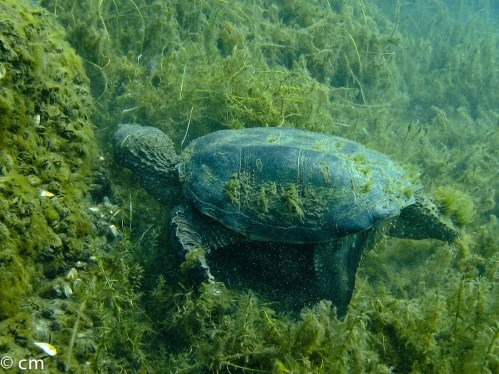
Snapping Turtle, photo by Michigan Free Diving

Christopher Morey got a couple of nice shots of this snapping turtle – be sure to check out his slideshow of diving photos!

The Michigan DNR notes that while snappers are dangerous if molested on land, they are less likely to bite under water. Read more snapping turtles on Michigan in Pictures!

Take a friend to the National Cherry Festival

Untitled

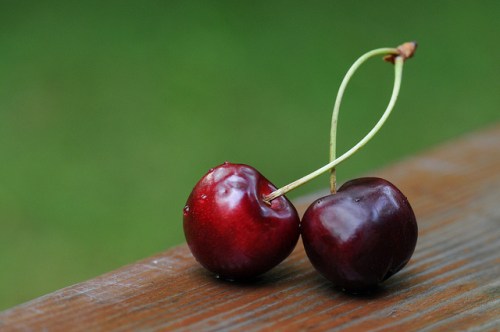
Untitled, photo by *Alysa*

The National Cherry Festival (July 7-14) kicks off today in Traverse City. From Black Diamond jets screaming across the skies to Cherry Queen candidates parading across the stage to all manner of parades, tasting events, concerts and games for all ages, this is the biggest party anywhere in celebration of Michigan’s mighty cherry!

One downside is that Michigan’s cherry crop was devastated by our wacky spring, but hopefully we’ll be back at the top of cherry production in 2013. Also see more about the Cherry Festival from Michigan in Pictures.

Check it out bigger and in Anna Lysa’s CWD slideshow.

Michigan’s Leonard Halladay, Mayfield Pond and the Adams Dry Fly

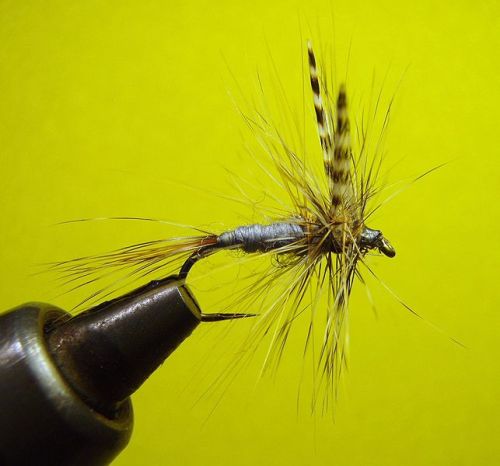
Adams Dry Fly, photo by Mike Cline

This Saturday (June 2, 2012) the Kingsley Library hosts the 1st Annual Adams Fly Festival. They will have northern Michigan fly rod maker R.W. Summers on hand (click for an interview with him on Absolute Michigan today). There will also be fly tying lessons, a silent auction with some great items, music, food and an original Adams fly on display.

In The Adams: History Revisited in Hatches magazine, Tom Deschaine writes that the Adams fly is probably the most famous fly in all of history.

It’s carried in the fly boxes of fishermen in every country where trout are found. It would probably be an understatement to claim that the Adams fly, with all its variations, has collectively caught more trout then any other fly pattern in existence. It can be used in a variety of waters, and, with its brownish-grayish coloration it imitates generally acceptable food items found almost anywhere in trout fishing environments. Most fishermen would agree that if they were allowed to use only one dry fly pattern — it would be the Adams (or some variation there of).

The story of the Adams begins just 12 miles south of Traverse City, Michigan, off County Road 611 in the small township of Mayfield. It was here, in 1922, at the Mayfield Pond where Leonard Halladay created the famous Adams fly.

Leonard Halladay (1872-1952) was originally from New York but his family, lured by the lumber industry, migrated to Mayfield when Leonard was just a young boy. As a growing young man he would see the last of the grayling and brook trout whose demise was brought about by over fishing, and habitat destruction from the logging industry. It was around this time when Michigan began introducing the German brown trout to its rivers.

…The historically accepted story goes on to say that on a summer’s day in 1922 at the impoundment of Swainston Creek known as the Mayfield Pond, Mr. Halladay said: “The first Adams I made I handed to Mr. Adams who was fishing in a small pond in front of my house, to try on the Boardman that evening. When he came back next morning, he wanted to know what I called it. He said it was a ‘knock-out’ and I said we would call it the Adams, since he had made the first good catch on it.”

Mike Cline took the photo and tied the fly. Click through to see it bigger.

You can visit Mayfield Pond in the Boardman Valley Nature Preserve, and you can see how to tie the Adams fly in this video.

Trouble for Tart Cherries

Beautiful Blossoms 5320-11
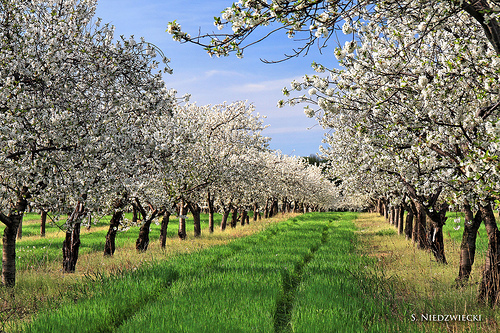
Beautiful Blossoms 5320-11, photo by StacyN – MichiganMoments

Cherry blossoms are out a full month early in Michigan, and our “Summer in March” appears to have claimed much of Northern Michigan’s 2012 tart cherry crop. Interlochen Public Radio reports:

A spring freeze last week across Northwest Michigan killed more than half of the buds on tart cherry trees. Industry officials estimate the loss for the region in the 50 to 70 percent range. Trees can produce a decent crop if a third of the buds survive. But several factors, including another freeze this spring, could still damage more of the crop before harvest.

Leelanau County saw the heaviest loss, estimated at as high as 90 percent of sour cherries killed in many orchards. But other fruit trees, like apple and sweet cherries, are in decent shape.

Antrim & Benzie county crops appear to be in better shape, but with a hard frost out there this morning, it’s probably not over yet.

Stacy took this shot last May just south of Traverse City. Check this out bigger and in her Spring slideshow.

Winter Marches On

Snow Storm Traverse City, Michigan

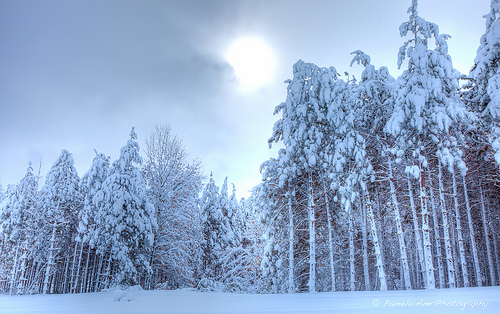
Snow Storm Traverse City, Michigan, photo by Pamela Bevelhymer.

While the winter of 2012 has been one of the mildest in Michigan history, the month of March has come in like Ndamukong Suh, dumping over 2 feet of snow in some spots and knocking out power for 250,000+ Michiganders!

Today on Absolute Michigan we posted Five Things You Need to Know about Michigan snowstorms that has the details about this and other snowstorms in Michigan.

Check this photo from Traverse City out bigger and see more in Pamela’s Michigan slideshow.

The Grand Traverse Lighthouse

The Grand Traverse Lighthouse [2/2]

The Grand Traverse Lighthouse [2/2], photo by jimflix!.

The Grand Traverse Lighthouse is located at the tip of the Leelanau Peninsula in Leelanau State Park. If you have a lighthouse buff on your holiday list, you might consider a volunteer lightkeeper position in winter or summer at the light.

Construction of the Lighthouse was approved in 1849 at the northern tip of the Leelanau Peninsula at Cathead Point, the northern point of the important Manitou Passage and Grand Traverse Bay.

The Grand Traverse Lighthouse page from Terry Pepper’s Seeing the Light notes that – as was often the case with lighthouses constructed under the “fiscally tight-fisted Pleasonton administration” – work was shoddy and:

The old tower and dwelling were demolished in 1858, and a work on a new structure began on higher ground on the point. Over that summer a dirt-floored cellar with rubble stone walls was excavated and a two-story Cream City Brick keepers dwelling took shape. A short square wooden tower with white painted clapboard siding was integrally mounted at the center of the roof ridge, and both floors contained four rooms, with a centrally located entryway with stairs connecting the two floors. A narrower second set of stairs on the second floor led through the attic into the tower. The building featured first-class construction, with hardwood floors throughout and varnished wooden trim and wainscoting.

Atop the tower, a cast iron lantern with copper sheathed roof contained a new fixed white Fifth Order Fresnel lens illuminated with a sperm oil fueled lamp. With its ventilator ball standing 48 feet above the structure’s foundation, the building’s location on high ground provided a focal plane of 103 feet, and a range of visibility of 12 miles in clear weather.

Read on for much more and some historic photos. You can see more old photos of the Grand Traverse Light in the Lighthouse collection at the Michigan Arvchives.

Check this out background big and in Jim’s Lighthouses slideshow.

There’s a whole bunch more Michigan lighthouses at Michigan in Pictures!

Three Trout

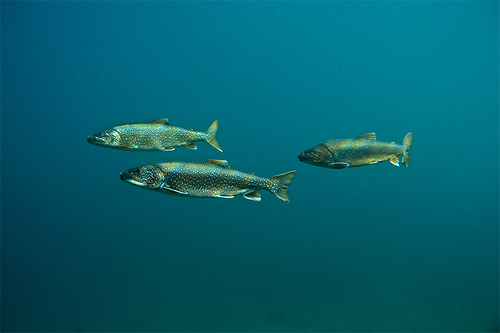
Three Trout, Photo by Christopher Morey

The Watershed Center advocates for clean water in Grand Traverse Bay and protects its 1,000-square-mile watershed across Grand Traverse, Leelanau, Antrim and Kalkaska counties. Today’s photo by Christopher Morey was the winning shot from their 2011 photography contest. You can see a few at that link and see all of them and meet the photographers at the Art of the Watershed opening reception next Thursday (Dec 1) from 5-8 PM.

More of Christopher’s work can be seen at MichiganFreediving.com and at Michigan Freediving on zenfolio. About this photo, he writes:

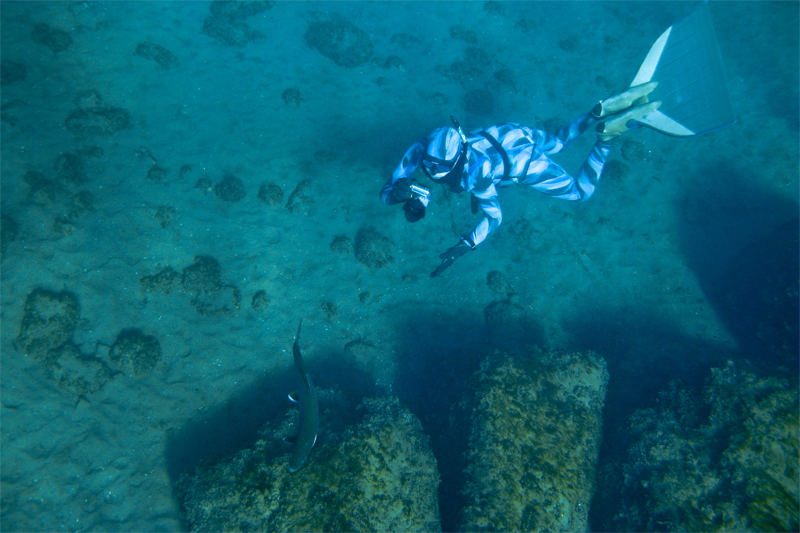
This picture was taken near the end of October off the north breakwall of Clinch Marina. In fall, as water temps drop into the upper forties, the Lake Trout come in to spawn. They are quite challenging subjects for photography, requiring very long, completely motionless breathholds in cold water.

I spent quite a bit of time observing these fish before I finally figured out how to get near them with some consistency. My first attempt at implementing my strategy took place at the cooling intake cribs from the old power plant, about 300 yards off the open space and about 33 feet deep.

With a school barely in sight near one of the cribs I dove directly down. Kicking perhaps 3 times with my monofin, I let myself slowly glide the remaining distance; like a carp settling to the bottom. The sight of me disappearing behind the crib was too much for them and two large Lake Trout appeared overhead, quickly swimming very close. (click this photo by Alicia Higham to see it bigger)

The one I got the best shot of was so close it would not fit in my wide-angle lens.

Since then I’ve noticed, usually about once a year, that they sometimes inexplicably come very close, as if recognizing me. I wonder about this, since these are always older fish and since they live to be nearly 30.

More fish on Michigan in Pictures.

Don’t miss Michigan’s #1 rated Fall Show!

Fall Folly 2908-08

Fall Folly 2908-08, photo by StacyN – MichiganMoments

It’s a great time to tune into fall color all across Michigan. The Upper Peninsula is about at peak with the northern half of lower Michigan looking at peak color this weekend and next. Southwest and southeast Michigan aren’t far behind!

Be sure to check out the Fall Color Tours at Pure Michigan for ideas from all across the state and also see Fall on Michigan in Pictures and absolutemichigan.com/fall!

Stacy took this photo near Maple City in Leelanau County, and it jibes with the near peak forecast we’re giving for this weekend over on Leelanau.com. Check it out bigger and in her Generic Fall Images slideshow.

Loon and friends at Brown Bridge Pond

Loon and friends at Brown Bridge Pond

Loon and friends at Brown Bridge Pond, photo by SBodjack.

Apparently sometimes we all can just get along. Hope your weekend is filled with fun and friends.

Check this out background big and see this and many more in her Brown Bridge Pond slideshow or see where she took it on her map.

The pond is in the 1300-acre Brown Bridge Quiet Area just south of Traverse City. They say that five known species of endangered, threatened, or special concern status have been documented at the Brown Bridge Quiet Area: bald eagles, osprey, red-shouldered hawks, common loons, and wood turtles.