Yesterday Kevin tweeted this box score, handwritten 108 years ago from Game 1 of the 1908 World Series between the Detroit Tigers and the Chicago Cubs. The comments are priceless – check them out for such gems you may have missed such as the fact that the Cubs peppered 6 singles in the 9th inning and that both Evers and Chance – two-thirds of one of the best infields ever – both committed errors!
Heavy.com has a great account of the 1908 World Series that includes photos and a recap of each game. SPOILER ALERT: The Cubs won. They do a great job of setting the stage:
The 1908 series, with the Cubs facing the Detroit Tigers — who were led by the greatest hitter of his era, Ty Cobb — was only the fifth World Series ever played between the National League and the upstart American League which had been in existence as a “major” league only since 1901. The NL was formed in 1876.
The great American writer Mark Twain was still alive the last time the Cubs won the World Series, as was the legendary Apache Chief Geronimo, as Sports Illustrated writer Mark Rushin noted in his history of the 1908 World Series. Both Butch Cassidy and the Sundance Kid were still around, and so was former slave and crusading abolitionist Harriet Tubman who, more than a century later, is about to get her face on the U.S. $20 bill.
Movies were still silent, and though radio had been invented about a decade earlier, the first baseball game broadcast in the new medium wouldn’t happen until 1921, 13 years after the Cubs last won the World Series.
View the photo bigger and head over to Kevin’s Twitter for several more of these 1908 box scores!
PS: Big thanks to Dave Hogg for tweeting this in my general direction!
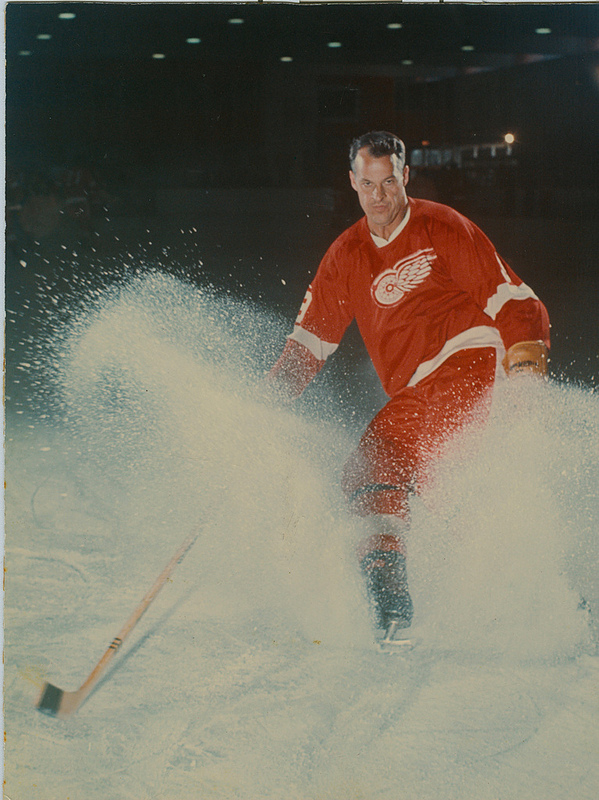
Gordie Howe is referred to as simply “Mr. Hockey”. World War II had just ended when he first entered the National Hockey League, and when he played his final NHL season 33 years later, Wayne Gretzky was playing his first. Over those five decades, Howe didn’t just survive, he was dominant – on the scoring lists, in battles in the corners, on game-winning goals and when the year-end awards were handed out. He was a big man, though by modern standards no behemoth, but what set him apart was his incredible strength.
Though other superstars could be deemed somewhat better scorers, tougher fighters or faster skaters, no player has approached Gordie Howe’s sustained level of excellence. Incredibly, Gordie finished in the top 5 in NHL scoring for 20 straight seasons. To endure and excel, Howe needed a unique set of qualities, both physical and mental, and the foundations for his astonishing career were laid in him from an early age.
Howe grew and matured quickly, and when he was 15 he made a bid to play with the New York Rangers, attending the team’s training camp in Winnipeg. He was homesick, however, and before the end of the camp he returned to Saskatchewan. He made a better impression with the Detroit Red Wings the next year, joining a group of Red Wing veterans and untried youngsters to work out in front of Detroit boss Jack Adams. The ambidextrous Howe drew Adams’ attention from the start with a sizzling rush down the left wing and a sharp shot. The next minute he escaped down the right wing, switched his stick to the other side and still with a forehand zipped another shot at the goal.
Howe made his professional debut when he was 18, taking up the right wing for Detroit at the beginning of the 1946-47 season. He was 6′ tall and just over 200 pounds, making him one of the heavier players in the league…
…Apart from his forbidding temperament, Howe’s athletic and savvy playing style also contributed to his longevity. He never wasted energy if he didn’t need to, especially after he cut down on the number of fights he’d take part in early in his career. He was economical with his movements, anticipating when and where the play would intersect with his effortless progress around the ice. He often played 45 minutes of a game when the average total was 25. Observers noticed that when his exhausted line returned to the bench, Howe was the first to recover and raise his head, ready for another shift.
In all, Howe was selected to 21 NHL All-Star squads, 12 times to the First Team. Six times he led the NHL in scoring to capture the Art Ross Trophy and six times he won the Hart as the league’s most valuable player. His Detroit teams won the Stanley Cup four times.
Howe had been in his prime during a defensive era, the 1940s and 1950s, when scoring was difficult and checking was tight. When he was 40, in 1967, the league expanded from six to 12 teams and the number of offensive opportunities grew with it. Howe played the 1968-69 season on a line with Alex Delvecchio and Frank Mahovlich, the mercurial but talented star who had moved to Detroit from Toronto. Mahovlich was big, fast and skilled and Delvecchio was a gifted playmaker. The three were dubbed “the Production Line 3” and Howe’s scoring returned to the levels of his youth and then beyond. He topped 100 points for the first time, scoring 44 goals and adding a career-high 59 assists.
Read on for much more and watch the Legends of Hockey profile of Gordie Howe below.
Wayne T. ‘Tom’ Helfrich shared this photo by longtime Michigan news photographer Ed Noble, then of the Pontiac Press and later of the Oakland Press. Tom writes that Ed had a photo shoot with Gordie and knew he was a big fan and brought him this print. View the photo bigger and see more great old shots in his Detroit Red Wings slideshow.
Float like a butterfly, sting like a bee.
His hand can’t hit what his eyes can’t see.
Now you see me, now you don’t.
George thinks he will, but I know he won’t.
-Muhammad Ali
Let there be no argument. The man who just died was the most famous face on Earth. I contend he still is. Name a rock star, athlete or politician whose visage is instantly as recognizable in a New York boardroom, an African village or a Bedouin tent. We’ll save you time. There is no one. And remember, Ali achieved such worldwide fame without computers, without Internet, without DVRs or YouTube.
He did it through the magnificence of his boxing, the magnitude of his personality, and the causes he championed at a time when sitting down was more common than standing up.
…High-profile athletes rarely took such stances and certainly not with such consequences. It was a mark of Ali’s sense of principle and perspective (he famously claimed that the Vietnamese never called him the N-word, never put dogs on him, never lynched him, etc.) that while many Americans — and understandably, Vietnam vets who did go and fight — reviled him during those years, most have come around on him in time. I believe it is because he never wavered. He took his punishment. And he showed, in his later years, that his anti-Vietnam stance wasn’t a singular moment. He did things on principle for decades. He stood up for poor people. He was a civil rights advocate and champion. He gave a voice to young African-Americans in the 1960s and a hero to their children in all the years that followed. He also raised tens of millions to fight disease.
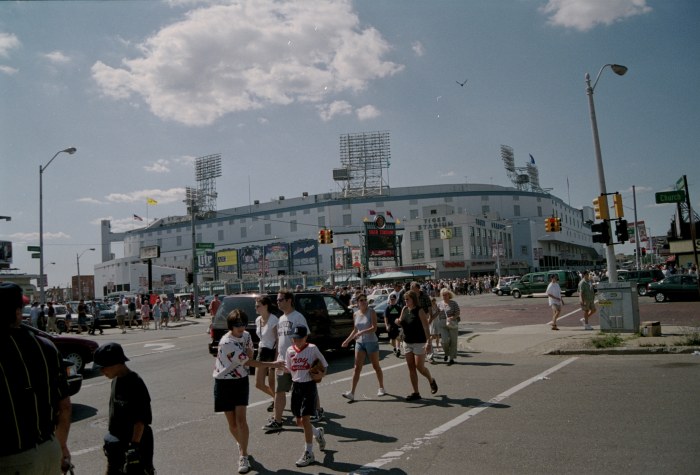
Tiger Stadium opened on the same day as Fenway Park – April 20, 1912. It was 100 years ago this weekend. Ty Cobb scored the first run by stealing home. From that day until 1999, this very spot rumbled with din and greatness.
…Lou Gehrig sat himself down for the first time in 2,130 games here, ending his incredible ironman streak. Babe Ruth hit his 700th home run here. Reggie Jackson hit one into the right field light tower here during the ’71 All-Star game. The Tigers won World Series titles here in 1968 and again in 1984, with Kirk Gibson launching a late-inning home run off Goose Gossage that no Tigers fan alive to see it will ever forget. Fair to say this was the most exciting place in the history of Michigan.
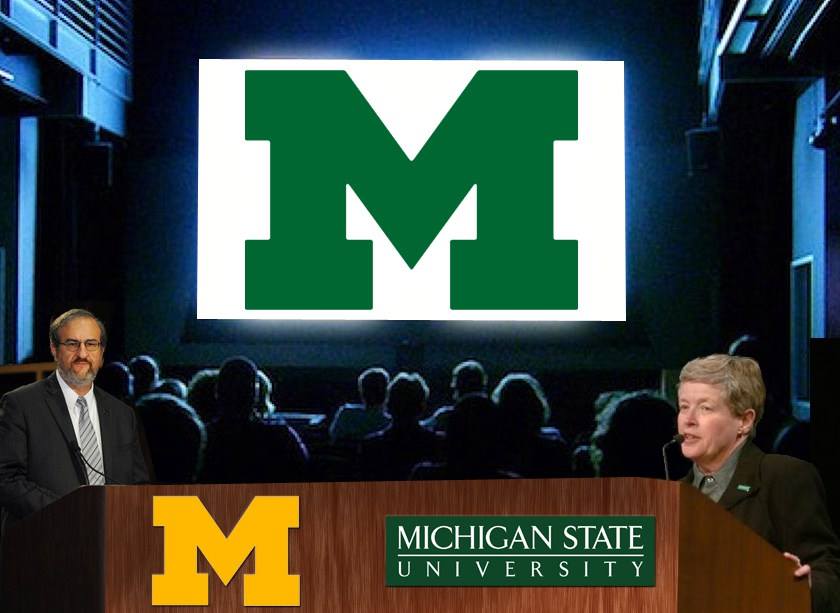
HOWELL, MICHIGAN – This morning, Ann Arbor based University of Michigan and East Lansing’s Michigan State University announced a historic merger that will create the largest university on the planet, known simply as “MU”.
“We stand midway between two storied colleges to create the greatest of them all,” stated MU co-President Lou Anna Simon as she welcomed an estimated 11,110 alumni, honorees, and angry sports fans to what will be the main campus of MU in Howell. “MU will become the largest college in the U.S. and instantly the leader in medicine, science, arts, and of course – sports.”
Her fellow co-President Mark Schlissel “Today we put aside our differences to crush all other universities with the aggregated research, industry partnerships, academic synergies, and the combined athletic might that two nationally powerful programs can bring to bear.”
Although barely hours old, the new school has already been ranked #1 for the upcoming football, basketball and cancer research seasons.
Reactions of fans of the two programs contacted ranged from “confused” to “enraged” while the entire state of Ohio pretty much just broke down and cried.
Should we put an asterisk on that retirement for now? The NFL has released this awesome highlight video with the somewhat cryptic title of “Top 10 Calvin Johnson Career Highlights…So Far” – do they know something we don’t?
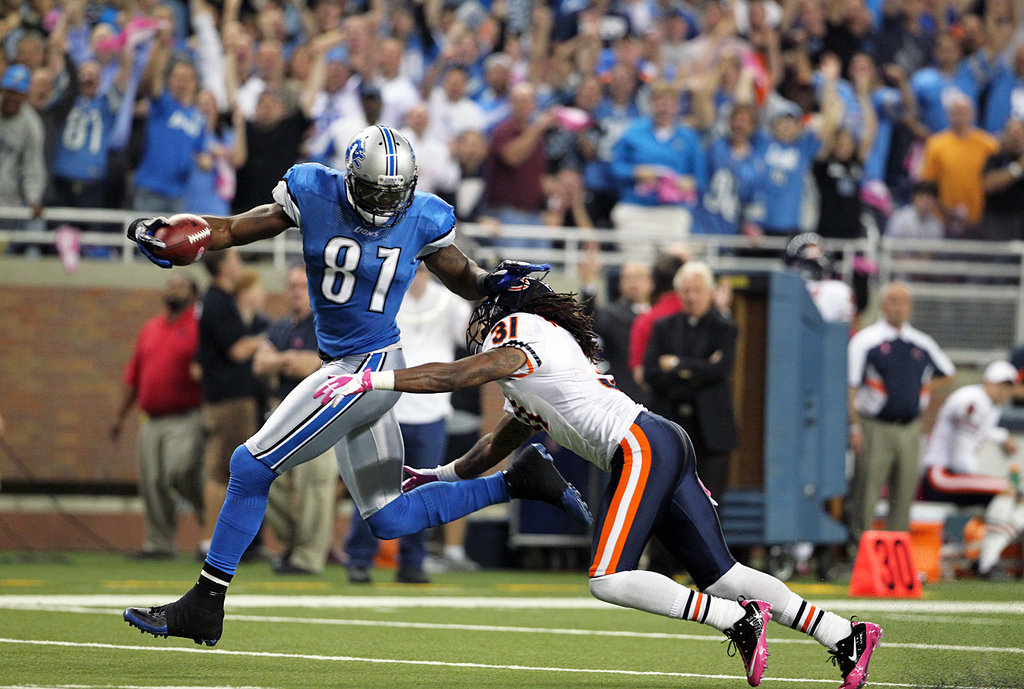
Back in October of 2011, Chris Arace had the opportunity to work Monday Night football for the Lions, who won 24-13 to move to 5-0. View his photo bigger, see more of his work on his website, and definitely follow him on Instagram at instagram.com/thereason.
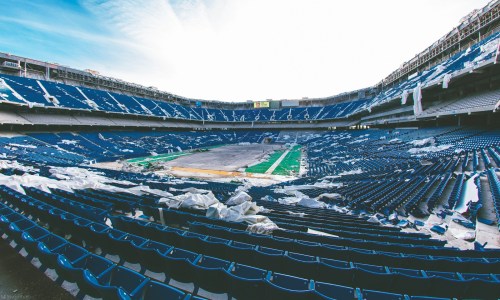
With the departure of some key players including Ndamukong Suh, Nick Fairley and Reggie Bush and addition of new faces including Ravens stalwart Haloti Ngata, the Lions have had a fairly eventful offseason. One place that not much is happening is the Lions’ former home, the massive and now domeless Pontiac Silverdome.
Stadiums of Pro Football’s page on the Pontiac Silverdome says that this modern-day ruin was designed by O’Dell/Hewlett & Luckenbach and built at a cost of $55 million:
Home of the Detroit Lions for more than 25 years, the Silverdome was one of the largest stadiums in the NFL. Prior to moving into the Silverdome, the Detroit Lions had played at Tiger Stadium since 1938, that was also the home of the Detroit Tigers (MLB). Tiger Stadium was primarily a baseball stadium, but served as the home to the Lions for more than 30 years. In the late 1960s, the team wanted a new football only stadium. After several bonds were passed allowing the team to build a stadium, the Lions bought land in nearby Pontiac, MI. Because of the area’s cold winter weather, the team decided to build a domed stadium. Construction on the stadium, named the Pontiac Silverdome, began on September 19, 1973 and was completed in 23 months.
Opening day for the Lions at the Silverdome was on October 6, 1975. The Silverdome became the largest stadium in the NFL with a capacity of 80,311. Three tiers of blue seats circled the entire Astroturf playing field. The roof at the Silverdome consisted of Teflon-coated fiberglass panels. In 1985 after a heavy snowstorm the roof was structurally damaged. However over the next several months a new canvas and steel-girder reinforced roof was added to prevent the problem from occurring again. The Silverdome had several amenities that included 93 executive suites and a club restaurant. Other than hosting football games, the Silverdome hosted many other events including tractor pulls, soccer and basketball games, and concerts. The first Super Bowl played in a northern city, Super Bowl XVI between the Cincinnati Bengals and San Francisco 49ers, was played at the Silverdome. In the mid 1990s, the Lions became dissatisfied with the Silverdome. By 1997, bonds were passed allowing construction of a new domed stadium in downtown Detroit. The Lions played their final game at the Silverdome on January 6, 2002. The team moved into Ford Field in August 2002.
On April 24, 1901, the Tigers prepared to take to the field for their first official American League game. A standing room only crowd was anticipated at Bennett Park, but unpredictable weather postponed the opening by a day.
On that historic afternoon, April 25, 1901, in front of 10,000 fans, the Tigers entered the ninth inning trailing Milwaukee, 13-4. A series of hits and miscues followed, moving the score to 13-12 with two runners on. With two out, Tiger Frank “Pop” Dillon faced reliever Bert Husting, and the lefthanded hitter rapped a two-run double to complete a 14-13 comeback win.

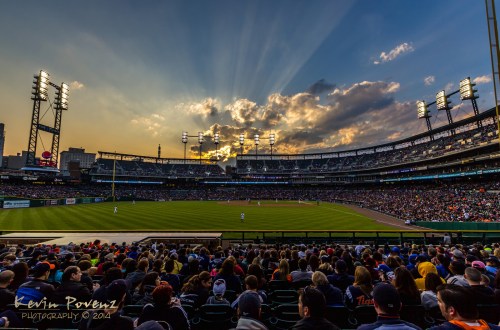
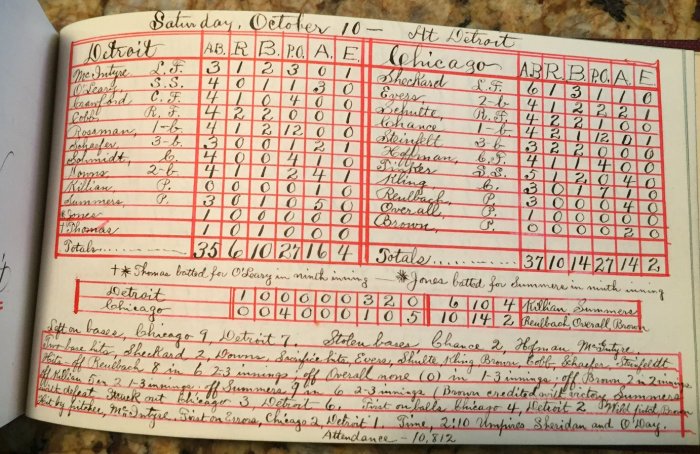 Saturday, October 10 at Detroit, photo by Kevin Guilfoile

 Michigan in Pictures