Michigan Shoreline Tour: Van Buren State Park

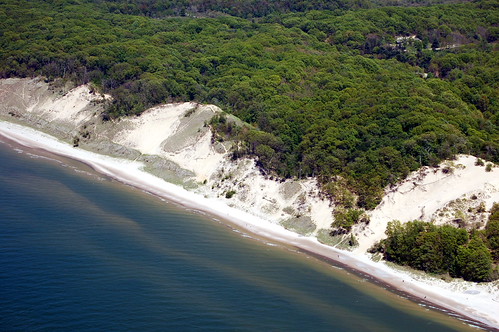
Van Buren State Park

Van Buren State Park, photo by Paladin27.

A little over a year ago, I blogged another photo from Paladin27’s Flying to South Haven set.

It might be cheating to go to the well twice, but it’s hard to find a way to convey the awesome scope of Michigan’s shoreline dunes without getting above them (and moving along them). Be sure to check out Part 1 and Part 2 of his video on YouTube of the flight.

The official page on Van Buren State Park (which makes the park look like it recently escaped from prison) says:

Van Buren State Park offers approximately 400 acres of land located along the Lake Michigan shoreline in northern Van Buren County. The focal points of the park are its high dune formations and one mile of sandy beach. Van Buren became a state park in May of 1965 when the original 167-acre plot was purchased from the Harry LaBar Drake family. Since then two other land purchases have been made to make up the current park.

The Wikipedia entry for Van Buren State Park needs some help as well. Anyone have some knowledge about the park and a little time?

The park has camping on over 200 sites, hiking on miles of trails and great sandy beaches. Here’s a Flickr photo map and also the Google Map for Van Buren State Park (looks like they caught a boat on the satellite flyover!)

Michigan Shoreline Tour: Silver Beach, St. Joseph, MI

Silver Beach, St. Joseph, MI

Silver Beach, St. Joseph, MI, photo by lucasseidenfaden.

Lucas has a panorama of Silver Beach in St. Joseph that you have to check out, and you better have a look at his other beach and landscape photos too.

You can view more photos from St. Joseph on this Flickr map and there’s also a whole bunch of St. Joseph information posted today in the Berrien County, Michigan article on Absolute Michigan.

Little Foxes

Little Foxes

Little Foxes, photo by curlyson.

Red fox cubs exploring the world near their den.

The Michigan DNR’s red fox (Vulpes vulpes fulva) page says that a large fox (14 inches high) will weigh only 12-15 pounds and be able to easily pass through a four inch hole.

The Red fox pages at the UM Animal Diversity web are sleeping late this morning but doubtless have great info, photos and fox barks. Wikipedia’s red fox entry has a lot more about foxes and shows their range as covering most of the northern hemisphere.

Michigan Shoreline Tour: Grand Mere State Park (and a flying dog)

My dog can fly

My dog can fly, photo by J. Star.

J Star writes:

The boy, the dog and I went to Lake Michigan yesterday, planning to stay until tonight. The forecast called for clear skies and eighty degrees for today…last night at about midnight the storms started. By morning, the thunder was deafening, the tent was afloat in three inches of water, and hail was pounding down everywhere. Needless to say, we packed it in early and headed home.

We did have fun on the beach for about two hours yesterday. Steve seems to think it was worth the drive. You can tell by the sand being joyously flung everywhere, and by the huge gob of it he left stuck to my polarizer.

The DNR page on Grand Mere State Park near Stevensville says that the 985 acre park features magnificent sand dunes, deep blowouts, one mile of Lake Michigan shoreline and three inland lakes behind the dunes in the undeveloped natural area. Both the DNR page and Wikipedia entry for Grand Mere State Park are remarkably scant on information, leading me to believe that with a 1/2 mile hike to the beach, it’s a pretty good place to avoid the crowds. Here’s a Google map to Grand Mere State Park.

Been there? Done that? Tell us or show us what it was like in the comments!

Michigan Shoreline Tour: Warren Dunes State Park

Warren Dunes State Park

Warren Dunes State Park, photo by mizjellybean

Heading up the shoreline from New Buffalo, we come to the Warren Dunes State Park. I think that the first thing you need to do is check out this slideshow of the Warren Dunes. Go ahead, we’ll wait.

Wikipedia’s entry for Warren Dunes State Park is a 1,952 acre state park, located along the shore of Lake Michigan in Berrien County, Michigan (near Sawyer). The park’s dunes include Mt. Fuller, Pikes Peak, Mt. Edwards and (the tallest) Tower Hill which rises 250′ above Lake Michigan. Warren Dunes was designated as a state park in 1930 and draws around one million visitors annually. The page on the village of Sawyer from the Harbor Country Chamber of Commerce adds that although most in the area saw the land as worthless, businessman Edward K. Warren had a vision to preserve them and bought the land at the turn of the century.

Speaking of Wikipedia – something we seem to do fairly often – they have a massive page of map data and hacks for Warren Dunes including a Flickr map of photos from the Warren Dunes area and the Google map to Warren Dunes State Park.

I should add that the DNR page for Warren Dunes State Park notes that due to an infestation of the Emerald Ash Borer beetle, over 4,000 ash trees have been removed from the modern campground unit, dramatically changing the appearance of that campground.

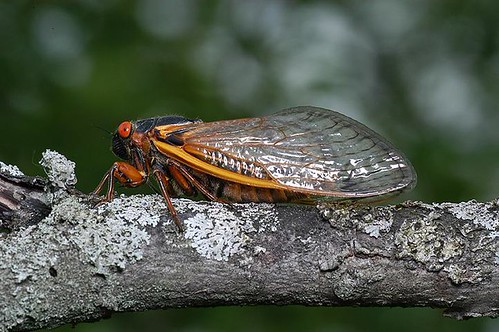
Brood XIII Cicadas in SW Michigan?

After 17 years?

After 17 years?, photo by mfophotos.

The Magicicada are the genus of the 13- and 17- year periodical cicadas of eastern North America who display a unique combination of long life cycles, periodicity, and mass emergences. They are classified according to “Brood” and 2007 is the year of Brood XIII, on a 17-year cycle and also known as the Northern Illinois Brood. Wikipedia’s Brood XIII page has a nice picture of the cicadas of this brood.

While Wikipedia and the U-M’s Museum of Zoology cicada page say that Brood XIII has a presence in southwest Michigan, retired University of Michigan entomologist and cicada expert Thomas Moore says (Freep article) that overeager graduate students and sloppy work by a 19th-Century government scientist and irresponsible replication are responsible for the erroneous perception that Brood XIII may make an appearance in Michigan.

Mark O’Brien comments that it’s unfortunate that Tom Moore was quoted as dismissing the work by former UMMZ graduate students John Cooley and David Marshall (who created the useful pages and did state that the maps are “approximate”). On his blog, Six-legged Wonders, Mark has a post about Brood XIII in Michigan where he says:

What needs to be done is to get modern records. Researchers tend to go to where previous records show emergences. So, if you know that Lake County, Illinois has 17-yr cicadas, that’s where you go if you have limited time to do experiments, etc. I don’t doubt that there may have been 17-yr cicadas at some point in SW Michigan — especially inland away from the sand dunes. However, the area has been heavily agriculturized over the past 100 years, and some areas have also gone back to woods. Have small pockets of Magicicada survived? The only way to know is to go and traverse the area and listen. Lacking that… if you live in that area of the state, tell me that you have them and show me the specimens. It would be nice to know, either way. The next emergence would be in 2024. I’m going to be an old man by then.

You can get a ton more information about the cicadas of Brood XIII (and others) including lots of photos and video and all your Brood XIII gear at Cicada Mania.

Memorial Day, near Charlotte, MI

Memorial Day, near Charlotte, MI

Memorial Day, near Charlotte, MI, photo by spaunsglo.


Throwing heavy stuff at the Alma Highland Festival & Games

Caber Toss!

Caber Toss, photo by BearlyWorking

This photo is part of a set of 2006 Alma Highland Festival photos featuring kilt-clad competitors lifting and hurling heavy objects.

The Alma Highland Festival and Games take place May 26 & 27, 2007 on the campus of Alma College (2007 is the 40th annual). In addition to the Great Lakes Scottish Heavyweight Athletic Events, the festival includes piping, drumming and traditional Scottish fiddling and dancing competitions. There’s also games for children, the Parade of Tartans, and lessons and Scottish clan tents when you can learn about Scottish culture.

In addition to explaining the dance and band competitions, Wikipedia’s entry on the Highland Games lists the Heavy Events as stone put, Scottish hammer throw, weight throw, weight over the bar, sheaf toss and:

Caber toss: A long tapered pine pole or log is stood upright and hoisted by the competitor who balances it vertically holding the smaller end in his hands. Then the competitor runs forward attempting to toss it in such a way that it turns end over end with first, the upper (larger) end striking the ground and then the smaller end, originally held by the athlete, following through and in turn striking the ground in the 12 o’clock position measured relative to the direction of the run. If successful, the athlete is said to have turned the caber. Cabers vary greatly in length, weight, taper, and balance, all of which affect the degree of difficulty in making a successful toss. Competitors are judged on how closely their throws approximate the ideal 12 o’clock toss on an imaginary clock.

Michigan (Shoreline) in Pictures

You can see Chicago from 42 miles away! by by TRVentura

You can see Chicago from 42 miles away! by TRVentura

This summer, Absolute Michigan will be taking a tour of Michigan’s shoreline, looking at the heritage and attractions of the communities along Michigan’s Great Lakes shoreline.

Michigan in Pictures will be going along, trying to point out some of the beauty along the way.

We’d really like it if you’d help us by telling us what not to miss. If we do miss something – and with 3000+ miles of coastline, that’s pretty likely – then please feel welcome to post a comment or a link at the place where we missed it.

And if you want to climb in the car (or on the bike or in the kayak) and join the tour and let us know what you found, well that would be very cool too.

The above photo was taken at the beach in Michiana, Michigan (and Yahoo/Flickr geotagged photo map). I’m always a little surprised to find that you can’t see the state line from space.

Dancing through West Michigan

The PitchKlompen Dancing

Some days the photo for Michigan in Pictures is easy to find. Some days it’s not. Today was one of those days and after a lot of time wandering around the Library of Congress, I went back to Flickr and started looking through photos matching a search for Michigan.

Somewhere around page 12, I found these two photos – Untitled (from a West Michigan Whitecaps game) by Em Smith and Klompen Dancing at the Tulip Festival by Norm Hoekstra (from a group of Tulip Time klompen photos) – sitting side by side. That seemed to me to be some kind of sign, and I read it to say: blog the photos and get back to work!

Happy Friday and I hope your weekend gives you a chance to kick up your heels!