Monroe Pier Lighthouse and Uncle Peter

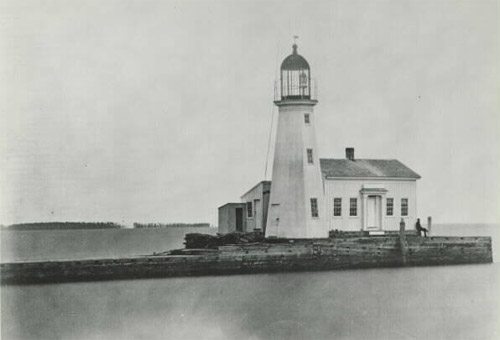
Monroe Pier Lighthouse, c. 1859

Monroe Pier Lighthouse, photo courtesy Archives of Michigan

This photo of the Monroe Pier light on Lake Erie in the city of Monroe was taken somewhere around 1859. Here’s another shot of Monroe Lighthouse c. 1900 with what looks to be a Mackinaw boat from the HAL Digital Lighthouse Collection. There is incredibly little information about the Monroe Pier Lighthouse, so I have to assume that it’s long gone. Anyone know anything more?

The Monroe County Library has an article titled The Lighthouse Keeper in their very cool Bygones of Monroe with some recollections of and insight into the life of a lighthouse keeper:

“Uncle” Peter Gussenbauer keeps the government lighthouse at Monroe Piers. For fifteen years he has tended the great light that has served as a beacon to incoming yachts and steam craft, or as a guide to the merchant boats passing up and down Lake Erie between Toledo and the upper lake regions. One expects to find the average seafaring man gruff in his manners, and little inclined to the companionship of land-lubbers. But not so with “Uncle” Peter, for he has become famous for his genial hospitality and his courteous bearing toward the hundreds who visit the lighthouse during the summer months.

They have another item marking the passing of Uncle Peter and a whole lot more great historical clippings including a bit of bragging about the poundage of Monroe’s menfolk.

A House on a Hill and the Michigan Film Office

House on a Hill by Richard Thompson

House on a Hill, photo by Richard Thompson

Janet Lockwood, Director of the Michigan Film Office writes:

The Film Office needs your help again…

We need a spooky house VERY remote and stark with open landscape and minimal trees in the way. Needs a big basement, but if no basement, a big attic. Big rooms, open halls, high ceilings, all the usual accoutrements for a haunted house. Nice film, will be shooting later in the year, not a big budget but recognizable actors.

You can contact Janet through the link above. She she says that with Michigan’s new film incentive package, you can expect to hear a lot more calls for location suggestions!

If you’re wondering why Michigan would want to attract movie production, consider that a major picture can provide $150,000 or more per day in economic impact on the local economy and films also generate interest in the region they are set in for tourists and others. Here’s a Detroit News story with some more info.

The Victorian home pictured above is near Chelsea and is part of Richard’s Landscape set (slideshow). I’m not the only one who thinks that Richard’s photos are basically movies waiting to happen

eclipsed

eclipse

eclipse, photo by mfophotos.

Well, this was SUPPOSED to be a photo of the moon in honor of tonight’s total eclipse of the moon.

What can I say? I’m easily distracted.

Mark took this photo in Saline with a Diana camera and it’s just one of many in his outstanding alternative cameras set (slideshow) featuring images from Polaroids, 110 cameras, toy cameras, and Holgas.

Here are some ACTUAL Michigan photos from the lunar eclipse of February 20, 2008!

Exposure.Detroit January 2008 Photography Exhibit

Packard Proving 058 B&W 4x6

Packard Proving 058 B&W 4×6, photo by Kevin Ridge Photo.

Kevin is one of a large number of very talented photographers who will be presenting work at the Exposure.Detroit January 2008 Photography Exhibit. He took this photo on one of the group’s photo safaris to the Packard Proving Grounds – check out his photos from the outing and/or everyone’s.

What: Exposure.Detroit January 2008 Photography Exhibit
When: 7pm-10pm ~ January 18th, 2008
Where: The Bean & Leaf Cafe, Royal Oak, MI
Who: 30 of Exposure.Detroit’s finest photographers

Coming to you via the coffee coated walls of the Bean & Leaf Cafe (the BLC) is the next round of talented Michigan photographers (in no particular order):Exposure.Detroit January 2008 Show

Ledio
LAWRENCEcreative
Ken Jacoby
Amy Palomar
Vanessa Miller
Ryan Southen
Mike Harabedian II
Mark F. O’Brien
One Foot Over The Moon
Detroit Derek
Stephanie Aust
C.J. Peters
Meghan East
David M. Haupt
St. Laurent Photography
Larry Carr
Scott Carey
Kyle Engelhart
James Szewczyk
Keith Burgess
Becky Layton
Ross Sandelius
Kevin Ridge
Rob Terwilliger
Patrick Simpson
David Kohrman
Paul Nichol
Paul K
John Levanen
Alexander J. Hernandez

The Octagon House

wash up

wash up, photo by n.elle.

Nicole writes:

a few of us from exposure detroit took a road trip up to the northern burbs and further. some poked fun that i wanted to stop at the octagon house, but i think it’s a pretty cool building.

tucked behind the octagon house were a few old barns. sitting out it front of one of them was this old claw foot tub and sink. just in case you need to wash up.

The Friends of the Loren Andrus Octagon House say that in 1828, Loren traveled with his father to find a new home in the Territory of Michigan, settling in Washington Township in Macomb County. In 1858 with the help of prominent architect and brother-in-law David Stewart and using Orson Squire Fowler’s book about the wonders of 8-sided houses, A Home For All, Andrus built the Octagon House as his entry in a home-for-show contest between several families to see who could build the most unusual house. He won.

The Octagon House is Italianate in style, surrounded on six sides by a Corinthian-columned porch. A cedar shake shingled roof, with elegant scrolled brackets, supports the octagonal cupola. The house has eight sides with eight-foot windows letting daylight fill the interior. The interior is centered around a dramatic, 55-step cantilevered spiral staircase which winds from the first floor to the third story cupola.

The Friends of the Loren Andrus Octagon House was formed to preserve this structure (which is on the National Register and you can learn a lot more about it, see a slideshow and help them to save the old barns.

Here’s an entry for The Octagon House on the Absolute Michigan map of Michigan.

December snow in SE Michigan

December snow in SE Michigan

December snow in SE Michigan, photo by oakwood.

Oakwood writes 8 inches of snow fell in our area today – lots of blowing and drifting. Pretty isn’t it!

The word of the week this week over on Absolute Michigan is “snow“, and if you’re tired from digging out, maybe you should grab a cup of cocoa and explore the happier side of snow!

Also check out photos of “Michigan snow” from the last couple days.

Wyandotte shipbuilding, the Fitzgerald brothers and the launch of the Little Fitz

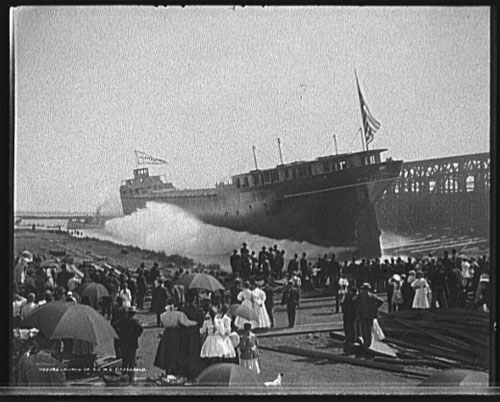
Launch of the W.E. Fitzgerald at Wyandotte

Launch of the S.S. W.E. Fitzgerald at Wyandotte, Detroit Publishing Co.

I have no idea how I ended up at this photo (and why I suddenly feel like Paul Harvey), but here’s what I’ve learned through Boatnerd.com and a forum with a brief article from Boatnerd by Dick Wiklund about the “Little Fitz.”

William and Julia Fitzgerald of Marine City, Michigan sired six sons. The sons were fascinated by the wooden sailing ships and early steamboats on the St. Clair River, and all six became captains of Great Lakes ships. The youngest of these was John Fitzgerald, who started a shipyard in Milwaukee. His son, William E. Fitzgerald, took over the business in the 1890s but died just a few years later. William’s close friend, Captain Dennis Sullivan, built and christened the W.E. Fitzgerald in Wyandotte in his honor in 1906.

The Wyandotte Historical Museum’s history page says that Wyandotte’s shipbuilding industry was started by Eber B. Ward:

Wyandotte produced over 200 ships, varying from small tugs to large steamers and passenger ferries. Under the name of the American Shipbuilding Company the Wyandotte yards flourished. Hulls were constructed in Wyandotte and were taken up the Detroit River to Detroit, Michigan were they were outfitted. Smaller companies such as the E.H.Doyle Hoop & Stave Works(1889)who provided the city’s first electric power, the Regeant Stove Company, the McCord Corp. and the Beals & Selkirk Trunk Company soon made Wyandotte a famous industrial town.

In 1953, the WE Fitzgerald became known as the Little Fitz when the massive freighter named after William’s son was launched. His name, of course, was Edmund Fitzgerald.

The Library of Congress index of Wyandotte photos is heavy ships & shipyards (you may need to go to this page and search for “Wyandotte”). If you’re in the mood for a ton of Great Lakes freighter information (and a little music and “Laker” cooking), head over to Absolute Michigan’s word of the week: Freighter.

Afield

Afield

Afield, photo by Voxphoto.

Ross writes:

…In the LeFurge woods preserve. This is one of Matt’s pinhole stomping grounds, and I have to give him all the credit for bodily dragging me to this spot, saying “there’s a better view from over this way… “

Detroit … Exposure

Detroit

Detroit, photo by JoeJoeSmoe.

Five photographers will be at the Exposure.Detroit show next Friday. Only four had been featured on Michigan in Pictures and I couldn’t have that, so here’s one of my favorite photos from Joe Alisa aka JoeJoeSmoe. The photo is from fall of 2006 – be sure to check out Joe’s photography site for more pics!

Exposure Detroit show poster…and because I can’t resist, here’s more Detroit manhole covers from Drainspotting.

Exposure.Detroit Presents!

When: November 9th 7pm-10pm
Who: Cris Rea, Joe Alisa, Ralph Krawczyk Jr., Rhonda McElroy, Sue Fraser
Where: The Bean & Leaf Cafe, Royal Oak
Music by: Theatre of the Absurd

Flint Vehicle City Arch – The Making of Modern Michigan

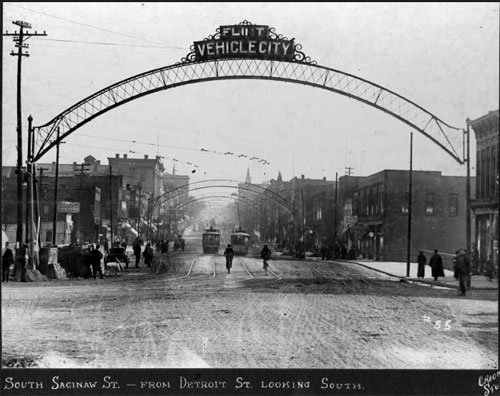
Flint Vehicle City Arch

Flint Vehicle City Arch, photo by Arthur Crooks (Kettering University Library, Scharchburg Archive)

This photo of Saginaw Street (from Detroit Street looking south) shows the Vehicle City Arch that was erected in 1905 as part of the City’s 50th anniversary. It was taken in 1909 and is one of many photos from Michigan’s past in The Making of Modern Michigan, a collaborative project headed by the Michigan State University Libraries, in partnership with the Library of Michigan, the Michigan Library Consortium, and the 50+ libraries currently participating in the project. It includes local history materials from communities around the state – photographs, family papers, oral histories and genealogical materials on a wide range of subjects.

Many of the images (such as the one above) are part of collections. The Crooks collection includes lots more photos of Flint at the turn of the century like Buick: Made in Flint, The circus comes to town and a shot of the arches lit up at night. The Crooks collection reaches into the 1920s, and you have to check out Bootleg Raid in Flint.

As is often the case, I got curious about those arches. Fortunately, I didn’t have to go any further than Arches Restoration to Celebrate our Heritage (ARCH). Their history page explains:

The Flint arches were erected in 1899 to replace gas lanterns used to illuminate the business district at night. Built by Genesee Iron Works, five arches were placed at intersections along Saginaw Street. Each arch was built with 50 light bulbs to illuminate the City’s main street at night. Half were turned off at midnight. The arches supported decorations for every parade of importance held in the city and colorful lights replaced golden incandescence at holiday times. None of the original arches had the famous Flint Vehicle City crown at its apex.

When Flint celebrated its 50th anniversary in 1905 two additional arches were erected with the famous Flint Vehicle City graphic at the crown. These arches were placed at the south end of the city at the intersection of Fifth and Saginaw Streets and at the north end of the business district at the confluence of Saginaw and Detroit Streets (now M.L. King Boulevard).

Though many believe the arches celebrated Flint’s heritage as a center for automobile manufacturing, the original arches were a salute to Flint as the world’s largest volume manufacturer of horse drawn carriages.

They were successful in their campaign to restore the arches on Saginaw and you can see a photo by day and by night!