Into the Icy Void at the Eben Ice Caves

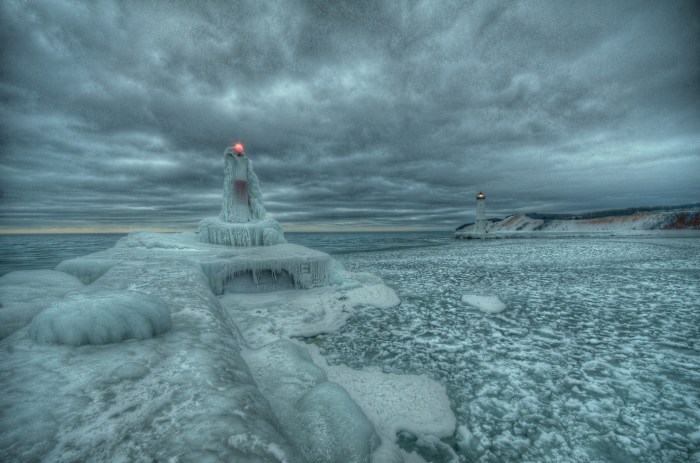
Into the icy void

Into the icy void, photo by Anapko.

I know that winter is here when the searchers start showing up – 50 or 100 or more each day – for the Eben Ice Caves. In our first post on the Eben ice caves, Northern Michigan University professor Dr. John Anderton (who I got to know by chance this spring) explained that the Eben Ices Caves are located just a few miles north of the little town of Eben, within the Rock River Canyon Wilderness Area.

Within its interior there are two short user-developed trails (totaling about 1.75 miles) leading to Rock River Falls and the Eben Ice Caves. An estimated 1,700 people visit the area annually (USFS records) …

The Ice Caves are not true caves at all. They consist of walls or vertical sheets of ice that form across the face of overhanging rock outcrops. In the summer, small unimpressive waterfalls and groundwater seeps may found along the overhangs. In the winter, however, the water hits the cold air, drips downward under the influence of gravity and freezes, creating spectacular ice caves. Each winter they look a little different, but typically there are openings in the ice that allow you to walk behind the ice walls.

The rock overhangs, where the ice caves form, consist of outcrops of Munising Formation (Cambrian) with a capstone of AuTrain Formation (Ordovician). The outcrops are found along the south side of the valley of Silver Creek, which is part of a network of secondary glacial drainage channels that formed during the Marquette Advance (about 10,000 years ago). Theses secondary drainage channels flowed easterly into the AuTrain-Whitefish Channel, a primary glacial meltwater channel that flowed south to the Lake Michigan basin. Groundwater naturally seeps from these rocks, providing the water necessary to form the ice caves in the winter.

Check this out background big and definitely do not miss Anapko’s Eben Ice Caves slideshow which includes a lot of great, wallpaper sized views and also a sign with more about this incredible natural wonder!

Toe to Toe in the January Snow

Toe to Toe

Toe to Toe, photo by Elizabeth Glass.

“January brings the snow, makes our feet and fingers glow.”

~Sara Coleridge

January is upon us and – for the northern part of the state at least – that means snow! It also means that many of the events on our Michigan January event calendar on Absolute Michigan are focused on celebrating all that snow Michigan gets! From ice skating all month at Campus Martius in Detroit to racing with sled dogs in Newberry to Michigan’s largest ice sculpture display in Plymouth, you’ll find plenty to do all over the state. There’s also wine tours, autos shows and much more. Click through for all the details!

Check this shot from the Boyne City waterfront out bigger and in Elizabeth’s great ice slideshow.

Much more snow and winter photos from Michigan in Pictures!

The Hiawatha National Forest

Hiawatha National Forest

Hiawatha National Forest, photo by Sean Depuydt.

Ever thicker, thicker, thicker
Froze the ice on lake and river,
Ever deeper, deeper, deeper
Fell the snow o’er all the landscape,
Fell the covering snow, and drifted
Through the forest, round the village.
~Henry Wadsworth Longfellow
The Song of Hiawatha

The Hiawatha National Forest in the Upper Peninsula is known as “the Great Lakes National Forest” because nearly 1 million acre forest touches three Great Lakes: Superior, Huron and Michigan.

The landscape of sandstone and limestone includes the watersheds of the three Great Lakes, five National Wild & Scenic Rivers – the Carp, Indian, Sturgeon, Tahquamenon, and Whitefish.

Northern hardwood and mixed forest types are common on the Hiawatha National Forest. Tree species include sugar maple, red maple, American Beech, white pine, red pine, northern white cedar, eastern larch/tamarack, and balsam fir. Jackpine savannahs are also common in some areas. Much of the Hiawatha is covered in wetlands, and as a result there are many wetland plants.

Spring wildflowers bloom in May and June.
The Forest contains habitat for northwoods species like whitetail deer, gray wolf, and lynx. Kirtland’s warbler, an endangered species, relies on young jackpine stands for its nesting grounds, and piping plover nest along our pebbly Great Lakes beaches. Trout are native to coldwater streams, and our inland lakes support strong, diverse fisheries

In short, a wonderful place. Here’s hoping you get a chance to have fun as the covering snow piles deeper this winter.

Check the photo out on black and in Sean’s Upper Michigan slideshow.

Frankfort North Breakwater Light

Frankfort Lights by Jason Lome

Frankfort Lights, photo by lomeranger.

The Detroit Free Press reports that Coast Guard has given the Frankfort Lighthouse to the City of Frankfort under the National Historic Lighthouse Preservation Act. It’s one of 15 historic light stations in Michigan that have been transferred at no cost to nonprofits and government agencies.

The Frankfort North Breakwater Light entry at Terry Pepper’s Seeing the Light details the long history of the lights at Frankfort Harbor and says that:

By 1924, the total car ferry tonnage through Frankfort Harbor was twenty five times greater than that prior to the establishment of the ferries. To better serve this vital commerce, the Army Corps of Engineers began construction of a pair of reinforced concrete arrowhead-type breakwaters at the harbor entrance in order to create a large stilling basin to protect the opening into the harbor. With the completion of these breakwaters in the early 1930’s, the twin piers at the entry into Lake Betsie no longer served any purpose. With plans in place to shorten them into short stub piers, the North Pierhead Light was lifted from the pier onto the deck of a barge and carried out to the end of the North Breakwater. A square steel base 25 feet in height had been erected on the end of the breakwater to receive it, and the tower was lifted onto the new base. After being bolted into position, the new tower stood 67 feet in height from the upper level of the pier to the top of the lantern ventilator ball. By virtue of its location on the concrete pier, the light stood at a focal plane of 72 feet, and the 17,000 candlepower incandescent electric light within the Fourth Order Fresnel was visible for a distance of 16 miles in clear weather.

Be sure to click for much more including some very cool old photo of the South Pier fog bells and the story of captain George Tifft, who more or less founded Frankfort when his schooner was driven into Lake Betsie.

See this photo bigger, in Jason’s fantastic ice slideshow, and purchase prints on his photography website.

Michigan in Pictures has a great vintage postcard of the Frankfort Light in winter and you can see the tower in this shot by jimflix from the Absolute Michigan pool.

The Lake in Winter

DSC_0136

DSC_0136, photo by jsorbieus.

It changes every day, every hour. It is a thousand lakes, changing faces with every shift in wind and light – flurried by offshore wind, whitecapped in squalls, colored flannel gray or pearl-white or stormy black beneath the winter clouds, a dozen blues when the sky is blue.
~Jerry Dennis on Lake Michigan

Over on Absolute Michigan today we have an excerpt from The Windward Shore, the new book from Michigan outdoor writer Jerry Dennis. It’s titled The Lake in Winter and you should definitely take the time to read it!

Check this out background big and see more shots of the Lakeshore in winter in Jim’s slideshow.

More winter wallpaper on Michigan in Pictures!

Have a Holly Jolly Christmas

December 17 - Holly Jolly Christmas

December 17 – Holly Jolly Christmas, photo by Holly Jolly Christmas by Michael Koole – Vision Three Images

Here’s hoping that all of you have a great Christmas if that’s your thing and a wonderful weekend in any case!

See it bigger on black and in Michael’s great snow slideshow.

The Perfect Christmas Tree (some assembly required)

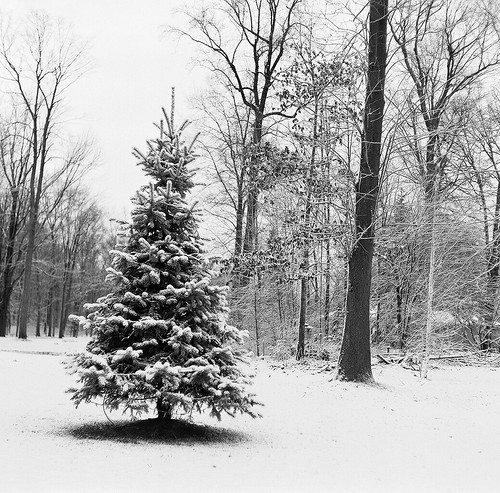
Roll 1 FILM Snowy Pine SOOC

Roll 1 FILM Snowy Pine SOOC, photo by Carolyn Gallo

The History of Christmas Trees from the History Channel notes that ancient peoples hung evergreen boughs over their doors and windows, many in the belief that evergreens would keep away witches, ghosts, evil spirits, and illness. A popular belief is that Martin Luther was walking one winter evening, and was overcome by the brilliance of stars twinkling amidst evergreens. To recapture the scene for his family, he erected a tree in the main room and wired its branches with lighted candles.

They note that as as late as the 1840s Christmas trees were seen as pagan symbols and not accepted by most Americans:

It is not surprising that, like many other festive Christmas customs, the tree was adopted so late in America. To the New England Puritans, Christmas was sacred. The pilgrims’s second governor, William Bradford, wrote that he tried hard to stamp out “pagan mockery” of the observance, penalizing any frivolity. The influential Oliver Cromwell preached against “the heathen traditions” of Christmas carols, decorated trees, and any joyful expression that desecrated “that sacred event.” In 1659, the General Court of Massachusetts enacted a law making any observance of December 25 (other than a church service) a penal offense; people were fined for hanging decorations. That stern solemnity continued until the 19th century, when the influx of German and Irish immigrants undermined the Puritan legacy.

…By the 1890s Christmas ornaments were arriving from Germany and Christmas tree popularity was on the rise around the U.S. It was noted that Europeans used small trees about four feet in height, while Americans liked their Christmas trees to reach from floor to ceiling.

The early 20th century saw Americans decorating their trees mainly with homemade ornaments, while the German-American sect continued to use apples, nuts, and marzipan cookies. Popcorn joined in after being dyed bright colors and interlaced with berries and nuts. Electricity brought about Christmas lights, making it possible for Christmas trees to glow for days on end. With this, Christmas trees began to appear in town squares across the country and having a Christmas tree in the home became an American tradition.

See this gorgeous tree on black and in Carolyn’s snow slideshow.

Help the National Audubon Society with their Christmas Bird Count

Out On A Limb

Out On A Limb, photo by Beth Crawford 65.

The Great Lakes Echo tipped us off to the National Audubon Society Christmas Bird Count. :

Each of the citizen scientists who annually braves snow, wind, or rain, to take part in the Christmas Bird Count makes an enormous contribution to conservation. Audubon and other organizations use data collected in this longest-running wildlife census to assess the health of bird populations – and to help guide conservation action.

From feeder-watchers and field observers to count compilers and regional editors, everyone who takes part in the Christmas Bird Count does it for love of birds and the excitement of friendly competition — and with the knowledge that their efforts are making a difference for science and bird conservation.

In years past, the Christmas Bird Count has helped the Society document species health and develop plans. Click to learn how to get involved!

See Beth’s photo of a pine siskin, a common finch, bigger and in her beautiful winter slideshow.

Many more Michigan birds on Michigan in Pictures.

The Light at Point Aux Bec Scies

 Pt. Betsie Lighthouse

Pt. Betsie Lighthouse , photo by GLASman1.

Point Betsie Light is one of the most photographed lighthouses in the world. The Friends of Point Betsie website notes that the point was originally known by the French as “Point Aux Bec Scies,” meaning “sawed beak point” and that it was was built in 1858 at a cost of $5000. If you want to get a taste of life at a lighthouse, you can rent the Assistant Keeper’s apartment in the summertime.

Check it out bigger and in Mark’s slideshow.

Much more about Point Betsie Lighthouse on Michigan in Pictures!

Waiting on Winter

Sunset on Ice
Sunset on Ice, photo by Happyhiker4

While we wait and wonder when winter will wander in, many folks including Mark are digging through their archives for helpful pictures to remind Old Man Winter to get busy. About this photo from last January Mark writes:

I had traveled to the icy shores looking for a chance to see the sunset from an icy shoreline. Little did I know I would be blessed in incredible beauty. I wanted to feel the ice and the textures were just incredible. I ran my fingers over the smooth solid ice. The ice held such a deep color as the sun put on an incredible show. Blessed in Nature. What a Life!

Check it out on black and see more of Mark’s amazing work in his Ice slideshow.