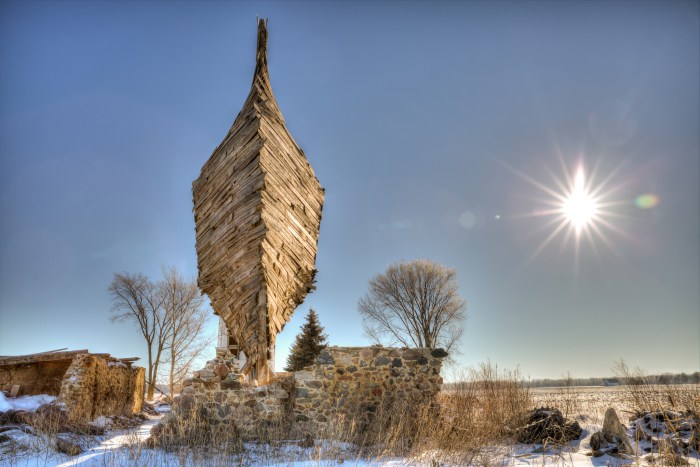
Emergency Ark: The Celestial Ship of the North

Emergency Ark

Emergency Ark, photo by Michael

The Celestial Ship of the North (Emergency Ark), aka the Barnboat, is a site-specific installation and permanent sculpture in Port Austin, Michigan created by Scott Hocking. He wrote to me:

I was asked by Detroiter Jim Boyle, whose family is still in Port Austin, if I’d ever had any ideas of working with old barns. He’s been trying to get a Detroit / Port Austin connection going by bringing artists up there to do projects. I basically told him I’d had some fleeting thoughts about how much certain barns look like overturned ship hulls, and that if I had an old barn to work with, I’d probably turn it into a boat.

So, that was the beginning.

Like all of my work, I try to let the materials and site dictate what I make, and as I worked on the barnboat the shape became what it is now – mostly influenced by the intense winds of Michigan’s thumb. It took about 3 months total, but I’m not quite done yet: I’m still planning to fill in the base with mounded sand this spring for a little extra stability, and so that it can once again overgrow like that ivy covered barn it was made from.

Awesome. Check out lots more of Scott’s engaging work on his website.

Enjoy Michael’s photo background bigtacular on Flickr and see more in his slideshow.

More art and more winter wallpaper on Michigan in Pictures.
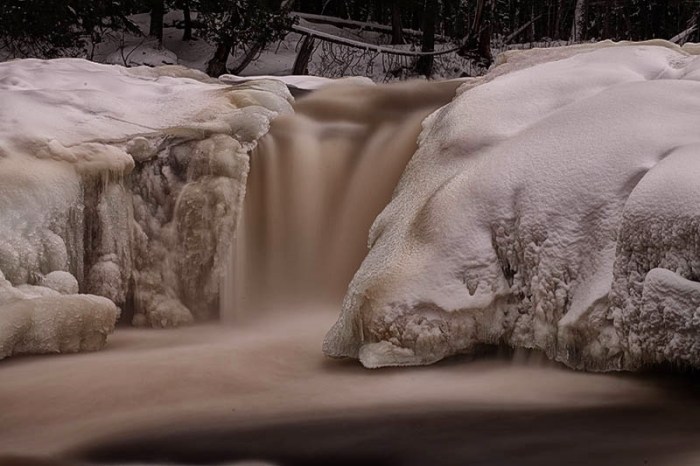
Waterfall Wednesday: Manido Falls in the Porcupine Mountains

Manido Falls Porcupine Mountains Wilderness

Manido Falls, Porcupine Mountains Wilderness, photo by Kirt E. Carter

The Waterfall Record’s page on Manido Falls has directions and some more photos and says:

Manido Falls did not impress me at first, at least not as much as the downstream Manabezho Falls. After seeing the pictures I had taken, though, I discovered what an amazingly beautiful waterfall Manido Falls is. It’s beauty comes from its complexity. The waterfall itself is not very tall at all. It is wide, though. As the Presque Isle River tumbles down toward Lake Superior, it comes to this set of rocks that create a beautifully cascading waterfall. I think what makes me like Manido Falls so much is that the water has taken such an interesting course here, erosion taking its effect in an oddly unique way.

Add to it that the just as spectacular Manabezho Falls is only hundreds of yards away, and Lake Superior not much more distant, this makes for one of the most beautiful waterfall stretches in the Upper Peninsula.

View Kirt’s photo bigger and check out his website for more.

More Michigan waterfalls on Michigan in Pictures!


Chapel Rock in Winter

Chapel Rock in Winter

Live Anywhere, photo by Jay

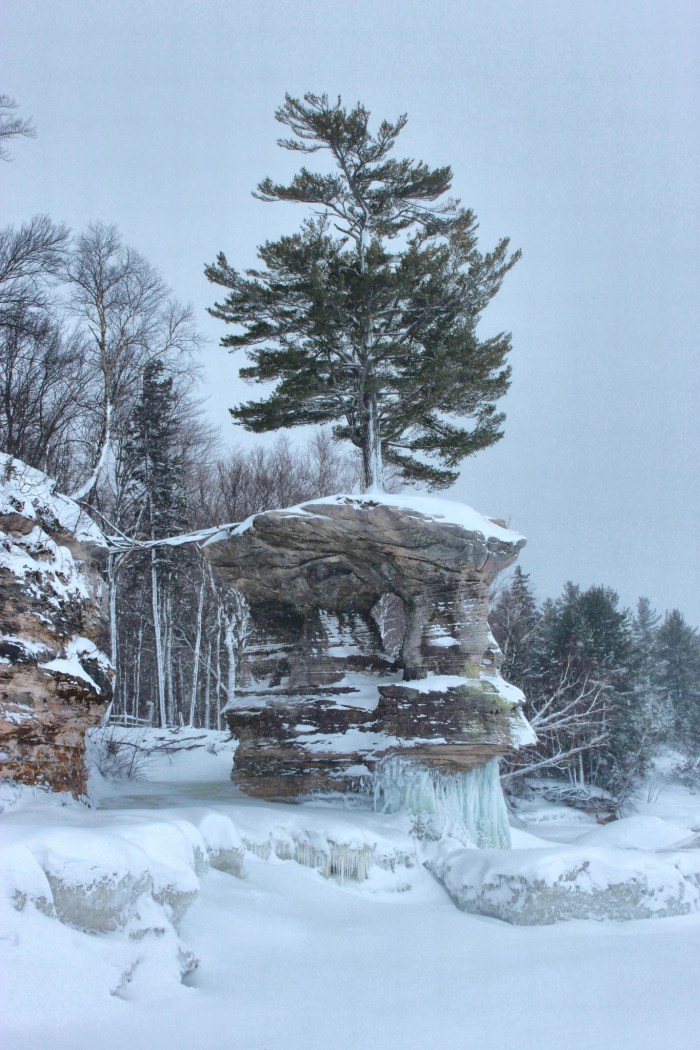
When you think about it, it’s not only miraculous that the white pine on Chapel Rock in the Pictured Rocks National Lakeshore survives with barely any soil, but also that it endures winter after winter in the teeth of Lake Superior.

Jay took this shot on February 20th last year. View it background bigtacular and jump into his slideshow for some more spectacular winter photos from the Pictured Rocks.

Why is Ice Blue or Green?

The Blue Ice

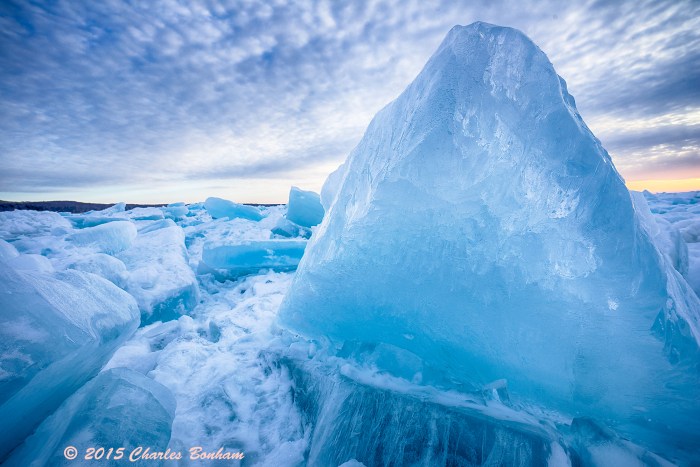
The Blue Ice, photo by Charles Bonham

The Causes of Color answers the question: What causes the blue color that sometimes appears in snow and ice?

As with water, this color is caused by the absorption of both red and yellow light (leaving light at the blue end of the visible light spectrum). The absorption spectrum of ice is similar to that of water, except that hydrogen bonding causes all peaks to shift to lower energy – making the color greener. This effect is augmented by scattering within snow, which causes the light to travel an indirect path, providing more opportunity for absorption. From the surface, snow and ice present a uniformly white face. This is because almost all of the visible light striking the snow or ice surface is reflected back, without any preference for a single color within the visible spectrum.

The situation is different for light that is not reflected, but penetrates or is transmitted into the snow. As this light travels into the snow or ice, the ice grains scatter a large amount of light. If the light is to travel over any distance it must survive many such scattering events. In other words, it must keep scattering and not be absorbed. We usually see the light coming back from the near surface layers (less than 1 cm) after it has been scattered or bounced off other snow grains only a few times, and it still appears white.

In simplest of terms, think of the ice or snow layer as a filter. If it is only a centimeter thick, all the light makes it through; if it is a meter thick, mostly blue light makes it through. This is similar to the way coffee often appears light when poured, but much darker when it is in a cup.

Click through for lots more about light & color!

Charles took this photo last March off Gills Pier on the Leelanau Peninsula when there was a whole lot more ice than there is this winter. View it background bigilicious and see more in his Leelanau Peninsula slideshow.

More winter wallpaper and more amazing ice on Michigan in Pictures.

Below the Mighty Mac

Under the Mighty Mac

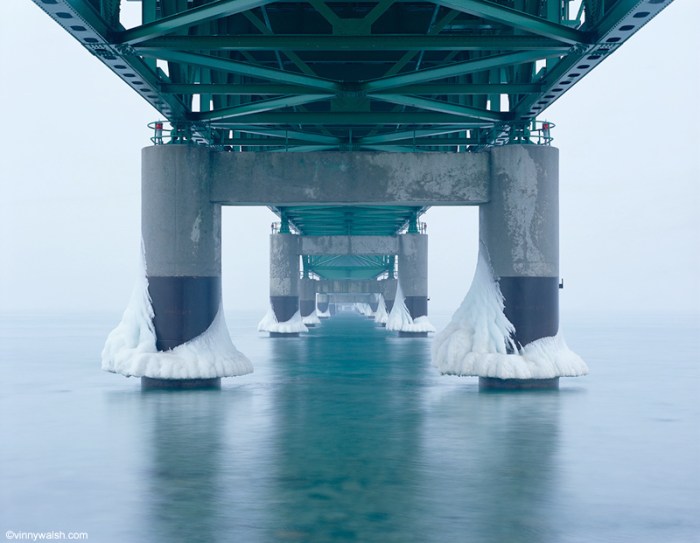
Mighty Mack, photo by vinnywalsh.com

Last week I shared how you can get driven across the Mackinac Bridge. Guessing you’re on your own if you want to cross the Straits of Mackinac at this level!

Vinny took this photo on Christmas Eve of 2005. If you want to check in with the current scene, the Mackinac Bridge Authority webcams have you covered with three different views.

Check his photo out bigger and see more at vinnywalsh.com.

Much more Mackinac Bridge on Michigan in Pictures.

Deer Michigan, I Love You

Deer Tracks - Kitch-iti-Kipi

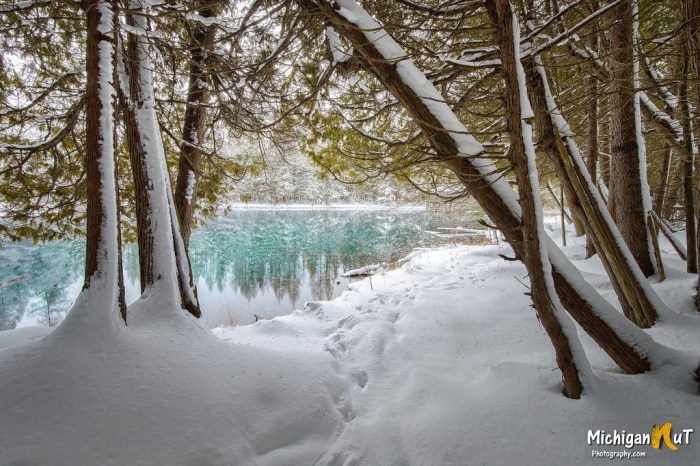
Deer Tracks – Kitch-iti-Kipi, photo by John McCormick/Michigan Nut

Happy Valentines Day to all of you! I love Michigan even more than stupid puns. 

Someone else who loves this state is my friend John McCormick of Michigan Nut Photography. He’s on quite a tear right now with photos on many Pure Michigan billboards and being featured as an Instagram must-follow for Michigan lovers.

Kitch-iti-kipi means “The Big Spring” and it’s located in Palms Book State Park near Manistique. The park page shares what I’m realizing is kind of a dark story for Valentine’s Day. I do have past Valentine’s Day posts that are sweeter.

The legend of Kitch-iti-kipi is said to be about a young chieftain whose girlfriend got the best of him. He told her he loved her far above the other dark-haired maidens dancing near his birch bark wigwam. Prove it, she insisted. As a test of his devotion, she declared that he must set sail in his canoe on the pool deep in the conifer swamp. He was to catch her from his canoe as she leaped from an overhanging bough. His canoe overturned in the icy waters and he drowned. It turns out that the maiden was back at the village laughing at his foolish quest. According to legend, the Spring was named Kitch-itikipi in memory of the young chieftain who went to his death in the icy waters in an attempt to satisfy the vain caprice of his ladylove.

John observes that the deer that winter in this cedar swamp have a never ending supply of “Kitch-iti-Kipi Spring water.” View the photo bigger on Facebook, dive into his slideshow for some stunning winter shots from the UP, follow him at Michigan Nut Photography, and purchase photos from his website if you’re so inclined.

PS: I shared a summertime pic by John of Kitch-iti-Kipi with more info about this hidden Michigan gem!

News for the Nervous: Mackinac Bridge Driver’s Assistance Program

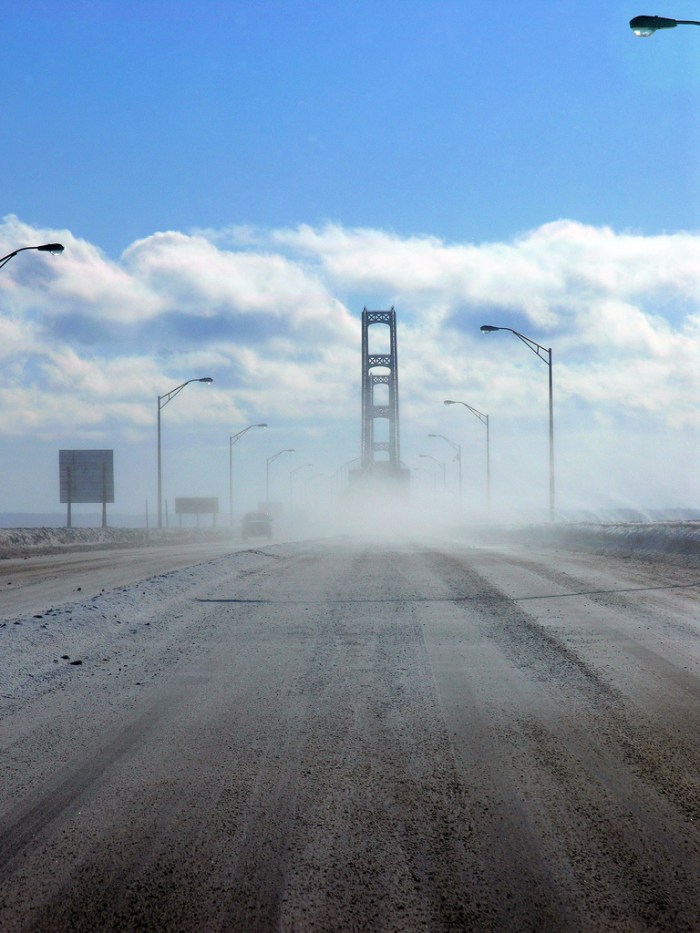
Mackinac Bridge Snow Winter

Mackinac Bridge, photo by Blondieyooper

Fun fact of the day: I have a mild fear of heights! While it’s not crippling enough to stop me from being able to drive over the Mighty Mac, I can definitely see where some people aren’t able to do that. For all of you, here’s a story (with a good video) about a little known service: The Mackinac Bridge Authority will drive you across!

The Mackinac Bridge Authority explains further:

The Mackinac Bridge Authority has a “Driver’s Assistance Program” that provides drivers for those uncomfortable with driving across the Mackinac Bridge. If you are traveling northbound, there is a phone at the south end of the bridge. Instructions for using the phone are posted in the phone box. If you are southbound, just ask a fare collector for assistance. There is no additional fee for this service.

The phone is located on the shoulder of I-75 just north of the Jamet Street exit to Mackinaw City (near Audies Restaurant). You do not need to exit the freeway. Just past the exit, you can pull over to the right and park on the shoulder. The phone box is located on the right-of-way fencing. The box is green and easily spotted. If this is still unclear, please call us at 906-643-7600.

View Blondieyooper’s photo background big and see more in her Gotta Love Winter slideshow.

Lots more about the Mighty Mac on Michigan in Pictures.

February at the Eben Ice Caves

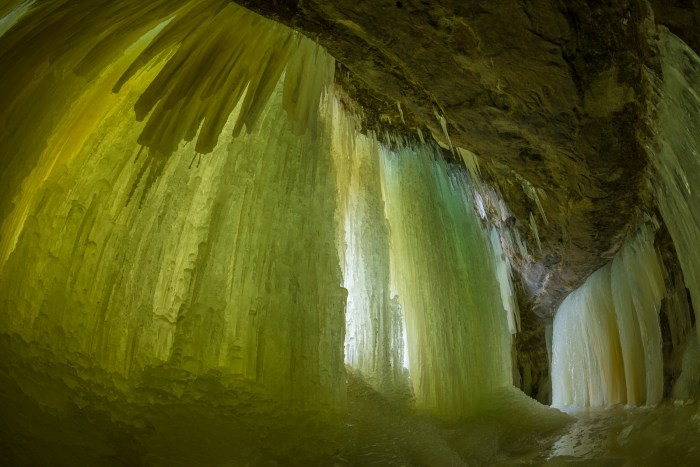
Eben Ice Cave Entry

Ice Cave Entry, photo by Eric Hackney

On the Pure Michigan blog, guest blogger Jesse Land of Things To Do in the U.P. details how to get to the Eben Ice Caves in Michigan’s Upper Peninsula, writing in part:

Just outside of Marquette County, the Eben Ice Caves are one of Michigan’s prime winter attractions. Each winter, once the ice caves start to freeze up (usually sometime in December), visitor’s flock to the tiny town of Eben Junction to see the ice caves and, while they’re out there, support local businesses like the Eben Ice Caves concession stand, the Rock River Cafe and the New Moon Tavern.

The “Rock River Canyon Ice Caves” better known as the Eben Ice Caves, form when melting snow runs over the edge of a small cliff and freezes, forming “ice caves” Much like the large ice formations along Munising’s Grand Island and parts of Pictured Rocks National Lakeshore, if you were to visit here in the summer you would see little to no water running over the edge.

Sometimes I feel like Eric spends his time at all the cool Michigan places I never seem to make it to. View his photo bigger and see more in his 2-5-16: Eben Ice Caves II slideshow. Readers who are on the ball will wonder about #1 in the series – here’s 1-31-15: Eben Ice Caves that also includes pics of Munising Falls, MNA Memorial Falls and Tannery Falls!

Read more about the Eben Ice Caves in this Michigan in Pictures post featuring Nina of Black Coffee at Sunrise.

Happy Birthday Holland: Looking back on the Holland Channel

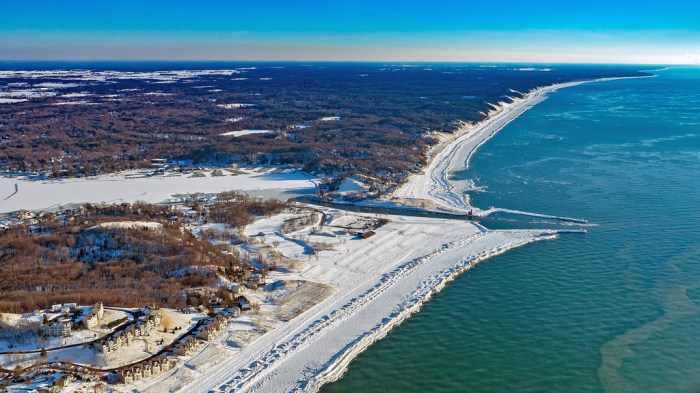
Looking Back on the Holland Channel

Looking Back at the Holland Channel, photo by Sandy Hansen Photography

February 9th is the 169th anniversary of the founding of Holland, Michigan. The History of Holland has some background about one of the prime factors for the city’s success, the Holland Channel:

From its very beginnings, Holland provided a refuge for those seeking freedom of expression and a more vibrant economy. Persuaded by religious oppression and economic depression, a group of 60 men, women, and children, led by Albertus C. VanRaalte, prepared for their 47-day trip from Rotterdam to New York. VanRaalte intended to purchase land in Wisconsin, but travel delays and an early winter caused the group to layover in Detroit. After hearing about available lands in west Michigan, VanRaalte decided to scout the territory. They reached their destination on February 9, 1847 on the banks of Black Lake—today’s Lake Macatawa.

The hundreds of Dutch immigrants that followed expected to find their promised land, but instead found a swamp and insect-infested forest. Although food was scarce, and the log sheds they built were unable to hold everyone, the settlers persevered. VanRaalte realized the practical and economic potential of the dense forest: trees could be felled to build homes and businesses, while the excess lumber could be sold to purchase farming supplies.

In the early years of Holland history, the settlers set out to conquer several projects. They knew that if Lake Michigan was to provide growth and development, it had to be made accessible by an adequate channel. After trying in vain to receive government aid, the determined Hollanders took up picks and shovels and went about digging the channel themselves. The immigrants also cleared a one-block square of land in the center of the colony—today’s Centennial Park—to serve as a market square.

Read on for more and click for a live webcam of the Holland Channel.

View Sandy’s photo bigger, see more in her Aerial slideshow, and follow her on Facebook too!

More aerial photos and more from Holland on Michigan in Pictures.

Blue Hour at the St Joseph Pier

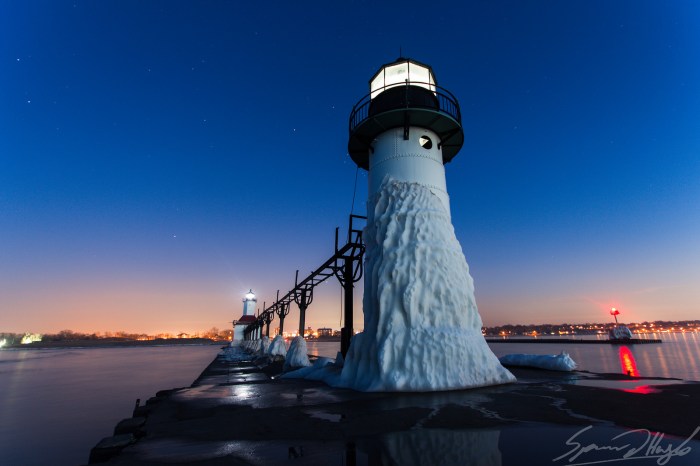
Blue Hour at the St Joseph Pier

Untitled, photo by Spencer D Hughes

If you want to take a look at the Pier from the beach, check out the St Joseph webcam. Have a great weekend everyone!!

View Spencer’s photo bigger and see more of his awesome St Joseph photos. Some seriously cool ice shots in there.

PS: Here’s a link to more information and a photo of the St. Joseph North Pier Outer & Inner Lights from almost exactly a year ago – lots more ice.

PPS: I’d love it if you’d become a patron of Michigan in Pictures. Thanks to all who have so far – I really appreciate it!