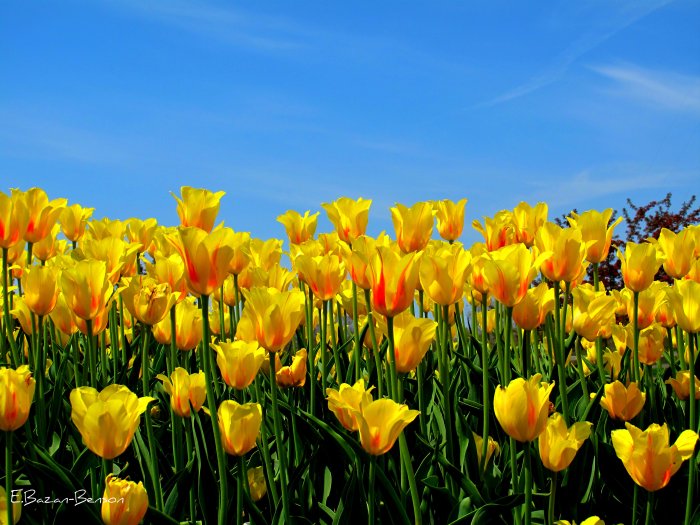
Holland’s annual Tulip Time festivalreturns May 7-14, 2016. They have 4.5 MILLION tulips in Holland and are reporting about 30% of tulip bloom right now – just about perfect. Stay tuned through their Tulip Tracker.
Here’s a cool video showing how they plant Windmill Island with 55,000 tulips in a matter of hours.
Music is music, ultimately. If it makes you feel good, cool. ~Prince
Prince was a musician who had a huge effect on my life. I went to school near Minneapolis when he was transforming music through his own work and what he did with a host of artists. I’m very sad at his passing. Down at the bottom I have one of my favorite clips of Prince.
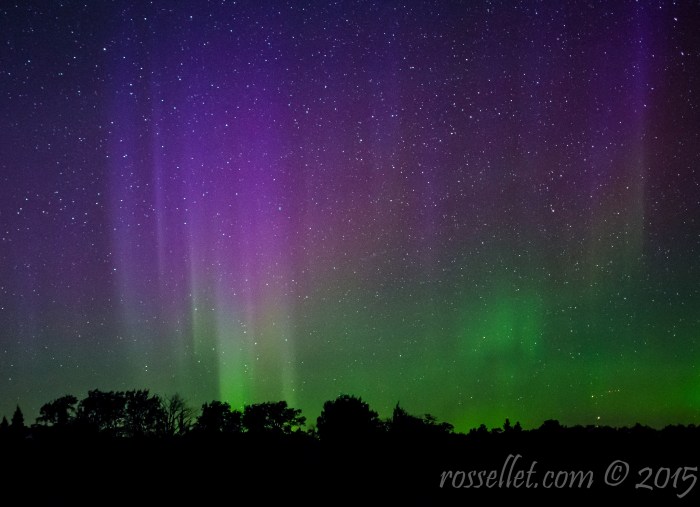
I’ve been lucky enough to see the northern lights dozens of times but have probably only seen purple auroras three or four times. Causes of Color explains the colors of the northern lights:
The sun radiates all visible colors, which is why sunlight appears white. The spectrum of visible light associated with the aurora is much more restricted. The aurora is caused by charged particles in the solar wind colliding with atmospheric atoms and ions. The collisions cause the electrons of the atmospheric atoms to become excited. As the electrons return to their original energy levels, these atoms emit visible light of distinct wavelengths, to create the colors of the display we see.
The color of the aurora depends on the wavelength of the light emitted. This is determined by the specific atmospheric gas and its electrical state, and the energy of the particle that hits the atmospheric gas. The atmosphere consists mainly of nitrogen and oxygen, which emit the characteristic colors of their respective line spectra. Atomic oxygen is responsible for the two main colors of green (wavelength of 557.7 nm) and red (630.0 nm). Nitrogen causes blue and deep red hues.
Most of the auroral features are greenish-yellow, but sometimes the tall rays will turn red at their tops and along their lower edges. On rare occasions, sunlight will hit the top part of the auroral rays to create a faint blue color. On very rare occasions (once every 10 years or so) the aurora can be a deep blood red color from top to bottom. Pink hues may also be seen in the lower area of the aurora. In addition to producing light, the energetic auroral collisions transmit heat. The heat is dissipated by infrared radiation, or transported away by strong winds in the upper atmosphere.
Ross took this on August 10th last summer. He says “The Northern Lights over Moskey Basin in Isle Royale National Park. This is the first time in my life I have seen a bright purple aurora develop.”
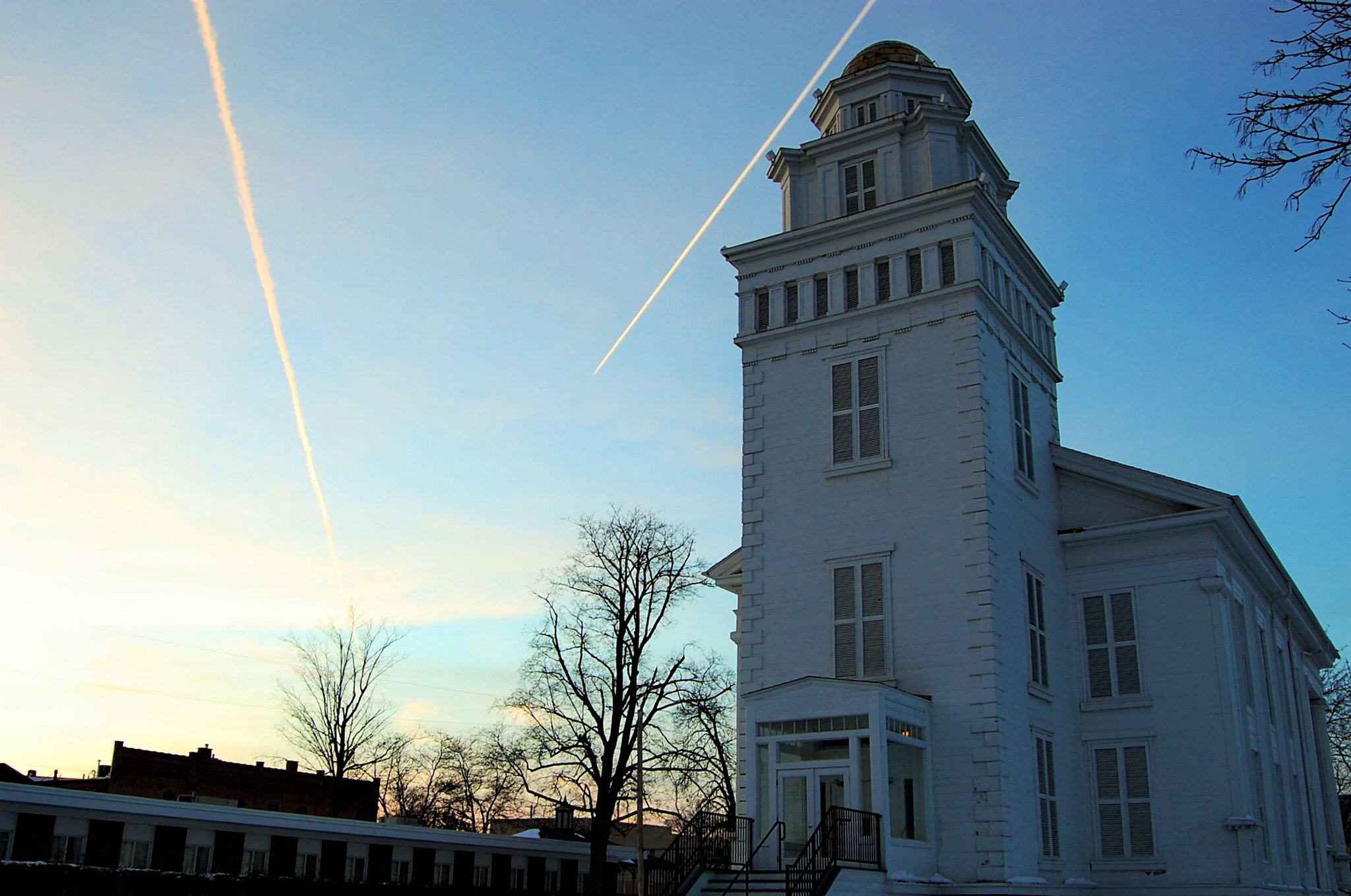
Wikipedia says that the the Lapeer County Courthouse is the oldest original courthouse structure still in use in the state of Michigan, and one of the ten oldest in the nation.
Folklore claims Lapeer was derived from the naming of the south branch of the Flint River, which flows northwestward over quite a long distance of rocky bed in Lapeer County. French and Indian traders frequently passed over this section of the county and through the river, ultimately naming our city for the stone that lay at the river bottom. The translation of stone in French is “LePierre”; the English translation of Canadian French accent of this word is “Lapeer”. The river was named Flint, synonymous with stone.
Lapeer County was once part of the Northwest Territory. By an ordinance of the Congress of the United States passed July 13th, 1787, the whole of the territory of the United States lying northwest of the Ohio River, though still occupied by the British, was organized as the Northwest Territory. In January of 1820 the County of Oakland was formed. Governor Lewis Cass set Lapeer County’s boundaries on September 18th, 1822, although it remained part of Oakland County until it was organized. Lapeer County officially became a county on February 2nd, 1835.
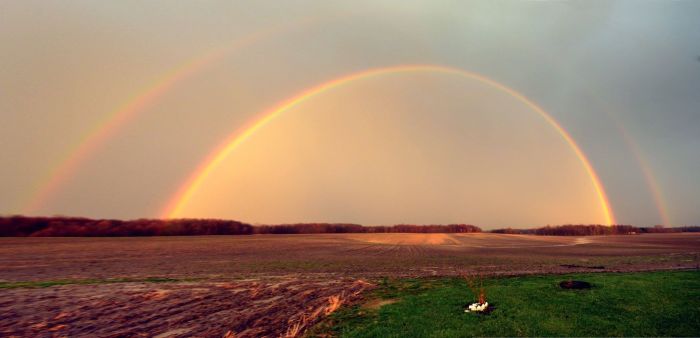
I simply love Atmospheric Optics for nearly everything about lights in the sky. Regarding secondary rainbows or “double rainbows” they say that the secondary is nearly always fainter than the primary, with colors reversed and more widely separated:
Light can be reflected more than once inside a raindrop. Rays escaping after two reflections make a secondary bow.
The secondary has a radius of 51º and lies some 9º outside the primary bow. It is broader, 1.8X the width of the primary, and its colours are reversed so that the reds of the two bows always face one another. The secondary has 43% of the total brightness of the primary but its surface brightness is lower than that because its light is spread over its greater angular extent. The primary and secondary are are concentric, sharing the antisolar point for a center.
About this particular rainbow from April 2, 2016, Gerry writes: “Double rainbow from the other night after the storms. The weather in Michigan can change quickly, from rainbows to snow. Yep, that’s Michigan.”
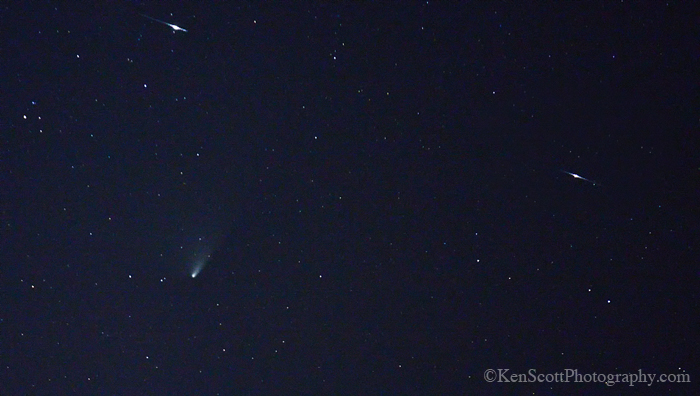
A pair of comets showing very similar orbits are approaching Earth, and astronomers will use radio-telescopes to obtain radar images, while advanced amateurs may capture images of each of the twin comets. While both will pass at a safe distance, one of them will have a record-breakingly close flyby. Comet s was already known to be passing by Earth on March 21, 2016 at a distance of 3,290,000 miles (5.3 million km). This is about 14 times the Earth-Moon distance, and, taken by itself, sets no record.
Comet P/2016 BA14 (Pan-STARRS) will safely pass Earth on March 22,2016, passing even closer than comet 252P. Comet P/2016 BA14 flyby will be at just 2,199,933 miles (3.5 million km) or about 9 lunar distances, which is very close for a comet. In fact, this comet – P/2016 BA14 – will set a record as the third-closest known comet to pass our planet in recorded history.
…First place goes to Comet D/1770 L1 (Lexell). Comet Lexell went at just 5.9 lunar distances on July, 1770. That was about 1,410,100 miles (2.3 million km), so close that Charles Messier noted the comet’s coma looked about the size of four times the apparent size of a full moon.
Read on for lots more and do yourself a favor and subscribe to their email newsletter!
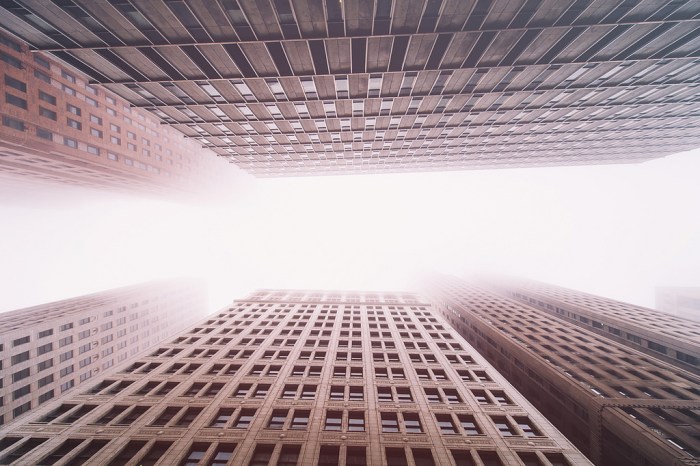
Hey Motor City cats & kittens – I’m visiting Detroit this Friday & Saturday. If you have thoughts about what I should be doing, please email me or hit me up through Facebook.
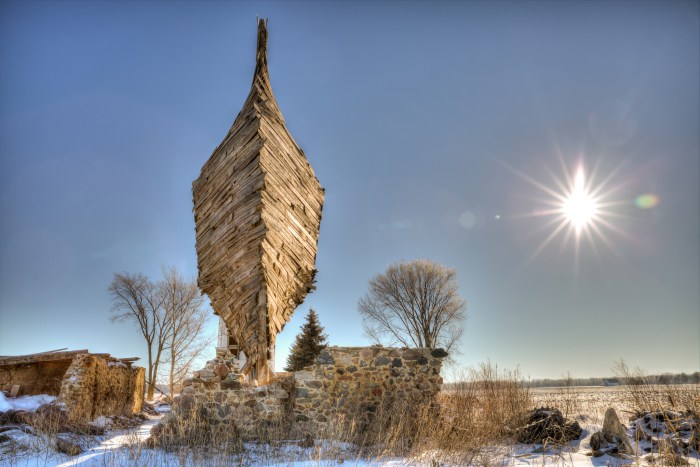
The Celestial Ship of the North (Emergency Ark), aka the Barnboat, is a site-specific installation and permanent sculpture in Port Austin, Michigan created by Scott Hocking. He wrote to me:
I was asked by Detroiter Jim Boyle, whose family is still in Port Austin, if I’d ever had any ideas of working with old barns. He’s been trying to get a Detroit / Port Austin connection going by bringing artists up there to do projects. I basically told him I’d had some fleeting thoughts about how much certain barns look like overturned ship hulls, and that if I had an old barn to work with, I’d probably turn it into a boat.
So, that was the beginning.
Like all of my work, I try to let the materials and site dictate what I make, and as I worked on the barnboat the shape became what it is now – mostly influenced by the intense winds of Michigan’s thumb. It took about 3 months total, but I’m not quite done yet: I’m still planning to fill in the base with mounded sand this spring for a little extra stability, and so that it can once again overgrow like that ivy covered barn it was made from.
Awesome. Check out lots more of Scott’s engaging work on his website.
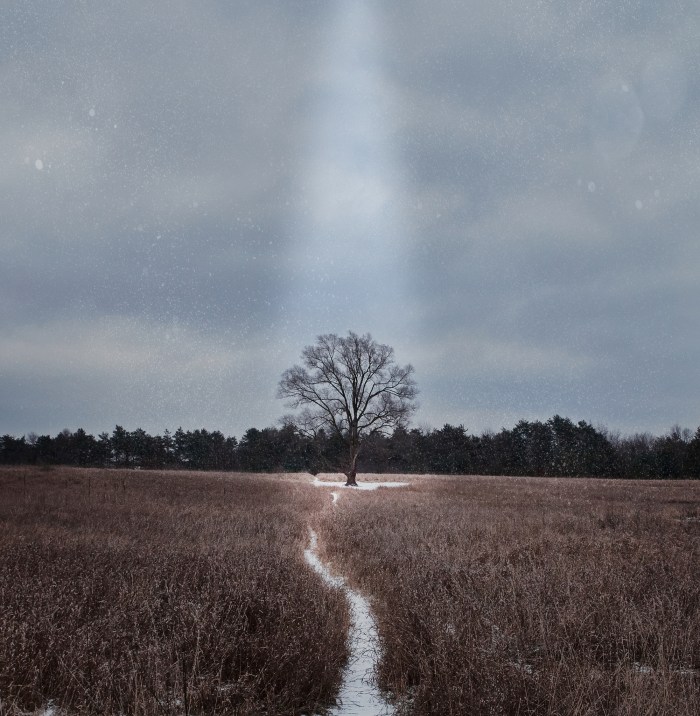
This tree in the Al Sabo Preserve in Kalamazoo County is a frequent subject and accessory for local photographers. I have images of it from the days I was still putting film into my SLR.
Regarding the Al Sabo Preserve, the Texas Charter Township Parks & Rec page says:
The Al Sabo Land Preserve was established in the early 1970’s in order to protect the groundwater supply of the Atwater wellfield. The 741 acres were purchased in the late 1960’s and a master plan was developed for its use as a passive recreation nature preserve. The City of Kalamazoo passed an ordinance that would ensure its protection as a water resource. The wetlands and sandy soils serve as a recharge area for the area’s groundwater.
I’ve never found a better website for information about rainbows and other optical phenomena than Atmospheric Optics. They have information about all flavors of rainbows including the primary rainbow, and explain that rainbows are disks of light rather than sets of coloured rings:
Early morning and late afternoon are the best times to see them because the sun must not be too high. Rainbows are always opposite the sun and their centres are below the horizon at the the antisolar point. The lower the sun the higher is the bow.
Red is always outermost in the primary bow with orange, yellow, green and blue within. Occasionally, when the raindrops are small, fainter supernumerary arcs of electric greens, pinks and purples lie just inside the main bow.
A rainbow is not just a set of coloured rings. The sky inside is bright because raindrops direct light there too. The primary bow is a shining disk brightening very strongly towards its rim.
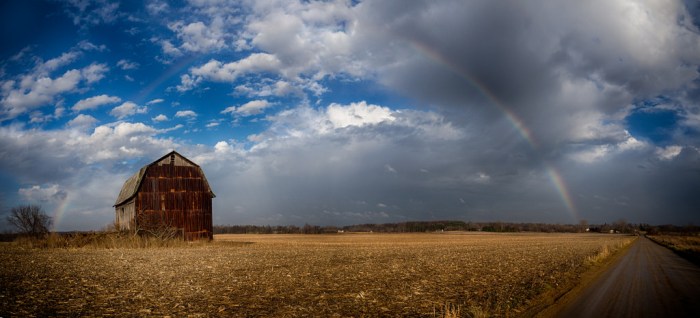
About this particular rainbow, Jamie writes:
This is the first time I have ever seen part of a rainbow in open skies. Look to the sky above the barn and you can just make out the missing portion of the rainbow.

 Michigan in Pictures